
General Patterns of Opposition Squares and 2 ngons


- Slides: 24
General Patterns of Opposition Squares and 2 n-gons Ka-fat CHOW The Hong Kong Polytechnic University
General Remarks v v v v Definitions of Opposition Relations: Subalternate: Unilateral entailment Contrary: Mutually exclusive but not collectively exhaustive Subcontrary: Collectively exhaustive but not mutually exclusive Contradictory: Both mutually exclusive and collectively exhaustive Do not consider inner / outer negations, duality Adopt a graph-theoretic rather than geometrical view on the logical figures which will be represented as 2 -dimensional labeled multidigraphs
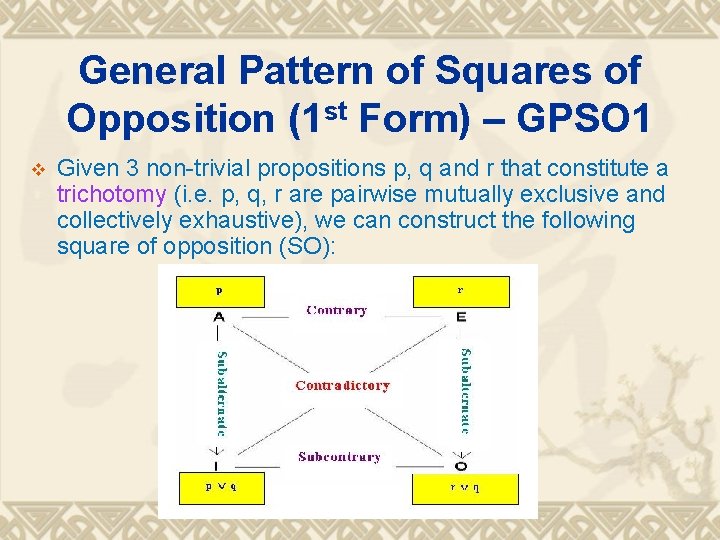
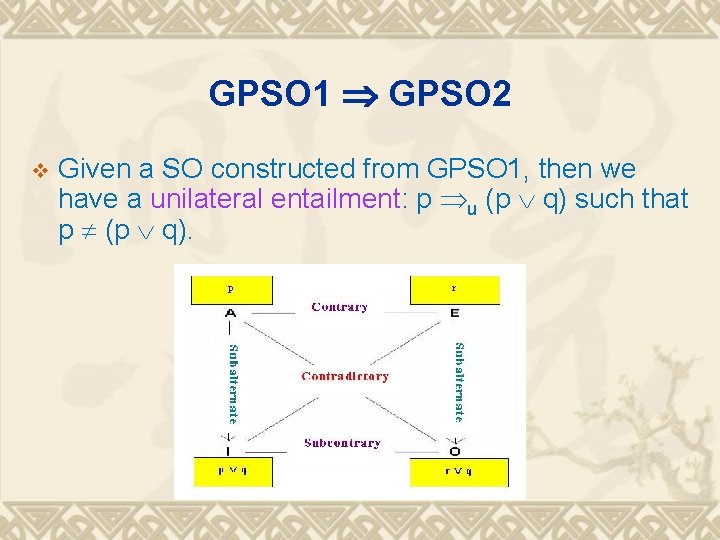
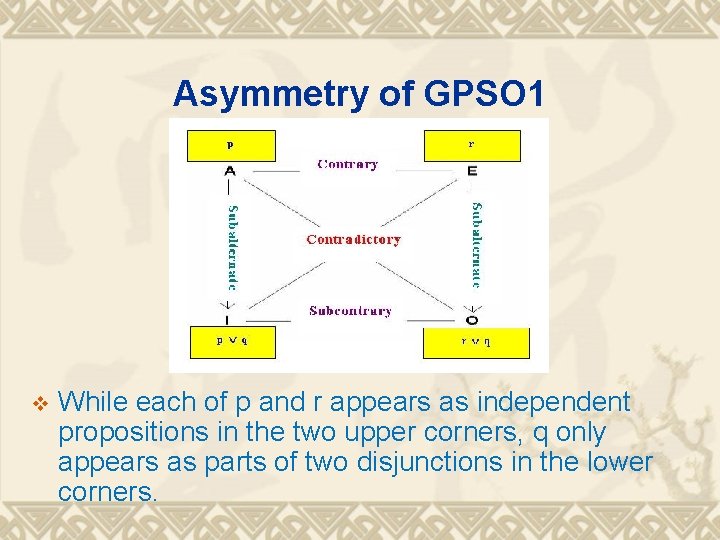
General Pattern of Squares of Opposition (1 st Form) – GPSO 1 v Given 3 non-trivial propositions p, q and r that constitute a trichotomy (i. e. p, q, r are pairwise mutually exclusive and collectively exhaustive), we can construct the following square of opposition (SO):
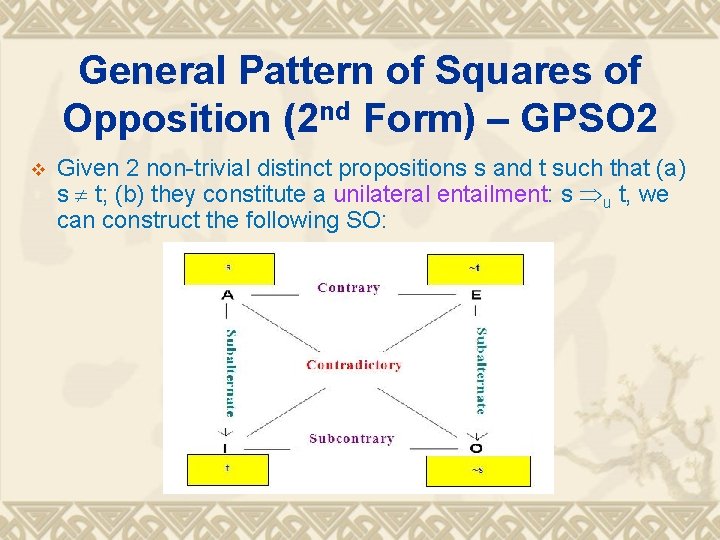
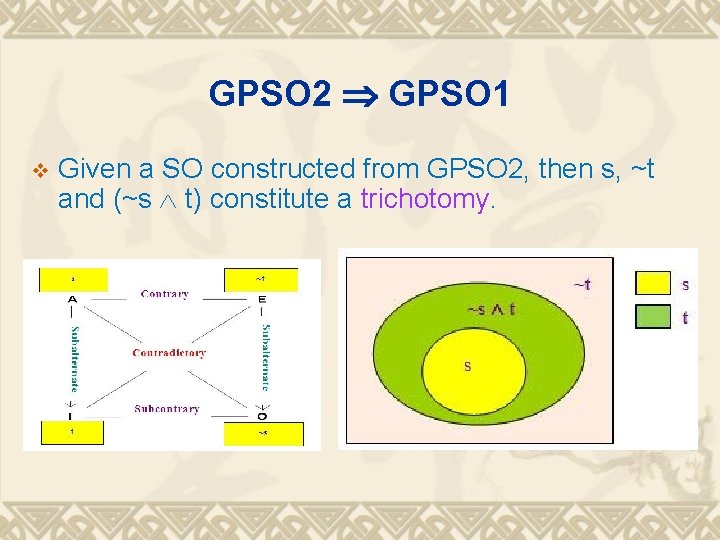
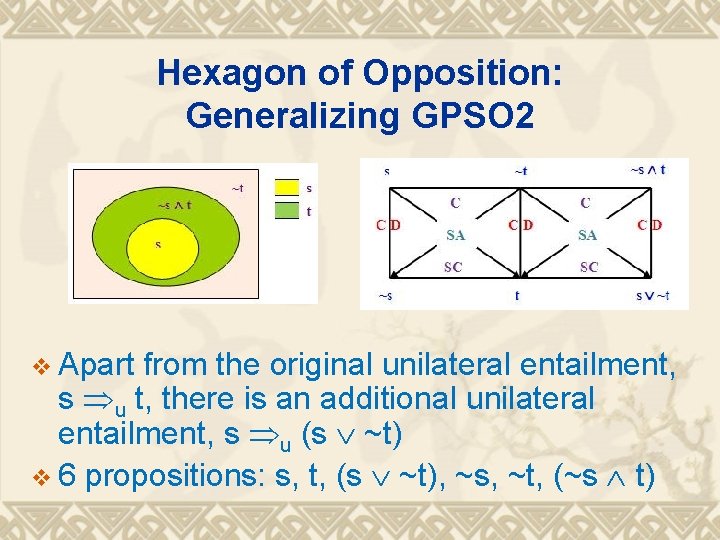
General Pattern of Squares of Opposition (2 nd Form) – GPSO 2 v Given 2 non-trivial distinct propositions s and t such that (a) s t; (b) they constitute a unilateral entailment: s u t, we can construct the following SO:
GPSO 1 GPSO 2 v Given a SO constructed from GPSO 1, then we have a unilateral entailment: p u (p q) such that p (p q).
GPSO 2 GPSO 1 v Given a SO constructed from GPSO 2, then s, ~t and (~s t) constitute a trichotomy.
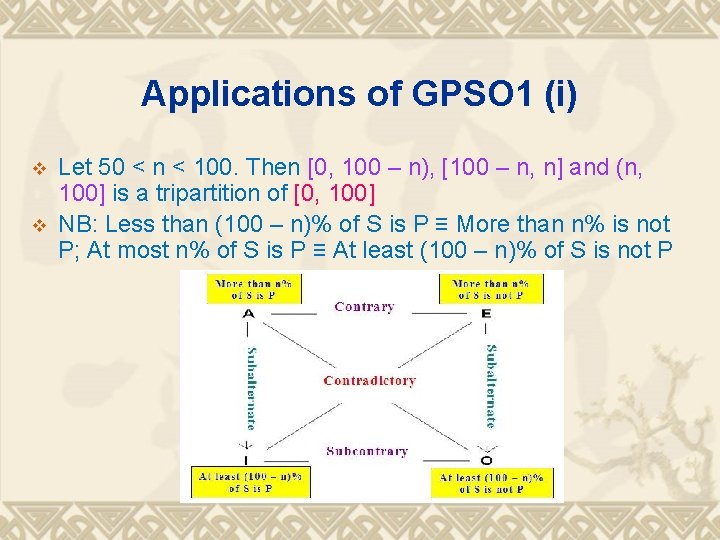
Applications of GPSO 1 (i) v v Let 50 < n < 100. Then [0, 100 – n), [100 – n, n] and (n, 100] is a tripartition of [0, 100] NB: Less than (100 – n)% of S is P ≡ More than n% is not P; At most n% of S is P ≡ At least (100 – n)% of S is not P
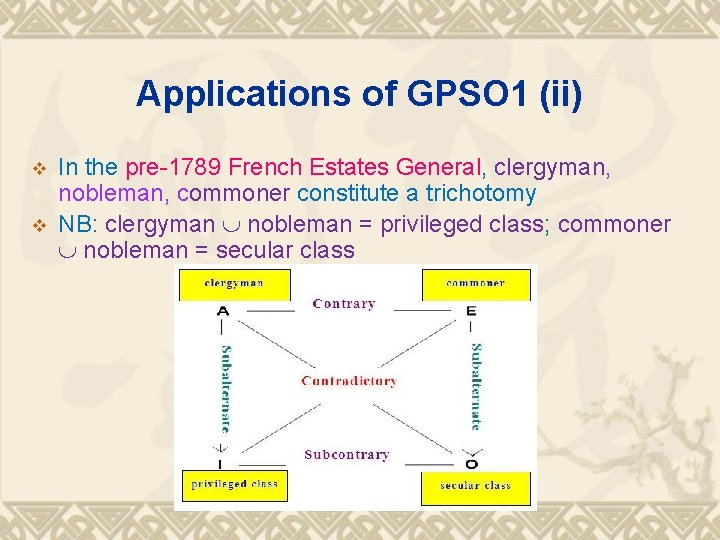
Applications of GPSO 1 (ii) v v In the pre-1789 French Estates General, clergyman, nobleman, commoner constitute a trichotomy NB: clergyman nobleman = privileged class; commoner nobleman = secular class
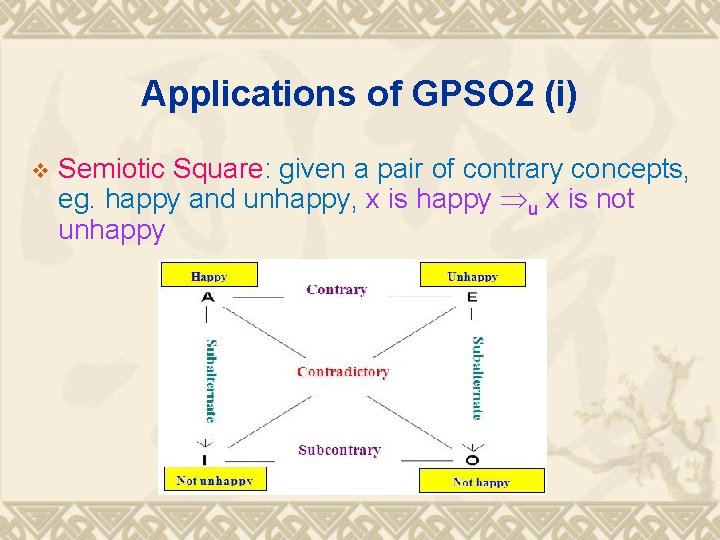
Applications of GPSO 2 (i) v Semiotic Square: given a pair of contrary concepts, eg. happy and unhappy, x is happy u x is not unhappy
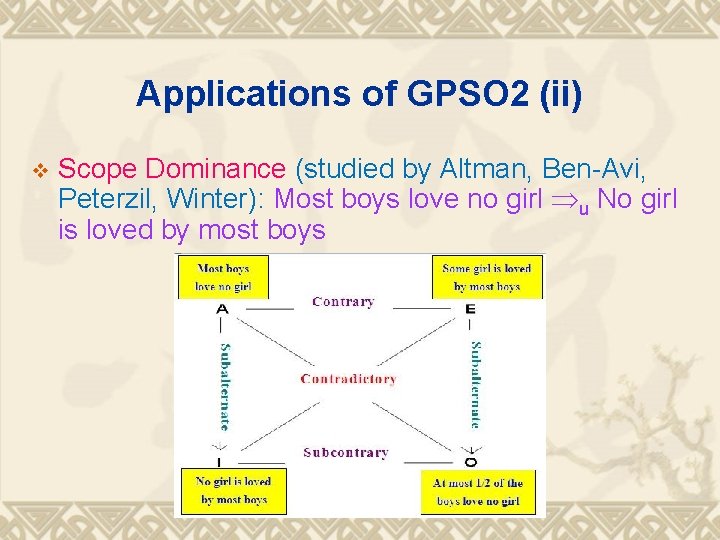
Applications of GPSO 2 (ii) v Scope Dominance (studied by Altman, Ben-Avi, Peterzil, Winter): Most boys love no girl u No girl is loved by most boys
Asymmetry of GPSO 1 v While each of p and r appears as independent propositions in the two upper corners, q only appears as parts of two disjunctions in the lower corners.
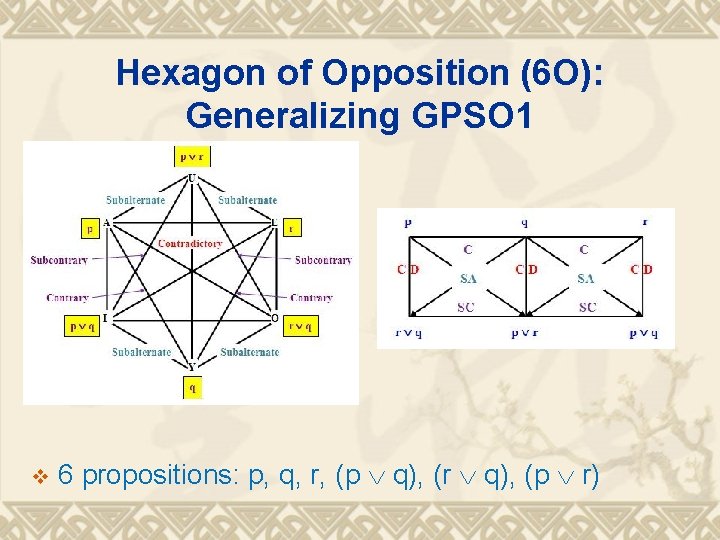
Hexagon of Opposition (6 O): Generalizing GPSO 1 v 6 propositions: p, q, r, (p q), (r q), (p r)
Hexagon of Opposition: Generalizing GPSO 2 v Apart from the original unilateral entailment, s u t, there is an additional unilateral entailment, s u (s ~t) v 6 propositions: s, t, (s ~t), ~s, ~t, (~s t)
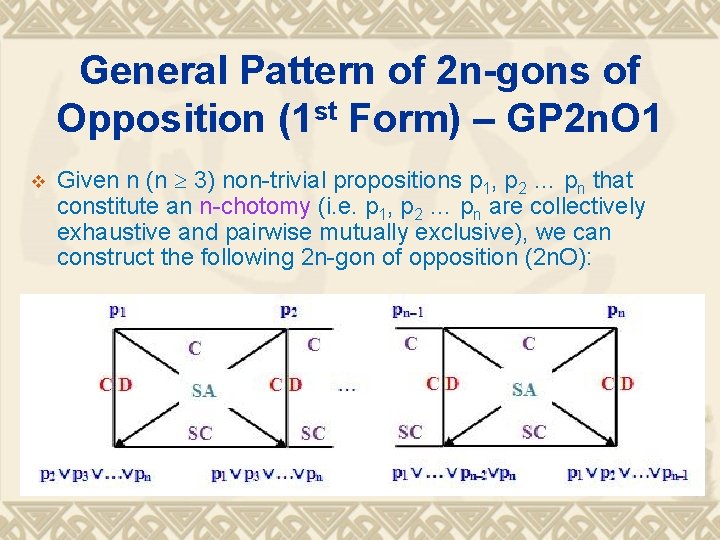
General Pattern of 2 n-gons of Opposition (1 st Form) – GP 2 n. O 1 v Given n (n 3) non-trivial propositions p 1, p 2 … pn that constitute an n-chotomy (i. e. p 1, p 2 … pn are collectively exhaustive and pairwise mutually exclusive), we can construct the following 2 n-gon of opposition (2 n. O):
General Pattern of 2 n-gons of Opposition (2 nd Form) – GP 2 n. O 2 v Given (n – 1) (n 3) non-trivial distinct propositions s, t 1, … tn– 2 such that (a) any two of t 1, … tn– 2 satisfy the subcontrary relation; (b) s t 1 … tn– 2; (c) they constitute (n – 2) co-antecedent unilateral entailments: s u t 1 and … s u tn– 2, then we have an additional unilateral entailment: s u (s ~t 1 … ~tn– 2) and we can construct the following 2 n. O:
GP 2 n. O 1 GP 2 n. O 2 v v Given a 2 n. O constructed from GP 2 n. O 1, then (a) any two of (p 1 p 3 … pn), … (p 1 … pn– 2 pn) satisfy the subcontrary relation (b) p 1 (p 1 p 3 … pn) … (p 1 … pn– 2 pn); (c) there are (n – 2) co-antecedent unilateral entailments: p 1 u (p 1 p 3 … pn) and … p 1 u (p 1 … pn– 2 pn) This 2 n. O also contains an additional unilateral entailment p 1 u (p 1 p 2 … pn– 1) whose antecedent is p 1 and whose consequent has the correct form: p 1 p 2 … pn– 1 ≡ p 1 ~(p 1 p 3 … pn) … ~(p 1 … pn– 2 pn)
GP 2 n. O 2 GP 2 n. O 1 v Given a 2 n. O constructed from GP 2 n. O 2, then s, ~t 1 … ~tn– 2, (~s t 1 … tn– 2) constitute an n-chotomy.
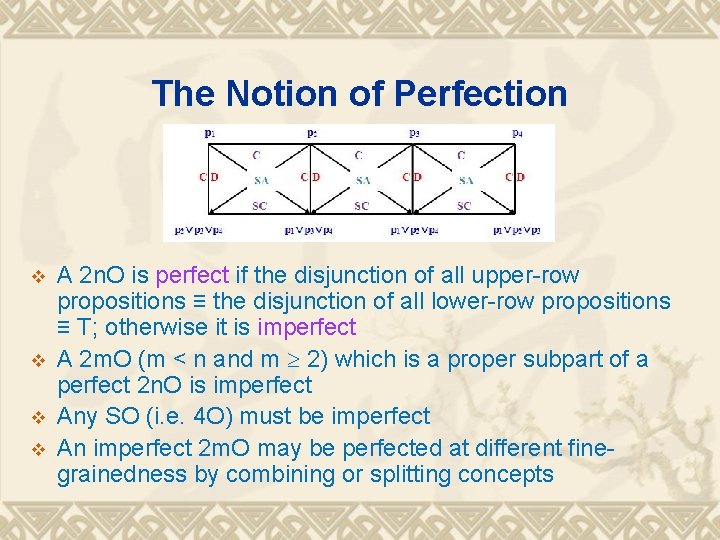
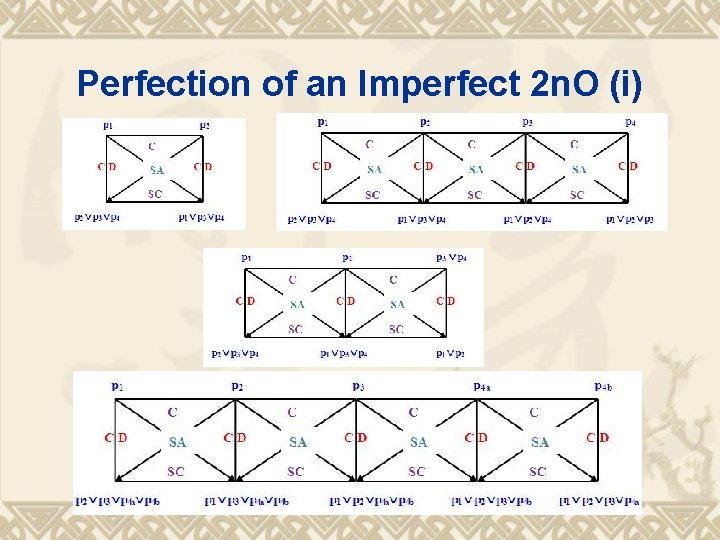
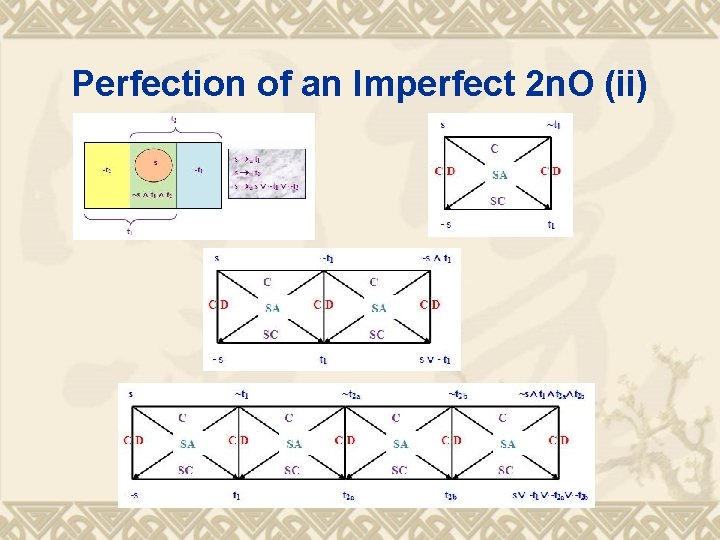
The Notion of Perfection v v A 2 n. O is perfect if the disjunction of all upper-row propositions ≡ the disjunction of all lower-row propositions ≡ T; otherwise it is imperfect A 2 m. O (m < n and m 2) which is a proper subpart of a perfect 2 n. O is imperfect Any SO (i. e. 4 O) must be imperfect An imperfect 2 m. O may be perfected at different finegrainedness by combining or splitting concepts
Perfection of an Imperfect 2 n. O (i)
Perfection of an Imperfect 2 n. O (ii)
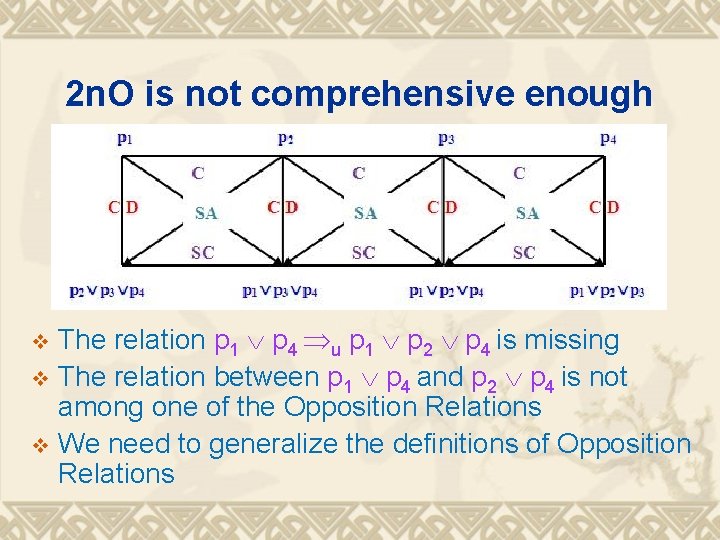
2 n. O is not comprehensive enough The relation p 1 p 4 u p 1 p 2 p 4 is missing v The relation between p 1 p 4 and p 2 p 4 is not among one of the Opposition Relations v We need to generalize the definitions of Opposition Relations v
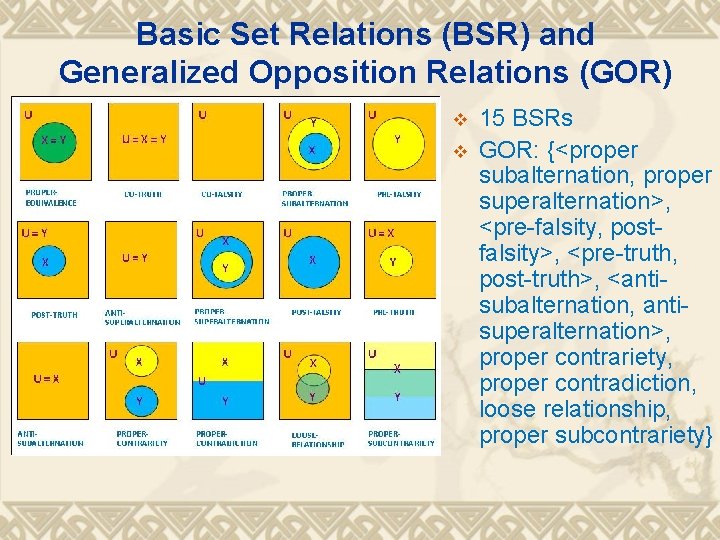
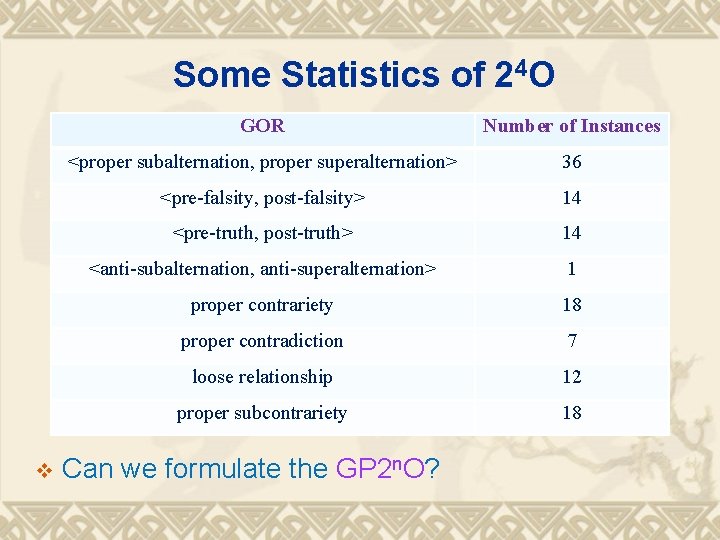
Basic Set Relations (BSR) and Generalized Opposition Relations (GOR) v v 15 BSRs GOR: {<proper subalternation, proper superalternation>, <pre-falsity, postfalsity>, <pre-truth, post-truth>, <antisubalternation, antisuperalternation>, proper contrariety, proper contradiction, loose relationship, proper subcontrariety}
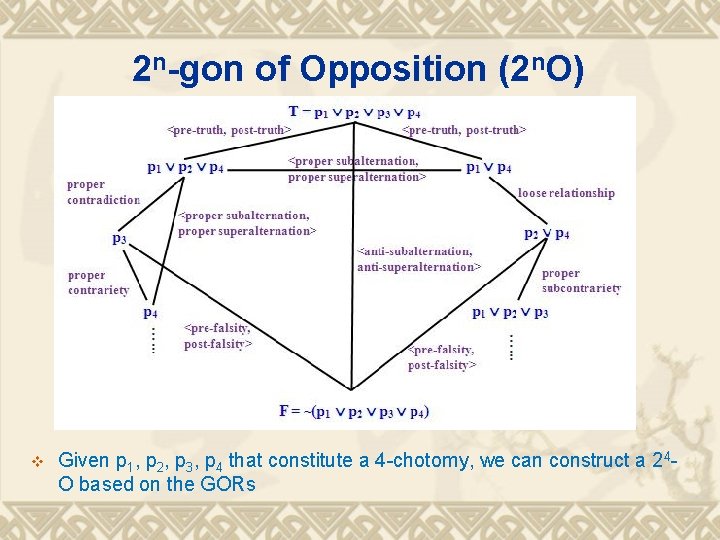
2 n-gon of Opposition (2 n. O) v Given p 1, p 2, p 3, p 4 that constitute a 4 -chotomy, we can construct a 24 O based on the GORs
Some Statistics of 24 O v GOR Number of Instances <proper subalternation, proper superalternation> 36 <pre-falsity, post-falsity> 14 <pre-truth, post-truth> 14 <anti-subalternation, anti-superalternation> 1 proper contrariety 18 proper contradiction 7 loose relationship 12 proper subcontrariety 18 Can we formulate the GP 2 n. O?