
General pathology Inflammation 1 Dr Bushra AlTarawneh Inflammation
General pathology Inflammation -1 Dr. Bushra Al-Tarawneh

Inflammation: It is a complex biological response of vascularized living tissues to local injury or harmful stimuli. Causes of inflammation 1. Infections: Most common causes of inflammation (bacterial, virual, fungal, parasitic). 2. Physical agents: Excessive heating, cooling, mechanical trauma, ultraviolet light or ionizing radiation. 3. Chemical agents: Organic and inorganic chemicals including toxins of bacteria. 4. Immune reaction Hypersensitivity reaction: Reaction of antibody or sensitized lymphocytes with antigenic materials like invasive bacteria or inhaled organic dusts or reaction against self tissues. 5. Surgery: Bad sterilization, foreign body like splinters, dirts or sutures. 6. Tissues necrosis: Result from ischemia as occurred in myocardial infarction.
Significance of inflammation: 1. Isolation & removing of the injurious stimuli. 2. Destroying the invading microorganisms. 3. Inactivation of toxins. 4. Preparing the tissue for healing and repair. So it is a protective response of the body In the absence of inflammation: Wounds & infections would never heal so lead to progressive destruction of the tissues affecting the survival of living tissues. Harmful effect of inflammation: 1. It can cause anaphylactic shock which is life-threatening hypersensitivity reaction. 2. It can cause progressive and irreversible organ damage from chronic inflammation and fibrosis like in: • Rheumatoid arthritis. • Atherosclerosis.

Classification of inflammation 1. Acute inflammation. 2. Chronic inflammation. Acute inflammation Chronic inflammation Early onset (sec. – min. ) Later onset (days) Short duration (min. - days) Longer duration (wks – yrs) Fluid exudation (edema) & polymorphonuclear leukocyte emigration. (neutrophil) Inducing B. V. proliferation and scarring (fibrosis) Lymphocytes, macrophages.
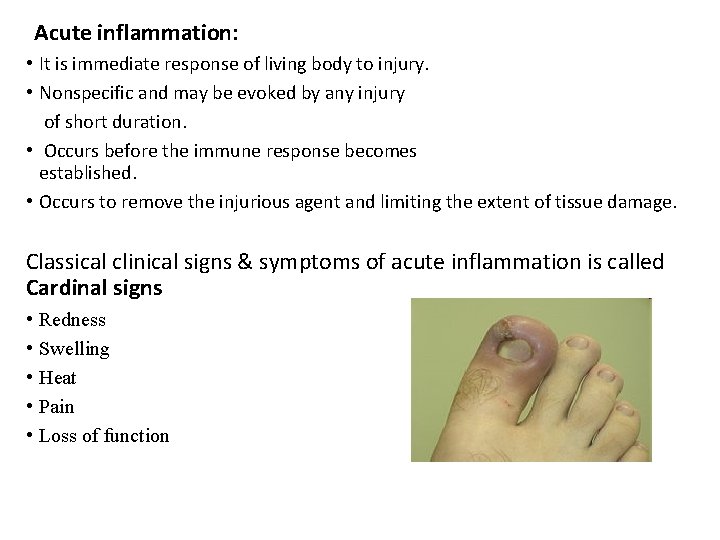
Acute inflammation: • It is immediate response of living body to injury. • Nonspecific and may be evoked by any injury of short duration. • Occurs before the immune response becomes established. • Occurs to remove the injurious agent and limiting the extent of tissue damage. Classical clinical signs & symptoms of acute inflammation is called Cardinal signs • • • Redness Swelling Heat Pain Loss of function
Causes of cardinal signs of acute inflammation: • ↑ Vascular caliber (Vasodilation) → ↑ Blood flow → Heat & redness • ↑ Permeability of B. V. → Leakage of plasma proteins & leukocytes → Exudates → Edema • Leukocyte emigration → Edema & Release of Inflammtory Mediators → Pain → Loss of function
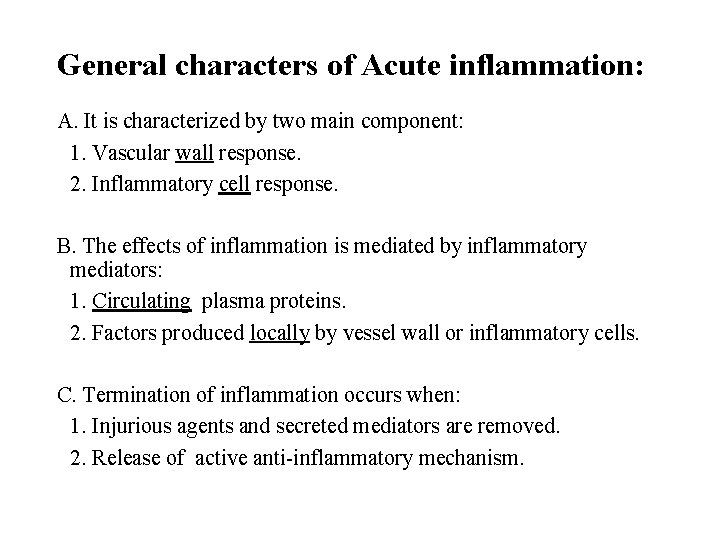
General characters of Acute inflammation: A. It is characterized by two main component: 1. Vascular wall response. 2. Inflammatory cell response. B. The effects of inflammation is mediated by inflammatory mediators: 1. Circulating plasma proteins. 2. Factors produced locally by vessel wall or inflammatory cells. C. Termination of inflammation occurs when: 1. Injurious agents and secreted mediators are removed. 2. Release of active anti-inflammatory mechanism.
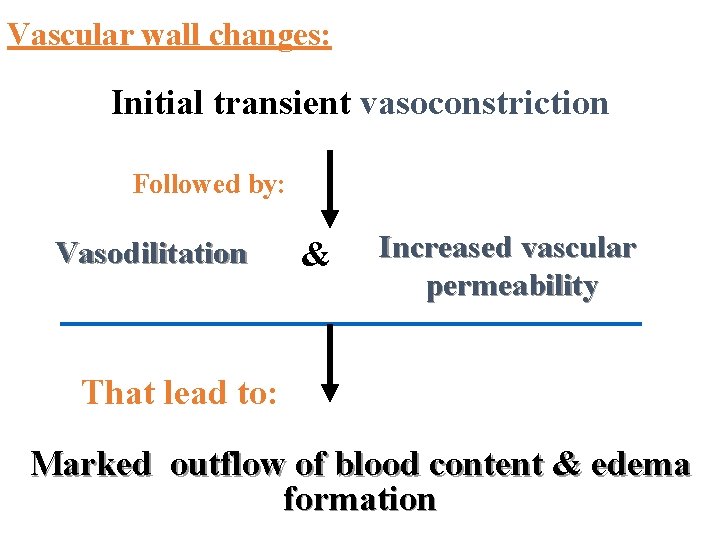
Vascular wall changes: Initial transient vasoconstriction Followed by: Vasodilitation & Increased vascular permeability That lead to: Marked outflow of blood content & edema formation
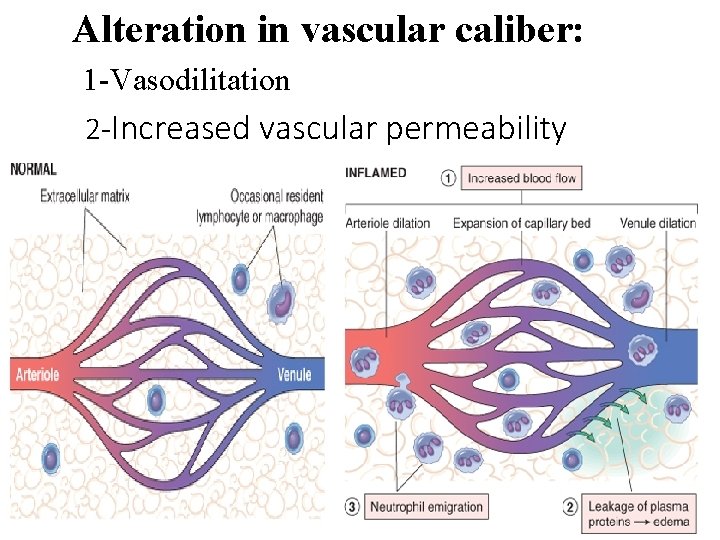
Alteration in vascular caliber: 1 -Vasodilitation 2 -Increased vascular permeability
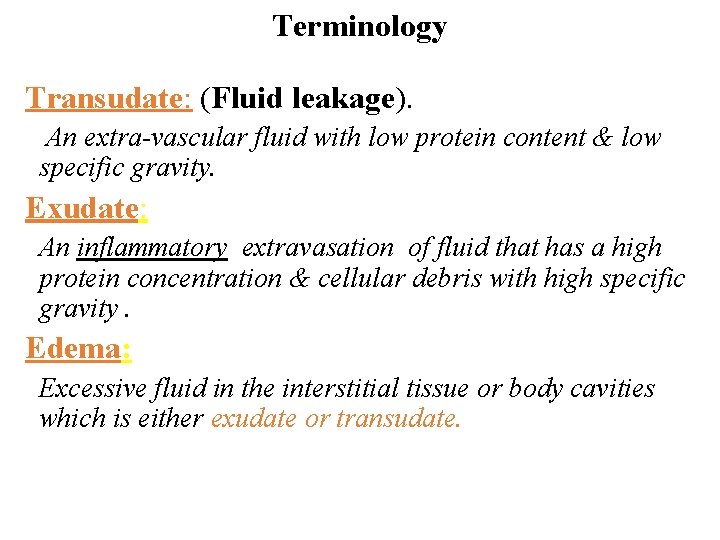
Terminology Transudate: (Fluid leakage). An extra-vascular fluid with low protein content & low specific gravity. Exudate: An inflammatory extravasation of fluid that has a high protein concentration & cellular debris with high specific gravity. Edema: Excessive fluid in the interstitial tissue or body cavities which is either exudate or transudate.
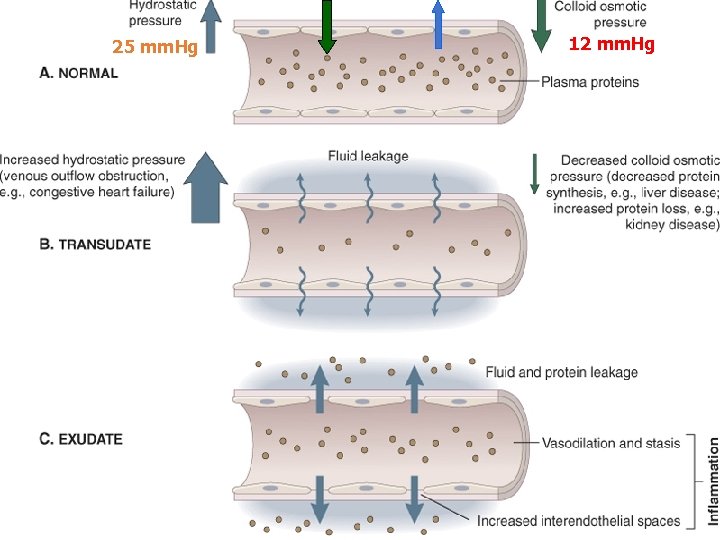
25 mm. Hg 32 mm. Hg 12 mm. Hg

Beneficial effects of fluid & cellular exudate: 1 - Dilution of bacterial toxins to be carried away by lymphatics. 2 - Entry of antibodies which help in lysis or phagocytosis of the microorganisms and neutralization of toxins. 3 - Transport of drugs to the site where the bacteria are multiplying. 4 - Exudative fibrinogen will form fibrin that trap the bacteria to facilitate phagocytosis & help in formation of granulation tissue. 5 - Delivery of nutrients and oxygen essential for neutrophils which have a high metabolic activity. 6 - Stimulation of immune response: Drainage of inflammatory exudate into lymphatics, reaching lymph node will stimulate the immune response.
Cellular changes: Extravasation of leukocyte & phagocytosis Extravasation: Delivery of leukocyte to site of injury. The sequence of events in extravasation is divided into: 1 - Margination: Rolling & adhesion of leukocyte to the endothelium. 2 -Transmigration of leukocytes across the endothelium. 3 - Emigration : Movement of WBC in the interstitial tissues toward a chemotactic stimuli. (Chemotaxis) 4 - Phagocytosis: Engulfment of invading microorganism.

1 - Margination, rolling and adhesion ØMargination occurs as a result of the release of chemical mediators: Histamine, Leukotrienes, Kinins, Cytokines. ØThese substances will affects the endothelial cells of the capillaries and causes the leukocytes to increase their expression of adhesion molecules. ØThe leukocytes begin to marginate, or move to and along the periphery of the blood vessels. ØThe first leukocyte marginated is neutrophil.
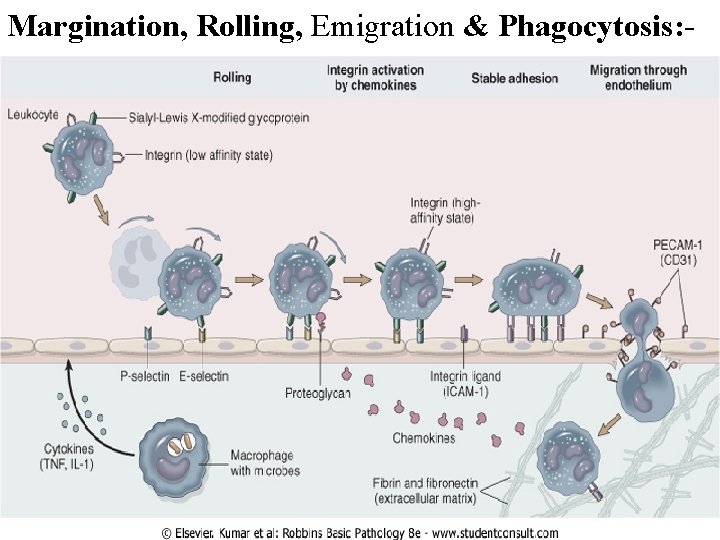
Margination, Rolling, Emigration & Phagocytosis: -
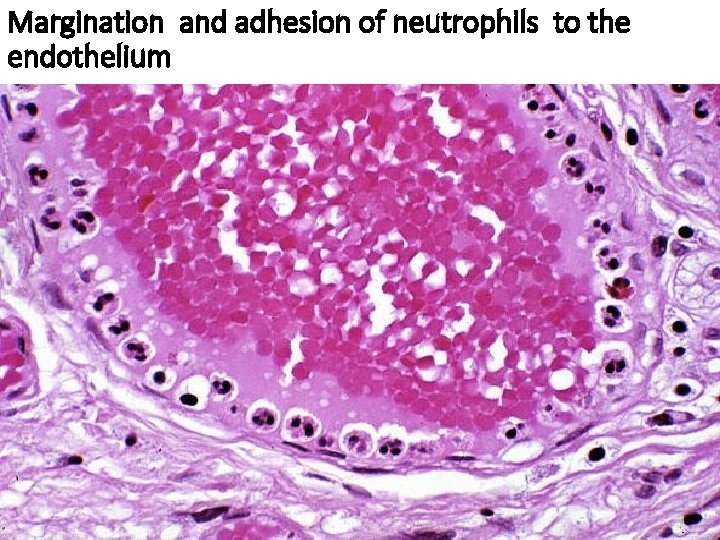
Margination and adhesion of neutrophils to the endothelium
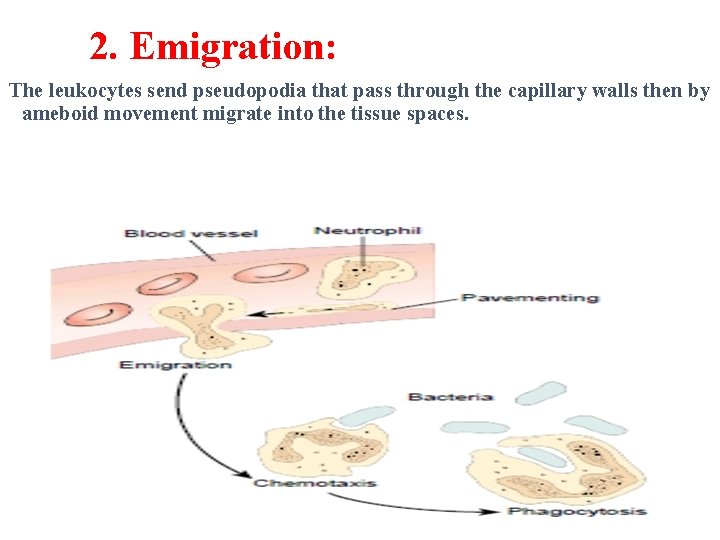
2. Emigration: The leukocytes send pseudopodia that pass through the capillary walls then by ameboid movement migrate into the tissue spaces.
3. Chemotaxis: Process by which leukocytes migrate in response to a chemical signal. Leukocytes move through the tissue guided by secreted cytokines: Chemokines. Interleukin. Bacterial & cellular debris. Complement fragments (C 3 a, C 5 a). 4. Phagocytosis: Engulfment & degradation of bacteria & cellular debris by Neutrophils & Macrophages Phagocytosis: three steps: 1. Adherence + opsonization. 2. Engulfment. 3. Intracellular killing.
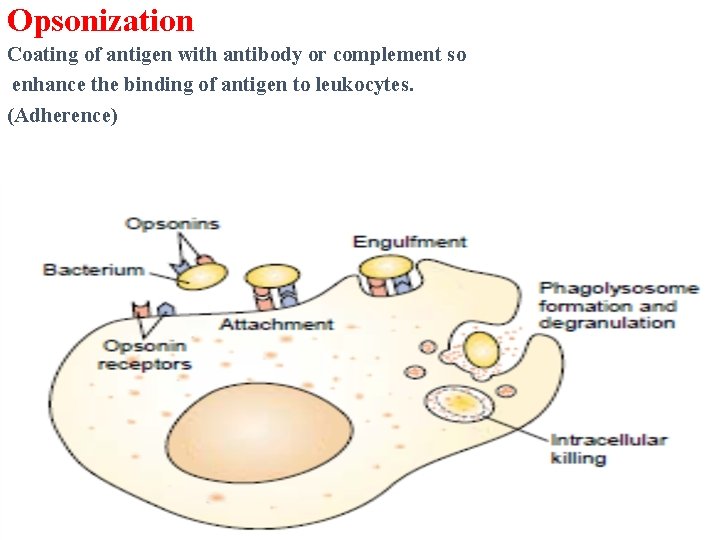
Opsonization Coating of antigen with antibody or complement so enhance the binding of antigen to leukocytes. (Adherence)
Phagocytosis 1 - Recognition of the agent as foreign leading to adherence and opsonization. 2 - Cytoplasmic extensions (pseudopods) surround this foreign agent. 3 - Fusion of the membrane forming phagocytic vesicle (Phagosome) 4 -The phagosome merges with a lysosome that containing antibacterial molecules and enzymes that digest the microbe
Outcome of acute inflammation: 1 - Resolution. 2 - Progression to chronic inflammation. 3 - (Pus formation). 4 - Scarring and fibrosis. Factors affect the Outcome of acute inflammation: 1. The nature and intensity of the injury. 2. The site and tissue affected. 3. The ability of host to mount the response.
1 - Resolution: Regaining normal histological & functional state of the tissue. It occurs when there is: a. Limited or short lived injury. b. Minimal or no tissue damage. c. A tissue which is capable of replacing any type of injured cells. 2 - Progression to chronic inflammation: Chronic inflammation occur if: a. The offending agent is not removed. b. There is extensive initial tissues injury. c. There is decreased capacity of the affected tissue to re-grow. Chronic inflammation may be followed by restoration of the normal structure and function or may lead to scarring.
3 - Pus formation Pus: A purulent inflammatory exudate caused by pyogenic bacteria, and it is a manifestation of healing that result in granulation & scaring. Pus is formed of: 1. Living & dead neutrophils. 2. Bacteria. 3. Cellular debris. Pus is surrounded by pyogenic membrane formed of capillaries, neutrophils and fibroblast led to the formation of abscess.
4 - Scarring and fibrosis: Replacement of the injured tissue by fibrous connective tissue. This occurs: 1 - If we have large tissue destruction. 2 - If the inflammation occur in tissue that do not regenerate.
- Slides: 24