
General Organic Compounds What You Should Know About
General Organic Compounds What You Should Know About Organic Compounds 1 pt 1 pt 2 pt The Structure of DNA Grab Bag 1 pt 2 pt 2 pt 3 pt 3 pt 4 pt 4 pt 5 pt 5 pt Enzymes
Name all 4 organic compounds
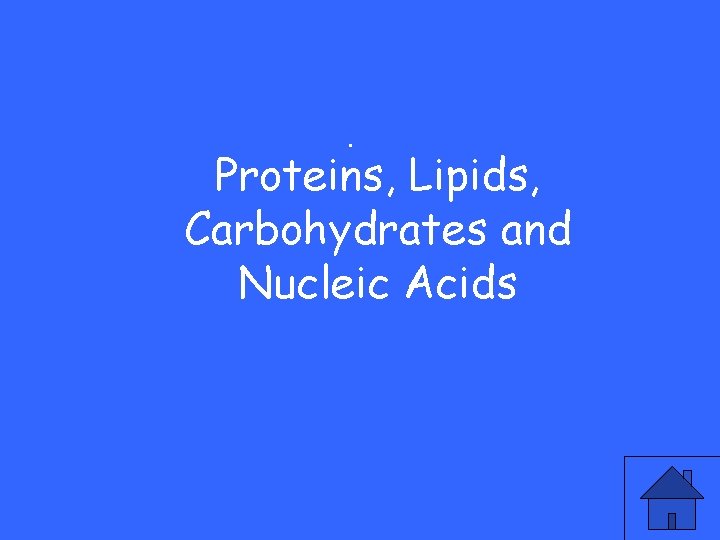
. Proteins, Lipids, Carbohydrates and Nucleic Acids
The term “organic compounds” may also be referred to as this. . .
What are Macromolecules
What specifically makes these compounds organic?
The presence of CARBON! Carbon is found in all living things. Organic is just a fancy word for saying “LIFE”.
Name all 4 macromolecules AND their units (or building blocks).
1. Protein; amino acids 2. Lipids; fatty acids 3. Carbohydrates; mono saccharides 4. Nucleic Acids; nucleotides
Where do we find organic compounds?
In our cells. . . DUH!
Long chains of sugar molecules are known as this.
POLYSACCHARIDES
How many different amino acids do we have AND how do proteins get their shape?
. We have 20 different amino acids and proteins are shaped based on the order of the amino acids.
Saturated fats come in the form of _______, while unsaturated fats come in the form of__________.
Saturated fats come in the form of solids, while unsaturated fats come in the form of a liquid.
Animal cells store sugar in this form. .
What is GLYCOGEN.
Plants store their sugar in this form. . .

What is STARCH!
The making and breaking of bonds results in this. . .
What is a chemical reaction
Enzymes speed up a chemical reaction by. . .
Reducing the activation energy required to start the reaction!
In our experiment last week, we were working with an enzyme known as _________, which is an enzyme that __________.
In our experiment last week, we were working with an enzyme known as catalase, which is an enzyme that can break down Hydrogen Peroxide.
The molecule an enzyme binds to is known as a ______, it binds to this molecule at the _________.
The molecule an enzyme binds to is known as a substrate, it binds to this molecule at the active site.
Name the reactants and products of last week's experiment, and tell us where we could find the products, and how we knew they were definitely there.
The reactant was the hydrogen peroxide, the products were water and oxygen. We could find water in the test tube, and oxygen inside bubbles. We knew the oxygen was there because it was able to light up our splint.
The structure of DNA is often times called this. .

What is a DOUBLE HELIX!
What does D. N. A. stand for? SPELL IT!
Deoxyribose Nucleic Acid
Name all 3 parts of a nucleotide and compare them to the parts of a ladder.
The 3 parts are the deoxyribose (5 -carbon sugar), the phosphate group, and the nitrogen base. The sugar and phosphate make up the sides of the ladder, and the bases connect to make the rungs.
Define “complementary base pairing” and then tell me HOW the bases bond together.
Complementary base pairing means that each base will bond to its complementary base via hydrogen bonds.
Define the base pairing rules AND tell me where DNA is found in our bodies.
The base pairing rules mean that A and T will only bond with each other and G and C will only bond with each other. DNA is found in the nucleus of our cells.
What is an element?
A pure substance made up of only one type of atom.
If an atom loses an electron it becomes ________ , if it gains an electron is becomes _________.
POSITIVE; NEGATIVE
Give me 4 examples of homeostasis.
Any 4 of these: 1. Animals growing winter fur coats 2. Sneezing 3. Coughing 4. Sweating 5. Goosebumps 6. Shivering 7. Blinking 8. Vomiting
1. Define “POLAR MOLECULE” 2. Tell me what polar molecules like to mix with and DO NOT like to mix with.
A polar molecule is a molecular with a positive pole and a negative pole. Polar molecules (like water) like to bond with other polar molecules (like salt). They DO NOT like to bond with NON-POLAR molecules (like fats).
- Slides: 49