
GENERAL MYCOLOGY BY Prof Dr Ghada Fahmy Helaly
GENERAL MYCOLOGY BY: Prof. Dr. Ghada Fahmy Helaly
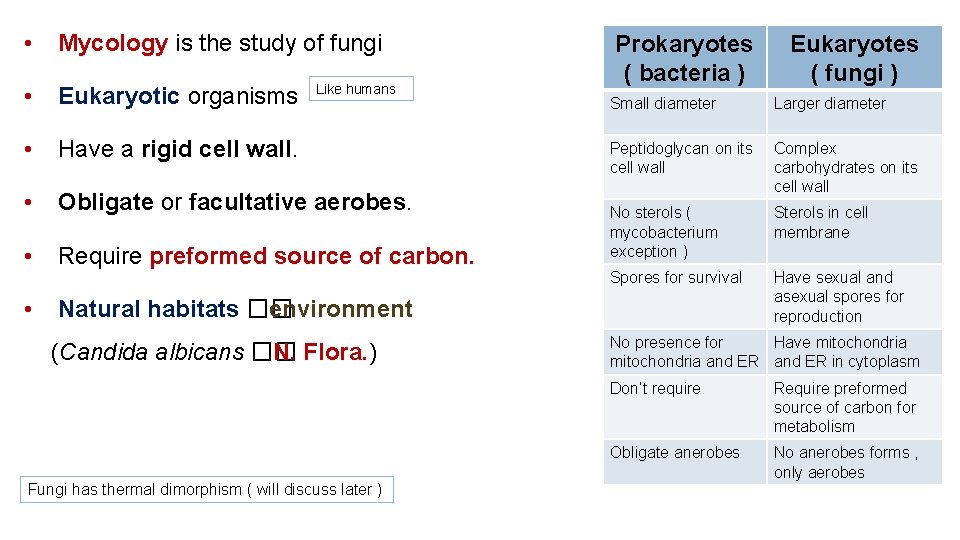
• Mycology is the study of fungi • Eukaryotic organisms • Have a rigid cell wall. • Obligate or facultative aerobes. • Require preformed source of carbon. • Like humans Prokaryotes ( bacteria ) Small diameter Larger diameter Peptidoglycan on its cell wall Complex carbohydrates on its cell wall No sterols ( mycobacterium exception ) Sterols in cell membrane Spores for survival Have sexual and asexual spores for reproduction Natural habitats �� environment (Candida albicans �� N. Flora. ) Fungi has thermal dimorphism ( will discuss later ) Eukaryotes ( fungi ) No presence for Have mitochondria and ER in cytoplasm Don’t require Require preformed source of carbon for metabolism Obligate anerobes No anerobes forms , only aerobes
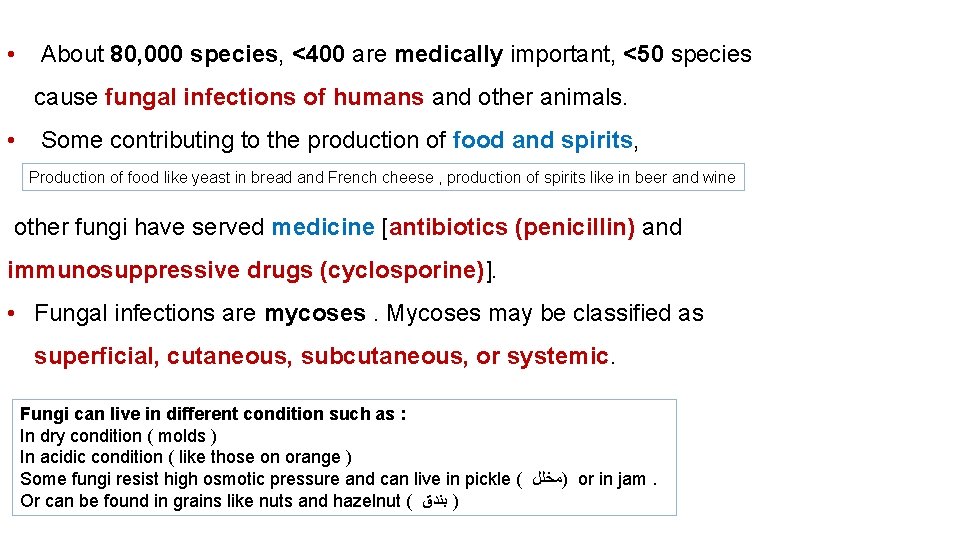
• About 80, 000 species, <400 are medically important, <50 species cause fungal infections of humans and other animals. • Some contributing to the production of food and spirits, Production of food like yeast in bread and French cheese , production of spirits like in beer and wine other fungi have served medicine [antibiotics (penicillin) and immunosuppressive drugs (cyclosporine)]. • Fungal infections are mycoses. Mycoses may be classified as superficial, cutaneous, subcutaneous, or systemic. Fungi can live in different condition such as : In dry condition ( molds ) In acidic condition ( like those on orange ) Some fungi resist high osmotic pressure and can live in pickle ( )ﻣﺨﻠﻞ or in jam. Or can be found in grains like nuts and hazelnut ( ) ﺑﻨﺪﻕ
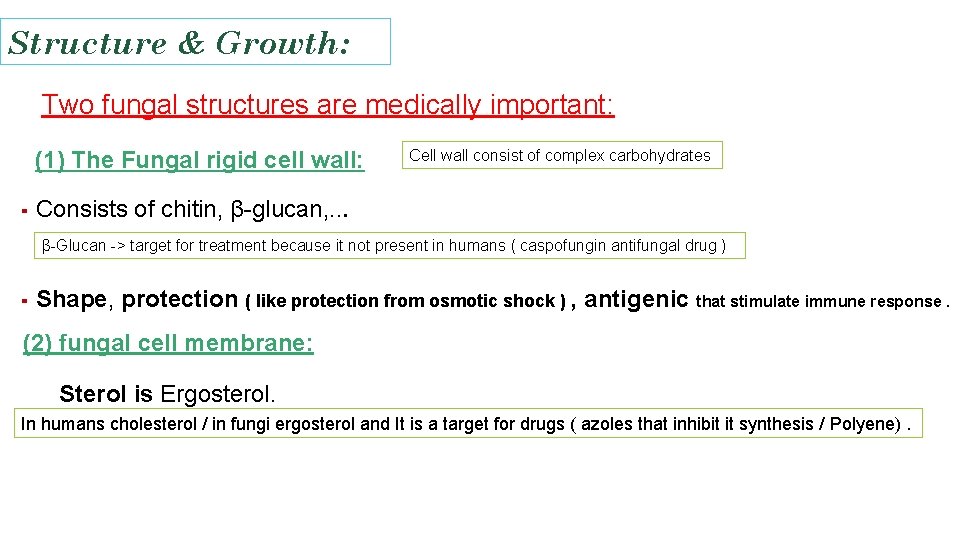
Structure & Growth: Two fungal structures are medically important: (1) The Fungal rigid cell wall: ▪ Cell wall consist of complex carbohydrates Consists of chitin, β-glucan, . . . β-Glucan -> target for treatment because it not present in humans ( caspofungin antifungal drug ) ▪ Shape, protection ( like protection from osmotic shock ) , antigenic that stimulate immune response. (2) fungal cell membrane: Sterol is Ergosterol. In humans cholesterol / in fungi ergosterol and It is a target for drugs ( azoles that inhibit it synthesis / Polyene).

Classification of fungi: Two basic forms of fungi : yeasts and molds (or moulds). Colonies of candida albicans Like candida ▪ Single cells. ▪ Reproduce by asexual budding (blastoconidia). Or blastospores : newly formed spores or buds In lab culture colonies of fungi larger than bacteria ▪ Yeast colonies are usually soft, opaque, 1– 3 mm in size, and cream-colored. Creamy in color and consistency Prof. Dr. Ghada Fahmy Helaly Yeasts:
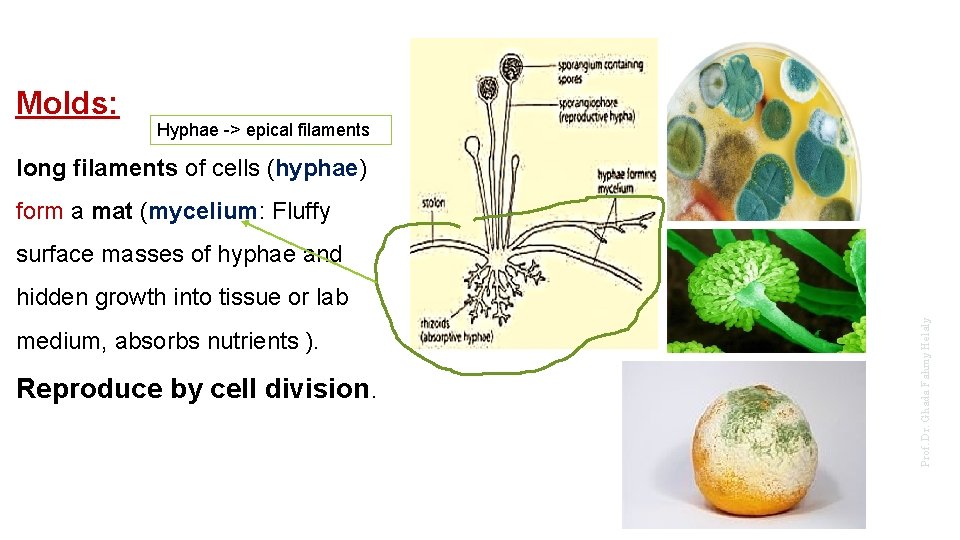
Molds: Hyphae -> epical filaments long filaments of cells (hyphae) form a mat (mycelium: Fluffy surface masses of hyphae and medium, absorbs nutrients ). Reproduce by cell division. Prof. Dr. Ghada Fahmy Helaly hidden growth into tissue or lab

Same of epical hyphae � Aerial hyphae project above the surface of the Septate hyphae each one has nucleus mycelium and usually bear the reproductive structures of the mold. Hyaline hyphae ﺷﻔﺎﻓﺔ ﺍﻭ ﺯﺟﺎﺟﻴﺔ � Some hyphae are Septate hyphae, Others nonseptate hyphae (Coenocytic). � Pseudohyphae -> Candida albicans. Pseudohyphae : reproduce by budding but without separation of buds , and result in sausage form Prof. Dr. Ghada Fahmy Helaly � Hyphae may be dematiaceous or hyaline.
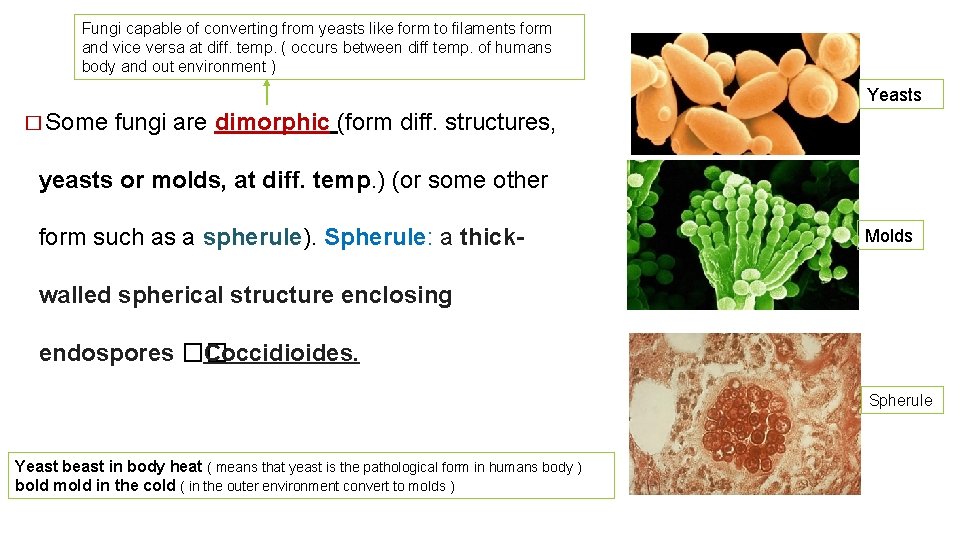
Fungi capable of converting from yeasts like form to filaments form and vice versa at diff. temp. ( occurs between diff temp. of humans body and out environment ) Yeasts � Some fungi are dimorphic (form diff. structures, yeasts or molds, at diff. temp. ) (or some other form such as a spherule). Spherule: a thick- Molds walled spherical structure enclosing endospores �� Coccidioides. Spherule Yeast beast in body heat ( means that yeast is the pathological form in humans body ) bold mold in the cold ( in the outer environment convert to molds )
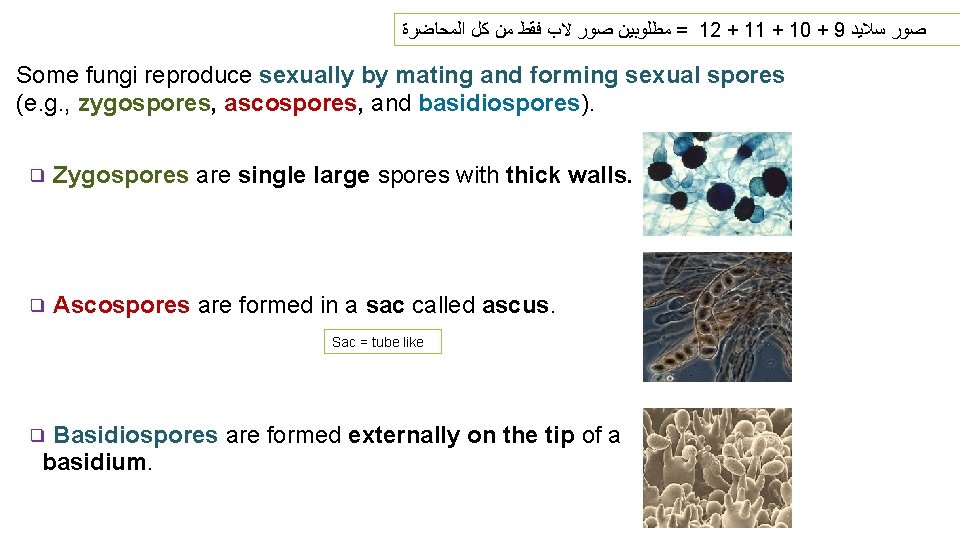
= ﻣﻄﻠﻮﺑﻴﻦ ﺻﻮﺭ ﻻﺏ ﻓﻘﻂ ﻣﻦ ﻛﻞ ﺍﻟﻤﺤﺎﺿﺮﺓ 12 + 11 + 10 + 9 ﺻﻮﺭ ﺳﻼﻳﺪ Some fungi reproduce sexually by mating and forming sexual spores (e. g. , zygospores, ascospores, and basidiospores). ❑ Zygospores are single large spores with thick walls. ❑ Ascospores are formed in a sac called ascus. Sac = tube like Basidiospores are formed externally on the tip of a basidium. ❑
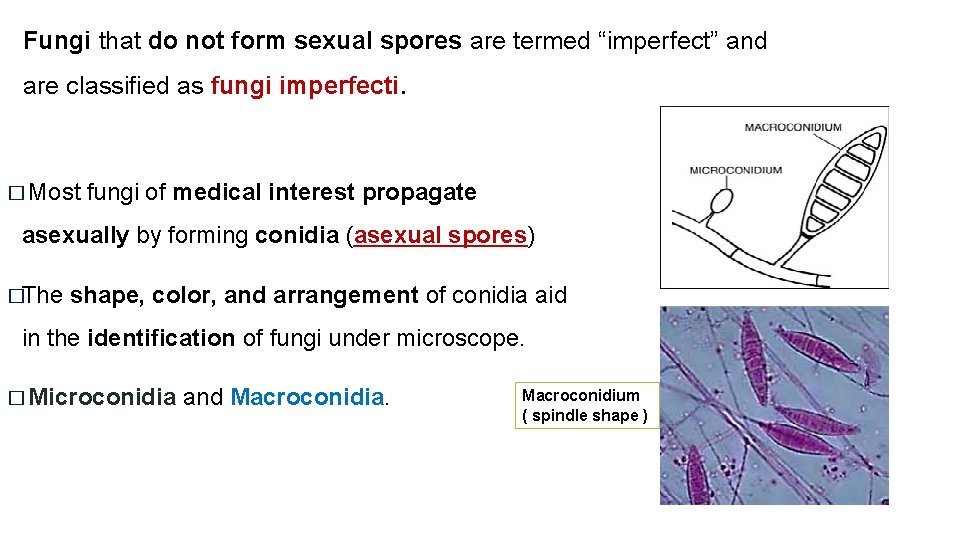
Fungi that do not form sexual spores are termed “imperfect” and are classified as fungi imperfecti. � Most fungi of medical interest propagate asexually by forming conidia (asexual spores) �The shape, color, and arrangement of conidia aid in the identification of fungi under microscope. � Microconidia and Macroconidia. Macroconidium ( spindle shape )
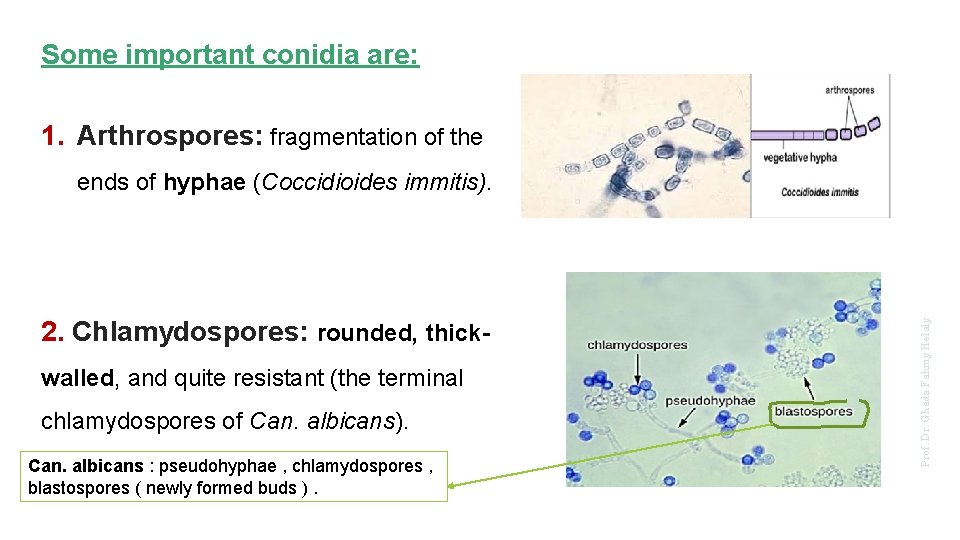
Some important conidia are: 1. Arthrospores: fragmentation of the 2. Chlamydospores: rounded, thickwalled, and quite resistant (the terminal chlamydospores of Can. albicans). Can. albicans : pseudohyphae , chlamydospores , blastospores ( newly formed buds ). Prof. Dr. Ghada Fahmy Helaly ends of hyphae (Coccidioides immitis).
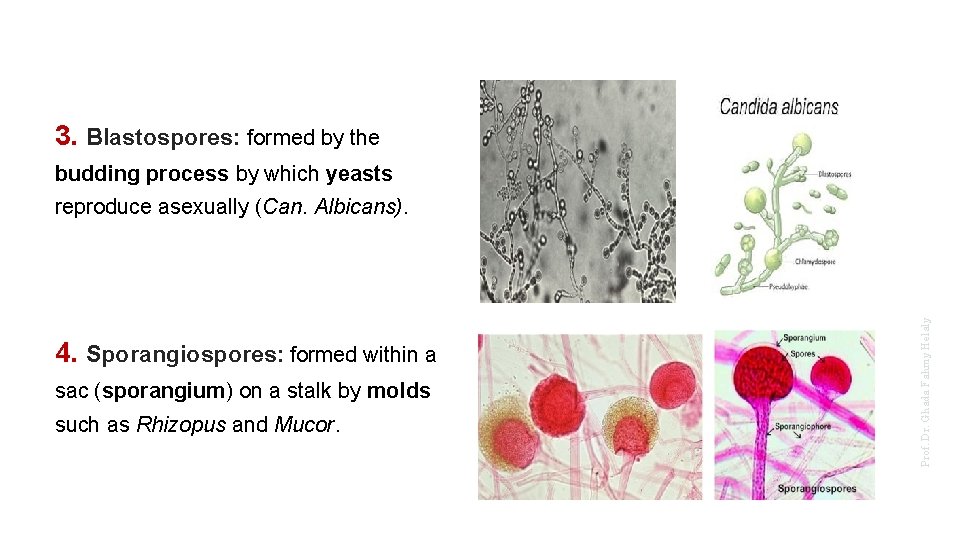
3. Blastospores: formed by the budding process by which yeasts 4. Sporangiospores: formed within a sac (sporangium) on a stalk by molds such as Rhizopus and Mucor. Prof. Dr. Ghada Fahmy Helaly reproduce asexually (Can. Albicans).
Pathogenesis: • Granulomatous �� Histoplasma and Coccidioides�� (macrophages and helper T cells). Pus formation • Pyogenic �� Aspergillus, Mucor, and Sporothrix�� (neutrophils). • Systemic fungi �� skin tests �� delayed hypersensitivity (manifested as induration of the skin). Positive skin test only indicates that infection has occurred. infection ﺑﺪﻭﻥ ﺗﺤﺪﻳﺪ ﻭﻗﺖ ﺍﻝ A false-negative skin test can occur in patients with reduced cellmediated immunity. In immunosuppressed patient like HIV patient The only fungi that give positive skin test for all humans ; candida test ( N. flora )
Host defense: • Intact skin • Fatty acids Tinea capitis -> fungal infection of the scalp ﺑﺘﻌﻤﻞ ﻣﺮﺽ ﺳﻌﻔﺔ ﺍﻟﺮﺃﺲ ﻓﻲ ﻫﺮﻣﻮﻥ ﺑﻄﻠﻊ ﻭﺍﺣﻨﺎ ﺻﻐﺎﺭ ﺑﻤﻨﻊ ﺍﻻﺻﺎﺑﺔ ﺑﻬﺎﺩ ﺍﻟﻨﻮﻉ • Hormones at puberty • In RT: mm of nasopharynx • Alveolar macrophages • • Cell mediated immune response -> protective Immunosuppression -> opportunistic infection
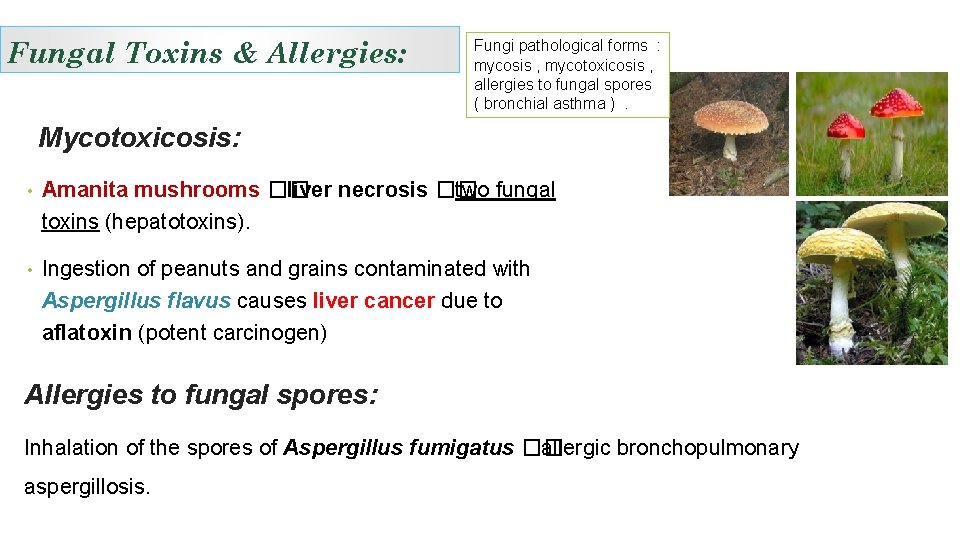
Fungal Toxins & Allergies: Fungi pathological forms : mycosis , mycotoxicosis , allergies to fungal spores ( bronchial asthma ). Mycotoxicosis: • Amanita mushrooms �� liver necrosis �� two fungal toxins (hepatotoxins). • Ingestion of peanuts and grains contaminated with Aspergillus flavus causes liver cancer due to aflatoxin (potent carcinogen) Allergies to fungal spores: Inhalation of the spores of Aspergillus fumigatus �� allergic bronchopulmonary aspergillosis.
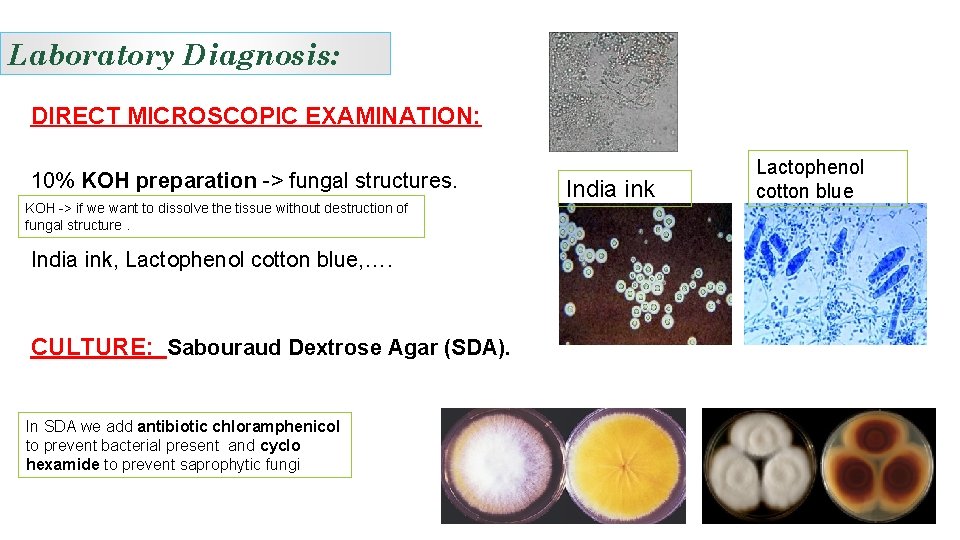
Laboratory Diagnosis: DIRECT MICROSCOPIC EXAMINATION: 10% KOH preparation -> fungal structures. KOH -> if we want to dissolve the tissue without destruction of fungal structure. India ink, Lactophenol cotton blue, …. CULTURE: Sabouraud Dextrose Agar (SDA). In SDA we add antibiotic chloramphenicol to prevent bacterial present and cyclo hexamide to prevent saprophytic fungi India ink Lactophenol cotton blue
SEROLOGICAL TESTS: for the presence of fungal antigens and antibodies. Two commonly used tests are those for cryptococcal antigen in spinal fluid and for Coccidioides antibodies in the patient’s serum We use serological test to see Ag in immunosuppressed patients DNA PROBES. Means nucleic acid amplification , kits for systemic infection
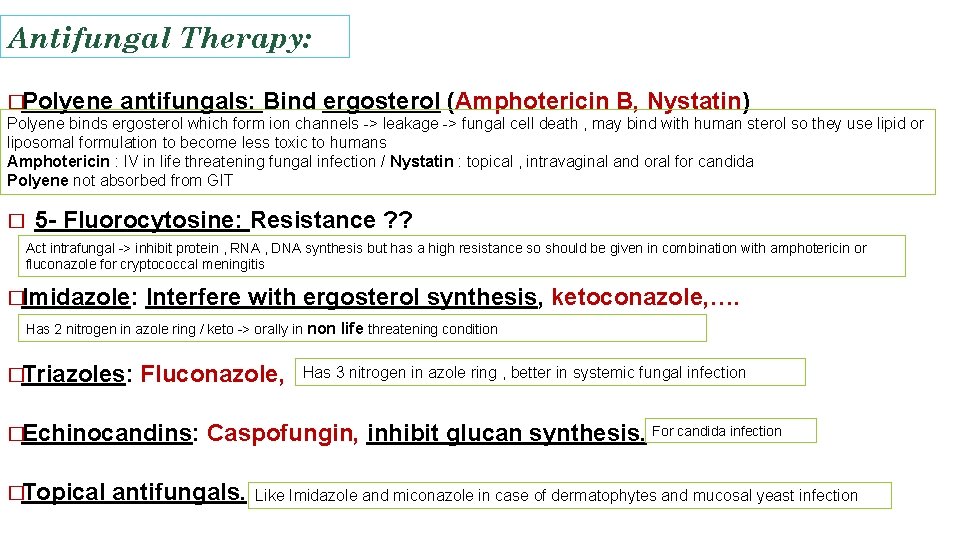
Antifungal Therapy: �Polyene antifungals: Bind ergosterol (Amphotericin B, Nystatin) Polyene binds ergosterol which form ion channels -> leakage -> fungal cell death , may bind with human sterol so they use lipid or liposomal formulation to become less toxic to humans Amphotericin : IV in life threatening fungal infection / Nystatin : topical , intravaginal and oral for candida Polyene not absorbed from GIT � 5 - Fluorocytosine: Resistance ? ? Act intrafungal -> inhibit protein , RNA , DNA synthesis but has a high resistance so should be given in combination with amphotericin or fluconazole for cryptococcal meningitis �Imidazole: Interfere with ergosterol synthesis, ketoconazole, …. Has 2 nitrogen in azole ring / keto -> orally in non life threatening condition �Triazoles: Fluconazole, �Echinocandins: �Topical Has 3 nitrogen in azole ring , better in systemic fungal infection Caspofungin, inhibit glucan synthesis. For candida infection antifungals. Like Imidazole and miconazole in case of dermatophytes and mucosal yeast infection
- Slides: 18