
General Musculoskeletal Screening Upper Extremities Dr m koushkzari
- Slides: 23
General Musculoskeletal Screening: Upper Extremities Dr. m. koushkzari Orthopedic spine felowship 1
General Approach History n Inspection n Range of Motion (ROM) n Palpation n Muscular and neurological exams n 2
History An accurate history is essential n Will give you diagnosis 80 -90% of time n How symptoms started (mechanism of injury)? n Duration of complaint? n Location, nature of pain, or symptoms? n Exacerbating or relieving maneuvers? n 3
General Inspection Observe how the patient moves as they go into the room or move from chair to table n General appearance n Body proportions n 8/27/02 4
Inspection of Specific Area Look for asymmetry between sides n Swelling n Deformities n Atrophy n Erythema n 8/27/02 5
Range of Motion (Active) Have patient range the joints n Watch for decreased or increased movement of the joint compared to the other side as well as the norm n Watch for pain with movement n Listen for crepitus or “popping” n Watch for abnormal movements n 8/27/02 6
Range of Motion (Passive) Next range the joints passively, comparing the end points to the active n Again note any decreased or increased movement n Pain with the movement n Crepitus or “popping” n 8/27/02 7
Palpation When palpating a structure, you need to know the anatomy of that structure n Palpate for swelling n Palpate for warmth n Palpate each area of the structure in turn evaluating for pain, and abnormalities as compared to the other side n 8/27/02 8
Muscular and Neurological n Check the following comparing one side to the other: – Grade strength (0 -5) – Grade reflexes (0 -4) – Sensory exam 8/27/02 9
Generalized Screening Exam n Each joint is: – Inspected (look for abnormalities) – Palpated – Examined 8/27/02 n If any abnormalities, a more thorough exam of the joint needs to be done. 10
Neck: Active Range of Motion Chin to chest (flexion) n “look at ceiling” (extension) n Chin to each shoulder (lateral rotation) n Ear to each shoulder (lateral flexion, i. e. , head tilt) n 8/27/02 11
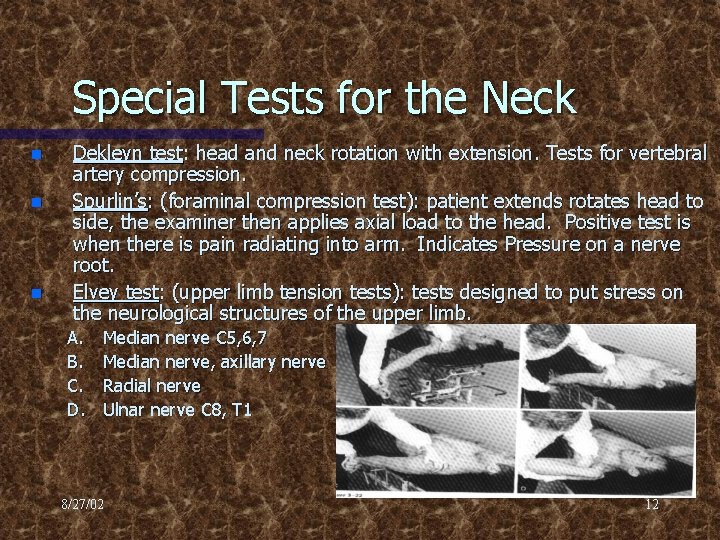
Special Tests for the Neck n n n Dekleyn test: head and neck rotation with extension. Tests for vertebral artery compression. Spurlin’s: (foraminal compression test): patient extends rotates head to side, the examiner then applies axial load to the head. Positive test is when there is pain radiating into arm. Indicates Pressure on a nerve root. Elvey test: (upper limb tension tests): tests designed to put stress on the neurological structures of the upper limb. A. B. C. D. Median nerve C 5, 6, 7 Median nerve, axillary nerve Radial nerve Ulnar nerve C 8, T 1 8/27/02 12
Shoulder Exam n n n n Inspection Palpation Passive Range of Motion Active Range of Motion – Appley scratch test for internal/external rotation Impingement Signs Bicep Tendonitis/Crossarm adduction/apprehension Neck exam: compression test Adson’s manuever 8/27/02 13
The Shoulder n Joints of the shoulder – Glenohumeral – Sternoclavicular – Acromioclavicular – Scapular thoracic (not a true joint) 8/27/02 14
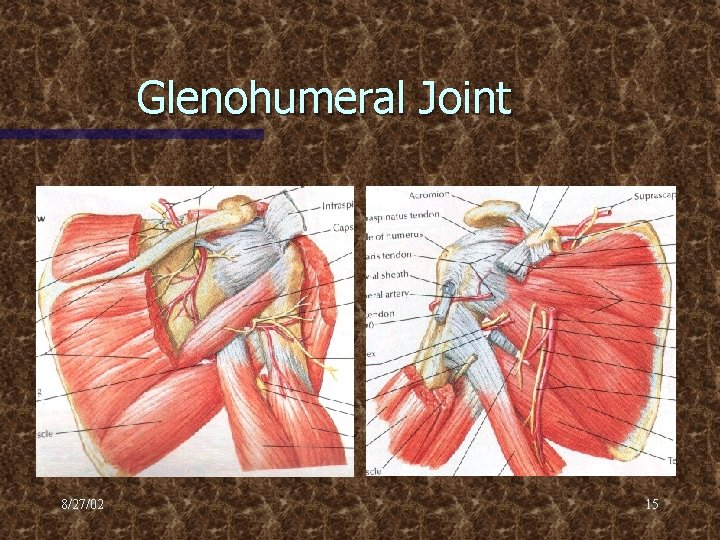
Glenohumeral Joint 8/27/02 15
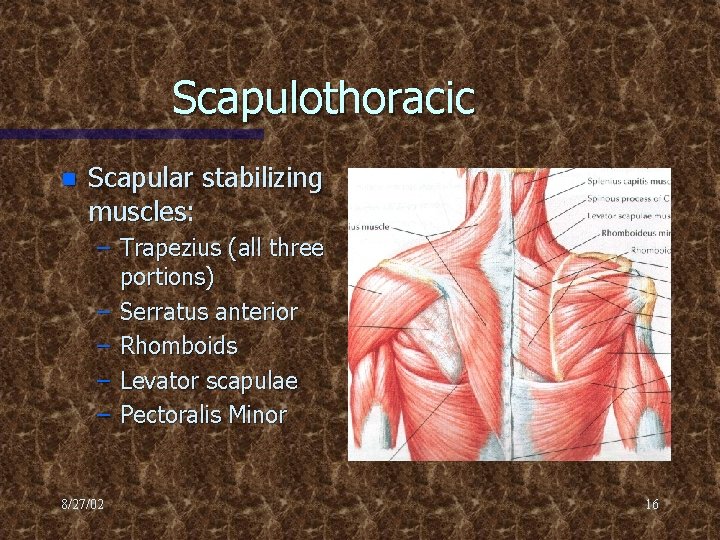
Scapulothoracic n Scapular stabilizing muscles: – Trapezius (all three portions) – Serratus anterior – Rhomboids – Levator scapulae – Pectoralis Minor 8/27/02 16
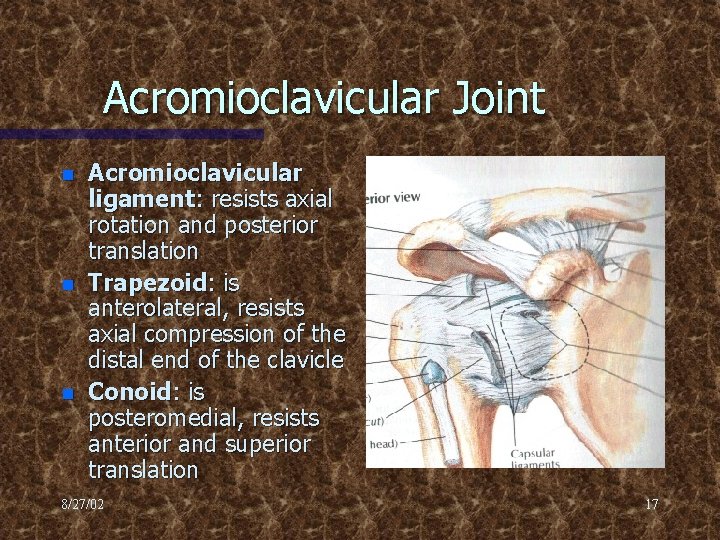
Acromioclavicular Joint n n n Acromioclavicular ligament: resists axial rotation and posterior translation Trapezoid: is anterolateral, resists axial compression of the distal end of the clavicle Conoid: is posteromedial, resists anterior and superior translation 8/27/02 17
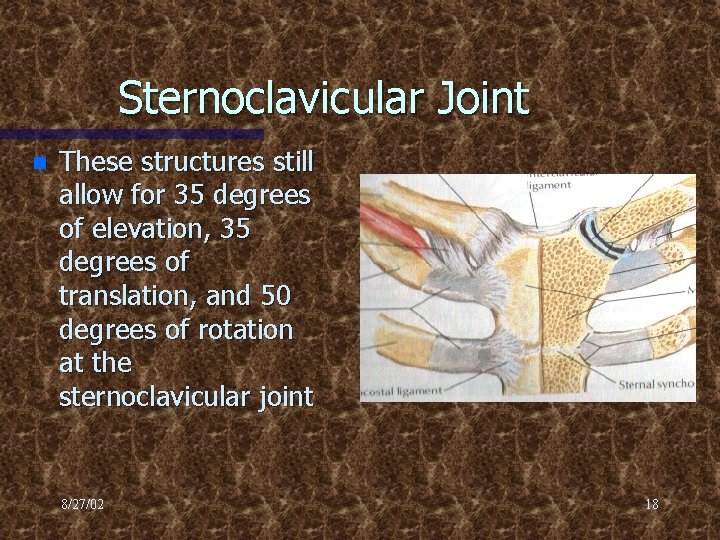
Sternoclavicular Joint n These structures still allow for 35 degrees of elevation, 35 degrees of translation, and 50 degrees of rotation at the sternoclavicular joint 8/27/02 18
Shoulder n Palpation of the shoulder includes: – Sternoclavicular joint – Acromioclavicular joint – Subacromial area – Bicipital groove – Muscles of the Scapula 8/27/02 Have patient place each hand: 1. Behind head (external rotation and abduction) 2. Up the small of the back (internal rotation) n 19
Shoulder n Rotator cuff: – Supraspinatus – Infraspinatus – Teres Minor – Subscapularis 8/27/02 20
The Elbow Palpation: lateral and medial epicondyles, olecranon, radial head, groove on either side of the olecranon n Inspect the carrying angle, and any nodules or swelling n 8/27/02 21
Wrist and Hand Inspect for swelling or deformities n Palpate: anatomic snuff box, volar and dorsal aspects of the wrist, all joints of the fingers n Flexion, extension, ulnar and radial deviation of the wrist n Have patient make a fist and extend and spread the fingers. n 8/27/02 22
Nerves of the Hand Ulnar n Radial n Median n Palmar branch of the median n 8/27/02 23