
General Mathematic HSC Tree Diagrams Stage 6 Year
- Slides: 6
General Mathematic (HSC) Tree Diagrams Stage 6 - Year 12 Press Ctrl-A ©G Dear 2009 – Not to be sold/Free to use 1
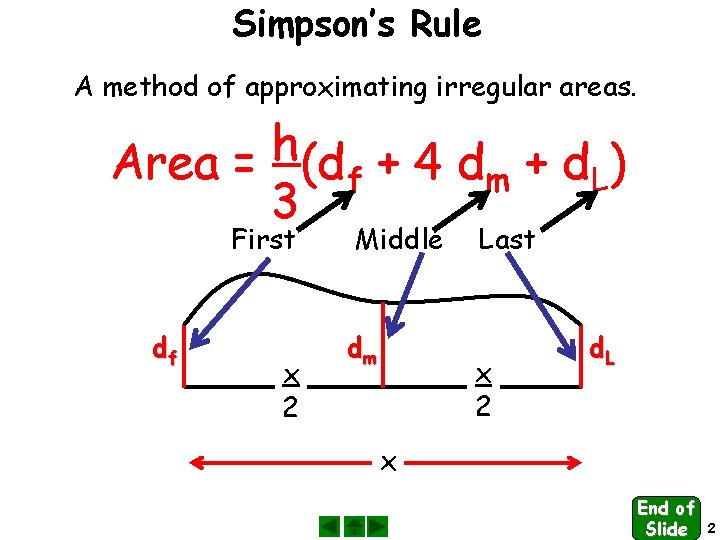
Simpson’s Rule A method of approximating irregular areas. h Area = (df + 4 dm + d. L) 3 First df x 2 Middle dm Last x 2 d. L x End of Slide 2
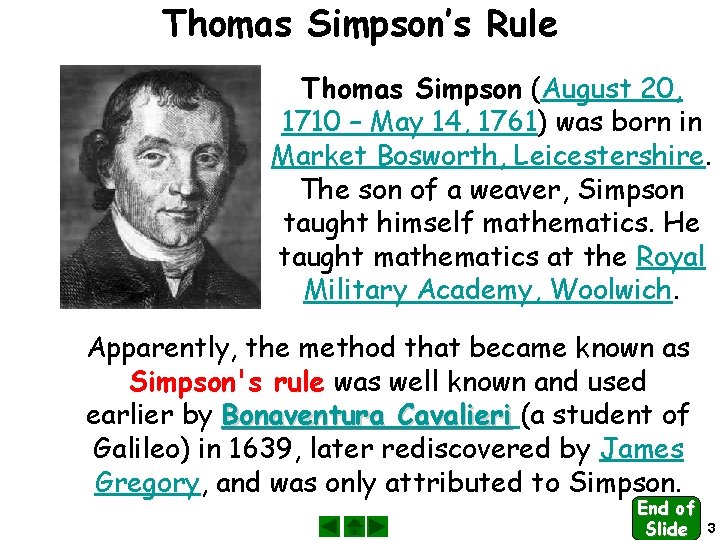
Thomas Simpson’s Rule Thomas Simpson (August 20, 1710 – May 14, 1761) was born in Market Bosworth, Leicestershire. The son of a weaver, Simpson taught himself mathematics. He taught mathematics at the Royal Military Academy, Woolwich. Apparently, the method that became known as Simpson's rule was well known and used earlier by Bonaventura Cavalieri (a student of Galileo) in 1639, later rediscovered by James Gregory, and was only attributed to Simpson. End of Slide 3
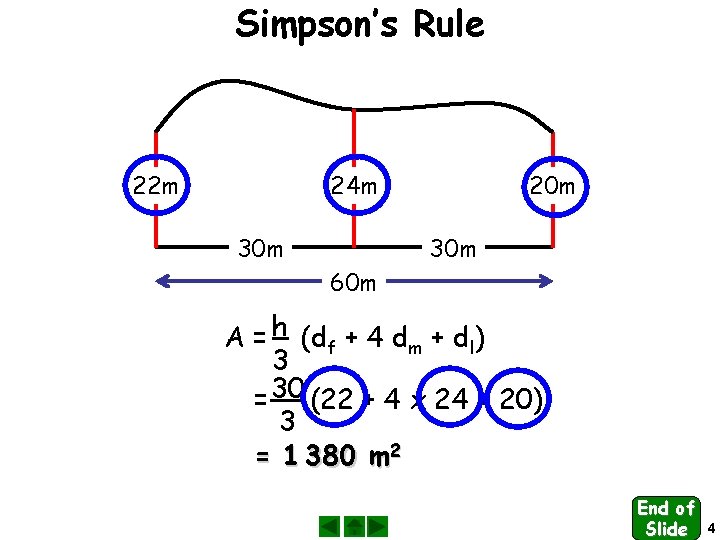
Simpson’s Rule 22 m 24 m 30 m 20 m 30 m 60 m A = h (df + 4 dm + dl) 3 = 30 (22 + 4 x 24 + 20) 3 = 1 380 m 2 End of Slide 4
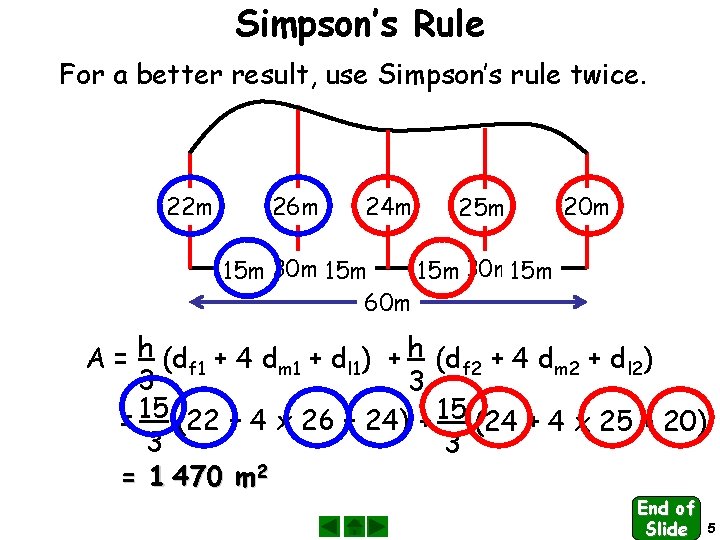
Simpson’s Rule For a better result, use Simpson’s rule twice. 22 m 26 m 24 m 25 m 20 m 15 m 30 m 15 m 60 m A = h (df 1 + 4 dm 1 + dl 1) + h (df 2 + 4 dm 2 + dl 2) 3 3 = 15 (22 + 4 x 26 + 24) + 15 (24 + 4 x 25 + 20) 3 3 = 1 470 m 2 End of Slide 5
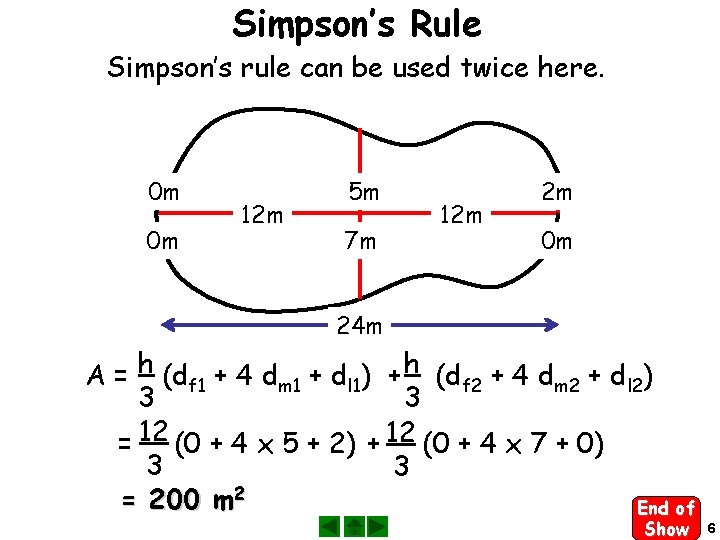
Simpson’s Rule Simpson’s rule can be used twice here. 0 m 0 m 12 m 5 m 7 m 12 m 2 m 0 m 24 m A = h (df 1 + 4 dm 1 + dl 1) + h (df 2 + 4 dm 2 + dl 2) 3 3 = 12 (0 + 4 x 5 + 2) + 12 (0 + 4 x 7 + 0) 3 3 = 200 m 2 End of Show 6