
General Laboratory Safety Hazardous Regulations Controlled substances drugs
General Laboratory Safety Hazardous Regulations
Controlled substances (drugs) n Purchase, Storage and use of: ¨ Narcotic ¨ Hallucinogenic ¨ Stimulants ¨ Depressive drugs Comes under Drug Enforcement Agency(DEA) Every parcel containing these sensitive materials must be placed within the plain outer container through which no marking indicating the nature of content can be seen. The purpose is to avoid temptation for those who would steal The contained drugs for illegal purpose.
Etiological Agents n Hazardous biological agents are classified as Etiological agents. It is a viable microorganism or toxin which can cause severe disabling or fatal human disease Authority permission from centre for disease control (CDC) ¨ Follow all the restrictions for the importations, possession, use and interstate shipment of pathogens which can be etiological agent for domestic livestock, poultry and humans ¨
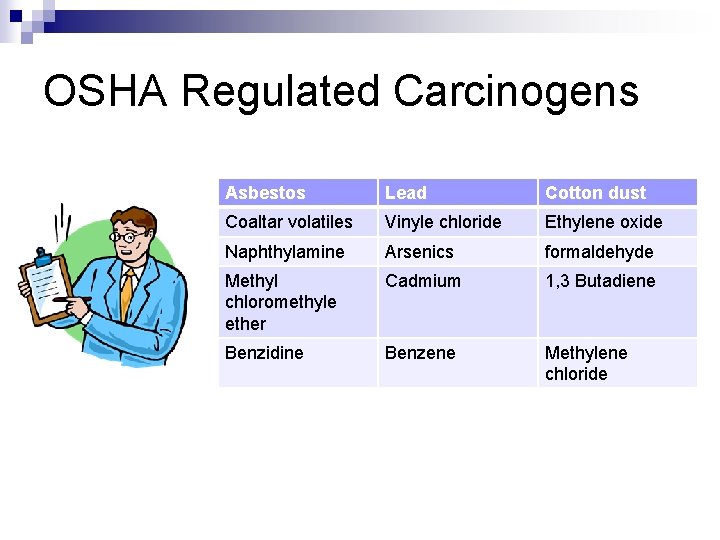
OSHA Regulated Carcinogens Asbestos Lead Cotton dust Coaltar volatiles Vinyle chloride Ethylene oxide Naphthylamine Arsenics formaldehyde Methyl chloromethyle ether Cadmium 1, 3 Butadiene Benzidine Benzene Methylene chloride
Explosives n n Any material which can be explosive during importation, manufacture, distribution and storage Class A: Maximum hazard, like dynamite, nitroglycerin, picric acid, Lead azide mercury, black powder Class B: Flammeable Hazard likephotographic flash powder, fireworks Class C: Forbidden or not acceptable explosives to transport by common carriers, by rail freight, rail express, highway or water
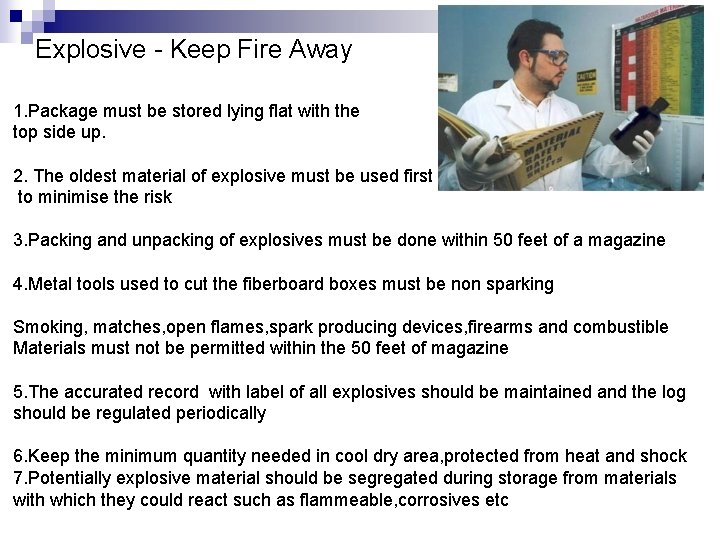
Explosive - Keep Fire Away 1. Package must be stored lying flat with the top side up. 2. The oldest material of explosive must be used first to minimise the risk 3. Packing and unpacking of explosives must be done within 50 feet of a magazine 4. Metal tools used to cut the fiberboard boxes must be non sparking Smoking, matches, open flames, spark producing devices, firearms and combustible Materials must not be permitted within the 50 feet of magazine 5. The accurated record with label of all explosives should be maintained and the log should be regulated periodically 6. Keep the minimum quantity needed in cool dry area, protected from heat and shock 7. Potentially explosive material should be segregated during storage from materials with which they could react such as flammeable, corrosives etc
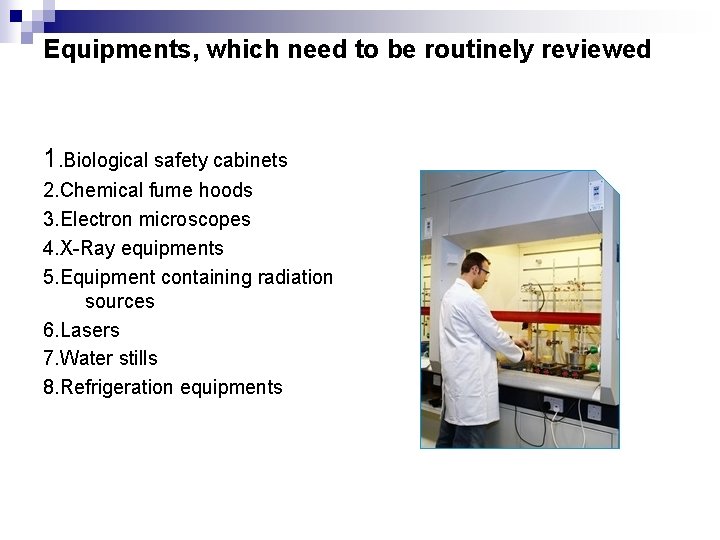
Equipments, which need to be routinely reviewed 1. Biological safety cabinets 2. Chemical fume hoods 3. Electron microscopes 4. X-Ray equipments 5. Equipment containing radiation sources 6. Lasers 7. Water stills 8. Refrigeration equipments
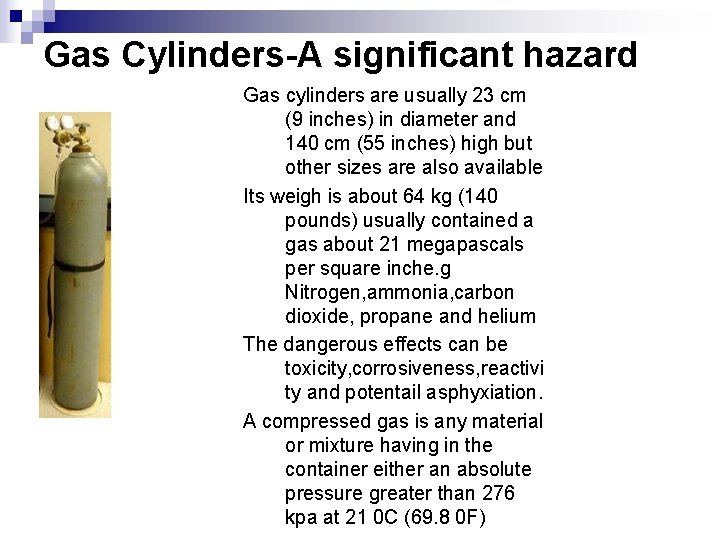
Gas Cylinders-A significant hazard Gas cylinders are usually 23 cm (9 inches) in diameter and 140 cm (55 inches) high but other sizes are also available Its weigh is about 64 kg (140 pounds) usually contained a gas about 21 megapascals per square inche. g Nitrogen, ammonia, carbon dioxide, propane and helium The dangerous effects can be toxicity, corrosiveness, reactivi ty and potentail asphyxiation. A compressed gas is any material or mixture having in the container either an absolute pressure greater than 276 kpa at 21 0 C (69. 8 0 F)
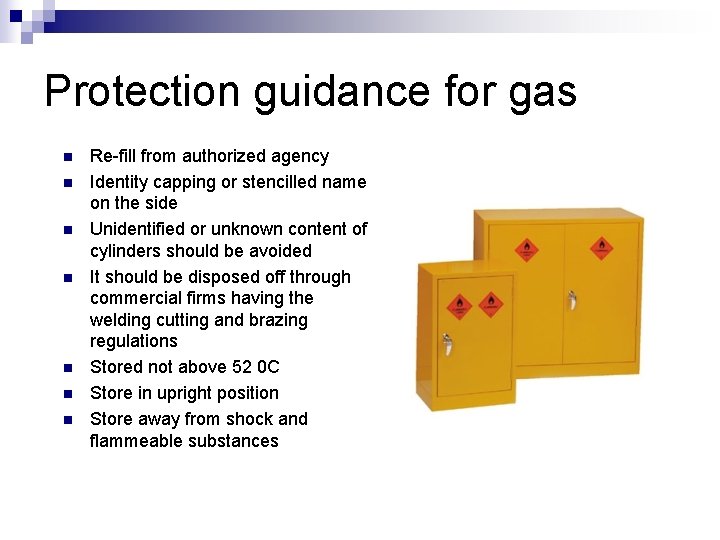
Protection guidance for gas n n n n Re-fill from authorized agency Identity capping or stencilled name on the side Unidentified or unknown content of cylinders should be avoided It should be disposed off through commercial firms having the welding cutting and brazing regulations Stored not above 52 0 C Store in upright position Store away from shock and flammeable substances
- Slides: 9