
General introduction to GPDs From data to GPDs

- Slides: 17
General introduction to GPDs From data to GPDs
General introduction to GPDs From data to GPDs
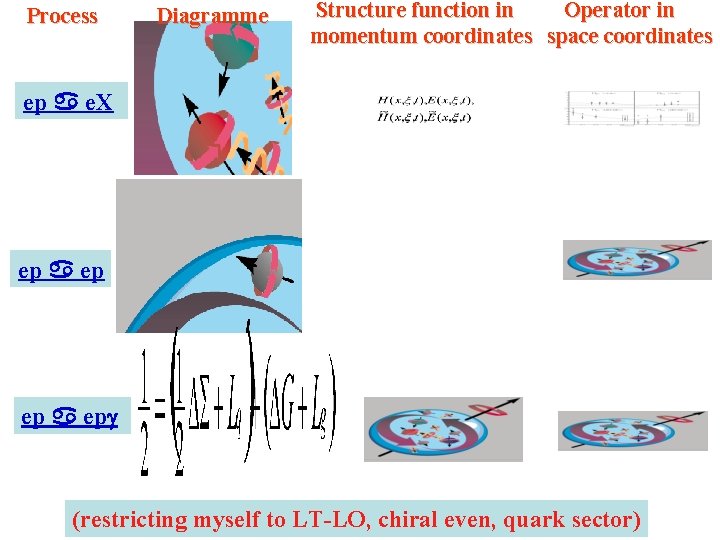
Process Diagramme Structure function in Operator in momentum coordinates space coordinates ep a e. X ep a epg (restricting myself to LT-LO, chiral even, quark sector)
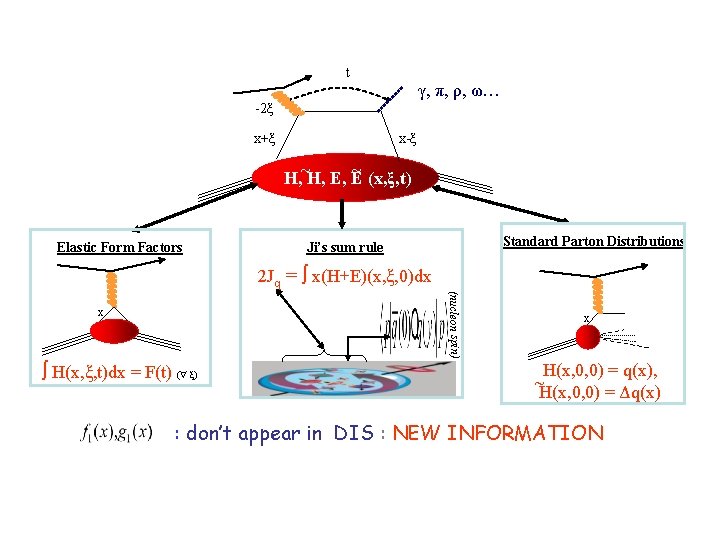
t γ, π, ρ, ω… -2ξ x+ξ x-ξ ~ ~ H, H, E, E (x, ξ, t) Elastic Form Factors Standard Parton Distributions Ji’s sum rule 2 Jq = x(H+E)(x, ξ, 0)dx H(x, ξ, t)dx = F(t) ( ξ) (nucleon spin) x x H(x, 0, 0) = q(x), ~ H(x, 0, 0) = Δq(x) : don’t appear in DIS : NEW INFORMATION
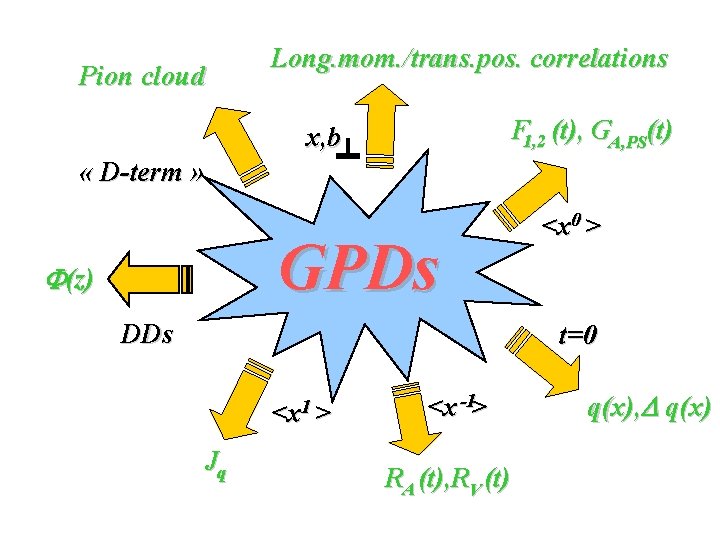
Pion cloud Long. mom. /trans. pos. correlations F 1, 2 (t), GA, PS(t) x, b « D-term » GPDs F(z) DDs <x 0 > t=0 <x 1 > Jq <x -1> RA (t), RV (t) q(x), D q(x)
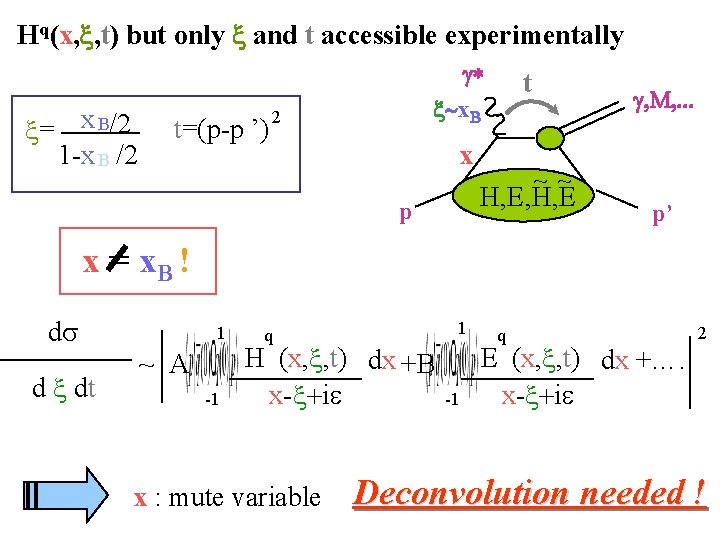
Hq(x, x, t) but only x and t accessible experimentally x= x B/2 1 -x B /2 t=(p-p ’) g* x~x. B 2 t x g, M, . . . ~ ~ H, E, H, E p p’ x = x. B ! ds d x dt B 1 ~ A -1 q 1 H (x, x, t) dx +B x-x+ie x : mute variable -1 q E (x, x, t) dx +…. x-x+ie 2 Deconvolution needed !
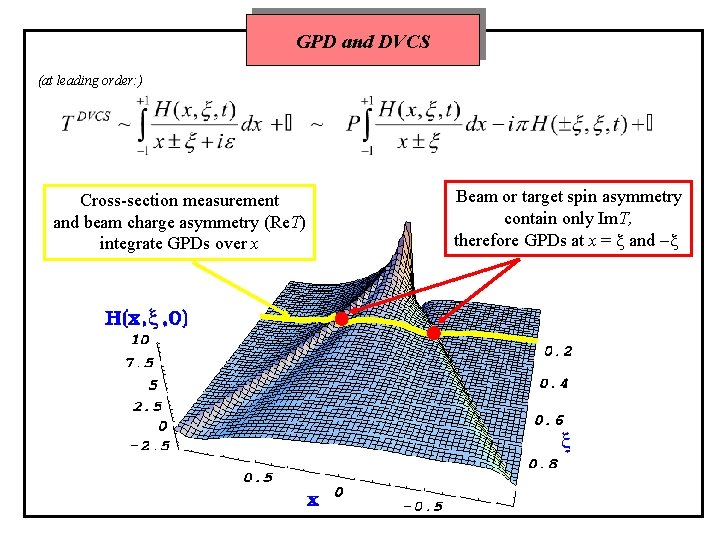
GPD and DVCS (at leading order: ) Cross-section measurement and beam charge asymmetry (Re. T) integrate GPDs over x Beam or target spin asymmetry contain only Im. T, therefore GPDs at x = x and -x
General introduction to GPDs From data to GPDs
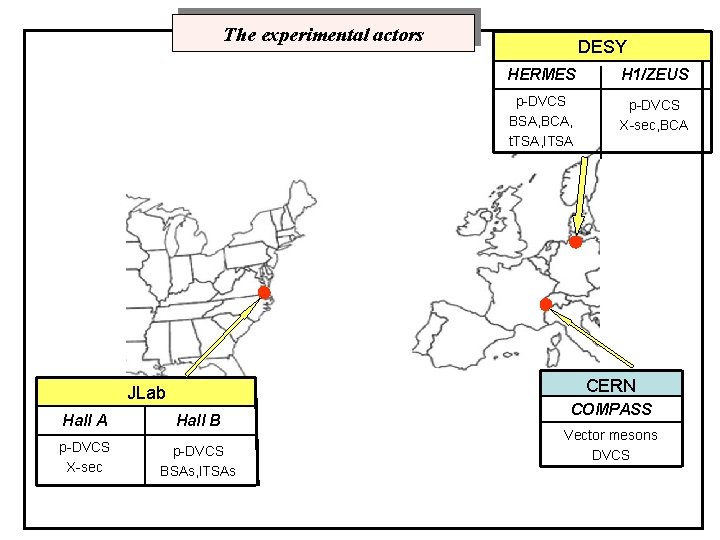
The experimental actors DESY HERMES H 1/ZEUS p-DVCS BSA, BCA, t. TSA, l. TSA p-DVCS X-sec, BCA CERN JLab Hall A Hall B p-DVCS X-sec p-DVCS BSAs, l. TSAs COMPASS Vector mesons DVCS
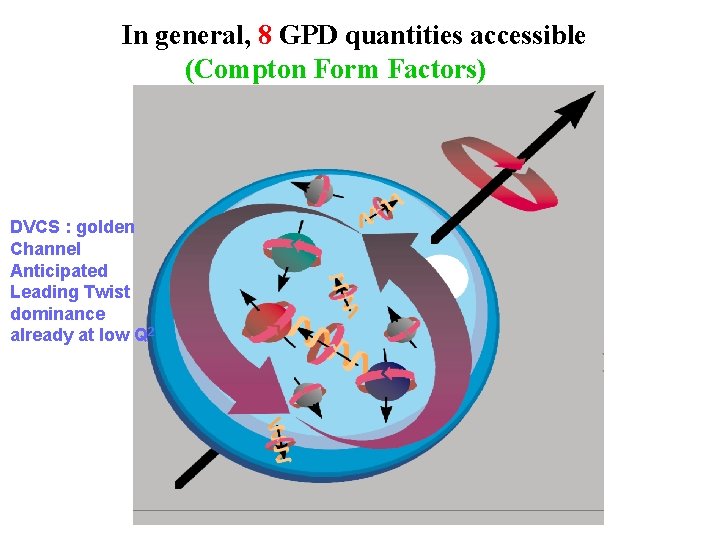
In general, 8 GPD quantities accessible (Compton Form Factors) DVCS : golden Channel Anticipated Leading Twist dominance already at low Q 2
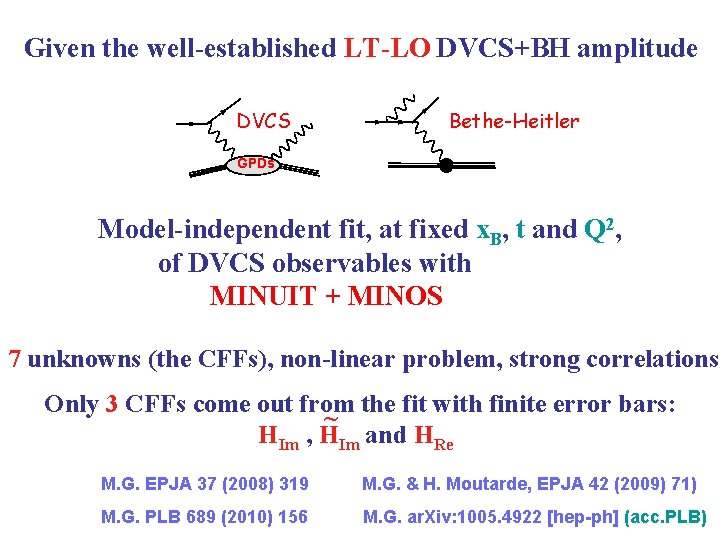
Given the well-established LT-LO DVCS+BH amplitude DVCS Bethe-Heitler GPDs Model-independent fit, at fixed x. B, t and Q 2, of DVCS observables with MINUIT + MINOS 7 unknowns (the CFFs), non-linear problem, strong correlations Only 3 CFFs come out from the fit with finite error bars: ~ HIm , HIm and HRe M. G. EPJA 37 (2008) 319 M. G. & H. Moutarde, EPJA 42 (2009) 71) M. G. PLB 689 (2010) 156 M. G. ar. Xiv: 1005. 4922 [hep-ph] (acc. PLB)
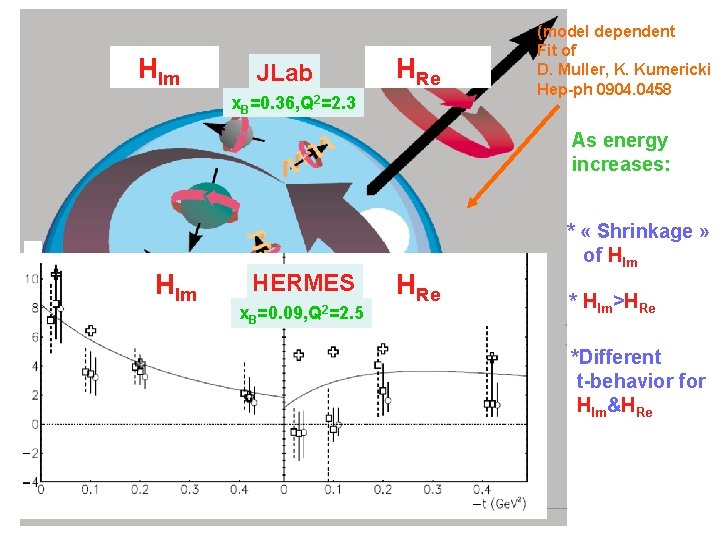
HIm JLab HRe x. B=0. 36, Q 2=2. 3 (model dependent Fit of D. Muller, K. Kumericki Hep-ph 0904. 0458 As energy increases: HIm HERMES x. B=0. 09, Q 2=2. 5 HRe * « Shrinkage » of HIm * HIm>HRe *Different t-behavior for HIm&HRe
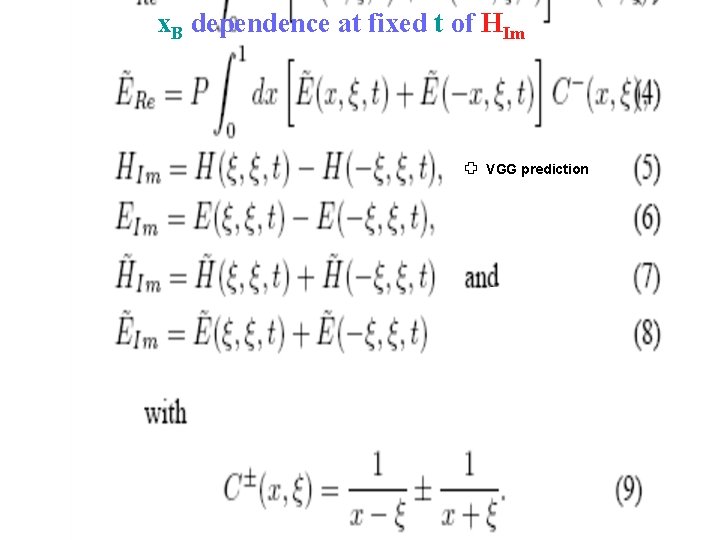
x. B dependence at fixed t of HIm VGG prediction
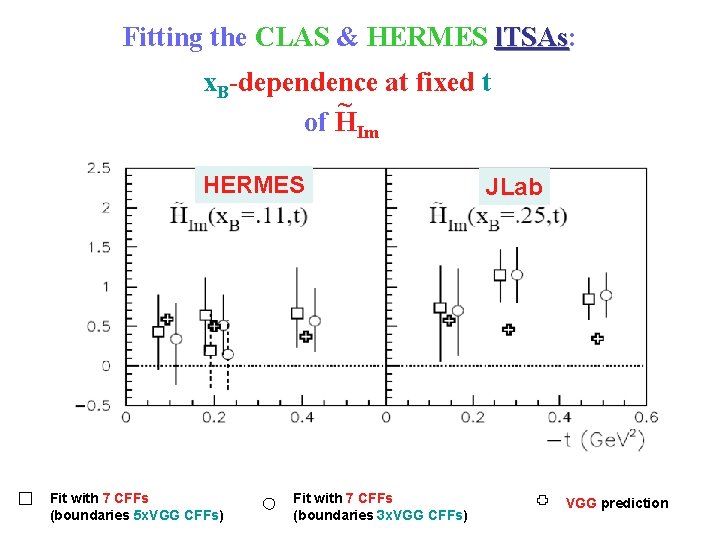
Fitting the CLAS & HERMES l. TSAs: l. TSAs x. B-dependence at fixed t ~ of HIm HERMES Fit with 7 CFFs (boundaries 5 x. VGG CFFs) Fit with 7 CFFs (boundaries 3 x. VGG CFFs) JLab VGG prediction
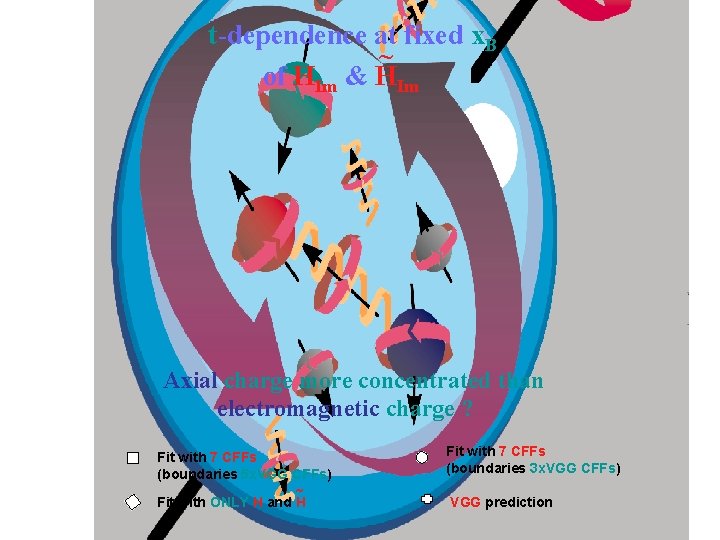
t-dependence at fixed x. B ~ of HIm & HIm Axial charge more concentrated than electromagnetic charge ? Fit with 7 CFFs (boundaries 5 x. VGG CFFs) ~ Fit with ONLY H and H Fit with 7 CFFs (boundaries 3 x. VGG CFFs) VGG prediction
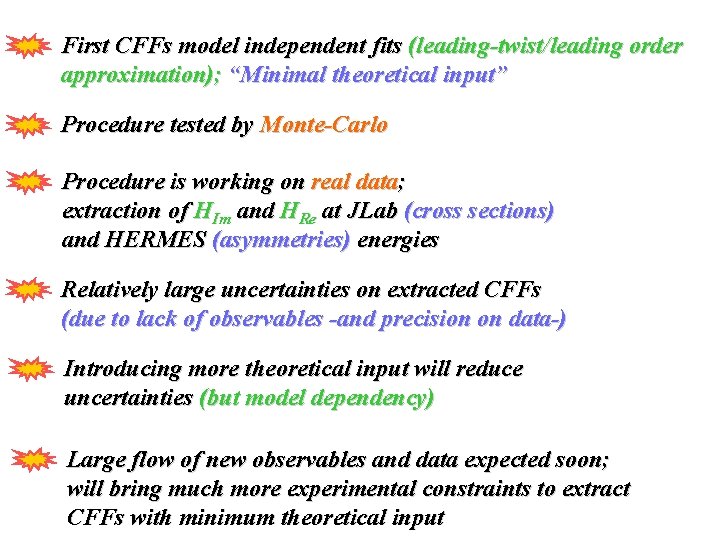
First CFFs model independent fits (leading-twist/leading order approximation); “Minimal theoretical input” Procedure tested by Monte-Carlo Procedure is working on real data; extraction of HIm and HRe at JLab (cross sections) and HERMES (asymmetries) energies Relatively large uncertainties on extracted CFFs (due to lack of observables -and precision on data-) Introducing more theoretical input will reduce uncertainties (but model dependency) Large flow of new observables and data expected soon; will bring much more experimental constraints to extract CFFs with minimum theoretical input