
General Features And Attachments Of Typical Ribs Atypical
General Features And Attachments Of Typical Ribs & Atypical Ribs DR. RASHIDA MEMON

General Features And Attachments Of Typical Ribs �Classification of Ribs �Twelve pairs of ribs, each terminating anteriorly in a costal cartilage �Classification of Ribs �True Ribs: � Costal cartilages of the upper seven ribs articulate directly with the sternum, known as TRUE RIBS. �False Ribs: Costal cartilages lower five do not articulate directly to the sternum called as FALSE RIBS. �Floating ribs: � Ribs 11 th and 12 th have no anterior connection with other ribs or with the sternum
Costal Margin: Costal cartilages of 8 th to 10 th ribs articulate anteriorly with costal cartilages of the ribs above, (like 8 th articulates with 8 th and so on) forming a continuous margin, Costal Margin.
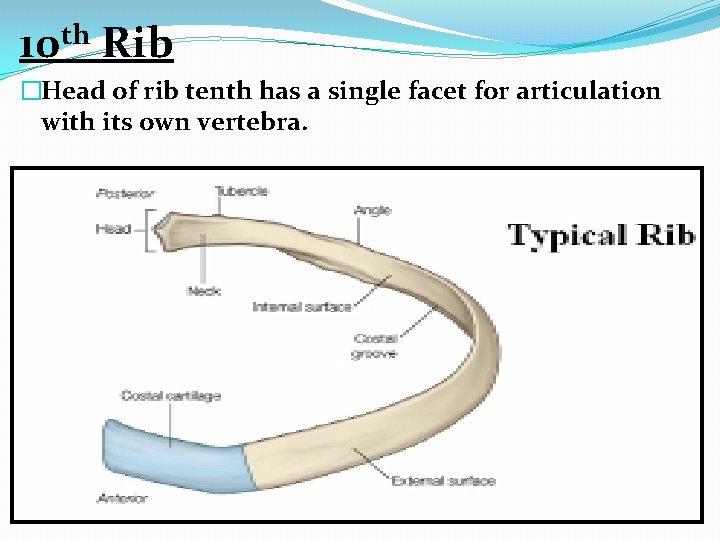
Typical Ribs �The Ribs 3 rd to 9 th or 10 th have similar features and called as TYPICAL RIBS Consists of: Three parts : �A curved shaft with anterior and posterior ends. � Anterior end is continuous with its costal cartilage. �Posterior end articulates with the vertebral column and is characterized by a head, neck, and tubercle.
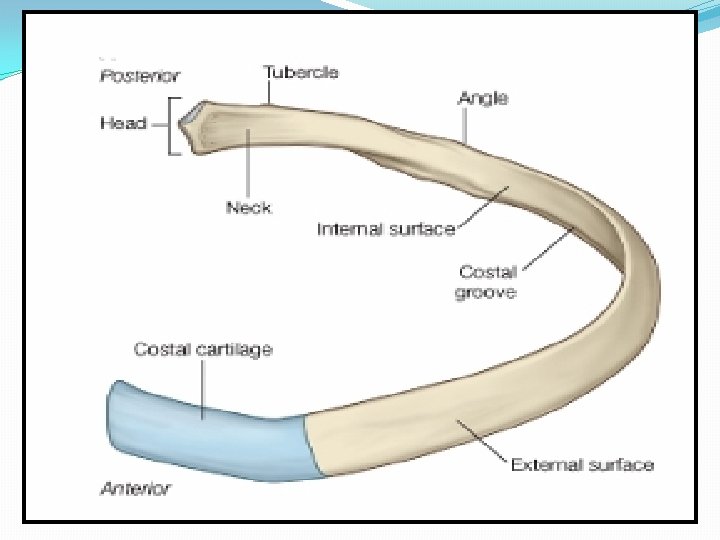
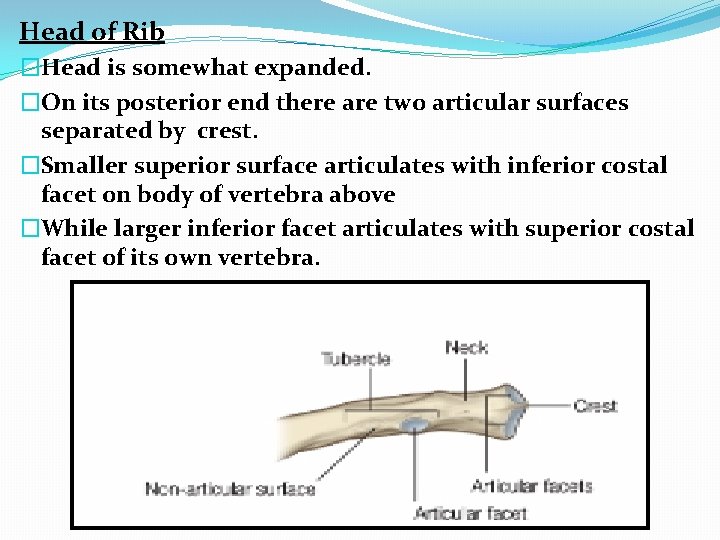
Head of Rib �Head is somewhat expanded. �On its posterior end there are two articular surfaces separated by crest. �Smaller superior surface articulates with inferior costal facet on body of vertebra above �While larger inferior facet articulates with superior costal facet of its own vertebra.
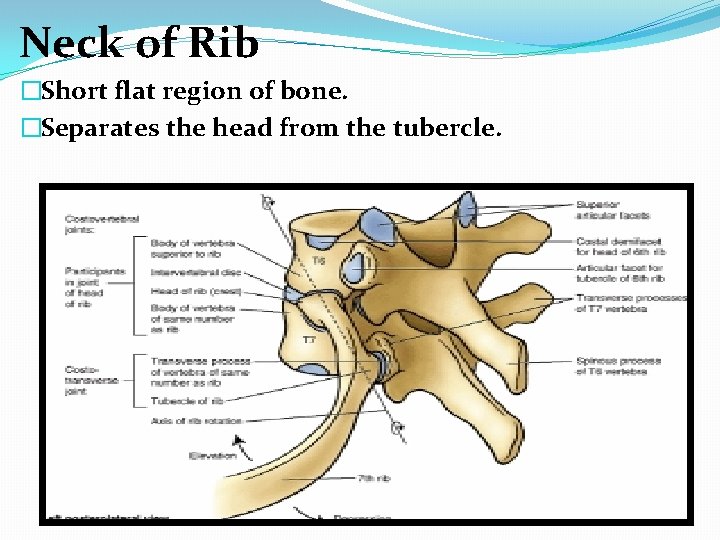
Neck of Rib �Short flat region of bone. �Separates the head from the tubercle.
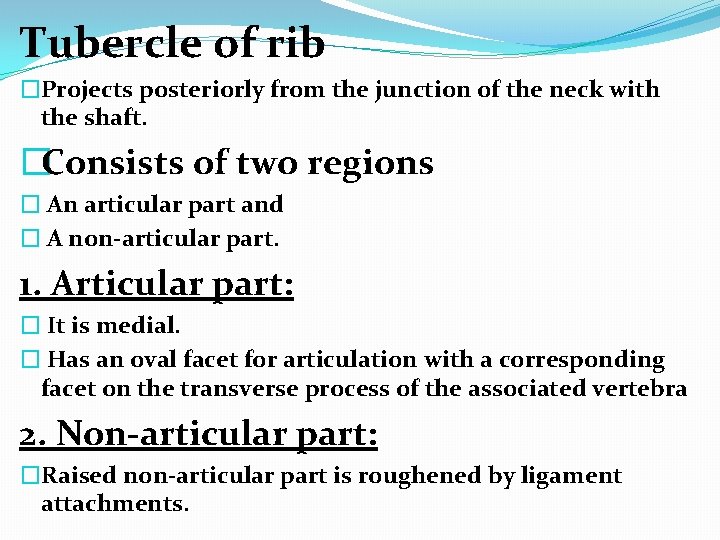
Tubercle of rib �Projects posteriorly from the junction of the neck with the shaft. �Consists of two regions � An articular part and � A non-articular part. 1. Articular part: � It is medial. � Has an oval facet for articulation with a corresponding facet on the transverse process of the associated vertebra 2. Non-articular part: �Raised non-articular part is roughened by ligament attachments.

Shaft of Rib �Shaft is generally thin and flat. �Has two borders. �Two surfaces. �Borders: � Upper Border � Lower Border �Surfaces: �Outer Surface �Inner Surface �Superior margin is smooth and rounded, � Inferior margin is sharp. �Inferior margin of internal surface of shaft extends beyond the limit of bone, called as costal groove.
Shaft of Rib �Beyond the tubercle the shaft of rib bends on itself, known as costal angle. �Along its long axis the shaft of ribs gently twisted, this can be visible when rib placed on the table. This is helpful in respiration.
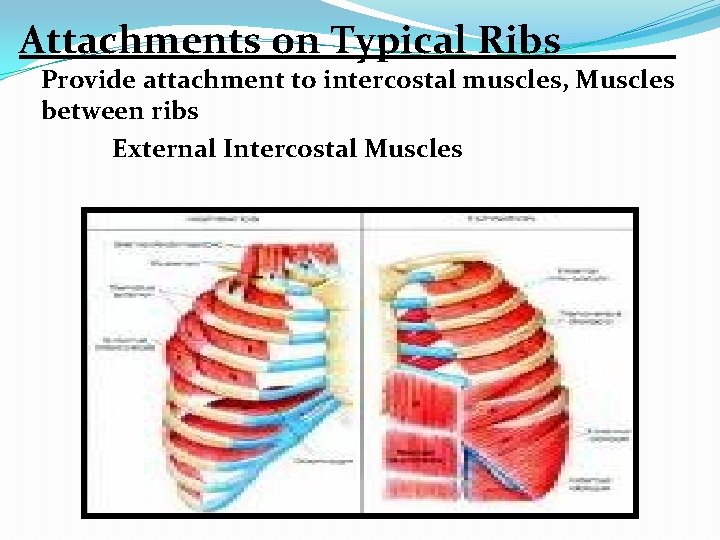
Attachments on Typical Ribs Provide attachment to intercostal muscles, Muscles between ribs External Intercostal Muscles
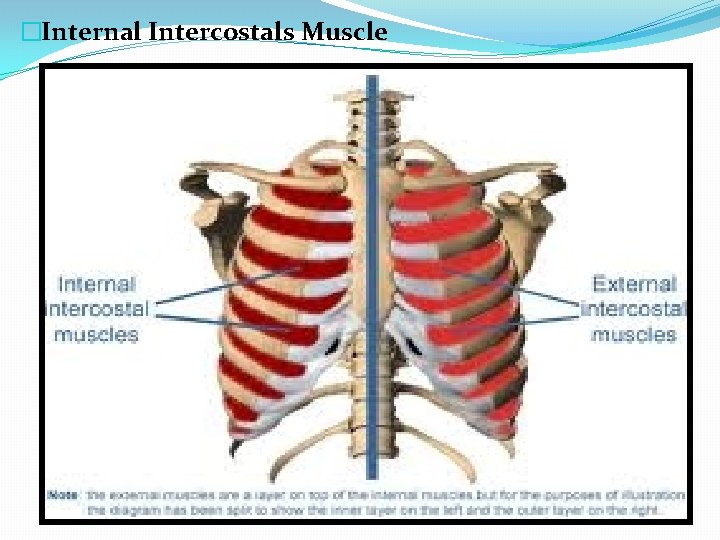
�Internal Intercostals Muscle
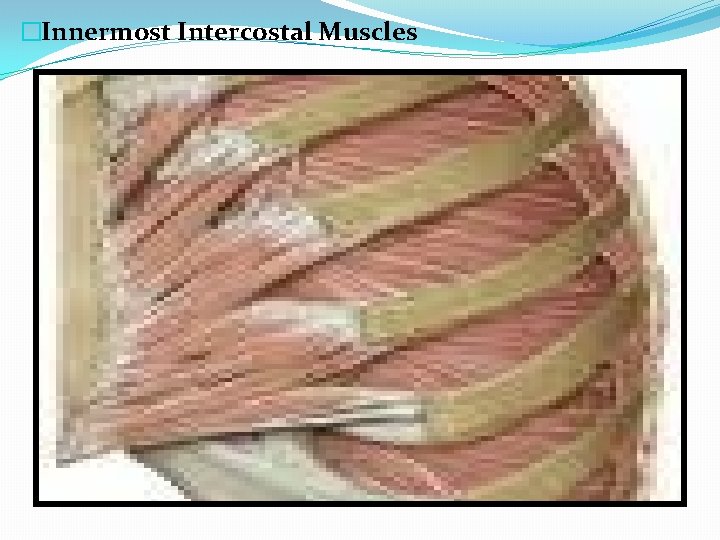
�Innermost Intercostal Muscles
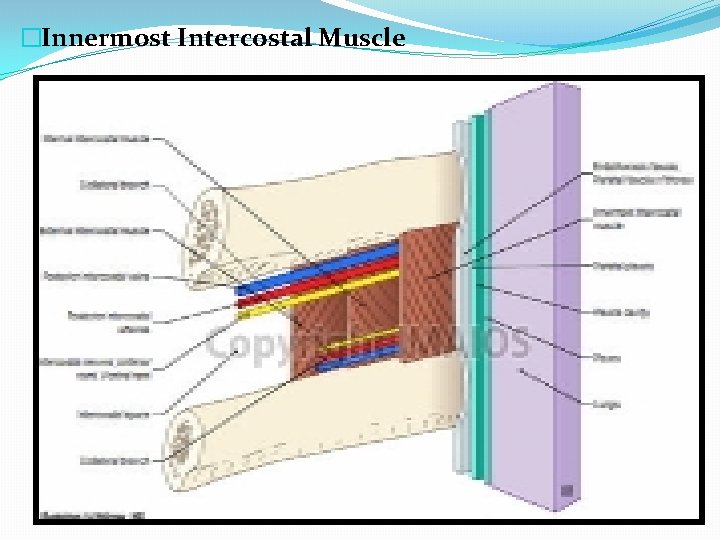
�Innermost Intercostal Muscle

� Transversus Thoracis

�Subcostales
General Features and attachment of Atypical Ribs �Ribs having dissimilar features are the Atypical ribs. �These are 1 st, 2 nd, 10 th, 11 th and 12 th.
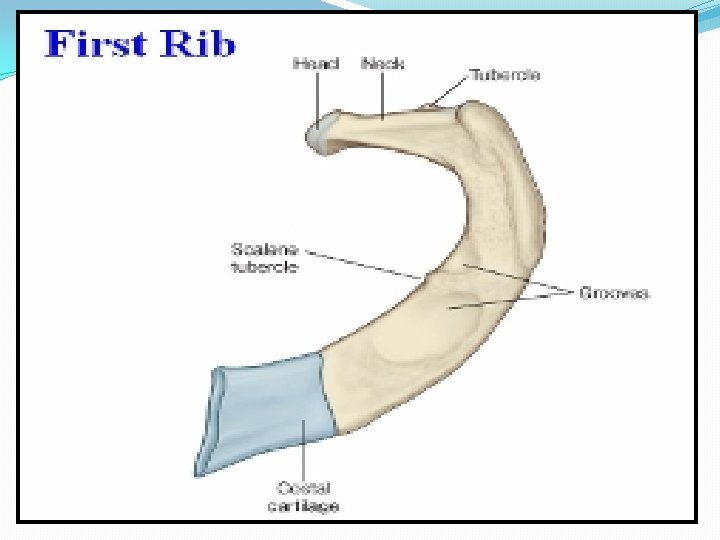
st 1 Rib The 1 st rib is: � The broadest (i. e. , Its body is widest and nearly horizontal), � Shortest, and � Most sharply curved of the seven true ribs. �Has a single facet on its head for articulation with the t 1 vertebra only. �In comparison of typical rib the first rib has outer and inner borders and superior and inferior surfaces �On its superior has two transversely directed grooves crossing for the subclavian vessels; �Grooves are separated by a scalene tubercle and ridge, to which the anterior scalene muscle is attached.
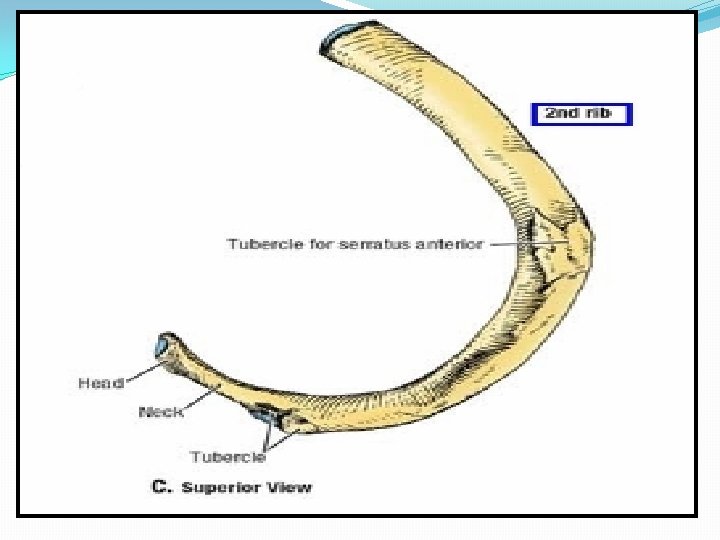
nd 2 Rib � More typical � Body is thinner, less curved, and substantially longer than the 1 st rib. � Head has two facets for articulation with the bodies of the T 1 and T 2 vertebrae �Main atypical feature is a rough area on its upper surface, � The tuberosity for serratus anterior, from which part of that muscle originates.
th 10 Rib �Head of rib tenth has a single facet for articulation with its own vertebra.
11 th & 12 th Ribs � 11 and 12 Ribs articulate only with the bodies of their own vertebrae and have no tubercles or necks. �Both ribs are short, have little curve, and are pointed anteriorly. �Anterior ends are free and covered with costal cartilages

- Slides: 25