
General Data Protection Regulation GDPR Dr Farah Jameel
- Slides: 43
General Data Protection Regulation (GDPR) Dr Farah Jameel GPC England Executive Team @Dr. FJameel @BMA_GP 03 November 2020 ©British Medical Association
Objectives • Basic introduction to the General Data Protection Regulations (GDPR) • Significant differences • What remains the same? 03 November 2020 ©British Medical Association 2
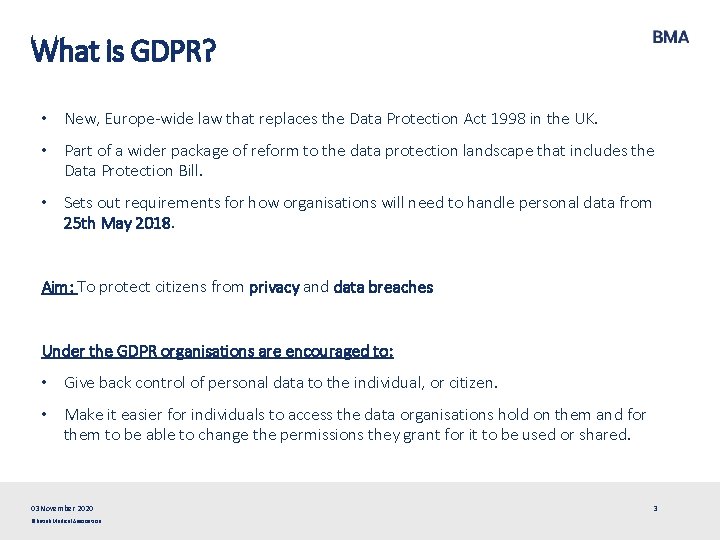
What is GDPR? • New, Europe-wide law that replaces the Data Protection Act 1998 in the UK. • Part of a wider package of reform to the data protection landscape that includes the Data Protection Bill. • Sets out requirements for how organisations will need to handle personal data from 25 th May 2018. Aim: To protect citizens from privacy and data breaches Under the GDPR organisations are encouraged to: • Give back control of personal data to the individual, or citizen. • Make it easier for individuals to access the data organisations hold on them and for them to be able to change the permissions they grant for it to be used or shared. 03 November 2020 ©British Medical Association 3
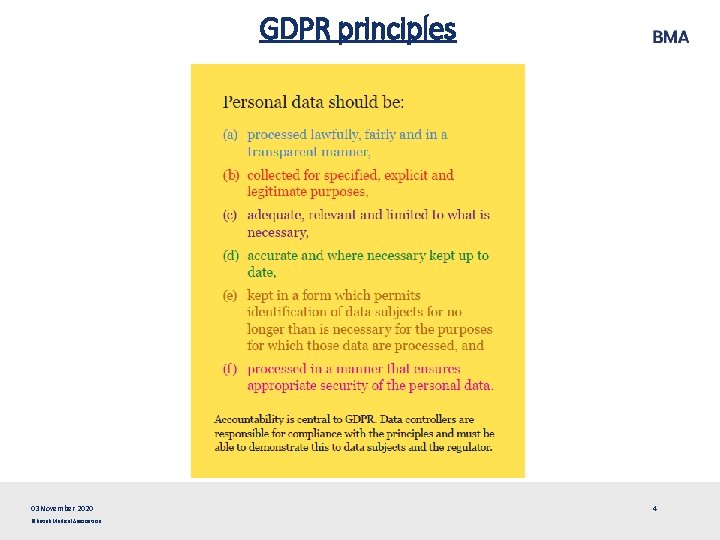
GDPR principles 03 November 2020 ©British Medical Association 4
What does this really mean? 03 November 2020 ©British Medical Association 5
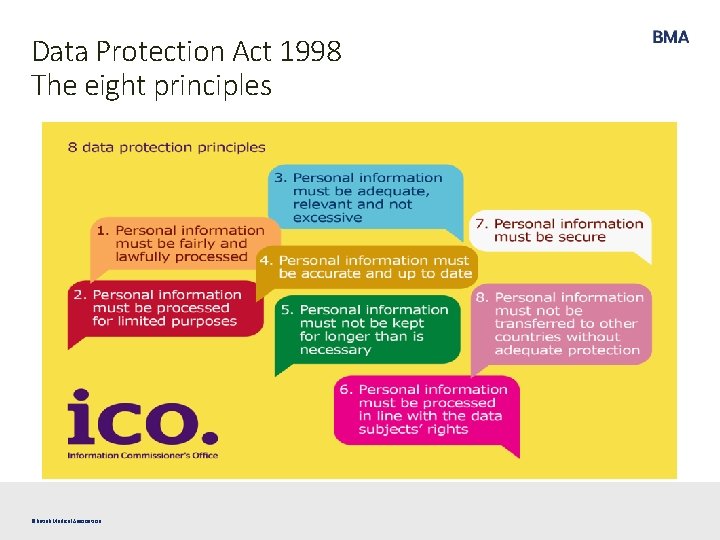
Data Protection Act 1998 The eight principles ©British Medical Association
General Data Protection Regulation It is not back to the starting line…. ©British Medical Association
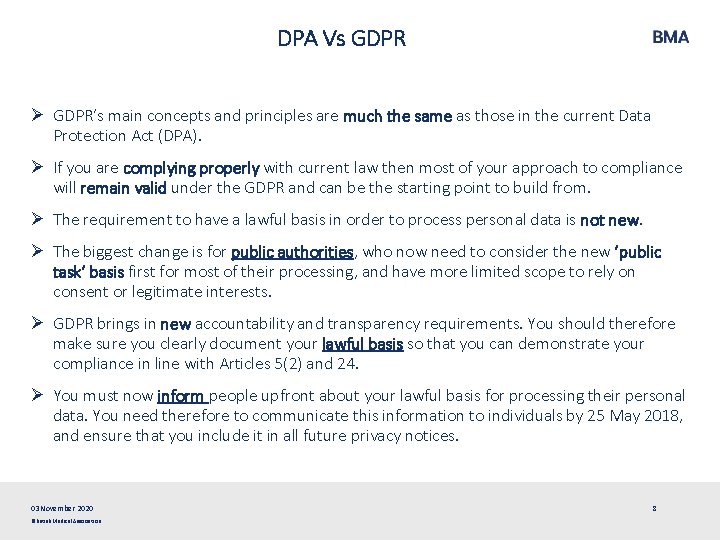
DPA Vs GDPR Ø GDPR’s main concepts and principles are much the same as those in the current Data Protection Act (DPA). Ø If you are complying properly with current law then most of your approach to compliance will remain valid under the GDPR and can be the starting point to build from. Ø The requirement to have a lawful basis in order to process personal data is not new. Ø The biggest change is for public authorities, who now need to consider the new ‘public task’ basis first for most of their processing, and have more limited scope to rely on consent or legitimate interests. Ø GDPR brings in new accountability and transparency requirements. You should therefore make sure you clearly document your lawful basis so that you can demonstrate your compliance in line with Articles 5(2) and 24. Ø You must now inform people upfront about your lawful basis for processing their personal data. You need therefore to communicate this information to individuals by 25 May 2018, and ensure that you include it in all future privacy notices. 03 November 2020 ©British Medical Association 8
Are GP practices a “public authority”? Yes The new Data Protection Bill (when passed) will define ‘public authority’. If you are a public authority as defined under the Freedom of Information Act 2000, or Freedom of Information (Scotland) Act 2002, as many GP practices that carry out NHS work are, you will be a public authority for the purposes of the GDPR. 03 November 2020 ©British Medical Association 9
Ø Responsibility and Accountability Ø Lawful basis for processing Ø Records of processing activities Ø Consent Ø Data protection officer Ø Psuedoanonymisation Ø Right of access Ø Right to erasure Ø Data portability Ø Data protection Ø Data breaches Ø Sanctions 03 November 2020 ©British Medical Association 10
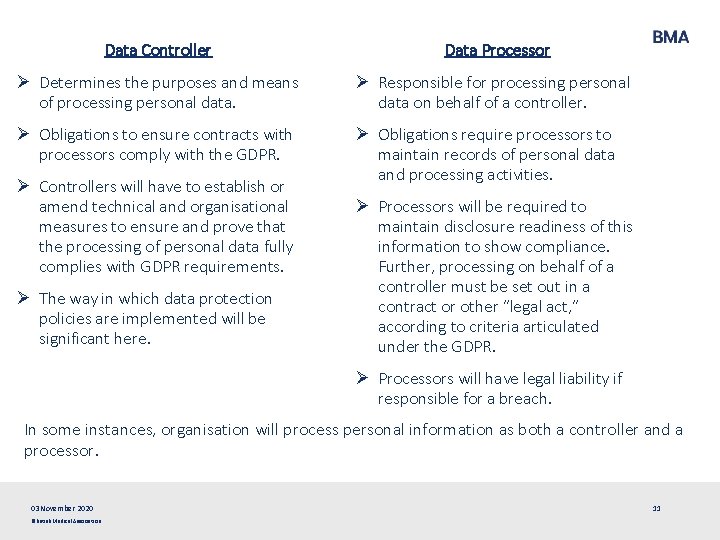
Data Controller Data Processor Ø Determines the purposes and means of processing personal data. Ø Responsible for processing personal data on behalf of a controller. Ø Obligations to ensure contracts with processors comply with the GDPR. Ø Obligations require processors to maintain records of personal data and processing activities. Ø Controllers will have to establish or amend technical and organisational measures to ensure and prove that the processing of personal data fully complies with GDPR requirements. Ø The way in which data protection policies are implemented will be significant here. Ø Processors will be required to maintain disclosure readiness of this information to show compliance. Further, processing on behalf of a controller must be set out in a contract or other “legal act, ” according to criteria articulated under the GDPR. Ø Processors will have legal liability if responsible for a breach. In some instances, organisation will process personal information as both a controller and a processor. 03 November 2020 ©British Medical Association 11
Consent Conditions for consent have been strengthened. Request for consent must be given in an intelligible and easily accessible form, with the purpose for data processing attached to that consent. The information you supply about the processing of personal data must be: – concise, transparent, intelligible and easily accessible; – written in clear and plain language, particularly if addressed to a child; and – free of charge. Consent means offering individuals real choice and control. Genuine consent should put individuals in charge. – It requires a positive opt-in (no pre-ticked boxes or any other method of default consent). – You must be specific and ‘granular’ so that you get separate consent for separate things. – You must make it easy for people to withdraw consent and tell them how they can do it and keep evidence of the consent you get. – Consent must be clear and distinguishable from other matters. 03 November 2020 ©British Medical Association 12
Consent contd … Ø Organisations in positions of power over individuals, like the providers of medical services, should avoid relying on consent unless they are confident they can demonstrate it is freely given. Ø One of the GDPR’s health data conditions calls for “explicit consent, ” but the general definition makes no reference to the word “explicit. ” Ø This has led to an on-going debate about whethere is a difference between “unambiguous” consent and “explicit” consent, and if so, what that difference might be. Ø Far from being academic, this issue could affect the practical implementation of consent in products, services, websites, etc. Ø However this ends, explicit consent for healthcare purposes is very likely to always require the strongest forms of agreement, such as an opt-in tick-box or a declaratory statement. Ø The healthcare sector will have to take a cutting-edge approach to obtaining consent. Consent will need to cover as many potential transfers of health data as possible, including international data transfers and cloud storage. Ø Explicit consent under GDPR is entirely separate to the common law and implied consent for sharing for direct care. Practices can continue to rely on established implied consent practices for sharing for direct care. 03 November 2020 ©British Medical Association 13
What are the lawful bases for processing? The lawful bases for processing are set out in Article 6 of the GDPR. At least one of these must apply whenever you process personal data: (a) Consent: the individual has given clear consent for you to process their personal data for a specific purpose. (b) Contract: the processing is necessary for a contract you have with the individual, or because they have asked you to take specific steps before entering into a contract. (c) Legal obligation: the processing is necessary for you to comply with the law (not including contractual obligations). (d) Vital interests: the processing is necessary to protect someone’s life. (e) Public task: the processing is necessary for you to perform a task in the public interest or for your official functions, and the task or function has a clear basis in law. (f) Legitimate interests: the processing is necessary for your legitimate interests or the legitimate interests of a third party unless there is a good reason to protect the individual’s personal data which overrides those legitimate interests. (This cannot apply if you are a public authority processing data to perform your official tasks. ) The GDPR sets a high standard for consent. But you often won’t need consent. If consent is difficult, look for a different lawful basis. 03 November 2020 ©British Medical Association 14
Special category data GDPR defines “personal” data as “any information relating to an identified or identifiable natural person (data subject); an identifiable natural person is one who can be identified, directly or indirectly, in particular by reference to an identifier such as a name, an identification number, location data, an online identifier or to one or more factors specific to the physical, physiological, genetic, mental, economic, cultural or social identity of that natural person. ” GDPR contains three additional important definitions that pertain to health data: 1. “Data concerning health” is “personal data related to the physical or mental health of a natural person, including the provision of health care services, which reveal information about his or health status. ” 2. “Genetic data” is “personal data relating to inherited or acquired genetic characteristics of a natural person which give unique information about the physiology or the health of that natural person and which result, in particular, from an analysis of a biological sample from the natural person in question. ” 3. “Biometric data” is “personal data resulting from specific technical processing relating to the physical, physiological or behavioural characteristics of a natural person, which allow or confirm the unique identification of that natural person, such as facial images or dactyloscopic data. ” 03 November 2020 ©British Medical Association 15
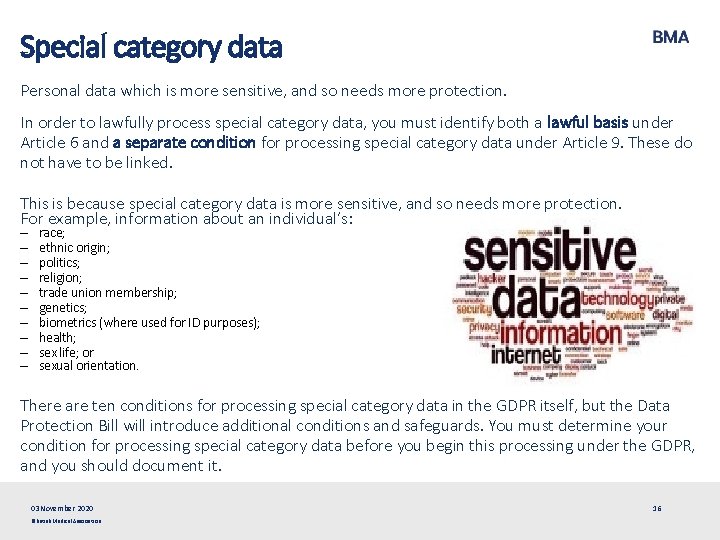
Special category data Personal data which is more sensitive, and so needs more protection. In order to lawfully process special category data, you must identify both a lawful basis under Article 6 and a separate condition for processing special category data under Article 9. These do not have to be linked. This is because special category data is more sensitive, and so needs more protection. For example, information about an individual’s: – – – – – race; ethnic origin; politics; religion; trade union membership; genetics; biometrics (where used for ID purposes); health; sex life; or sexual orientation. There are ten conditions for processing special category data in the GDPR itself, but the Data Protection Bill will introduce additional conditions and safeguards. You must determine your condition for processing special category data before you begin this processing under the GDPR, and you should document it. 03 November 2020 ©British Medical Association 16
Special category data “data concerning health, ” “genetic data” and “biometric data” will be subject to a higher standard of protection than personal data in general. The processing of these three forms of health data is prohibited unless one of several conditions applies. These health-specific conditions are as follows: 1. The data subject must have given “explicit consent” to the processing. 2. “Processing is necessary for the purposes of: • preventive or occupational medicine, • for the assessment of the working capacity of the employee, • medical diagnosis, • the provision of health or social care or treatment or the management of health or social care systems and services. ” 3. “Processing is necessary for reasons of public interest in the area of public health, such as protecting against serious cross-border threats to health or ensuring high standards of quality and safety of health care and of medicinal products or medical devices. ” 03 November 2020 ©British Medical Association 17
Special category data The lawful basis for processing special category health data for direct care is that processing is: ‘necessary… in the exercise of official authority vested in the controller’ (Article 6(1)(e)). It is also possible for NHS GP practices to rely on ‘processing is necessary for compliance with a legal obligation to which the controller is subject’ (Article 6(1)(c). The special category condition for processing for direct care is that processing is: ‘necessary for the purposes of preventative or occupational medicine for the assessment of the working capacity of the employee, medical diagnosis, the provision of health or social care or treatment or the management of health or social care systems and services. . . ’ (Article 9(2)(h)). When relying on Articles 6(1)(e) and 9(2)(h) to share data for the provision of direct care, consent under GDPR is not needed. However, in addition to the GDPR, data controllers must also satisfy the common law duty of confidentiality. In order to satisfy the common law data controllers can continue to rely on implied consent to share confidential health data for the provision of direct care. 03 November 2020 ©British Medical Association 18
Data Protection Officer Under the GDPR, there is an obligation to appoint a data protection officer (DPO) in some circumstances. You must appoint a DPO if you: – are a public authority; – carry out large scale systematic monitoring of individuals (for example, online behaviour tracking); or – carry out large scale processing of special categories of data (which includes information relating to an individual’s health) or data relating to criminal convictions and offences. Recruiting or training a suitable individual should be an immediate concern, as, in reality, there are not enough sufficiently qualified specialists in the market to meet demand. Organisations such as GP practices and particularly those that carry out NHS work, will need to appoint a DPO. 03 November 2020 ©British Medical Association 19
DPO Contd … Can the DPO be an existing employee? Yes. The person you appoint as a DPO can be an existing employee provided that their professional duties are compatible with the duties of the DPO and do not lead to a conflict of interest. What is a conflict of interest in relation to a DPO? In this context, ‘conflict of interest’ means a conflict with other possible tasks and duties. The DPO cannot hold a position within the organisation that leads him or her to determine the purposes and the means of the processing of personal data. More information on this can be found at questions 9 and 10 of the Article 29 DPO FAQ’s and in the Article 29 guidelines on DPO's. Can health organisations share a DPO? Yes. You may appoint a single data protection officer to act for a group of companies or a group of public authorities, taking into account their structure and size. 03 November 2020 ©British Medical Association 20
Managing Risks and Subject Access Requests (SAR) 03 November 2020 ©British Medical Association 21
Rights for individuals under the GDPR The main rights for individuals under the GDPR will be: • subject access; • to have inaccuracies corrected; • to have information erased; • to prevent direct marketing; • to prevent automated decision-making and profiling; • data portability. 03 November 2020 ©British Medical Association and 22
Data Portability and SARs New rights are being introduced under the GDPR, including the: - Right to Data Portability (allowing for data subjects to have their personal data sent back to them to transmit elsewhere more easily) and - an extended Right to Be Forgotten (allowing data subjects to have their personal data erased without undue delay). Subject Access Right, or “SAR, ” a process where data subjects can exercise their right to gain access to their personal data. Under GDPR, a SAR can be made free of charge and must be addressed quickly, i. e. within one month of receipt of the request (which may be extended for a maximum of two months when necessary, taking into account the complexity of the request and the number of requests). SARs have risen over the years; for example, the ICO estimated in June 2016 that 13% of UK residents had now made a SAR. This rise can be expected to continue once they are free, and SARs will become more costly and complicated for organizations to address, especially given the prevalence of email and cloud applications. 03 November 2020 ©British Medical Association 23
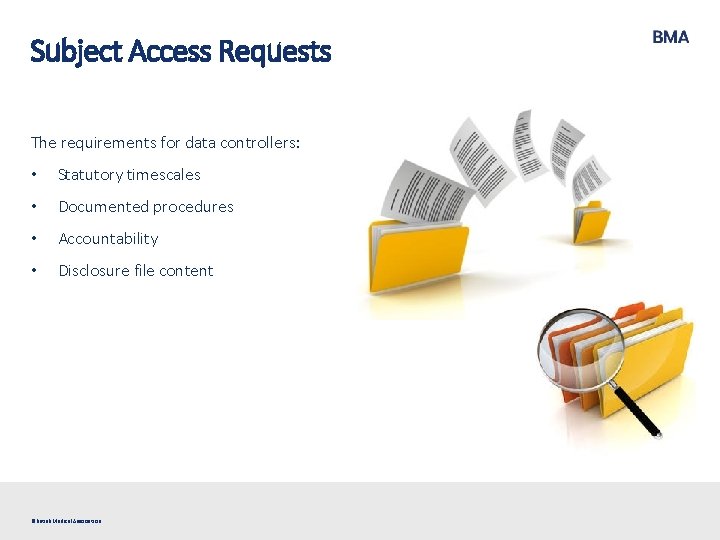
Subject Access Requests The requirements for data controllers: • Statutory timescales • Documented procedures • Accountability • Disclosure file content ©British Medical Association
Subject Access Requests The requirements for requestors: • Requests in writing • Proof of identity • Administration fee (Till May 24 th 2018) • Clarification of request ©British Medical Association
Subject access risks • Staff not fully aware of what a Subject Access Request (SARs) is and how to deal with one • SAR redactions and exemptions not logged or reported. • SAR response dates not met ©British Medical Association
Right to erasure: Medical records • There is no absolute ‘right to be forgotten’. • People can ask for their personal data to be erased - but only when there is no compelling reason for its continued processing. • Requests will have to be assessed on their own merits. However, care providers, for example, will likely have a very good reason for processing much of the personal data they hold for the purposes of providing medical care. This right does not apply when data is processed for health or social care purposes (Art 9(2)(h) - so does not apply to medical records (unless erasure is ordered by a court). 03 November 2020 ©British Medical Association 27
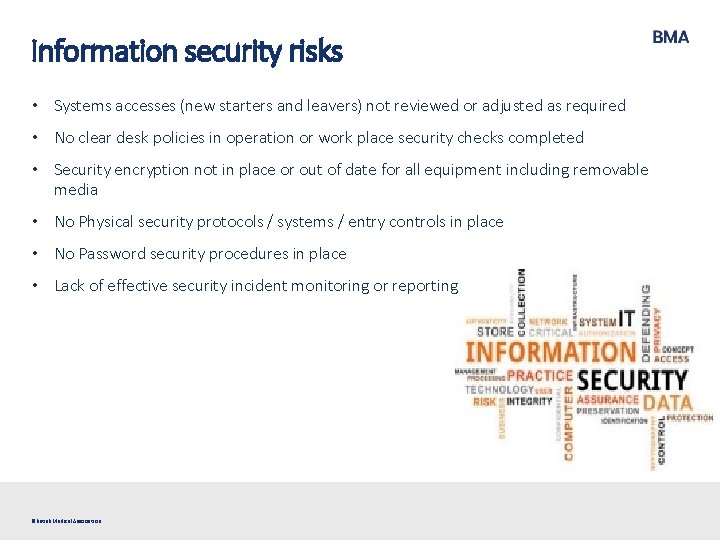
Information security risks • Systems accesses (new starters and leavers) not reviewed or adjusted as required • No clear desk policies in operation or work place security checks completed • Security encryption not in place or out of date for all equipment including removable media • No Physical security protocols / systems / entry controls in place • No Password security procedures in place • Lack of effective security incident monitoring or reporting ©British Medical Association
Manual records risks • Logging, tracking and movement of manual records • Secure storage areas for live and archived records • Maintaining the data quality of records • Lack of staff training in records management ©British Medical Association
Fair Processing Ø As under the DPA, practices must ensure they process data ‘fairly’. This means informing patients about the purposes of the processing and by whom the data are processed. Ø This should take the form of ‘privacy notices’ displayed in the practice and on the practice website. A single document is unlikely to be enough – ICO recommends a ‘layered’ approach for example, a basic notice, backed up with signposts to more detailed information. Ø Under GDPR, there is increased emphasis on transparency and certain information must now be provided in privacy notices including the legal basis for processing and contact details for the data controller. Ø The privacy notice should be ‘. . concise, transparent, intelligible, easily accessible. . ’ 03 November 2020 ©British Medical Association 30
Privacy notices : What to include? • What information is being collected? • Who is collecting it? • How is it collected? • Why is it being collected? • How will it be used? • Who will it be shared with? • What will be the effect of this on the individuals concerned? • Is the intended use likely to cause individuals to object or complain? 03 November 2020 ©British Medical Association 31
Data Protection Impact Assessments (DPIAs) • A type of risk assessment of the impact of the anticipated processing activities on personal data. • Under the GDPR, DPIAs will be required when health data is processed on a large scale. • A data protection regulator will also have to be consulted prior to personal data being processed when an assessment “indicates that the processing would result in a high risk in the absence of measures taken by a data controller to mitigate the risk. ” • The DPIA process can be a useful way of reducing risks. For example, DPIAs may identify security risks which can be mitigated by specific processes, training or software. • While this may at first sight seem to be a compliance burden, DPIAs can enable organisations to obtain a better grasp on their data processes and reduce risk, and also help with security auditing. 03 November 2020 ©British Medical Association 32
Mandatory breach reporting Ø One of the most important changes under the GDPR Ø Breaches must be reported to a data protection regulator within 72 hours, Ø and those affected by the breach must also be informed. Important to put in place clear, practical and effective procedures that can be acted upon immediately. 03 November 2020 ©British Medical Association 33
What does this mean for me? 03 November 2020 ©British Medical Association 34
Can I afford to do nothing? No! We will have to be more careful with data and more exact in knowing where it is being stored, how it is being processed and whether consent has been given. Penalties Ø If in breach of GDPR, can be fined up to 4% of annual global turnover or € 20 Million (whichever is greater). Ø This is the maximum fine that can be imposed for the most serious infringements e. g. not having sufficient customer consent to process data or violating the core of Privacy by Design concepts. Ø Tiered approach to fines e. g. a company can be fined 2% for not having their records in order (article 28), notifying the supervising authority and data subject about a breach or not conducting impact assessment. Ø Rules apply to both controllers and processors, meaning 'clouds' will not be exempt from GDPR enforcement. Ø More importantly, any step taken by the ICO will be published. This not only puts the organisation under the scrutiny of the ICO going forward, but puts any breach or investigation in the public domain. Highest fine to date in the UK is £ 325, 000 imposed after computer hard drives containing patient personal data were stolen from the Brighton and Sussex University Hospitals NHS Trust. 03 November 2020 ©British Medical Association 35
Implementation Must tell the data subject: • The identity of the data controller • Purpose of processing • The recipients of the data • If the data is sent abroad what safeguards are in place 03 November 2020 ©British Medical Association 36
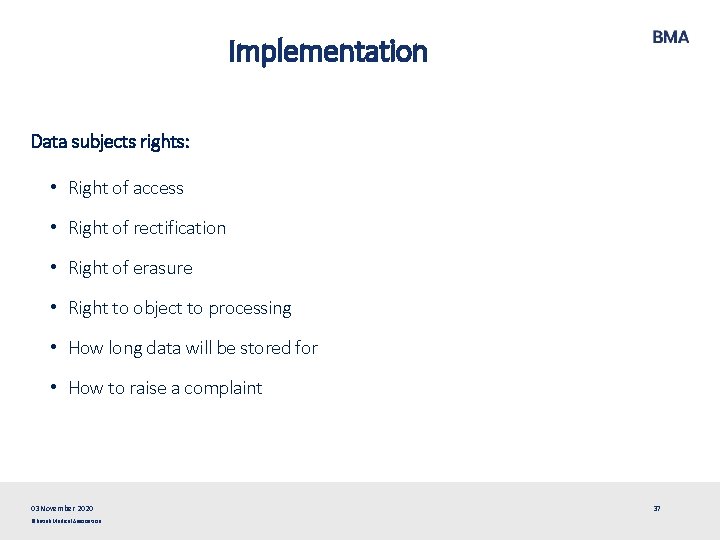
Implementation Data subjects rights: • Right of access • Right of rectification • Right of erasure • Right to object to processing • How long data will be stored for • How to raise a complaint 03 November 2020 ©British Medical Association 37
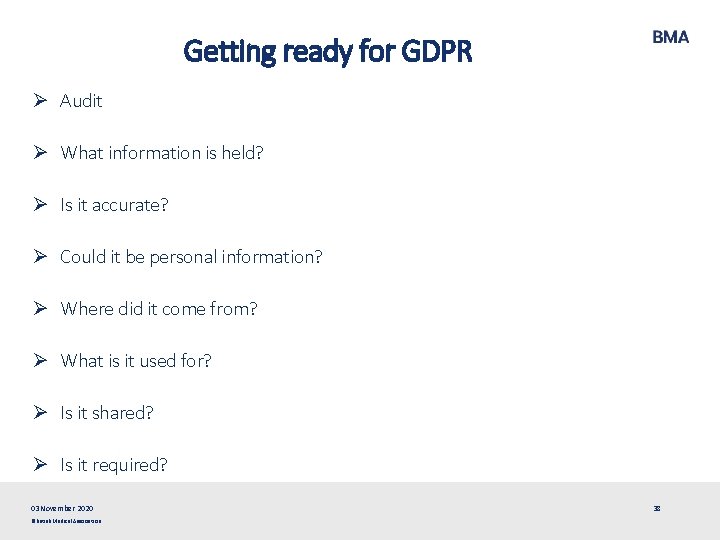
Getting ready for GDPR Ø Audit Ø What information is held? Ø Is it accurate? Ø Could it be personal information? Ø Where did it come from? Ø What is it used for? Ø Is it shared? Ø Is it required? 03 November 2020 ©British Medical Association 38
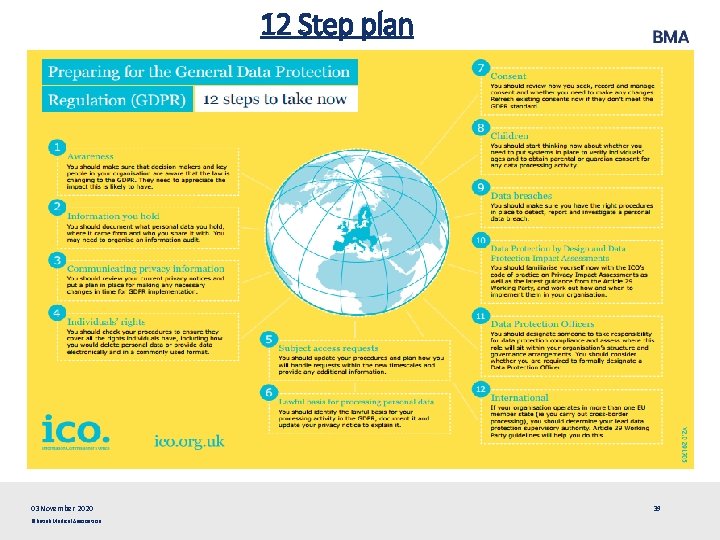
12 Step plan 03 November 2020 ©British Medical Association 39
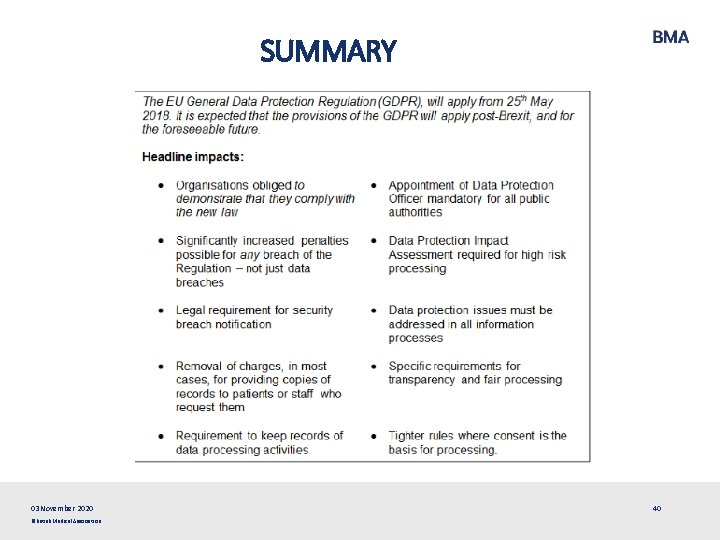
SUMMARY 03 November 2020 ©British Medical Association 40
Delays in formal guidance has been due to the need to consider both the forthcoming Article 29 working party guidance that will inform what the ICO will produce, and the Data Protection Bill. When this is approved it may change the advice provided. As Brexit is unlikely to take effect before March 2019; all UK organisations, including healthcare institutions, will need to comply with GDPR as of 25 May 2018 or risk being in breach. Even after Brexit takes effect, the UK will need to adopt its own legislation in place of GDPR, which will have to be broadly similar in effect. This will be the DPA 2018. The UK is replacing the DPA 98 with the DP Bill which will become DPA 2018 and that will bring through the provisions of the GDPR. The DP Bill is currently going through parliament. https: //www. parliament. uk/business/news/2018/march/have-your-say-on-the-dataprotection-bill/ 03 November 2020 ©British Medical Association 41
ICO Resources Ø Getting ready for GDPR Ø GDPR FAQs for small health sector bodies Ø GDPR 12 Steps Ø Advice for small organisations EU GDPR: https: //www. eugdpr. org/ Video for small healthcare organisations https: //www. youtube. com/watch? v=u. Eu. FGz. XVY 8 s BMA GDPR guidance NHS Digital: Suite of resources 03 November 2020 ©British Medical Association 42
03 November 2020 ©British Medical Association 43