
General Crime Scene Procedures Securing the scene Documentation
- Slides: 7
General Crime Scene Procedures Securing the scene Documentation Collection of Evidence
First Responding Officers n n n Usually consist of police, fire department, and emergency/medical personnel First concern: SAFETY of the victims 2) Then, search for and arrest suspect if still on the scene. 3) Detain all witnesses, and keep them separated to preserve their objectivity. 4) Protect the scene
Protecting the Scene n n Begin by using barrier tape. Establish a crime scene security log to record the names of ALL people who enter or exit the scene. n n Do not contaminate the scene or let unauthorized personnel to enter. Note all movements and alterations to the original scene, by police and emergency personnel.
Survey of the Scene n n n Performed when the crime scene investigator has arrived. A ‘walk-through’ is performed in which instant photography is taken. Evidence that needs to be immediately processed is noted. n n Points of entry and exit and travel paths are noted. Weather conditions may require quick processing or precautionary measures.
Documentation n There is a specific sequence to follow: Taking notes, written notes provide a record of all crime scene activities. Notes include arrival information, scene and victim description. Videotaping has become routine due to its ability to capture the scene in 3 -D and its acceptability to juries.
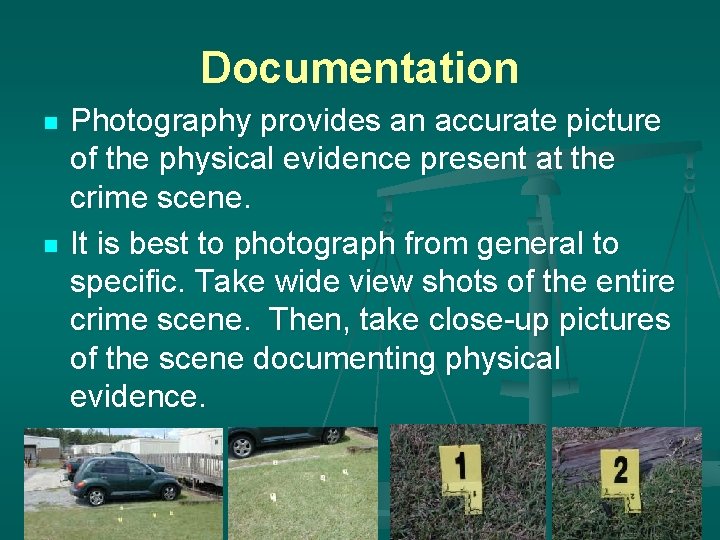
Documentation n n Photography provides an accurate picture of the physical evidence present at the crime scene. It is best to photograph from general to specific. Take wide view shots of the entire crime scene. Then, take close-up pictures of the scene documenting physical evidence.
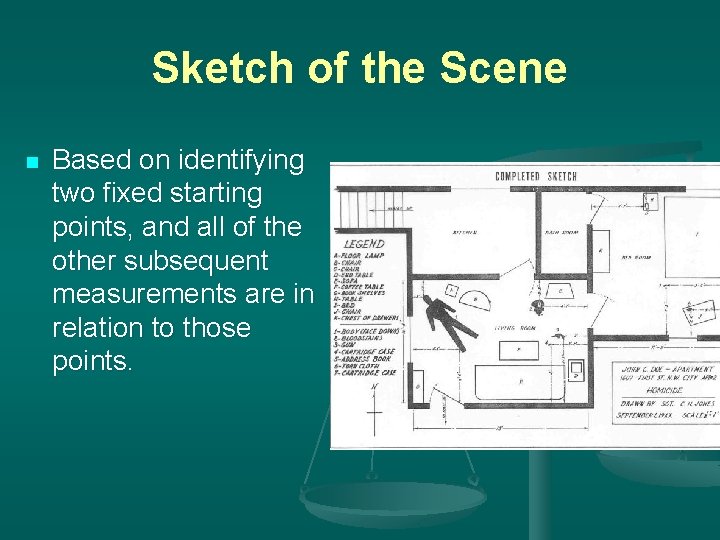
Sketch of the Scene n Based on identifying two fixed starting points, and all of the other subsequent measurements are in relation to those points.