
GENERAL CONTENT OF EEC EC AND EU TREATIES

- Slides: 13
GENERAL CONTENT OF EEC, EC AND EU TREATIES AND AREAS OF BASIC REGULATION (POLICY) q. COMMUNICATION OF COMMON MARKET AND ECONOMY POLICIES q. COMMON AGRICULTURE, FISHING, TRANSPORTATION AND TRADE POLICIES q. INSTITUTIONAL STRUCTURE OF THE COMMUNITY q. COMPETITION, MONITORING, STATE AID, TAX POLICIES
Integration Ways to the European Union 1. Economic Integration: As a result of the interdependence and functionality created and started in a single sector of the economy, spread in other sectors; then the gradual integration model that will lead to political integration; neo-functionalism, the effect of “spill over”… The effect of spill over; In the ECSC initiative, the economic unity between the member countries only in the coal and steel sector; As a result of the increase in the level of welfare with the efficient use of resources over time, the loyalty of the member state citizens towards the new transnational structure, and the economic integration that started in certain sectors inevitably have to be regulated for other sectors in time. It is based on the assumption that the said economic integration will first spread across all economic sectors and then from the economic field to the political field.
2. SUPRANATIONAL INTEGRATION: AUTHORIZATION TRANSFER OR SHARING; INTERNATIONAL SUPERIORITY IN CORPORATE STRUCTURE 3. LEGAL INTEGRATION : INSTALLATION OF A INTEGRATION IN WHICH LAW IS USED AS A VEHICLE AND COMBINED TO MEMBER COUNTRIES BY CREATING A COMMON LAW ORDER THIS THREE WAY WAS USED IN THE EU INTEGRATION PROCESS.
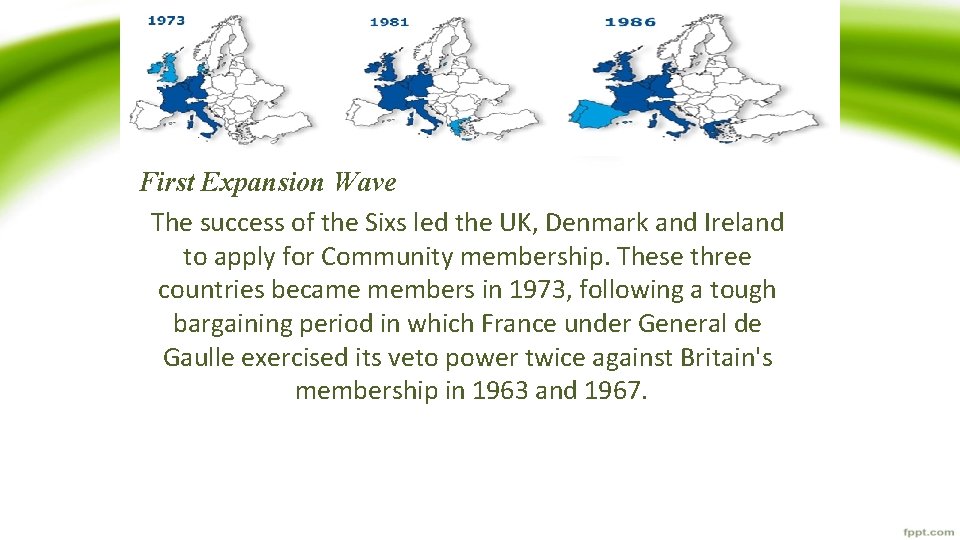
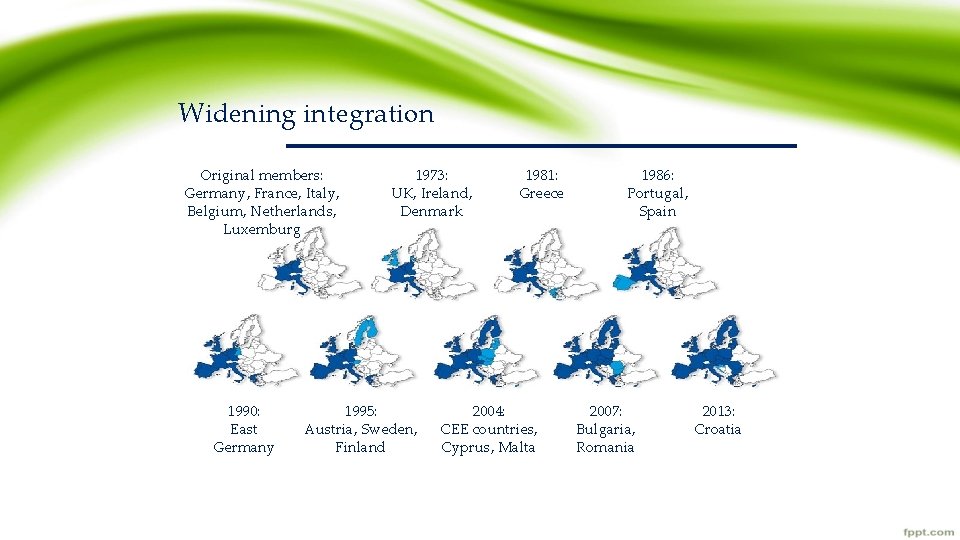
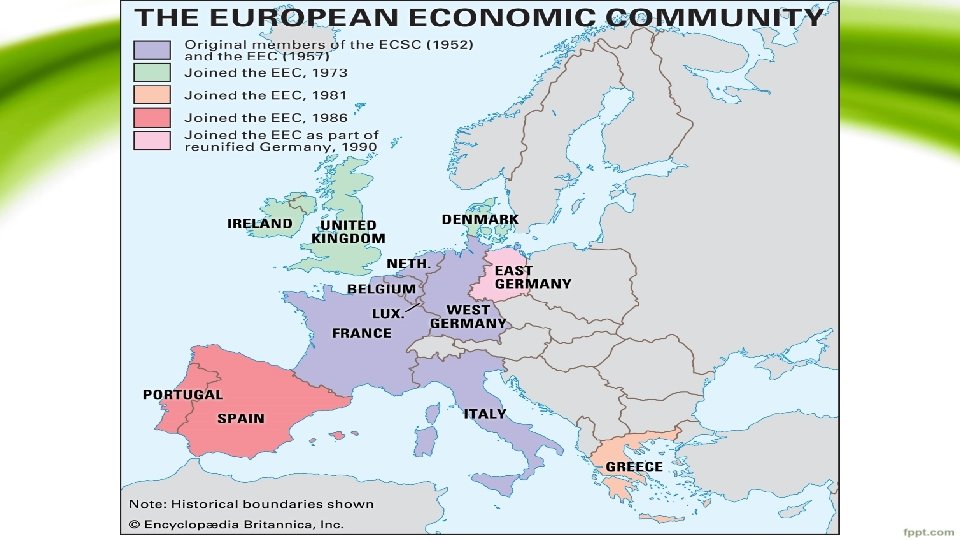
First Expansion Wave The success of the Sixs led the UK, Denmark and Ireland to apply for Community membership. These three countries became members in 1973, following a tough bargaining period in which France under General de Gaulle exercised its veto power twice against Britain's membership in 1963 and 1967.
European Monetary System (1979) The European Currency Unit ECU forms the basis of this system. It is considered the ancestor of the EURO. It was an account unit created according to the money basket technique, consisted of combining the amounts of member money determined according to their economic weight. (1970) Three Stage Werner Plan 1. Fluctuations in Member States' exchange rates will be limited 2. European Monetary Cooperation Fund (FECOM) will be established for short and long term loans 3. Establishing a regional central bank to fix exchange rates irrevocably
Single European Act The internal conflicts about stagnation and financial burden sharing in the world caused the emergence of a “European pessimism” atmosphere in the early 1980 s. However, after 1984 this was replaced by more hopeful expectations about the revitalization of the Community. Based on the White Paper of the Commission, led by Jacques Delors in 1985, the Community aimed at creating a single market until January 1, 1993. The Single European Act was signed by Germany, Belgium, France, the Netherlands, England, Ireland, Spain, Luxembourg and Portugal on February 17, 1986, and by Denmark, Italy and Greece on February 28, 1986. After the fall of the Berlin Wall, the unification of the two Germans on 3 November 1990, the liberation and democratization of the Central and Eastern European countries from the Soviet control and the dissolution of the Soviet Union in December 1991 completely changed the political structure of Europe. With the determination to strengthen the ties of the Member States, they began negotiations on a new Treaty, the main features of which were agreed at the European Union Summit, held on 9 -10 December 1991 in Maastricht. The Treaty of Maastricht, also known as the Treaty on European Union, entered into force on 1 November 1993.
Changes in the Corporate Area with a Single Act a) Transition from unanimity to qualified majority vote b) Reforming decision making processes and predicting the cooperation process; ensuring more effective parliament participation in this process c) Authorization of the European Parliament for new members and approval of partnership agreements (pre-approval) d) Establishment of the first instance court
CHANGES IN THE POLICY AREA WITH A SINGLE ACT a) ESTABLISHMENT OF THE EUROPEAN SINGLE MARKET (UNTIL 31 December 1992) b) Giving new policy areas such as social policy, economic and social cohesion, environment, technological research and development to the community authority c) Establishing European political cooperation
(1987) According to the Cecchini Report; The benefits of a single market transition: 1. It will provide the community with an economic gain close to 200 billion ECUs. 2. The formation of a single market will have a positive effect on the prices of goods and will have a 6% saving effect on consumers. 3. Removal of customs controls is estimated to bring a value of 1. 8% of the goods traded within the community. 4. Cost advantages to be provided with the transition to a single market will bring benefits from economies of scale. (Saving 2% of Community GDP) 5. The momentum to be provided to the economy of the group will also affect the labor markets positively. (an estimated 2. 5 million jobs)
Widening integration Original members: Germany, France, Italy, Belgium, Netherlands, Luxemburg 1990: East Germany 1973: UK, Ireland, Denmark 1995: Austria, Sweden, Finland 1981: Greece 2004: CEE countries, Cyprus, Malta 1986: Portugal, Spain 2007: Bulgaria, Romania 2013: Croatia
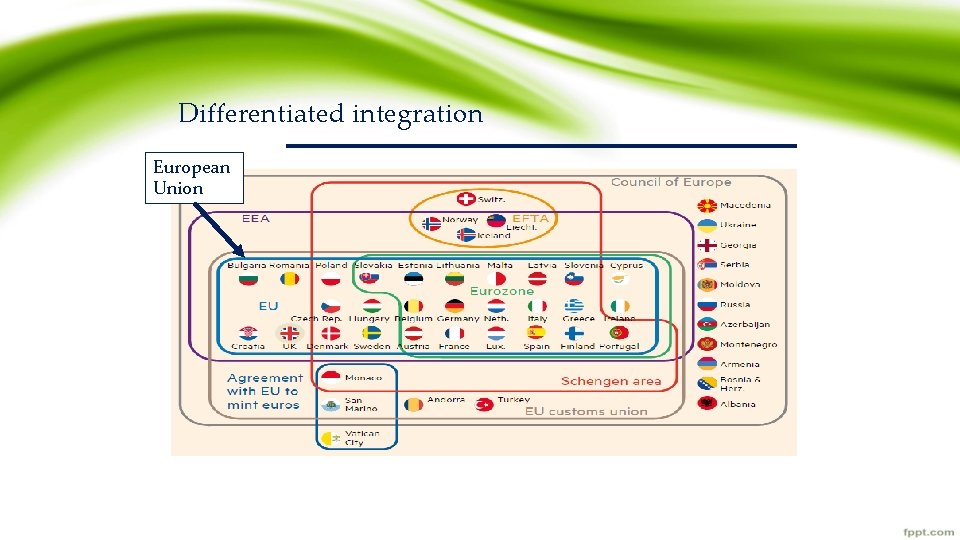
Differentiated integration European Union