
General concepts in epidemiology of communicable diseases Dr
�General concepts in epidemiology of communicable diseases Dr Amany Edward Prof of public health
Epidemiology (Epi=on, demos= population) may be defined as the study of the distribution and determinants of disease in human population, also it means study of the occurrence and natural history of all forms of disease (when, where and who affected). Infection: The entry and multiplication of an infectious agent inside the body. An infection does not always cause an illness.
�Infectious disease (Contagious , Communicable disease) is defined as an illness caused by a specific infectious agent or its toxic product that results from transmission of that agent or its products from an infected person, animal, or reservoir to a susceptible host, either directly or indirectly through an intermediate plant or animal host, vector or inanimate environment.
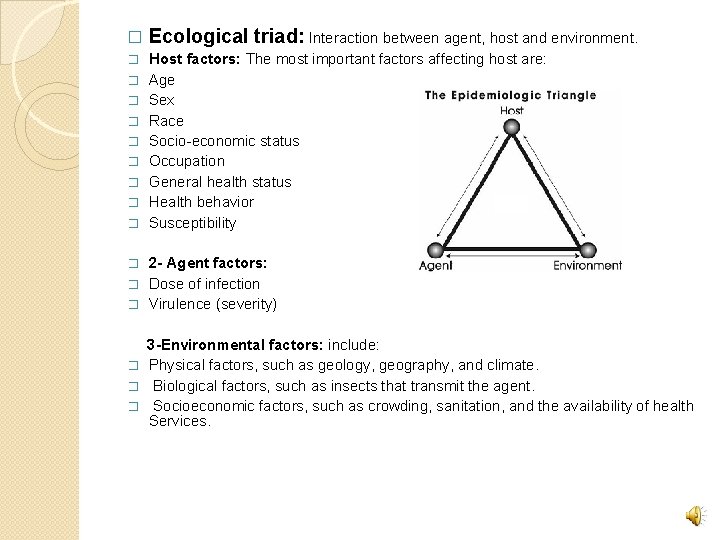
� Ecological triad: Interaction between agent, host and environment. � Host factors: The most important factors affecting host are: Age Sex Race Socio-economic status Occupation General health status Health behavior Susceptibility � � � � 2 - Agent factors: � Dose of infection � Virulence (severity) � 3 -Environmental factors: include: � Physical factors, such as geology, geography, and climate. � Biological factors, such as insects that transmit the agent. � Socioeconomic factors, such as crowding, sanitation, and the availability of health Services.

Infection cycle

Epidemiological Cycle (Infection cycle): �Agent �Source of infection (reservoir) �Exit of infection �Mode of transmission �Inlet of infection �Host �Epidemiologist's mission is to investigate thoroughly this cycle, where the weakest point is the key for prevention and control efforts.
I- Source of infection 1 - Man (case, carrier) �Case: Manifested disease. �Carrier: The carrier is an infected individual who harbors a pathogenic organisms in his body and can spread infection, but shows no signs and symptoms of disease. 2 - Animal (zoonosis): Infections naturally transmitted between animal and man.
Carriers and Sub-clinical Transmission �A carrier is a person that is not manifesting the disease, but can transmit the infective agent. �� Types of carriers: Four types �Incubatory �Convalescent �Contact �Healthy: man is infected from the environment and is not related to the case.
�(1) Incubatory carrier: Who are infectious persons but unaware that they are in the early stages of the disease. Or the patients incubating a communicable disease may transmit the infection shortly before they become symptomatic as in chicken pox. �(2) Convalescent carrier: Patients who have recovered from an acute illness may continue to shed the organism, particularly in cases of enteric infections caused by salmonella or shigella.
� (3) Contact carrier: � These are contacts of a case (or a carrier) may get infected, but eliminate infection in around two weeks without getting diseased. Meanwhile they are carriers and can spread infection. � (4) Healthy (asymptomatic) carrier or sub-clinical cases: Who remain well throughout the stage of infection and never develop clinical symptoms. Inhabitants of endemic areas of infectious diseases may get infected from polluted environment e. g. water supplies and food. If not become diseased, infection is eliminated in around two weeks, except for hepatitis B virus infection where healthy carriers are infectious for years.
� Carriers can be classified according to period of infectivity into: �(1) Chronic carriers: Patients may develop chronic infections and transmit the infection for long periods of time, usually over one year. Example; Salmonella typhi, Hepatitis B. Virus and HIV can cause life long infection. �(2) Transient carriers: For few days. �(3) Temporary carriers: For few weeks or months.
� Carriers can be also classified according to portal of exit of the infectious agent: �Respiratory carriers: diphtheria, meningitis. �Fecal: typhoid, dysentery. �Urinary: typhoid, paratyphoid. �Chronic typhoid carriers may be urinary or fecal.
The important features of carriers � 1 - The number of carriers may be far greater than the number of these who are sick. (Greater number) � 2 - Carriers are not manifest so they and others are unaware that they can transmit the disease (infection is unapparent). � 3 - As carriers are not sick, they are not restricted and therefore disseminate the disease widely (free to move). � 4 - Chronic carriers may produce repeated outbreaks over a considerable period of time (persistent infectivity).
Dangerous group of carriers: � 1 - Food handlers. � 2 - Hospital personnel (Nurses – physicians). � 3 - School personnel.
II- Mode of Transmission Droplet: direct and indirect A-Direct droplet infection: Both reservoir of infection and new host are found together within the same place within 6 feet (≈2 meters). The host gets infected through direct inhalation of droplet spray of the reservoir. B-Indirect droplet infection: 1 - Airborne infection: Air carries organisms in two forms: . Droplet nuclei; are minute residues of fine droplets after evaporation of water. They remain suspended in air for hours. . Dust (which contains scales of measles).
2 - Contaminated objects: Articles (e. g. cups, spoons, forks) and fomites (e. g. clothing, handkerchiefs) may be contaminated with respiratory discharges and transmit infection. 3 - Milk: Organisms in the infected milk may invade the upper respiratory mucosa (not ingestion) e. g. Hemolytic streptococci, Diphtheria bacilli and TB.
Food borne Ingestion of food or drinks which contain organisms which may reach food through; Hands, Vectors, Water, Fresh human manure and Dust. � Hand to mouth (fecal- oral) � Arthropod- borne infection Mechanical transmission e. g. house flies, cockroaches. � Biological transmission e. g. blood sucking insects: Mosquitoes: � Anopheles (malaria) � Culex (filariasis, encephalitis, Rift Valley fever) � Aedes ( yellow fever, dengue fever) Lice; which causes: epidemic typhus, epidemic relapsing fever and trench fever Fleas; which causes: plague, murine typhus, hymenolypes dimenuta, dipledium caninum. �
4 - Contact �Undamaged surface: Skin diseases: Scabies, impetigo, Conjunctivitis, Leptospirosis. , herpes simplex. �Injured surface: �Infections of animal bites: rabies, rat-bite fever �Sexually transmitted diseases (STD) �Injection infections: parenterally transmitted diseases: B and C hepatitis �Others: Brucella, Pyogenic infection.
5 - Vertical transmission: mother to infant infection in three ways �Inutero infection (congenital) e. g. Rubella �Perinatal (while passing the birth canal) �Breast feeding (during nursing the baby) �Some infectious diseases spread by only one mean of transmission e. g. influenza, cholera. Other diseases are
III – Susceptible host Immunity: resistance of the body against Infection. � Susceptibility: proneness to contract disease on exposure to infection Pattern of spread � 1) Endemic � is a habitual presence of a disease in a given geographical area due to favorable ecological factors � 2) Epidemic � Unusually increase in number of cases in a limited time � 3) Pandemic: � An epidemic affecting more than one country
- Slides: 20