
GENERAL CHEMISTRY LABORATORY RULES TO BE APPLIED IN
GENERAL CHEMISTRY LABORATORY
RULES TO BE APPLIED IN CHEMISTRY LABORATORY: 1 - As a danger can always be encountered in chemical laboratories, it should be worked very carefully. 2 - It is obligatory to work with white lab coat in the laboratories. To avoid splashes and other effects of acids and bases, do not enter the lab without a gown. 3 - The tools and equipment that must be kept with each student in the laboratory are: spatula, forceps, small scissors, notebook, cleaning cloth. 4 - Before coming to the laboratory, the preliminary information about the experiment should be learned thoroughly. 5 - If any acid or other corrosive chemical substance is spilled anywhere, it should be washed with water immediately.
6 - The chemicals used should not be touched by hand. 7 - Never taste chemical or solution. 8 - If you want to look at the smell of a substance do not do this by bringing your face closer to the container. Stand a little away and send some steam through the container to your nose, fan by hand. 9 - Throw away the paper and other solid materials in the waste basket. Never dispose of in places and sinks. 10 - Do not use more than the amount specified in the experiment and empty the materials back to the container without polluting. 11 - Before taking the material from a container, pay attention to the label on the container and make sure you get the correct container. 12 - Keep the table, tools and glass materials you use clean. At the end of the laboratory, leave all materials and table clean. 13 - If the materials you use are broken, cracked, damaged or lost, do not forget the difficulty of replacing them and the obligation you will have on this matter.
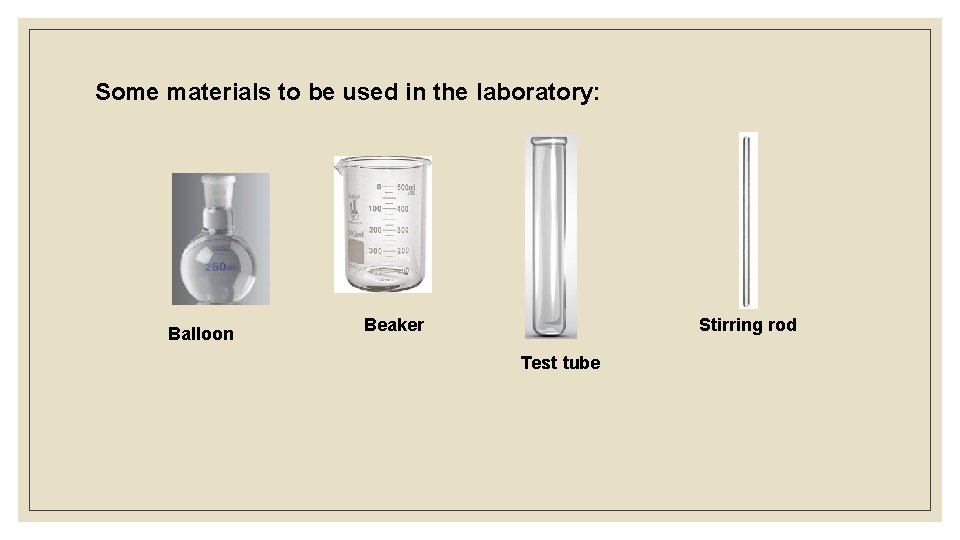
Some materials to be used in the laboratory: Balloon Beaker Stirring rod Test tube

Buret Pipet Funnel Pipet Bulb Thermometer
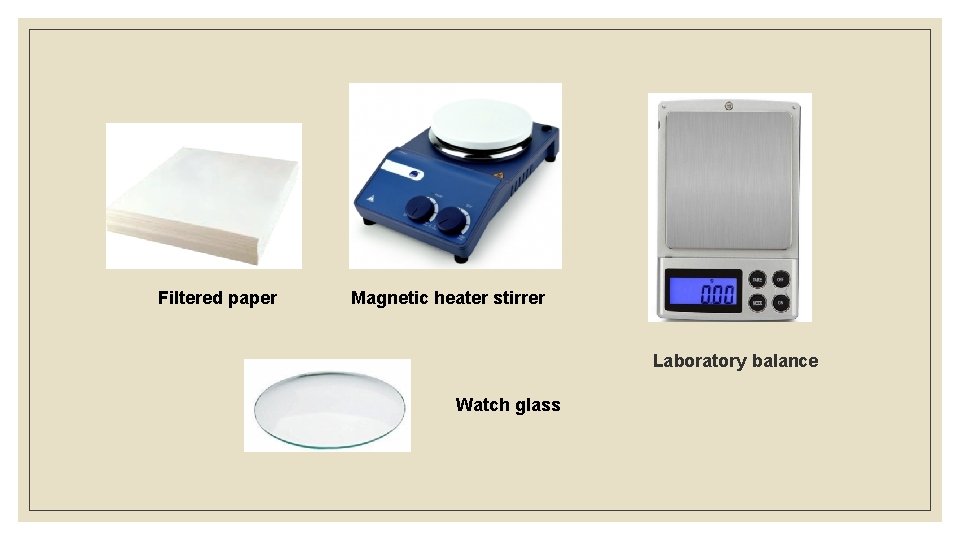
Filtered paper Magnetic heater stirrer Laboratory balance Watch glass
PHYSICAL AND CHEMICAL BASIC PROCESSES 1. Heating 2. Filtration 3. Precipitation 4. Crystallization 5. Centrifugation
TOPICS IN GENERAL CHEMISTRY LABORATORY 1. p. H Concept and Measurement 2. Qualitative Analysis of Anions 3. Acid-Base Reactions 4. Distillation 5. Electrolysis 6. Stoichiometry
7. Dissolution and Preparation of Solution 8. Qualitative Analysis of Cations 9. Redox Reactions 10. Chemical Equilibrium
- Slides: 9