
General Characters and Classification of Amphibia up to
General Characters and Classification of Amphibia up to Order
• The greatest event in the phylogenetic history was a transition from aquatic to terrestrial mode of life, and Amphibia were the first animals to attempt his transition. • But they are not fully terrestrially adapted and hover between aquatic and land environments. The name of the class also indicates this double life (Gr. , amphi. dual, double+bios, life). • Structurally, Amphibia are between the fish on one hand, and the reptiles on the other.

Salient features 1. Aquatic or semiaquatic (freshwater), air and water breathing, carnivorous, coldblooded, oviparous, tetrapod vertebrates. 2. Head distinct, trunk elongated. Neck and tail may be present or absent. 3. Limbs usually 2 pairs (tetrapod), some limbless. Toes 4 -5 (pentadactyle) or less. 4. Paired fins absent. Median fins, if present, without fin rays. 5. Exoskeleton absent. Digits clawless. Some with concealed dermal scales. 6. Endoskeleton mostly bony. Notochord does not persist. Skull with 2 occipital condyles.
7. Mouth large. Upper or both jaws with small homodont teeth. Tongue often protrusible. Alimentary canal terminates into cloaca. 8. Respiration by lungs, skin and mouth lining. Larvae with external gills which may persist in some aquatic adults. 9. Heart 3 -chambered (2 auricles+1 ventricle). Sinus venosus present. Aortic arches 1 -3 pairs. Renal and hepatic portal systems well developed. Erythrocytes large, oval and nucleated. Body temperature variable (poikilothermous). 10. Kidneys mesonephric
11, Brain poorly developed. Cranial nerves 10 pairs. 12. Nostrils connected to buccal cavity. Middle ear with a single rod-like ossicle, columella. Larval forms and some aquatic adults with lateral line system. 13, Sexes separate. Male without copulatory organ. Gonoducts open into cloaca. Fertilization mostly external. Females mostly oviparous. 14. Development indirect. Cleavage holoblastic but unequal. No extra-embryonic melbranes. Larva a tadpole which metamorphoses into adult.

Classification Subclass 1. Stegocephalia (Extinct) 2. Lissamphibia (living) Order 1. Gymnophiona or Apoda Order 2. Urodela or caudata Order 3. Salientia or Anura
Subclass. Lissamphibia (living) Modern Amphibia lacking dermal bony skeleton. Teeth small, simple. Order I. Gymnophiona or Apoda (Gr. gvmnos, nak. Lii+ophioncos, serpent-like) or (Gr. , a, without + podos, foot) 1. Limbless, blind, elongated worm like, burrowing tropical forms known as caecilians. 2. tail short or absent, cloaca terminal, 3. In some dermal scales embedded in skin which is transversely wrinkled. 4. Skull compact, roofed with bone. 5. Limb gridles absent. 6. Males have protrusible copulatory organs. Examples : Ichthyophis, Uroaeotyphlus
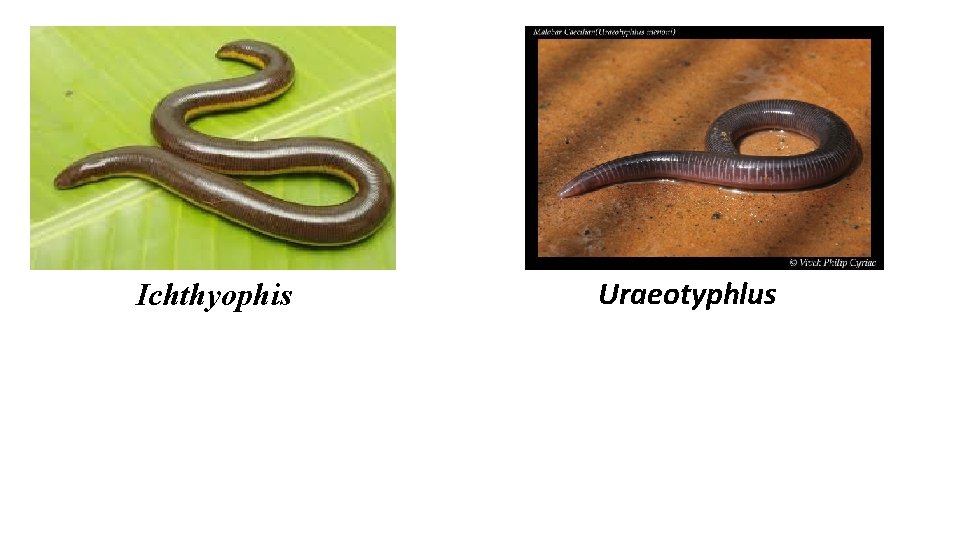
Ichthyophis Uraeotyphlus
Order 2. Urodela or caudata (Gr. , Una, tail + debs, visible) or (L. , cauda, tail) 1. Lizard-like amphibians with a distinct tail. 2. Limbs 2 pairs, usually weak, almost equal. 3. Skin devoid of scales and tympanum. 4. Gills permanent or lost in adult. 5. Males without copulatory organs. 6. Larvae aquatic, adult-like, with teeth. 7. About 300 species in 5 suborders. Example: Triton and Triturns (newts), Salamandra (salamander), Desmognathus, Amphiuma (congo eel), Plethodon.
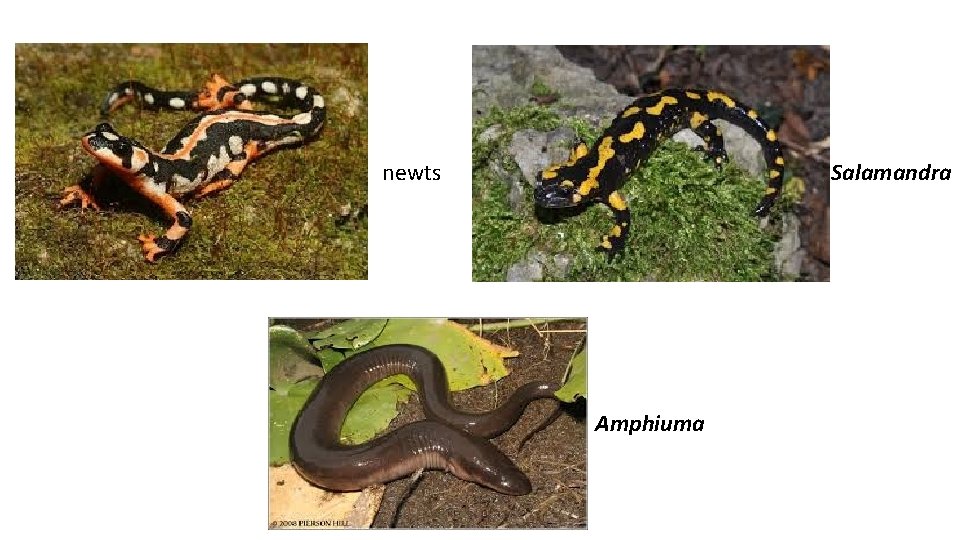
newts Salamandra Amphiuma
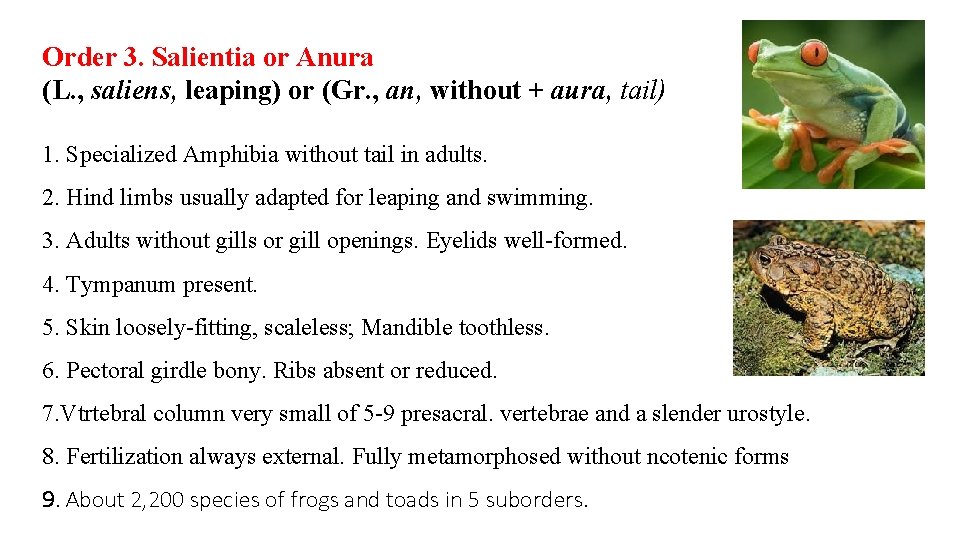
Order 3. Salientia or Anura (L. , saliens, leaping) or (Gr. , an, without + aura, tail) 1. Specialized Amphibia without tail in adults. 2. Hind limbs usually adapted for leaping and swimming. 3. Adults without gills or gill openings. Eyelids well-formed. 4. Tympanum present. 5. Skin loosely-fitting, scaleless; Mandible toothless. 6. Pectoral girdle bony. Ribs absent or reduced. 7. Vtrtebral column very small of 5 -9 presacral. vertebrae and a slender urostyle. 8. Fertilization always external. Fully metamorphosed without ncotenic forms 9. About 2, 200 species of frogs and toads in 5 suborders.
- Slides: 11