
General Characteristics of the Earth Internal Structure Crust
- Slides: 12
General Characteristics of the Earth
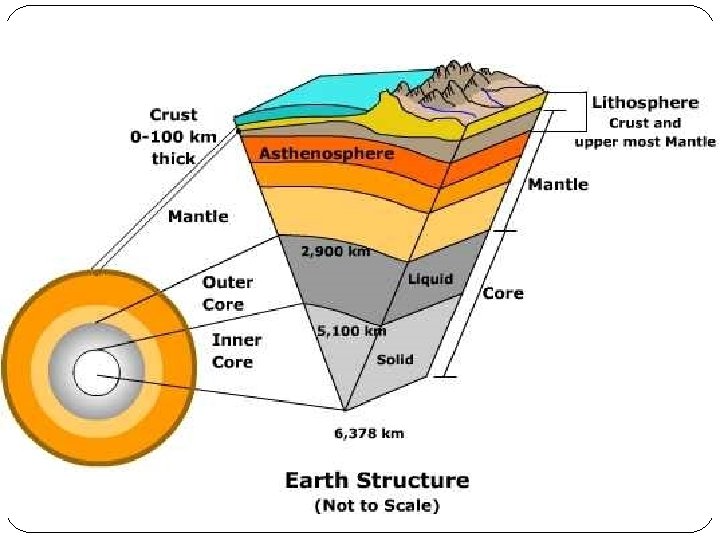
Internal Structure Crust: solid outer layer. Between 5 -10 km beneath the oceans and 30 -65 km beneath the continents Mantle: The upper mantle is semi fluid and believed to cause continental drift. The lower mantle is solid despite high temperatures due to high pressure Core: Outer core is liquid (magnetic field), inner core is solid due to high pressure
Scientific understanding of Earth's internal structure is based on observations of topography, observations of rock in outcrop, samples brought to the surface from greater depths by volcanic activity, analysis of the seismic waves that pass through the Earth, measurements of the gravity field of the Earth, and experiments with crystalline solids at pressures and temperatures characteristic of the Earth's deep interior.
Atmosphere This is an envelope of gas that surrounds the Earth It is a HOMOGENEOUS mixture (solution) of nitrogen (78%), oxygen (21%), water vapour (0. 3%), carbon dioxide (0. 03%), ozone (0. 000 003%) and other trace gases
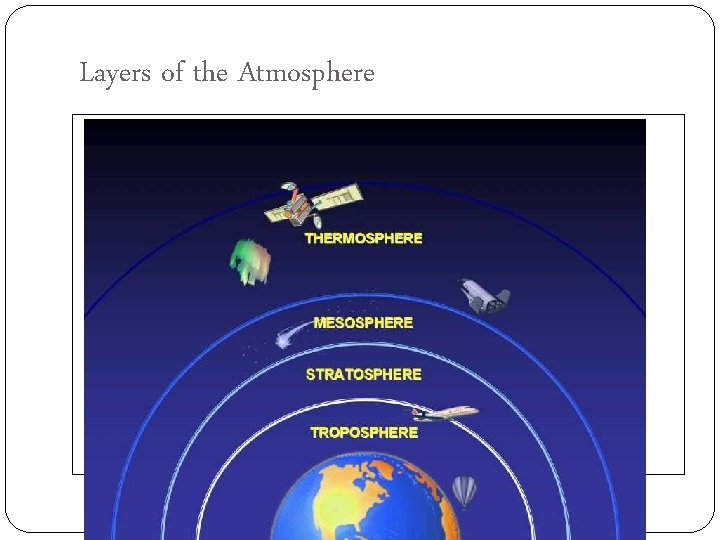
Layers of the Atmosphere
Troposphere: thicker near equator than at the poles. Contains 80% of all the air in the atmosphere, produces weather phenomena, determines climate. Temperature DROPS with altitude Stratosphere: contains the ozone (O 3) layer, which absorbs most ultraviolet rays. Airplanes usually fly here since there is less friction (less fuel)
Mesosphere: air molecules are scarce, but this layer can still protect us from meteoroids. Friction cause them to break apart Thermosphere: Thickest layer. Sun’s rays create extremely high temperatures. Ionosphere is found here, which can bounce radio waves due to the electrically charged particles it contains. Polar auroras happen in this layer. Meteoroids burn up here, too.
Human activities & the Atmosphere Chlorofluorocarbons (CFCs) and aerosol products caused thinning of ozone layer by reacting with it and transforming it into regular oxygen. Less protection from UV rays results in increased skin cancer, cataracts Ozone increased in the troposphere due to pollution irritates the mucous membrane of respiratory system
Hydrosphere Formed by all bodies if water on Earth Fresh water make sup only 3% of Earth’s surface (glaciers, underground water, lakes & rivers) Most of this fresh water is frozen (ice caps, glaciers) so it’s inaccessible Four countries alone (Brazil, Canada, China & USA) possess nearly half the world’s fresh water
Lithosphere This comprises the Earth’s crust and part of the upper mantle Includes mountains, plains, volcanoes Contains minerals for plant growth, habitats for animals, has natural resources like oil & natural gas The lithosphere is constantly changing due to climate, human activity, etc. .
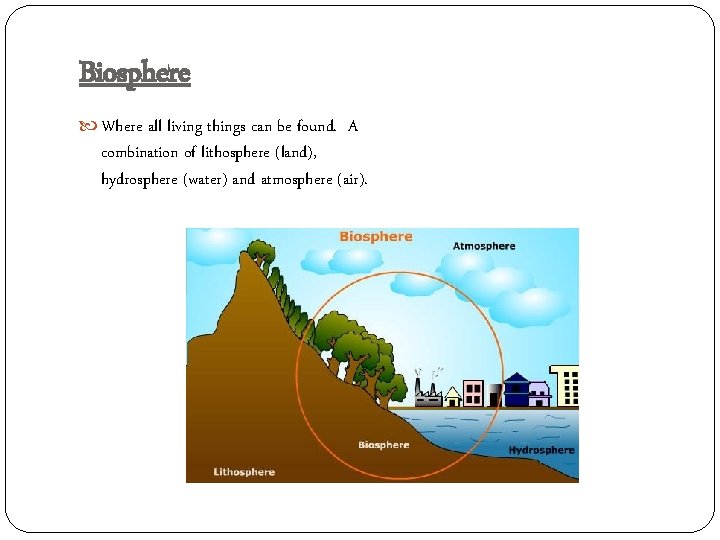
Biosphere Where all living things can be found. A combination of lithosphere (land), hydrosphere (water) and atmosphere (air).