
General Biology 1 BIO 1101 Syllabus Textbook http
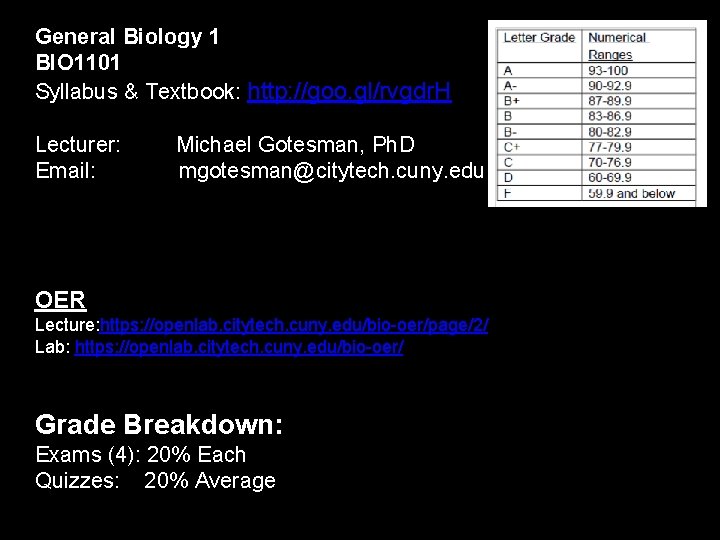
General Biology 1 BIO 1101 Syllabus & Textbook: http: //goo. gl/rvgdr. H Lecturer: Email: Michael Gotesman, Ph. D mgotesman@citytech. cuny. edu OER Lecture: https: //openlab. citytech. cuny. edu/bio-oer/page/2/ Lab: https: //openlab. citytech. cuny. edu/bio-oer/ Grade Breakdown: Exams (4): 20% Each Quizzes: 20% Average
Consider this cross: Rr x Rr Think about the gametes that each could produce and assign a fraction to each Fertilization occurs. What percentage would be… RR ? Rr ? rr ? What fraction would be the dominant phenotype? Consider this cross: Tt x tt What fraction would be tt? What fraction would be the recessive phenotype? Consider this cross: Xb. Y X XBXb What type of children would they have (B = Blue, b = green eye) Consider this cross: Gg. Ee x Gg. EE What fraction would be gg. EE? What fraction would be Gg. Ee? What fraction would be ggee?
1)Cell Theory: 1. All living things or organisms are made of cells and their products. 2. New cells are created by old cells dividing into two. 3. Cells are the basic building units of life. How is the information for life inherited?
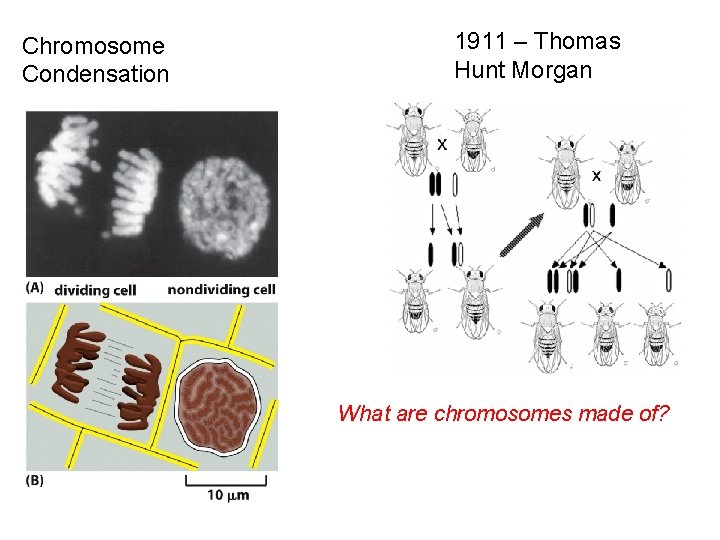
Chromosome Condensation 1911 – Thomas Hunt Morgan What are chromosomes made of?
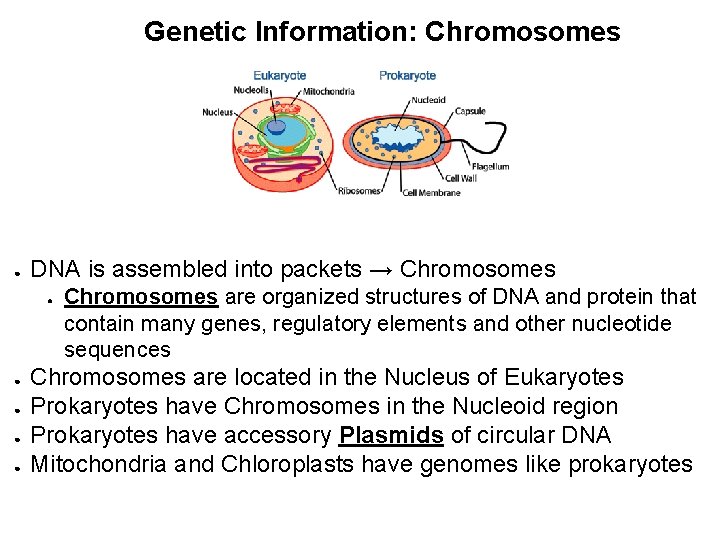
Genetic Information: Chromosomes ● DNA is assembled into packets → Chromosomes ● ● ● Chromosomes are organized structures of DNA and protein that contain many genes, regulatory elements and other nucleotide sequences Chromosomes are located in the Nucleus of Eukaryotes Prokaryotes have Chromosomes in the Nucleoid region Prokaryotes have accessory Plasmids of circular DNA Mitochondria and Chloroplasts have genomes like prokaryotes
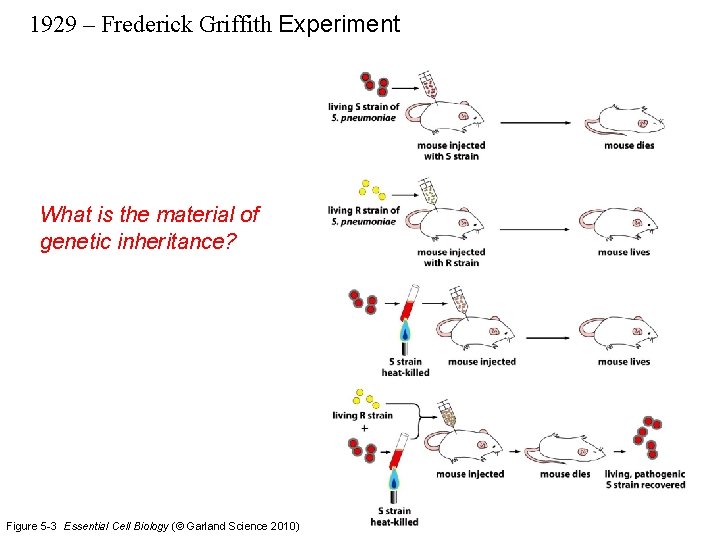
1929 – Frederick Griffith Experiment What is the material of genetic inheritance? Figure 5 -3 Essential Cell Biology (© Garland Science 2010)
What is the “transforming” agent? What are the major macromolecules? ●Which is the most likely candidate based on setting up rules of inheritance? ●Which is the most diverse type of biologically significant macromolecule? ●How would you go about deciphering which is the transforming agent? ●
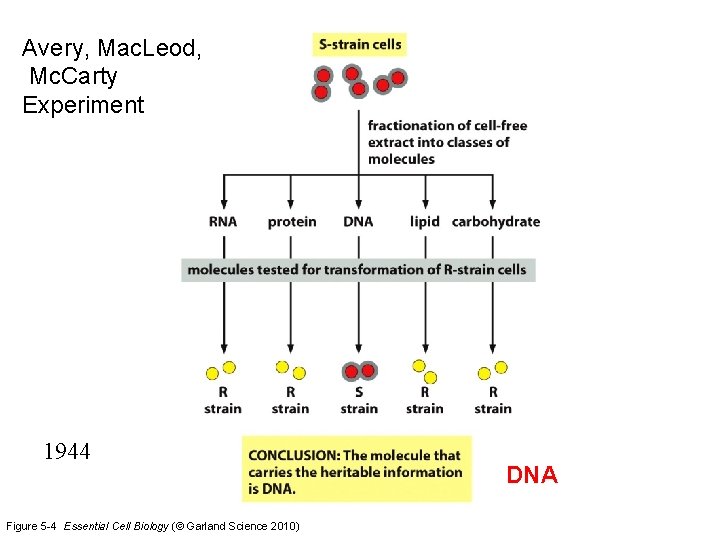
Avery, Mac. Leod, Mc. Carty Experiment 1944 Figure 5 -4 Essential Cell Biology (© Garland Science 2010) DNA
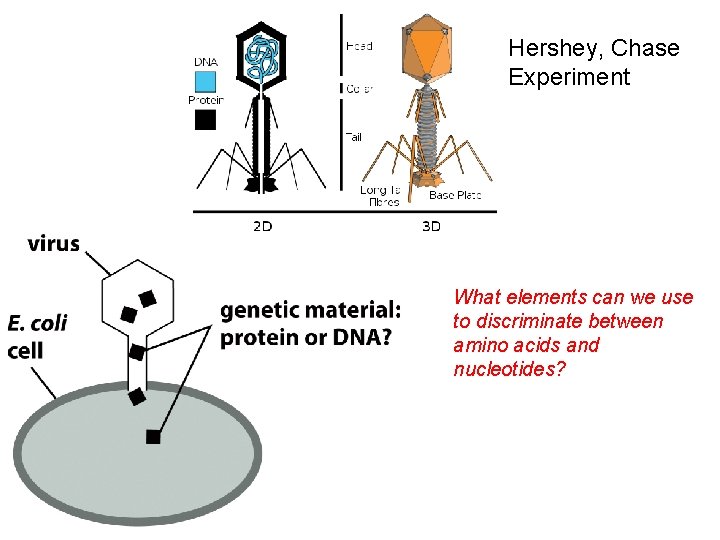
Hershey, Chase Experiment What elements can we use to discriminate between amino acids and nucleotides?
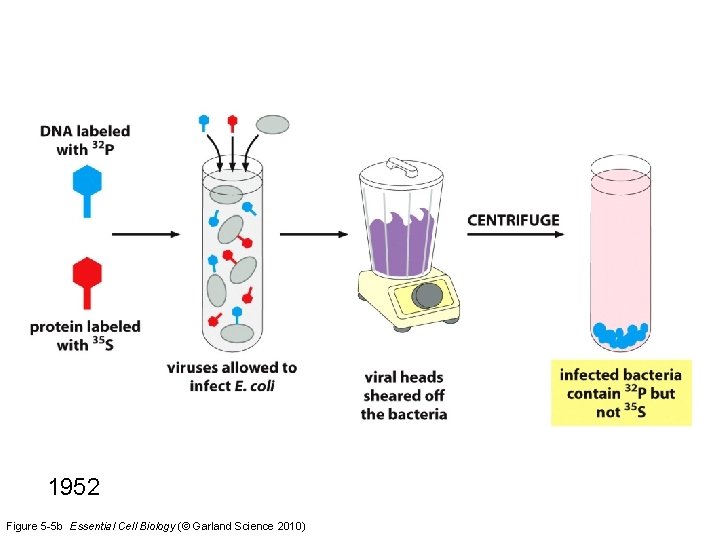
1952 Figure 5 -5 b Essential Cell Biology (© Garland Science 2010)
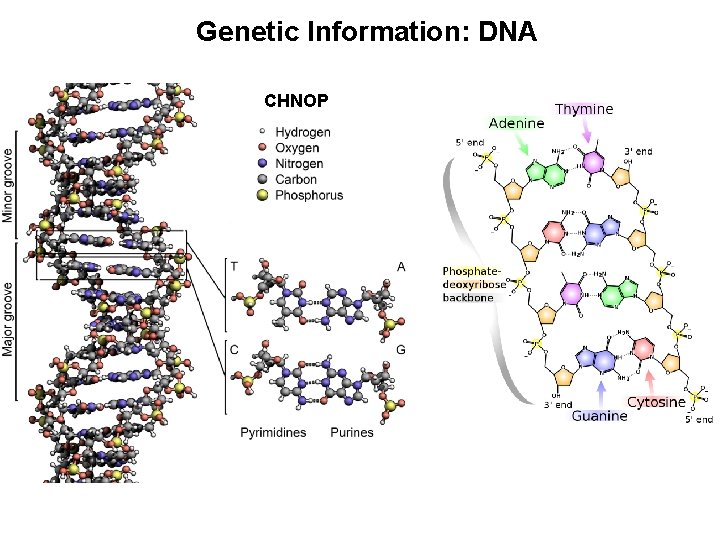
Genetic Information: DNA CHNOP
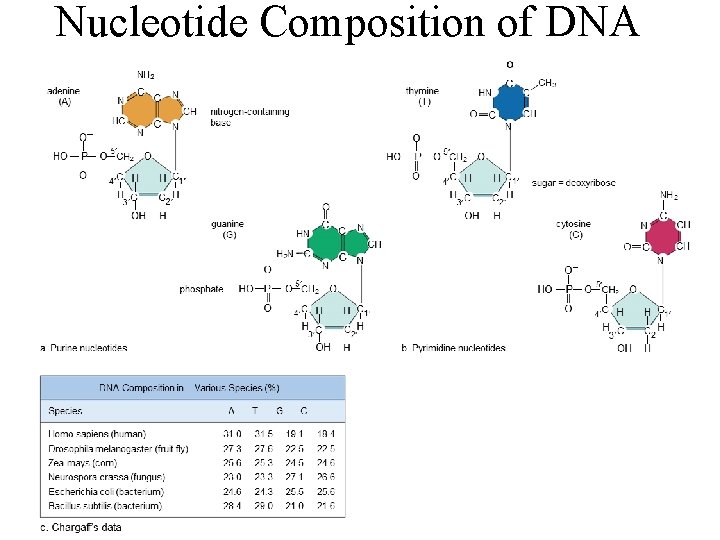
Nucleotide Composition of DNA
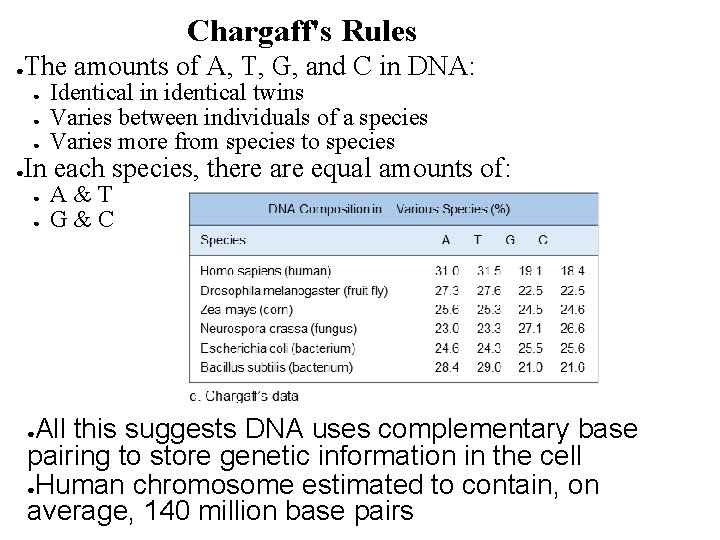
Chargaff's Rules The amounts of A, T, G, and C in DNA: ● ● Identical in identical twins Varies between individuals of a species Varies more from species to species In each species, there are equal amounts of: ● ● ● A&T G&C All this suggests DNA uses complementary base pairing to store genetic information in the cell ●Human chromosome estimated to contain, on average, 140 million base pairs ●
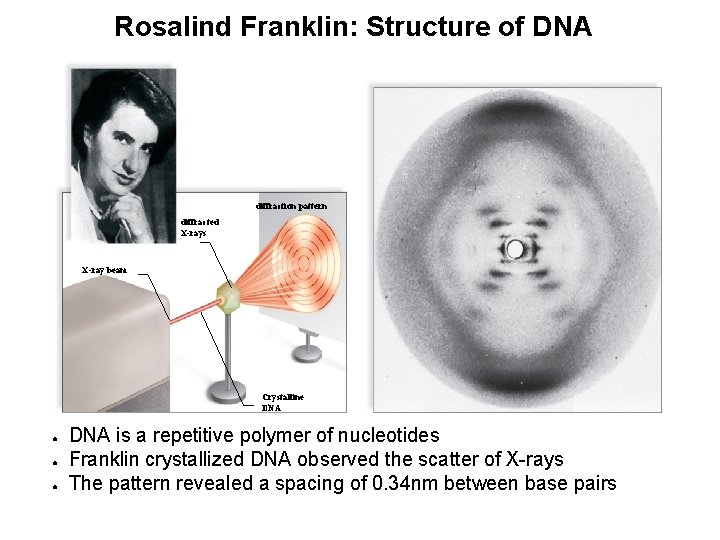
Rosalind Franklin: Structure of DNA diffraction pattern diffracted X-rays X-ray beam Crystalline DNA ● ● ● DNA is a repetitive polymer of nucleotides Franklin crystallized DNA observed the scatter of X-rays The pattern revealed a spacing of 0. 34 nm between base pairs
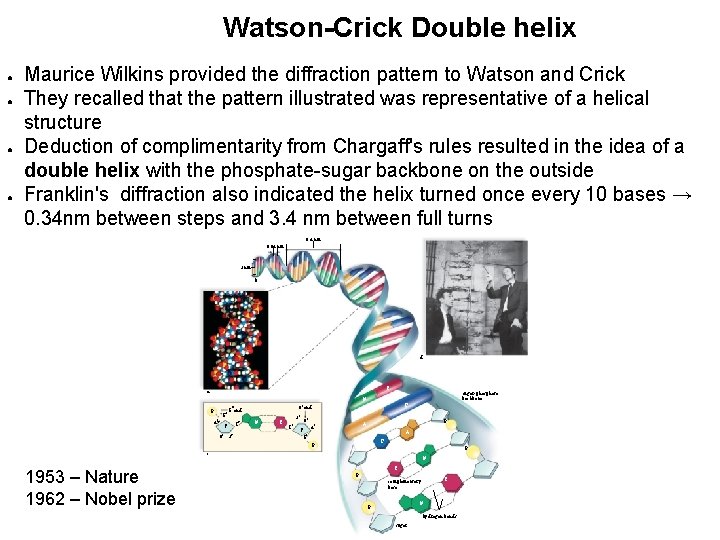
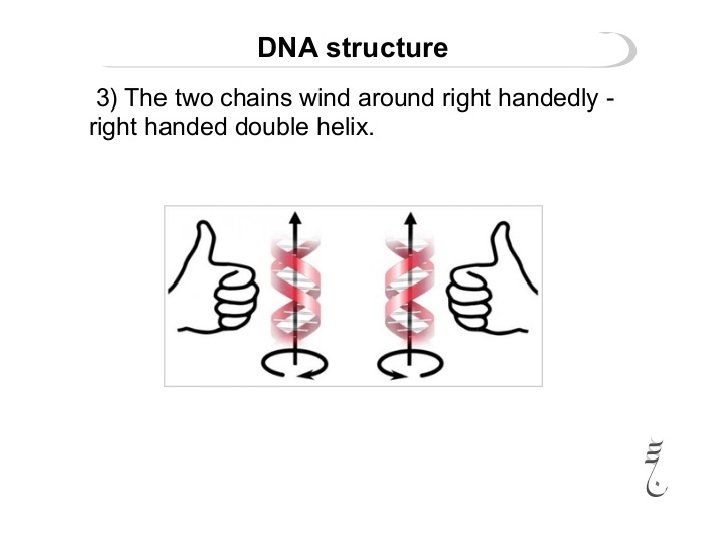
Watson-Crick Double helix ● ● Maurice Wilkins provided the diffraction pattern to Watson and Crick They recalled that the pattern illustrated was representative of a helical structure Deduction of complimentarity from Chargaff's rules resulted in the idea of a double helix with the phosphate-sugar backbone on the outside Franklin's diffraction also indicated the helix turned once every 10 bases → 0. 34 nm between steps and 3. 4 nm between full turns 3. 4 nm 0. 34 nm 2 nm b. d. C a. sugar-phosphate backbone G P 5 4 3 3 end 5 end 1 S 2 T G C 2 1 3 P A 4 S A 5 T P P c. 1953 – Nature 1962 – Nobel prize G C P C complementary base G P hydrogen bonds sugar
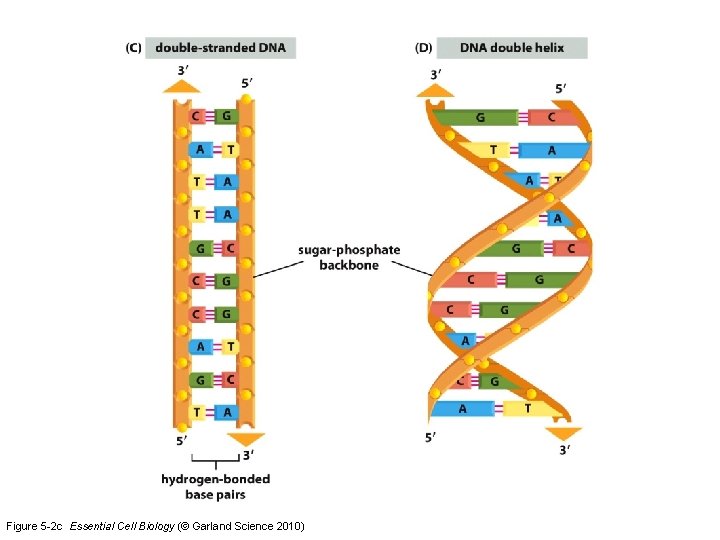
Figure 5 -2 c Essential Cell Biology (© Garland Science 2010)
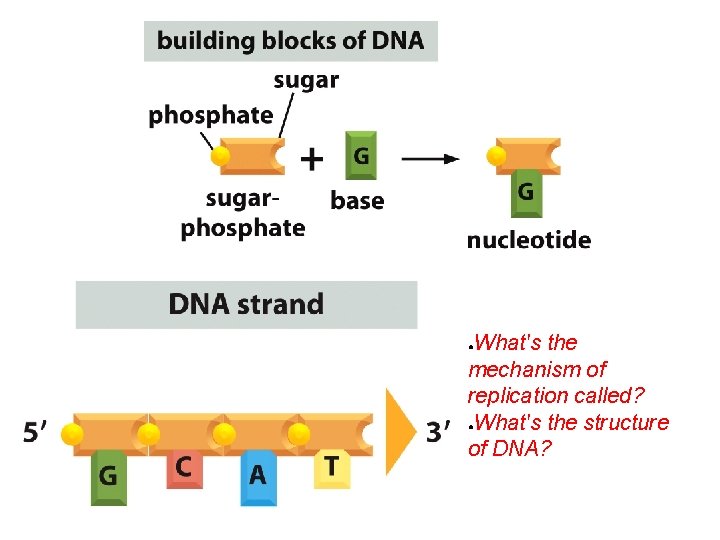
What's the mechanism of replication called? ●What's the structure of DNA? ●
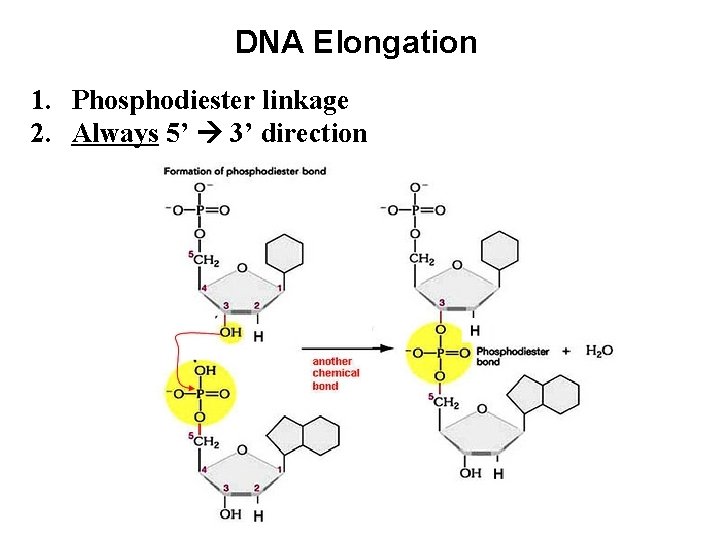
DNA Elongation 1. Phosphodiester linkage 2. Always 5’ 3’ direction
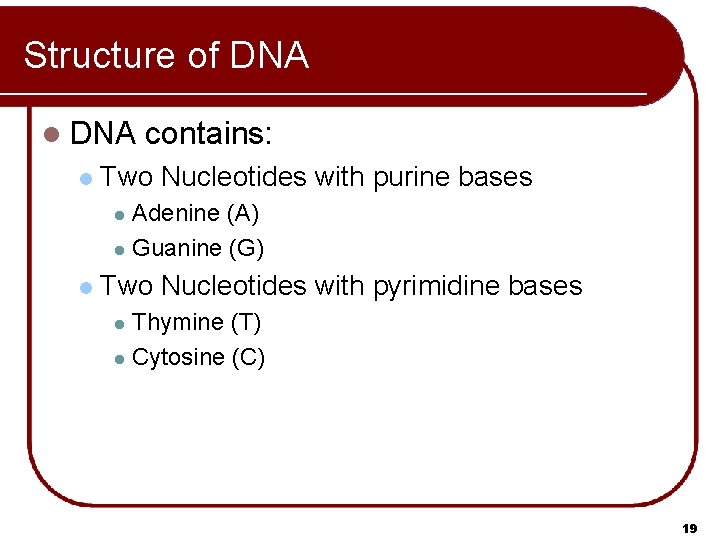
Structure of DNA l contains: Two Nucleotides with purine bases Adenine (A) l Guanine (G) l l Two Nucleotides with pyrimidine bases Thymine (T) l Cytosine (C) l 19
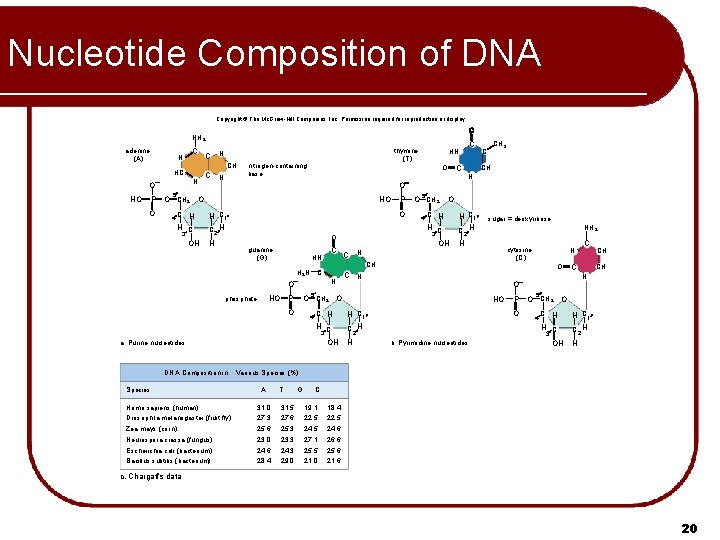
Nucleotide Composition of DNA Copyright © The Mc. Graw-Hill Companies, Inc. Permission required for reproduction or display. NH 2 adenine (A) N C CH HC N O HO P O thymine (T) N C C N nitrogen-containing base O H C 3 OH CH O O CH 2 O C H C CH 3 C N 5 4 C HN HO O H C 1 C H 2 H HN H 2 N N C H OH H C 1 C H HO P C H H C 3 OH a. Purine nucleotides NH 2 H cytosine (C) N C C P O H C 1 C H CH 5 O CH 2 O 4 C H H C 3 2 b. Pyrimidine nucleotides CH N O HO H C N O CH 2 O 4 sugar = deoxyribose 2 5 O Species 4 CH C O phosphate C 5 O CH 2 O H C 3 O guanine (G) DNA Composition in P OH H C 1 C H 2 H Various Species (%) A T G C Homo sapiens (human) 31. 0 31. 5 19. 1 18. 4 Drosophila melanogaster (fruit fly) 27. 3 27. 6 22. 5 Zea mays (corn) 25. 6 25. 3 24. 5 24. 6 Neurospora crassa (fungus) 23. 0 23. 3 27. 1 26. 6 Escherichia coli (bacterium) 24. 6 24. 3 25. 5 25. 6 Bacillus subtilis (bacterium) 28. 4 29. 0 21. 6 c. Chargaff’s data 20
Animation Please note that due to differing operating systems, some animations will not appear until the presentation is viewed in Presentation Mode (Slide Show view). You may see blank slides in the “Normal” or “Slide Sorter” views. All animations will appear after viewing in Presentation Mode and playing each animation. Most animations will require the latest version of the Flash Player, which is available at http: //get. adobe. com/flashplayer. 21
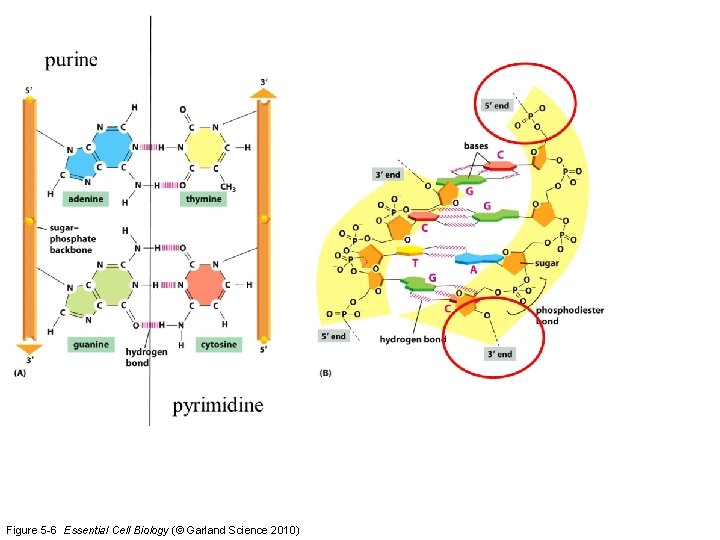
Figure 5 -6 Essential Cell Biology (© Garland Science 2010)
Animation Please note that due to differing operating systems, some animations will not appear until the presentation is viewed in Presentation Mode (Slide Show view). You may see blank slides in the “Normal” or “Slide Sorter” views. All animations will appear after viewing in Presentation Mode and playing each animation. Most animations will require the latest version of the Flash Player, which is available at http: //get. adobe. com/flashplayer.
Animation Please note that due to differing operating systems, some animations will not appear until the presentation is viewed in Presentation Mode (Slide Show view). You may see blank slides in the “Normal” or “Slide Sorter” views. All animations will appear after viewing in Presentation Mode and playing each animation. Most animations will require the latest version of the Flash Player, which is available at http: //get. adobe. com/flashplayer.
Replication of DNA l DNA replication is the process of copying a DNA molecule. l Replication is semiconservative, with each strand of the original double helix (parental molecule) serving as a template (mold or model) for a new strand in a daughter molecule. 26
Animation Please note that due to differing operating systems, some animations will not appear until the presentation is viewed in Presentation Mode (Slide Show view). You may see blank slides in the “Normal” or “Slide Sorter” views. All animations will appear after viewing in Presentation Mode and playing each animation. Most animations will require the latest version of the Flash Player, which is available at http: //get. adobe. com/flashplayer. 27
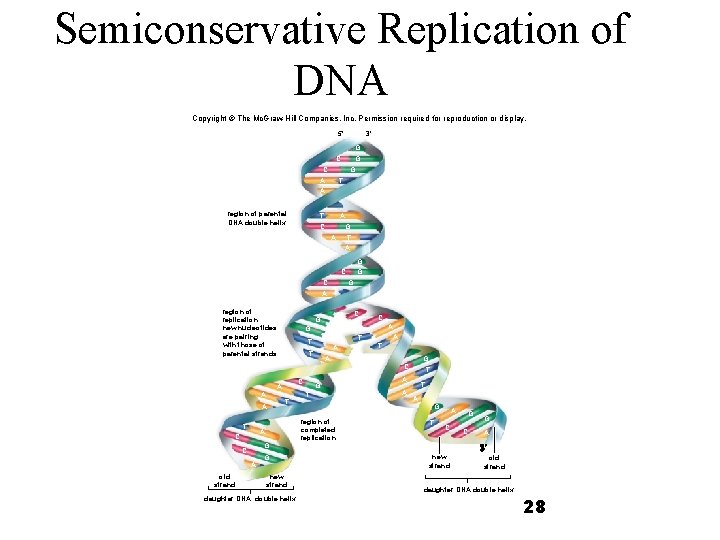
Semiconservative Replication of DNA Copyright © The Mc. Graw-Hill Companies, Inc. Permission required for reproduction or display. 5' 3' G C G A T A region of parental DNA double helix T A C G A T A G C C G G A region of replication: new nucleotides are pairing with those of parental strands C G C A A G T T A T T G A C C A A A T A C G C A old strand T G new strand daughter DNA double helix G T region of completed replication T A A T A G T A C new strand G C G A old strand daughter DNA double helix 28
Animation Please note that due to differing operating systems, some animations will not appear until the presentation is viewed in Presentation Mode (Slide Show view). You may see blank slides in the “Normal” or “Slide Sorter” views. All animations will appear after viewing in Presentation Mode and playing each animation. Most animations will require the latest version of the Flash Player, which is available at http: //get. adobe. com/flashplayer.
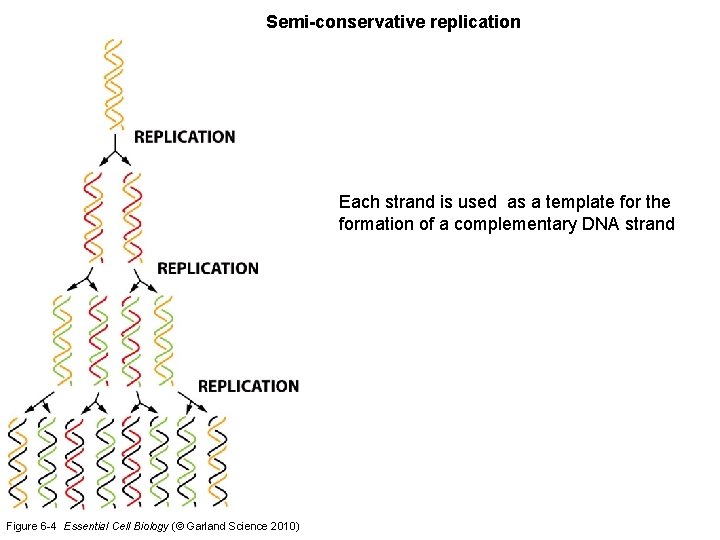
Semi-conservative replication Each strand is used as a template for the formation of a complementary DNA strand Figure 6 -4 Essential Cell Biology (© Garland Science 2010)
Animation Please note that due to differing operating systems, some animations will not appear until the presentation is viewed in Presentation Mode (Slide Show view). You may see blank slides in the “Normal” or “Slide Sorter” views. All animations will appear after viewing in Presentation Mode and playing each animation. Most animations will require the latest version of the Flash Player, which is available at http: //get. adobe. com/flashplayer. 31
Animation Please note that due to differing operating systems, some animations will not appear until the presentation is viewed in Presentation Mode (Slide Show view). You may see blank slides in the “Normal” or “Slide Sorter” views. All animations will appear after viewing in Presentation Mode and playing each animation. Most animations will require the latest version of the Flash Player, which is available at http: //get. adobe. com/flashplayer.
Replication: Eukaryotic l DNA replication begins at numerous points along linear chromosome l DNA unwinds and unzips into two strands l Each old strand of DNA serves as a template for a new strand l Complementary base-pairing forms new strand on each old strand l Requires enzyme DNA polymerase 33
Replication: Eukaryotic Replication bubbles spread bi-directionally until they meet l The complementary nucleotides join to form new strands. Each daughter DNA molecule contains an old strand a new strand. l l Replication is semiconservative: l One original strand is conserved in each daughter molecule i. e. each daughter double helix has one parental strand one new strand. 34
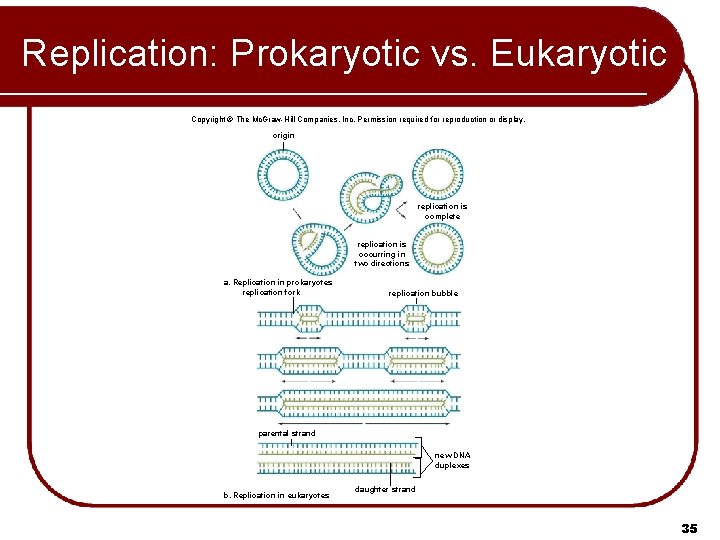
Replication: Prokaryotic vs. Eukaryotic Copyright © The Mc. Graw-Hill Companies, Inc. Permission required for reproduction or display. origin replication is complete replication is occurring in two directions a. Replication in prokaryotes replication fork replication bubble parental strand new DNA duplexes b. Replication in eukaryotes daughter strand 35
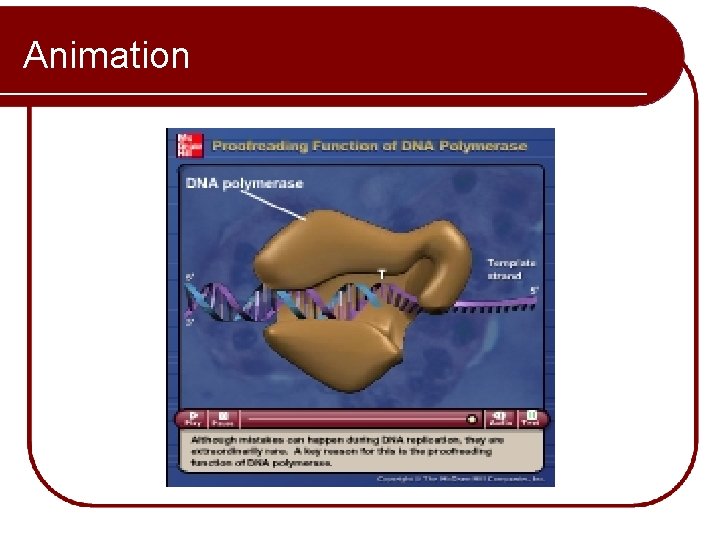
Animation Please note that due to differing operating systems, some animations will not appear until the presentation is viewed in Presentation Mode (Slide Show view). You may see blank slides in the “Normal” or “Slide Sorter” views. All animations will appear after viewing in Presentation Mode and playing each animation. Most animations will require the latest version of the Flash Player, which is available at http: //get. adobe. com/flashplayer.
Replication: Eukaryotic Replication bubbles spread bi-directionally until they meet l The complementary nucleotides join to form new strands. Each daughter DNA molecule contains an old strand a new strand. l l Replication is semiconservative: l One original strand is conserved in each daughter molecule i. e. each daughter double helix has one parental strand one new strand. 37
Animation Please note that due to differing operating systems, some animations will not appear until the presentation is viewed in Presentation Mode (Slide Show view). You may see blank slides in the “Normal” or “Slide Sorter” views. All animations will appear after viewing in Presentation Mode and playing each animation. Most animations will require the latest version of the Flash Player, which is available at http: //get. adobe. com/flashplayer.
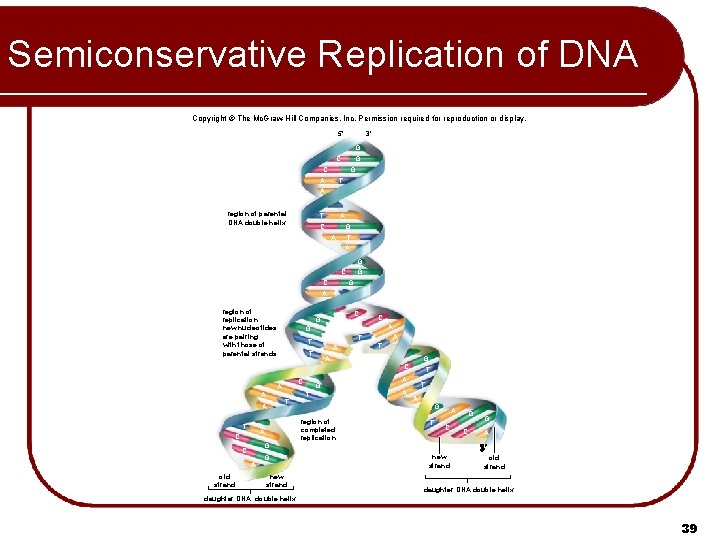
Semiconservative Replication of DNA Copyright © The Mc. Graw-Hill Companies, Inc. Permission required for reproduction or display. 5' 3' G C G A T A region of parental DNA double helix T A C G A T A G C C G G A region of replication: new nucleotides are pairing with those of parental strands C G C A A G T T A T T G A C C A A A T A C G C A old strand T G new strand G T region of completed replication T A A T A G T A C new strand G C G A old strand daughter DNA double helix 39
Animation Please note that due to differing operating systems, some animations will not appear until the presentation is viewed in Presentation Mode (Slide Show view). You may see blank slides in the “Normal” or “Slide Sorter” views. All animations will appear after viewing in Presentation Mode and playing each animation. Most animations will require the latest version of the Flash Player, which is available at http: //get. adobe. com/flashplayer.
https: //www. youtube. com/watch? v=G 1 A o. VF 3 k 9 Hg
- Slides: 41