
General Assembly Georgias Legislative Branch EQ What is
General Assembly Georgia’s Legislative Branch EQ: What is the role of Georgia’s legislative branch, and how is it organized?
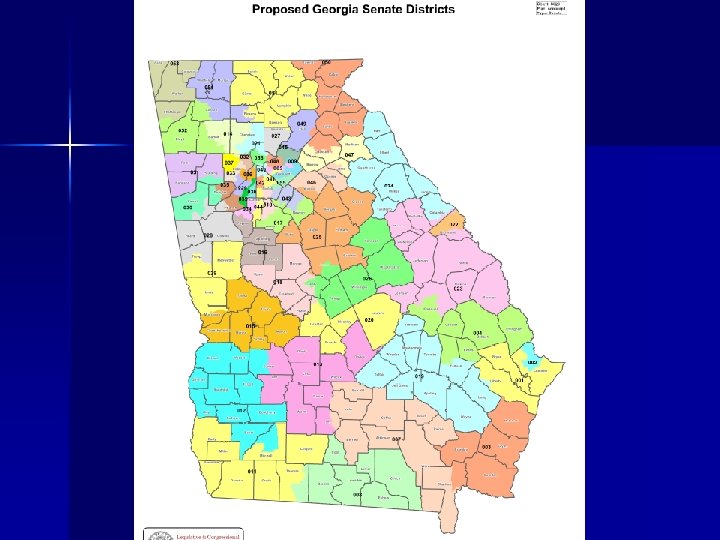
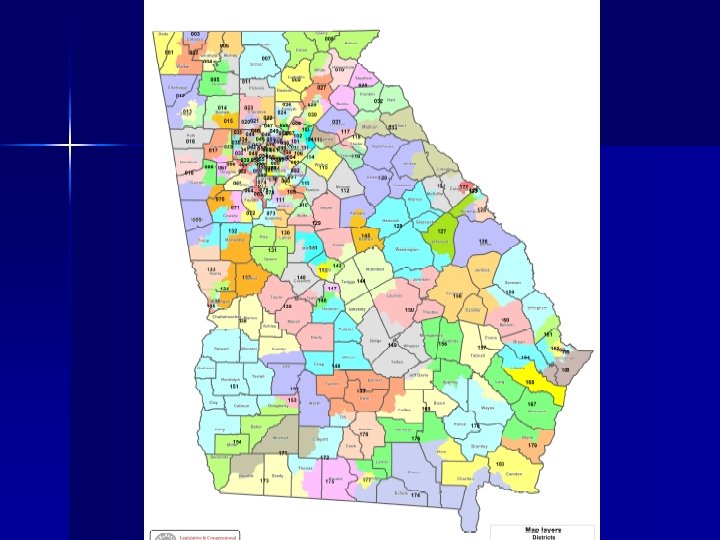
Georgia Legislative Branch n The legislative branch of government makes laws. Georgia’s legislative branch is called the General Assembly. It is bicameral. Two houses make up the General Assembly—the House of Representatives and the Senate. There are 180 representatives in the House of Representatives, and 56 senators in the Senate.
Senate n n n Who presides? – President of the Senate n lieutenant governor (designated by the Constitution) Size – 56 members Qualifications – 25 years old – U. S. citizen – GA resident for 2 years – Resident of district for at least 1 year Term – 2 years (no term limits) How elected – By constituents (voters)
House of Representatives n n n Who presides? – Speaker of the House n Elected by the house Size – 180 members Qualifications – 21 years old – U. S. citizen – GA resident for 2 years – Resident of district for at least 1 year Term – 2 years (may be re-elected unlimited times) How elected – By constituents (voters)
Duties of the General Assembly n n n Duties When does it meet? Most important duty is making n GA meetings begin on laws and passing budget the 2 nd Monday of (proposed by governor) January for their regular session They also may abolish laws or amend laws. n Session usually lasts for 40 days (recesses can Can amend (change) the GA make it go into April) constitution with a 2/3 vote n For remainder of their Senate two year terms they – confirms appointments meet in special sessions House of Representatives and committees – originate tax bills to raise or n Governor can call spend money (Appropriation special sessions bills)
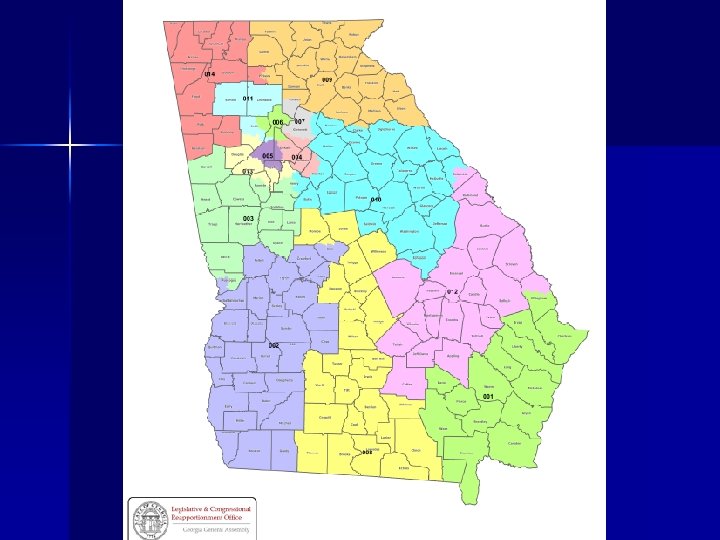
Reapportionment • • • Redistricting (redrawing the boundaries of the election districts) Occurs every 10 years Why? to make sure that the size of the populations remains equal
Organization of General Assembly • Caucus – meeting of party leaders • Occurs in both Purpose – to choose a “leader” and a “whip” and other officers n Each house has a majority and a minority party – Majority party is the political party with the most members in the house – Minority party has the fewest members •
Leadership in the General Assembly n Speaker of the House (presides over the House meetings) – elected by the House – 3 rd in line to succeed the governor n President of the Senate (presides over the Senate meetings) – Lieutenant Governor – 2 nd in line to succeed the governor n Majority Leader (leader of the party in control of the House or Senate) – Elected by majority party caucus n Majority Whip (person that keeps party members in line – vote for the party they
Leadership in the General Assembly n Minority Leader (leader of the party in minority in the House or Senate) – Elected by minority party caucus n Minority Whip (person chosen to keep party members in line) – Elected by minority party caucus n Administrative Floor Leaders (introduce bills that the governor wants passed) – Appointed by the governor n Committee Chairman (appointed to direct the work of his/her committee) – Appointed by the presiding officer of House or Senate
Powers of a Presiding Officer n n n n Appoints committees and their chairs Assigns bills to committees Determine the order of business Control debate Rule out proposed amendments to bills Enforce rules of procedures for the General Assembly Control meeting times and recesses of the General Assembly Order a roll call vote on any issue
n The Lieutenant governor does not have a vote in the Senate, BUT can break a tie.
Types of Committees n Standing Committees (permanent) – Examples n Ways and Means n Appropriations Committee n Judiciary committee n Interim Committees – One that works on assigned issues and concerns between sessions of the legislature
Types of Committees n Conference Committees – When the house and senate pass different versions of a bill, 3 senators and 3 representatives try to write one bill that both houses will pass n Joint Committee – Made up of members from both the house and senate – Works on an assigned topic or issue
Committee System • Committees- groups of senators/representatives who consider (work on) bills and • vote in committee to bring the bills to the floor of the House or Senate for a vote • They recommend to the House or Senate whether or not to pass the bills. • • • Bill – written proposal to enact, amend, or repeal a law Examples – public schools, agriculture, industry, Each senator and representative serves on two or three committees.
Lobbyist • Person (representing a group) who tries to persuade legislators to vote for or against specific bills
The General Assembly can make laws on any subject EXCEPT those subjects specifically assigned to the U. S. Constitution. It may not violate the U. S. or Georgia constitutions.
Laws passed by the General Assembly are … n general application – Laws that apply throughout the state of Georgia n local application – Laws that only apply to a specific city or county

n The Green Tree Frog
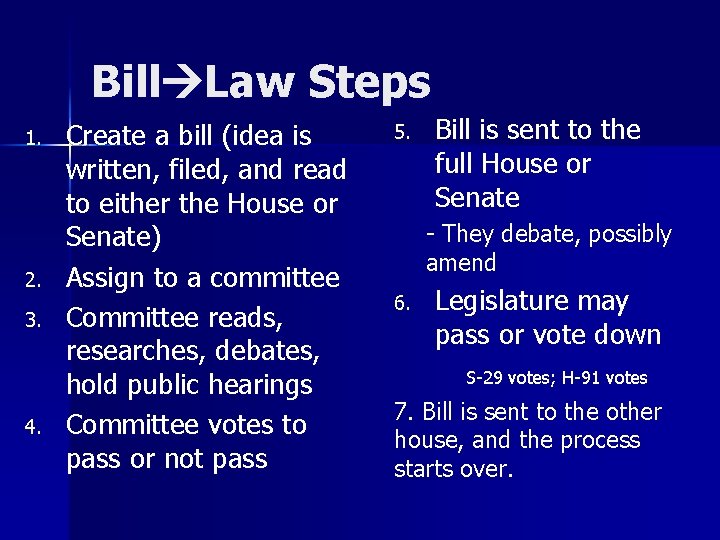
Bill Law Steps 1. 2. 3. 4. Create a bill (idea is written, filed, and read to either the House or Senate) Assign to a committee Committee reads, researches, debates, hold public hearings Committee votes to pass or not pass 5. Bill is sent to the full House or Senate - They debate, possibly amend 6. Legislature may pass or vote down S-29 votes; H-91 votes 7. Bill is sent to the other house, and the process starts over.
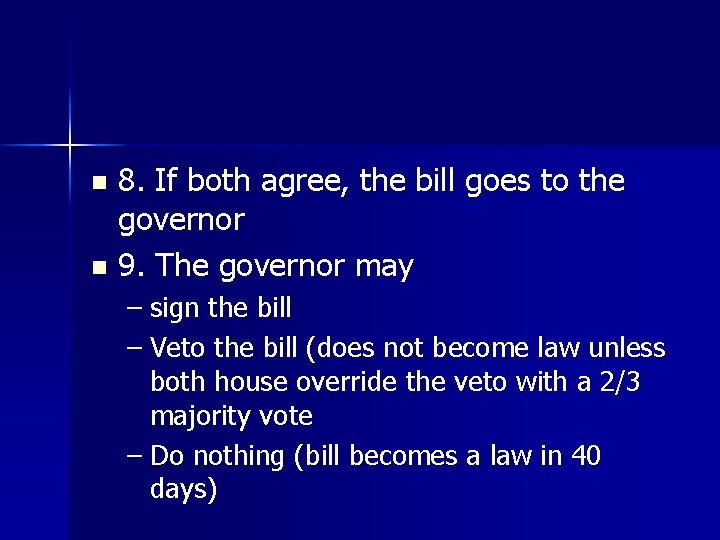
8. If both agree, the bill goes to the governor n 9. The governor may n – sign the bill – Veto the bill (does not become law unless both house override the veto with a 2/3 majority vote – Do nothing (bill becomes a law in 40 days)
- Slides: 23