
GENERAL APPEARANCE BEHAVIORMENTAL STATUS GENERAL SURVEY Overall impression
GENERAL APPEARANCE & BEHAVIOR/MENTAL STATUS
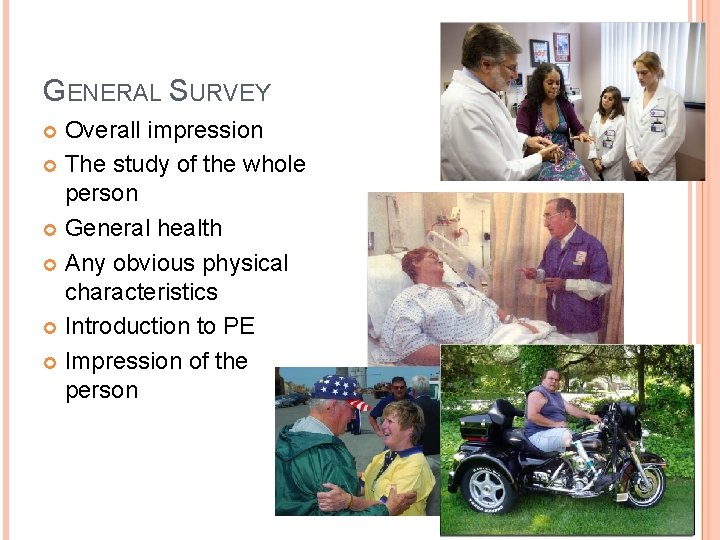
GENERAL SURVEY Overall impression The study of the whole person General health Any obvious physical characteristics Introduction to PE Impression of the person
GENERAL SURVEY Physical Appearance � Age, sex, LOC, skin color, facial features Body Structure � Height, Mobility � Gait nutrition, symmetry, posture position & build. & ROM Behavior � Facial expression, mood, affect, speech, dress & personal hygiene.
GENERAL SURVEY 1. Level of consciousness 1. Fully alert 2. Describe if drowsy 3. Lethargic 4. Unresponsive
GENERAL SURVEY 2. Orientation 1. Person 2. Place 3. Time 4. Describe the problem briefly
GENERAL SURVEY 3. Nutritional status 1. Does the patient appear well nourished? 2. Trim 3. Muscular 4. Obese 5. Emaciated
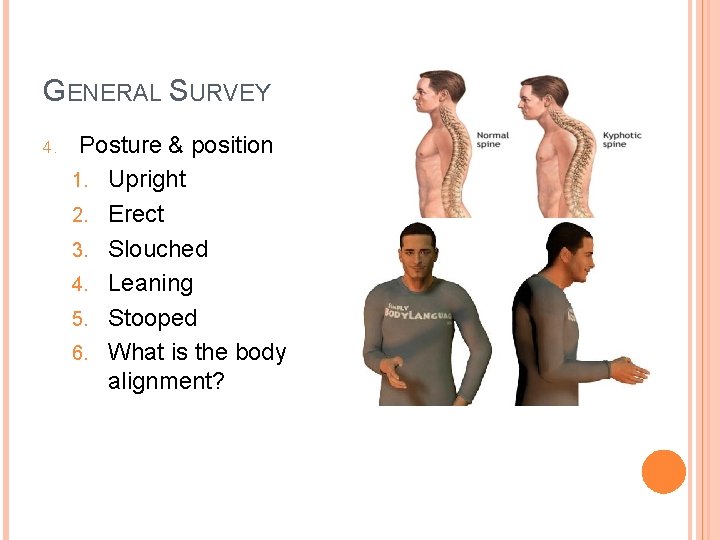
GENERAL SURVEY 4. Posture & position 1. Upright 2. Erect 3. Slouched 4. Leaning 5. Stooped 6. What is the body alignment?
GENERAL SURVEY 5. Obvious physical deformities 1. Body proportions 2. Amputations 3. Contractures 4. None observed
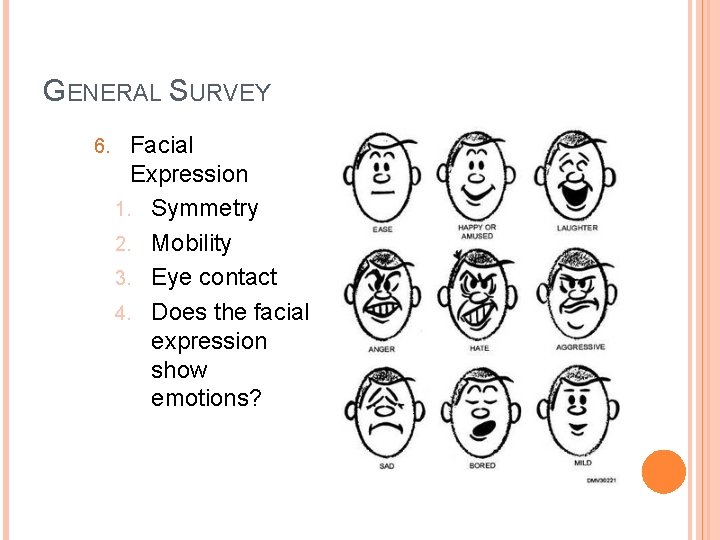
GENERAL SURVEY 6. Facial Expression 1. Symmetry 2. Mobility 3. Eye contact 4. Does the facial expression show emotions?
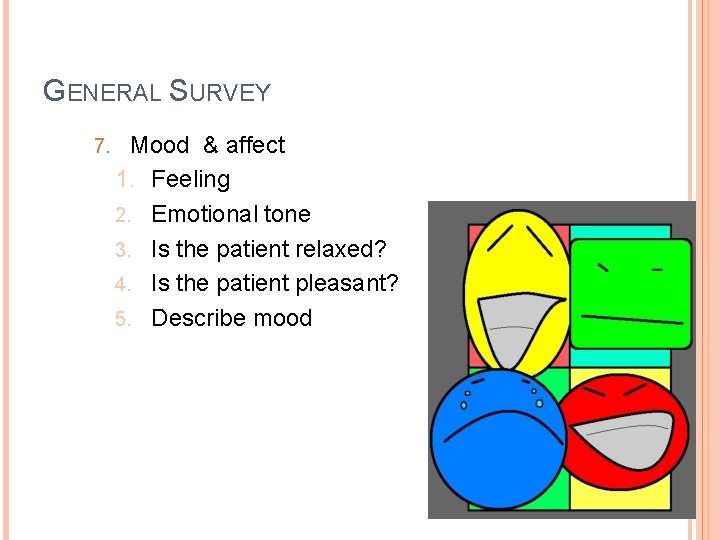
GENERAL SURVEY 7. Mood & affect 1. Feeling 2. Emotional tone 3. Is the patient relaxed? 4. Is the patient pleasant? 5. Describe mood
GENERAL SURVEY 8. Speech 1. Articulation 2. Pattern 3. Content appropriate 4. Native language 5. Is the speech fluent? 6. Understandable 7. No hesitation 8. Meaningful
GENERAL SURVEY 9. State of personal hygiene/grooming 1. General cleanliness 2. Odors 3. Appearance
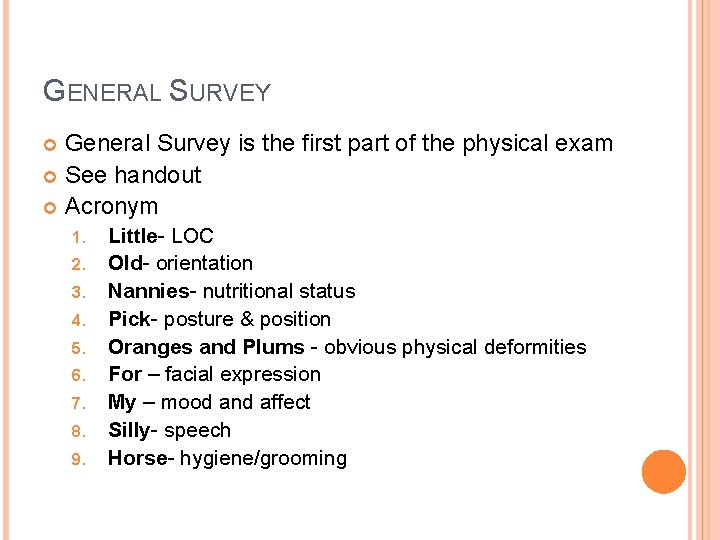
GENERAL SURVEY General Survey is the first part of the physical exam See handout Acronym 1. 2. 3. 4. 5. 6. 7. 8. 9. Little- LOC Old- orientation Nannies- nutritional status Pick- posture & position Oranges and Plums - obvious physical deformities For – facial expression My – mood and affect Silly- speech Horse- hygiene/grooming
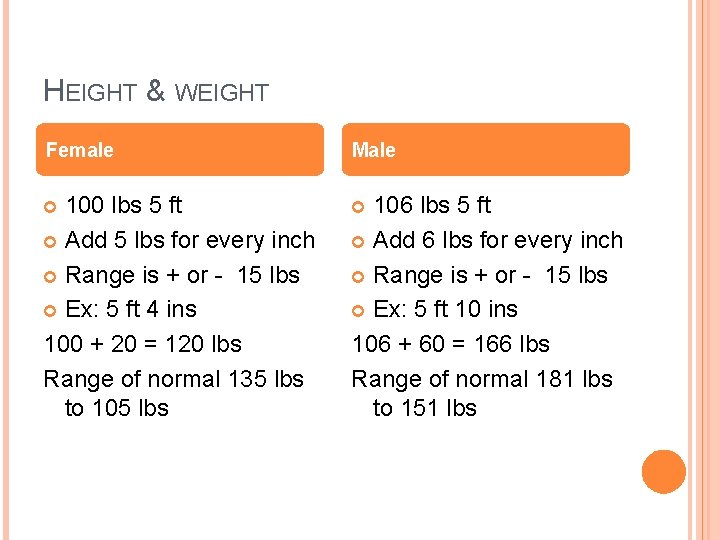
HEIGHT & WEIGHT Female Male 100 lbs 5 ft Add 5 lbs for every inch Range is + or - 15 lbs Ex: 5 ft 4 ins 100 + 20 = 120 lbs Range of normal 135 lbs to 105 lbs 106 lbs 5 ft Add 6 lbs for every inch Range is + or - 15 lbs Ex: 5 ft 10 ins 106 + 60 = 166 lbs Range of normal 181 lbs to 151 lbs
MENTAL STATUS ASSESSMENT
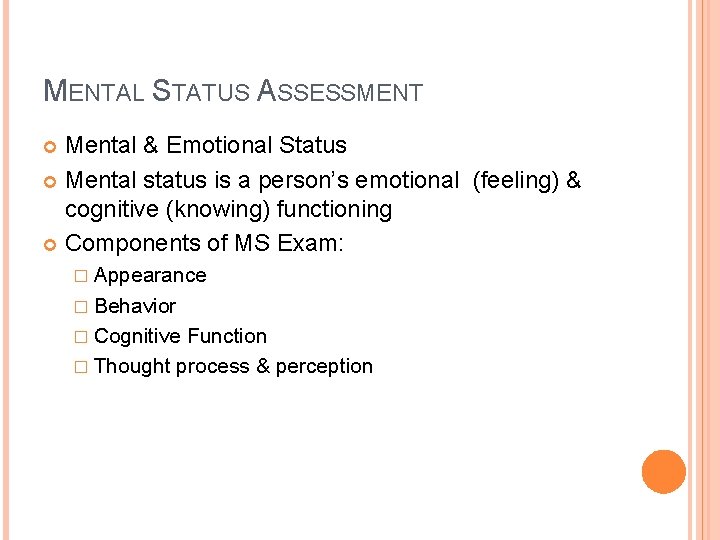
MENTAL STATUS ASSESSMENT Mental & Emotional Status Mental status is a person’s emotional (feeling) & cognitive (knowing) functioning Components of MS Exam: � Appearance � Behavior � Cognitive Function � Thought process & perception
APPEARANCE Posture Body Movements Dress Grooming & Hygiene
BEHAVIOR Level of consciousness Facial Expression Language Mood/Affect Speech
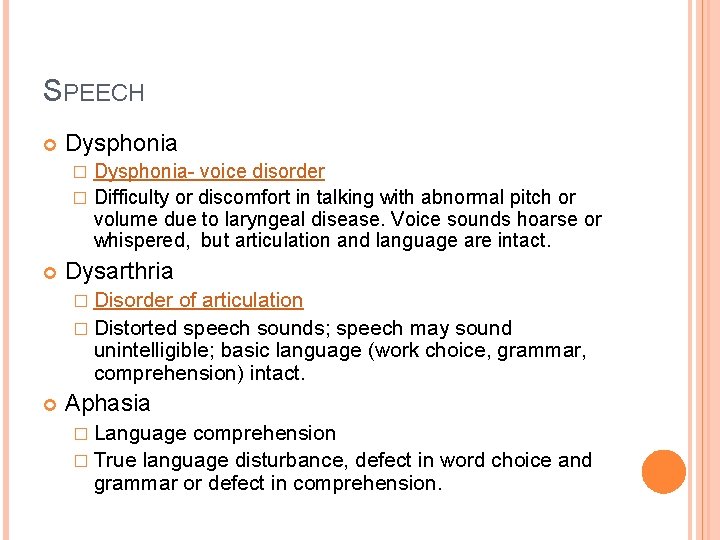
SPEECH Dysphonia- voice disorder � Difficulty or discomfort in talking with abnormal pitch or volume due to laryngeal disease. Voice sounds hoarse or whispered, but articulation and language are intact. � Dysarthria � Disorder of articulation � Distorted speech sounds; speech may sound unintelligible; basic language (work choice, grammar, comprehension) intact. Aphasia � Language comprehension � True language disturbance, defect in word choice and grammar or defect in comprehension.
COGNITIVE FUNCTION Orientation Attention span Memory Recent/Short term memory Remote/Long term memory New Learning Higher Intellectual Functioning The Mini-Cog � Reliable, quick and easily available to screen for cognitive impairment in otherwise health adults
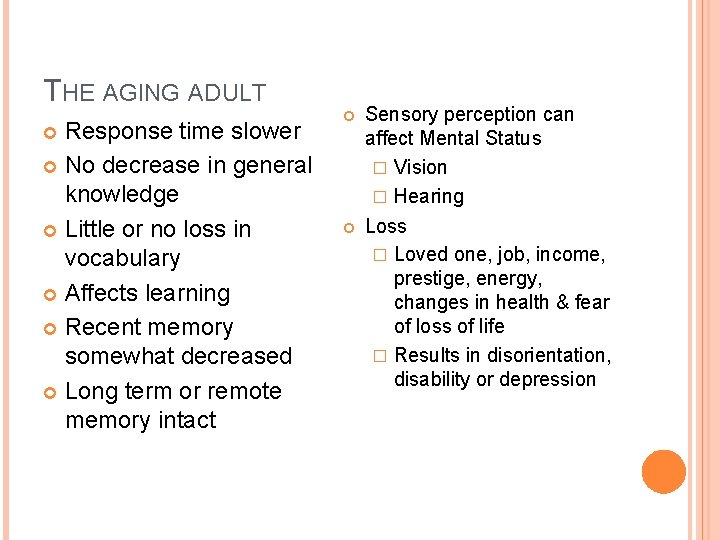
THE AGING ADULT Response time slower No decrease in general knowledge Little or no loss in vocabulary Affects learning Recent memory somewhat decreased Long term or remote memory intact Sensory perception can affect Mental Status � Vision � Hearing Loss � Loved one, job, income, prestige, energy, changes in health & fear of loss of life � Results in disorientation, disability or depression
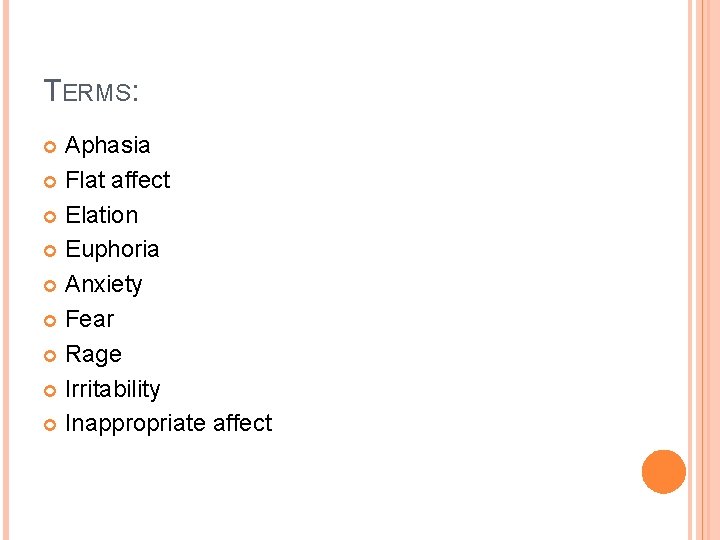
TERMS: Aphasia Flat affect Elation Euphoria Anxiety Fear Rage Irritability Inappropriate affect
ALTERED THOUGHT PROCESS
Still Alice- Intro
DELIRIUM Disturbance of consciousness A change in cognition Decreased ability to focus, sustain or shift attention Develops over a short period of time See handout
DELIRIUM Reversible Treat the cause if possible & decrease stimuli Acute confusional state � Causes: Hypoglycemia Electrolytes imbalance Ischemia Infection Heart failure Drug therapy
DEPRESSION A medical illness that involves the mind and body. Depression is not a normal part of growing older, and most seniors feel satisfied with their lives. In older adults, depression may go undiagnosed May always want to stay at home, rather than going out to socialize or doing new things.
DEPRESSION 20% of older adults. Associated with major life changes. Defining characteristics- feeling of sadness, inadequacy, social withdrawal, physical symptoms. Treatment
DEMENTIA Impairment of intellectual functioning associated with changes in personality, impaired judgment and reasoning Decreased ability to manage stress Increased anxiety Changes in behavior The most common cause of dementia is Alzheimer’s
ALZHEIMER’S DISEASE Alzheimer's disease causes brain changes that gradually get worse. It's the most common cause of dementia Brain cells degenerate and die, causing a steady decline in memory and mental functions. Build up of amyloid protein plaque Still Alice- Lost Slill Alice - Speech
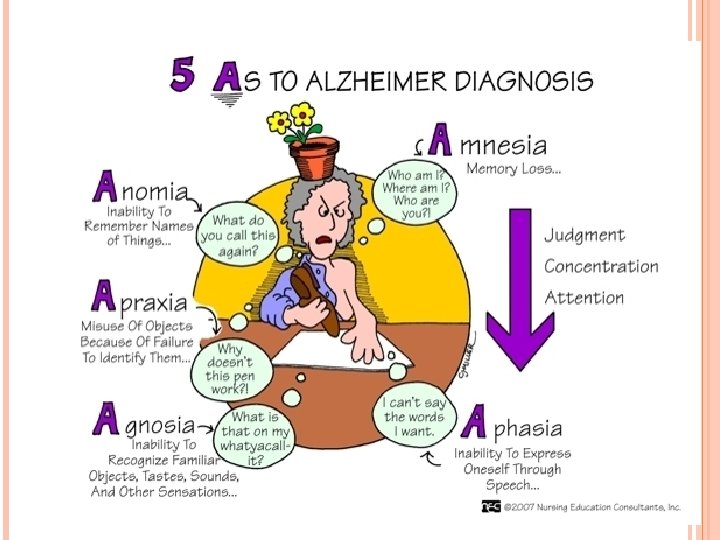
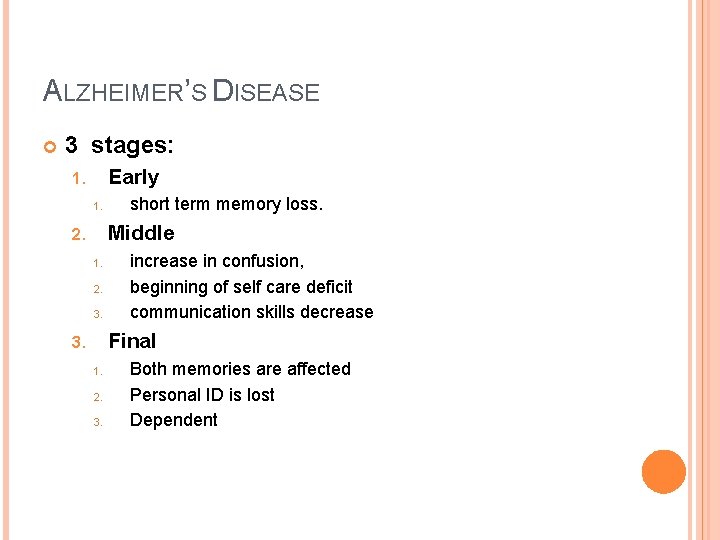
ALZHEIMER’S DISEASE 3 stages: Early 1. 1. short term memory loss. Middle 2. 1. 2. 3. increase in confusion, beginning of self care deficit communication skills decrease Final 3. 1. 2. 3. Both memories are affected Personal ID is lost Dependent
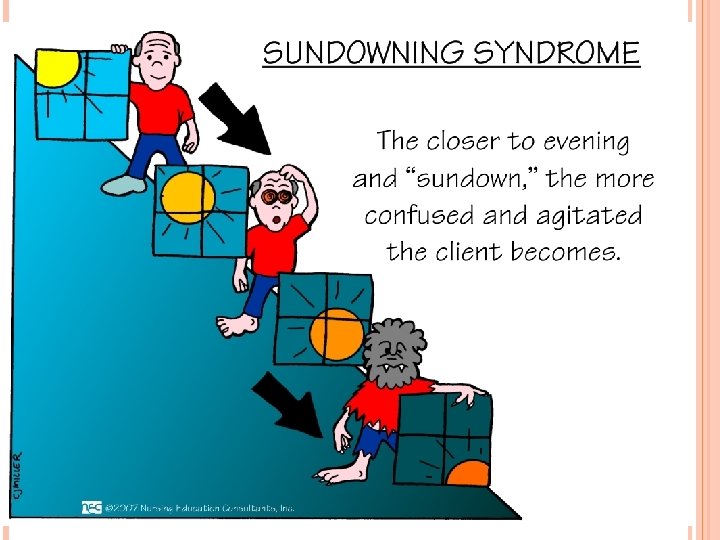
VASCULAR DEMENTIA Interruption in blood supply to the brain 2 nd most common cause Underlying problems � Hypertension � Stroke � Coronary � Obesity Artery Disease
OVERALL TREATMENT OF DEMENTIA Safety issues Psychosocial support Minimize environmental stressors Maintain functional abilities Maintain quality of life
QUESTIONS? The aging process has you firmly in its grasp if you never get the urge to throw a snowball. ~Doug Larson
- Slides: 36