
General Adaptation Syndrome GAS To start take a
- Slides: 10
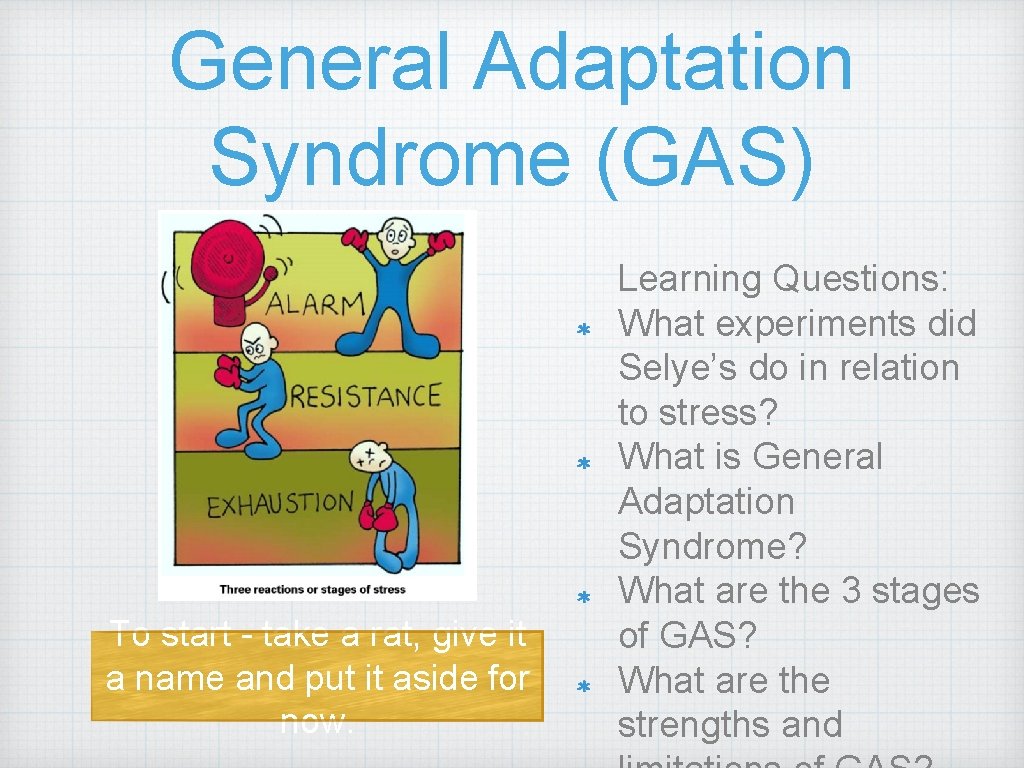
General Adaptation Syndrome (GAS) To start - take a rat, give it a name and put it aside for now. Learning Questions: What experiments did Selye’s do in relation to stress? What is General Adaptation Syndrome? What are the 3 stages of GAS? What are the strengths and
Selye’s Experiments on Rats You are going to do an experiment on your rat. The first piece of paper will describe what you have to do to your rat. Don’t let any of the other groups hear. With your partner, discuss what you think will happen to your rat after 48 hours
Selye’s Experiments on Rats Does what actually happened to the rat match what you discussed? Repeat this for: Between 48 hours and one month 1 -3 months Explain your findings to the class Come to a conclusion about Selye’s experiments
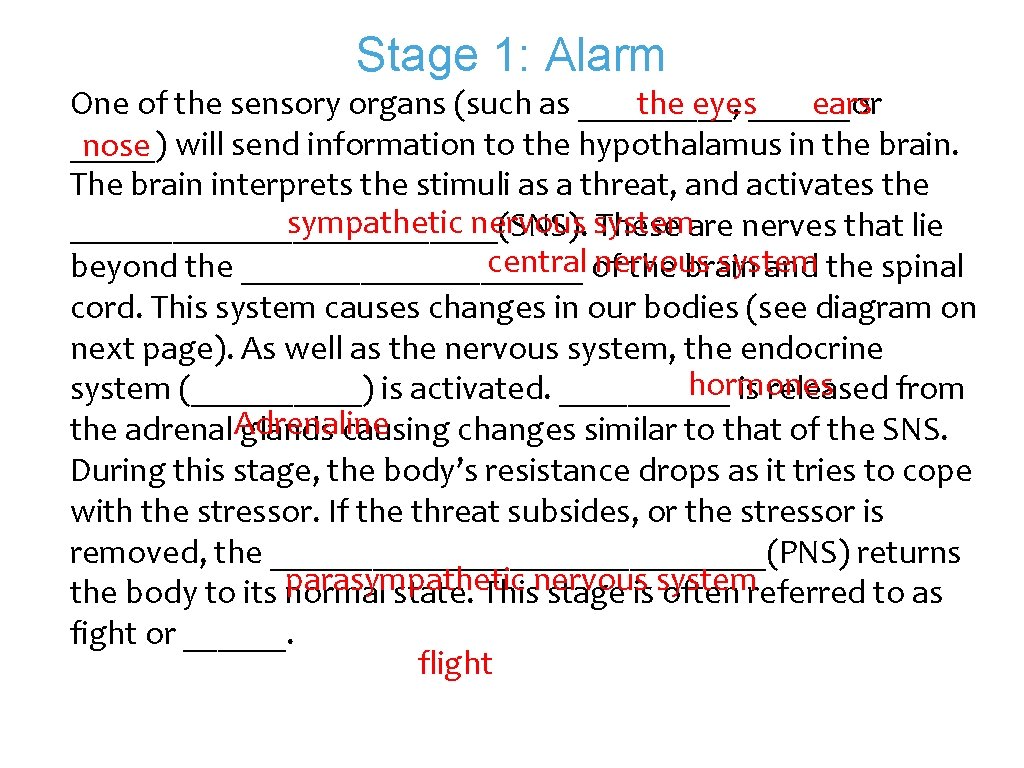
Stage 1: Alarm the eyes______or ears One of the sensory organs (such as _____, _____) nose will send information to the hypothalamus in the brain. The brain interprets the stimuli as a threat, and activates the sympathetic nervous system _____________(SNS). These are nerves that lie central of nervous system beyond the __________ the brain and the spinal cord. This system causes changes in our bodies (see diagram on next page). As well as the nervous system, the endocrine hormones system (_____) is activated. _____ is released from the adrenal Adrenaline glands causing changes similar to that of the SNS. During this stage, the body’s resistance drops as it tries to cope with the stressor. If the threat subsides, or the stressor is removed, the _______________(PNS) returns parasympathetic the body to its normal state. Thisnervous stage is system often referred to as fight or ______. flight
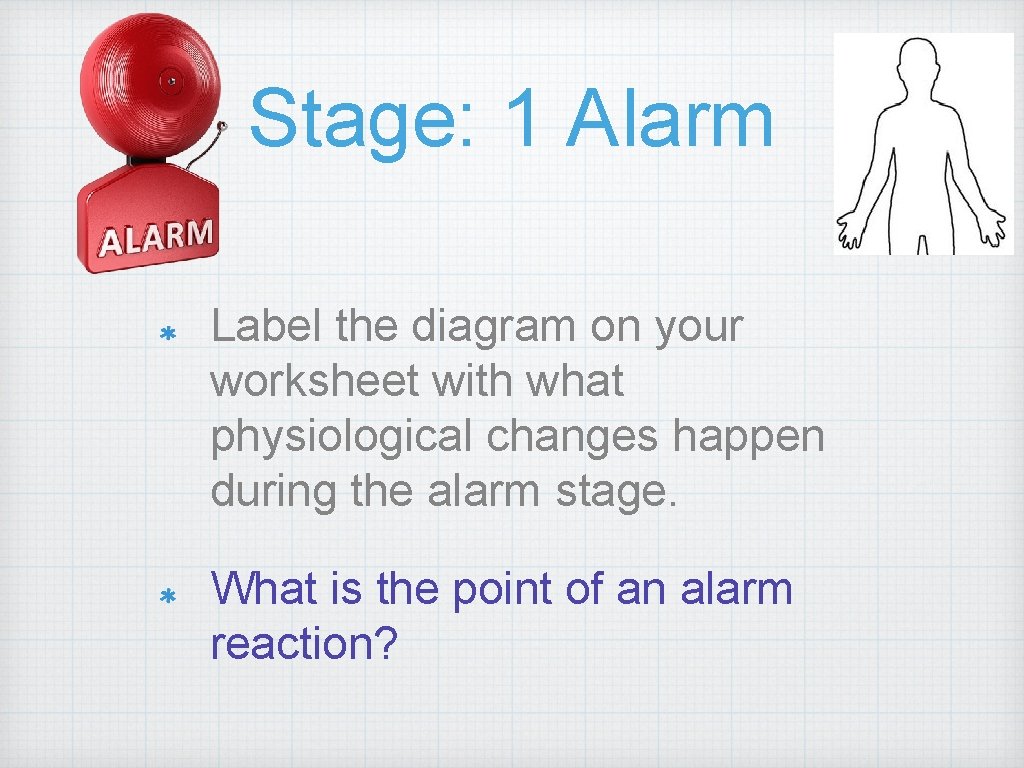
Stage: 1 Alarm Label the diagram on your worksheet with what physiological changes happen during the alarm stage. What is the point of an alarm reaction?
Stage 2: Resistance If the source of the stressor is not dealt with immediately and the state of stress continues, energy is still required and the body will continue responding in order to cope with and adapt to the stressor. Match the hormone to the action
Stage 3: Exhaustion If the stressor is not dealt with successfully during the resistance stage, and stress continues, the organism enters an exhaustion stage. What happens if our immune system is not functioning at 100%? Complete the graph to show our body’s resistance changes over the three stages.
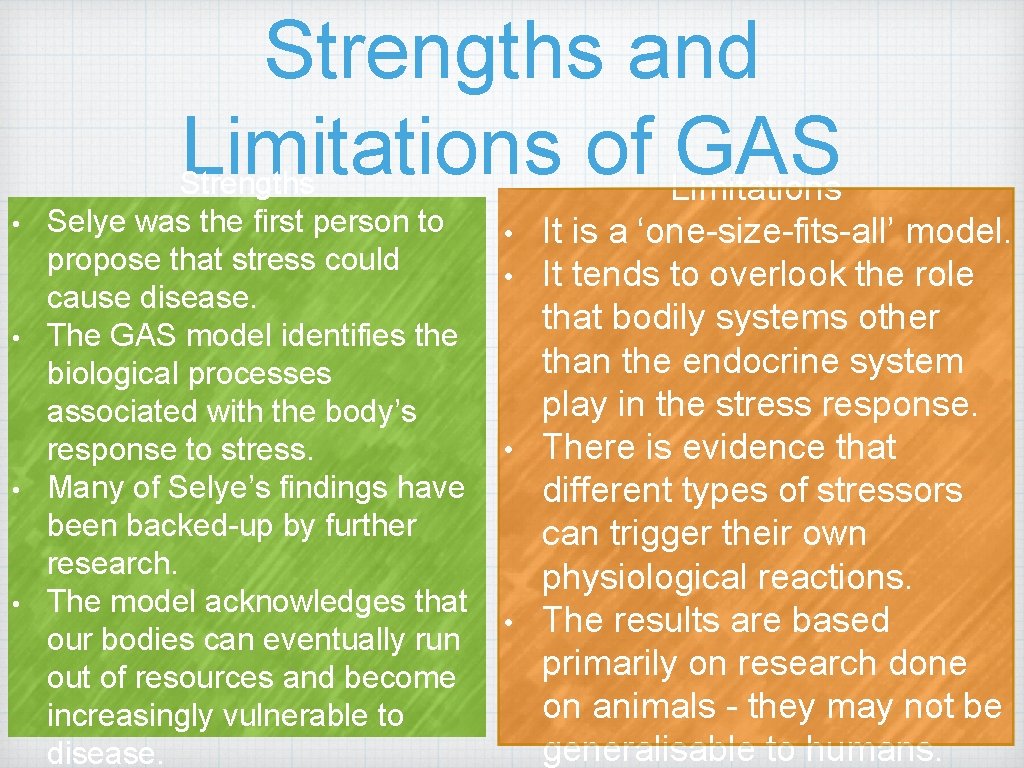
Strengths and Limitations of Limitations GAS • • Strengths Selye was the first person to propose that stress could cause disease. The GAS model identifies the biological processes associated with the body’s response to stress. Many of Selye’s findings have been backed-up by further research. The model acknowledges that our bodies can eventually run out of resources and become increasingly vulnerable to disease. • • It is a ‘one-size-fits-all’ model. It tends to overlook the role that bodily systems other than the endocrine system play in the stress response. There is evidence that different types of stressors can trigger their own physiological reactions. The results are based primarily on research done on animals - they may not be generalisable to humans.
Reflection and Homework Finish off your GAS tasks. For homework - complete learning activity 3. 15.