
GeneEnvironment Interactions Nazarbayev University July 2012 Jan Dorman

Gene-Environment Interactions Nazarbayev University July 2012 Jan Dorman, Ph. D University of Pittsburgh, PA, USA jsd@pitt. edu
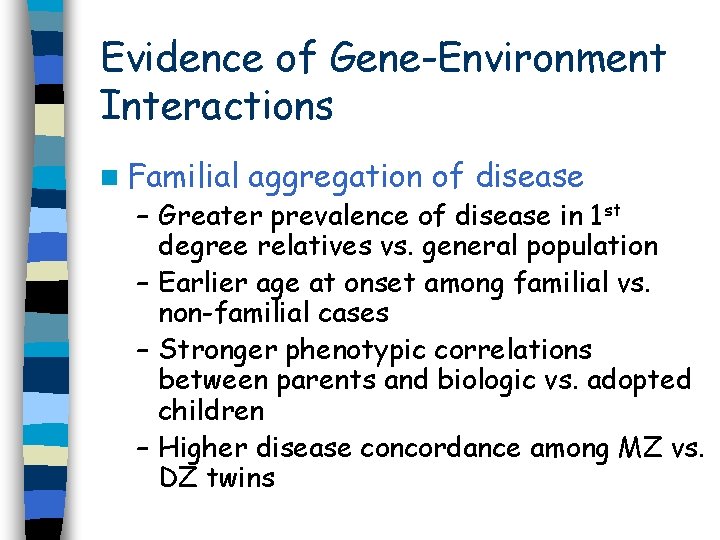
Evidence of Gene-Environment Interactions n Familial aggregation of disease – Greater prevalence of disease in 1 st degree relatives vs. general population – Earlier age at onset among familial vs. non-familial cases – Stronger phenotypic correlations between parents and biologic vs. adopted children – Higher disease concordance among MZ vs. DZ twins
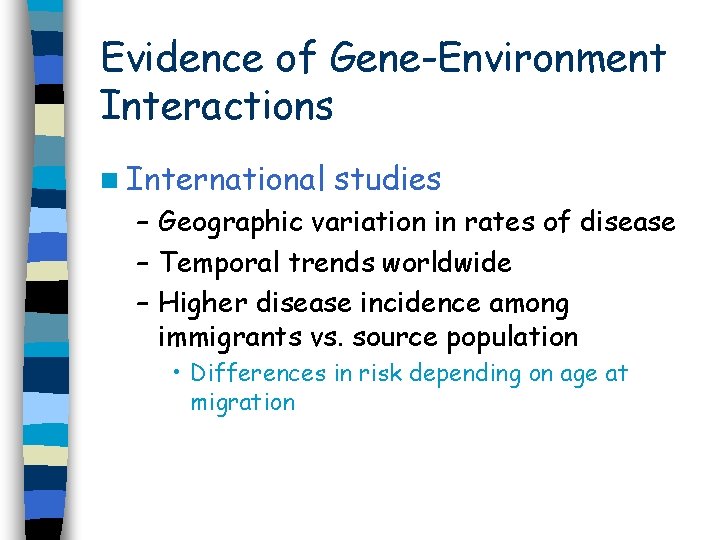
Evidence of Gene-Environment Interactions n International studies – Geographic variation in rates of disease – Temporal trends worldwide – Higher disease incidence among immigrants vs. source population • Differences in risk depending on age at migration
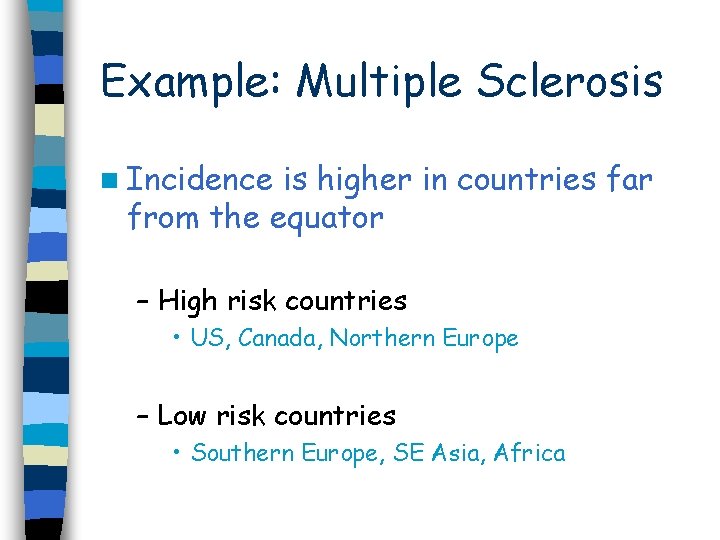
Example: Multiple Sclerosis n Incidence is higher in countries far from the equator – High risk countries • US, Canada, Northern Europe – Low risk countries • Southern Europe, SE Asia, Africa
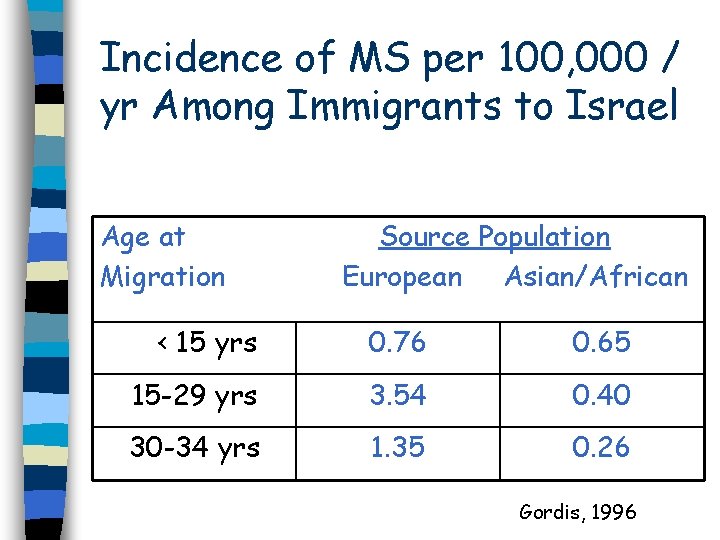
Incidence of MS per 100, 000 / yr Among Immigrants to Israel Age at Migration Source Population European Asian/African < 15 yrs 0. 76 0. 65 15 -29 yrs 3. 54 0. 40 30 -34 yrs 1. 35 0. 26 Gordis, 1996
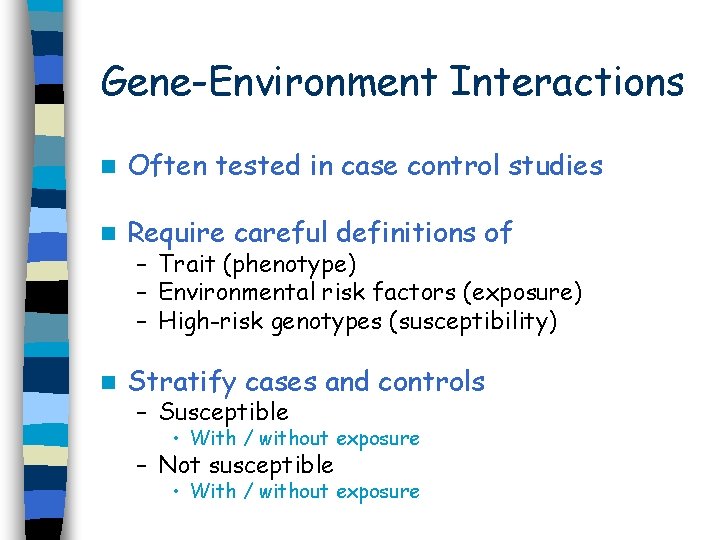
Gene-Environment Interactions n Often tested in case control studies n Require careful definitions of n Stratify cases and controls – Trait (phenotype) – Environmental risk factors (exposure) – High-risk genotypes (susceptibility) – Susceptible • With / without exposure – Not susceptible • With / without exposure
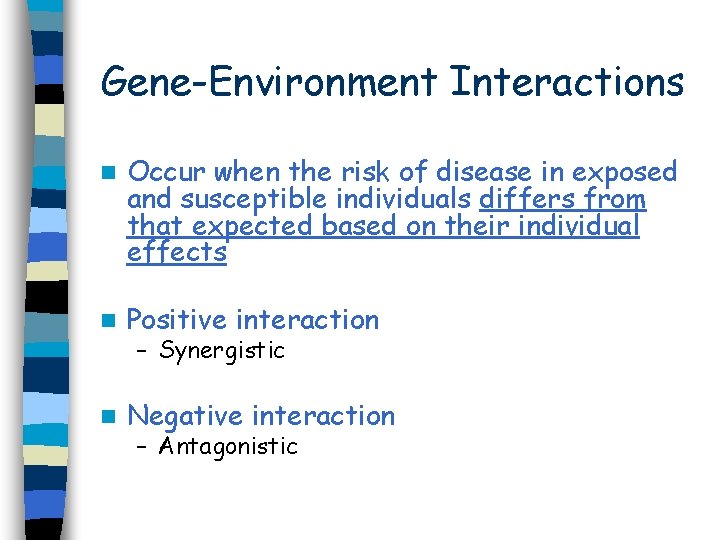
Gene-Environment Interactions n Occur when the risk of disease in exposed and susceptible individuals differs from that expected based on their individual effects n Positive interaction n Negative interaction – Synergistic – Antagonistic
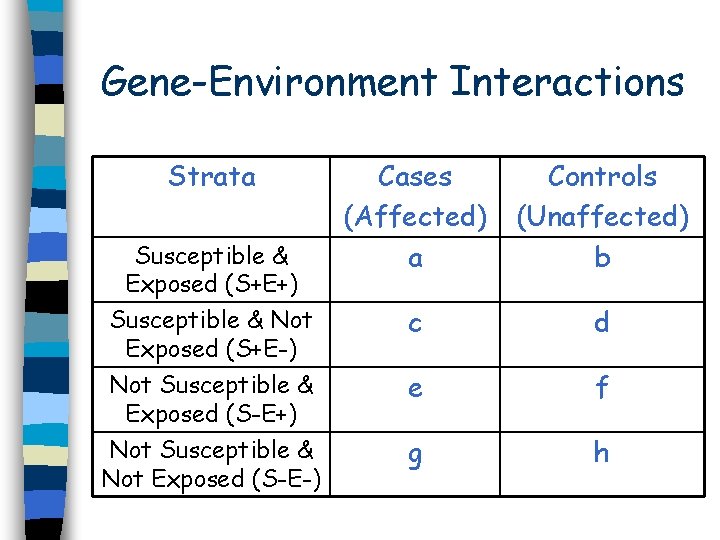
Gene-Environment Interactions Strata Cases (Affected) a Controls (Unaffected) b Susceptible & Not Exposed (S+E-) c d Not Susceptible & Exposed (S-E+) e f Not Susceptible & Not Exposed (S-E-) g h Susceptible & Exposed (S+E+)
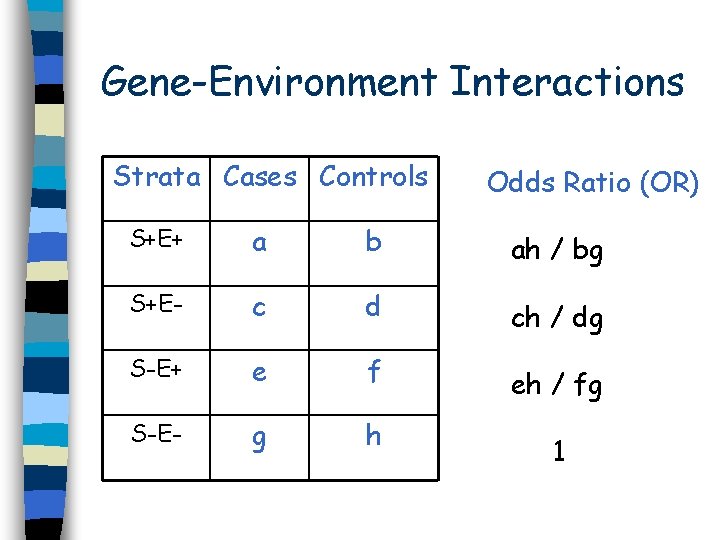
Gene-Environment Interactions Strata Cases Controls Odds Ratio (OR) S+E+ a b ah / bg S+E- c d ch / dg S-E+ e f eh / fg S-E- g h 1
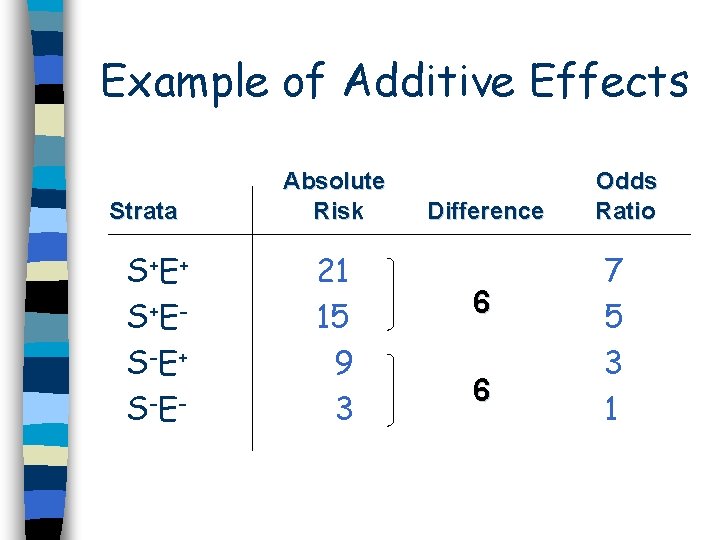
Example of Additive Effects Strata S+E + S+E S-E + S-E - Absolute Risk 21 15 9 3 Difference 6 6 Odds Ratio 7 5 3 1
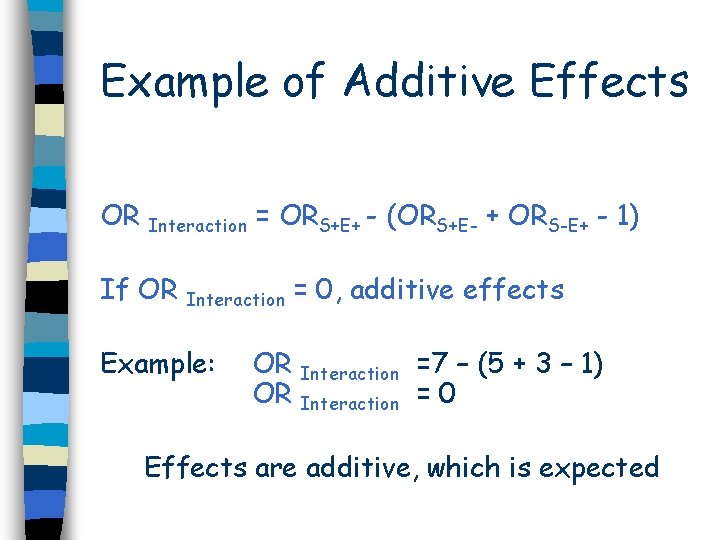
Example of Additive Effects OR Interaction = ORS+E+ - (ORS+E- + ORS-E+ - 1) If OR Interaction Example: = 0, additive effects OR Interaction =7 – (5 + 3 – 1) OR Interaction = 0 Effects are additive, which is expected
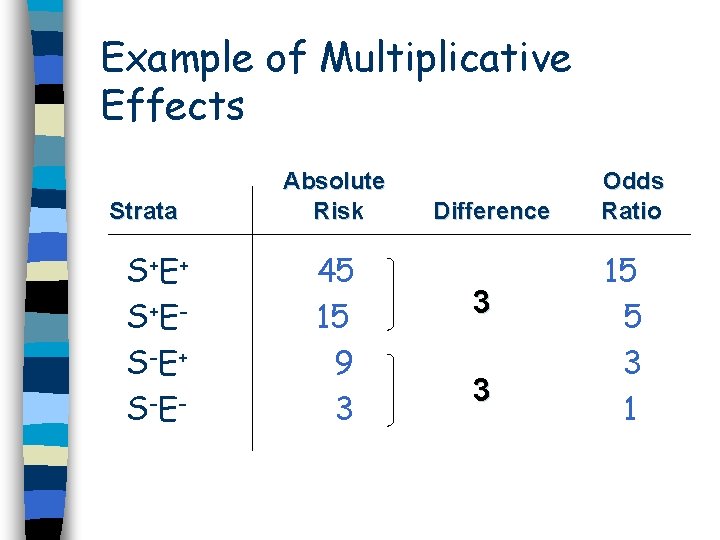
Example of Multiplicative Effects Strata S+E + S+E S-E + S-E - Absolute Risk 45 15 9 3 Difference 3 3 Odds Ratio 15 5 3 1
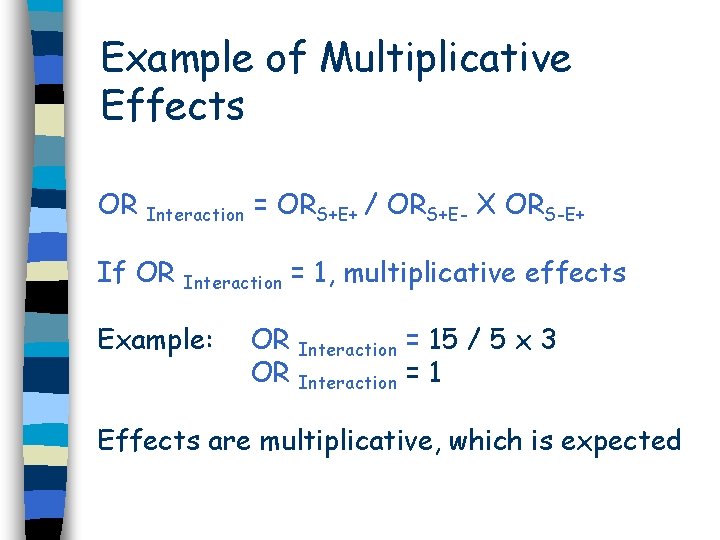
Example of Multiplicative Effects OR Interaction = ORS+E+ / ORS+E- X ORS-E+ If OR Interaction Example: = 1, multiplicative effects OR Interaction = 15 / 5 x 3 OR Interaction = 1 Effects are multiplicative, which is expected
Advantages of 2 x 4 Table n Data displayed clearly and completely n OR for joint effects are readily generated and directly comparable – Based on same reference group n Can easily evaluate additive or multiplicative effects and identify interactions n Highlights sample size issues
Limitations of 2 x 4 Table n Only 2 risk factors are considered n Are not evaluating dose-response effects in exposure or susceptibility n Can only examine additive or multiplicative effects – Most gene-environment interactions are more complicated
Evaluating Gene-Environment Interactions – Clinical Example n Vandenbroucke JP, Koster T, Briet E, et al. Increased risk of venous thrombosis in oral contraceptive users who are carriers of factor V Leiden mutation. Lancet 1994; 344: 1453 -1547
Venous Thrombosis n Most frequent cardiovascular event in young women n Generally manifests as thrombosis of deep leg veins or pulmonary embolism n Incidence in women age 20 -49 yrs is ~ 2 /10, 000 persons/yr n Case fatality rate is ~ 1% to 2%
Oral Contraceptive Pills (OCP) and Venous Thrombosis (VT) n Association between OCP and VT has been known since early 1960 s n Led to development of OCP with lower estrogen content – Incidence of VT is ~12 to 34 / 10, 000 in OCP users n Risk of VT is highest during the 1 st year of exposure
Factor V Leiden Mutations n R 506 Q mutation – amino acid substitution n Geographic variation in mutation prevalence n Prevalence among individuals with VT n Relative risk of VT among carriers – Frequency of the mutation in Caucasians is ~2% to 10% – Rare in African and Asians – 14% to 21% have the mutation – 3 - to 7 -fold higher than non-carriers
OCP, Factor V Leiden Mutations and Venous Thrombosis n What is risk of venous thrombosis among women who use OCP and carry the mutation? n Is there a gene-environment interaction? n If so, what are the clinical implications?
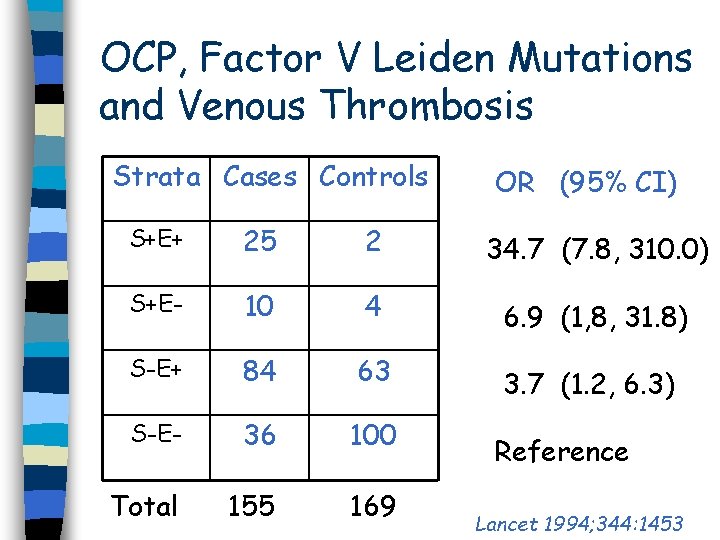
OCP, Factor V Leiden Mutations and Venous Thrombosis Strata Cases Controls OR (95% CI) S+E+ 25 2 34. 7 (7. 8, 310. 0) S+E- 10 4 6. 9 (1, 8, 31. 8) S-E+ 84 63 3. 7 (1. 2, 6. 3) S-E- 36 100 Total 155 169 Reference Lancet 1994; 344: 1453
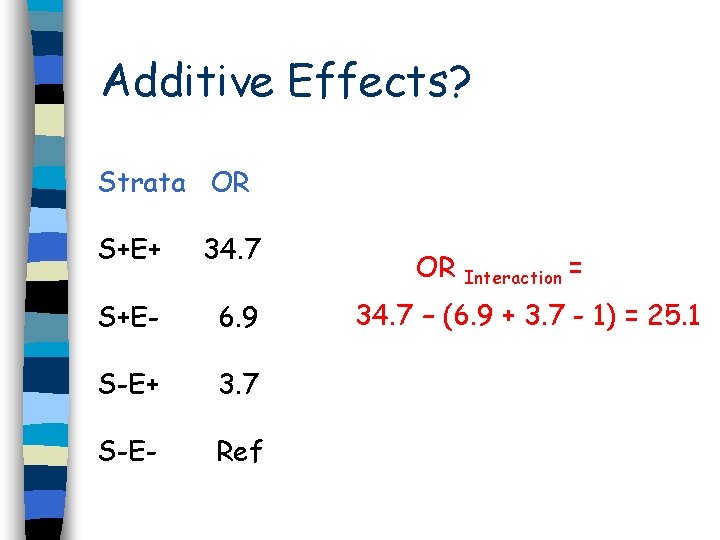
Additive Effects? Strata OR S+E+ 34. 7 S+E- 6. 9 S-E+ 3. 7 S-E- Ref OR Interaction = 34. 7 – (6. 9 + 3. 7 - 1) = 25. 1
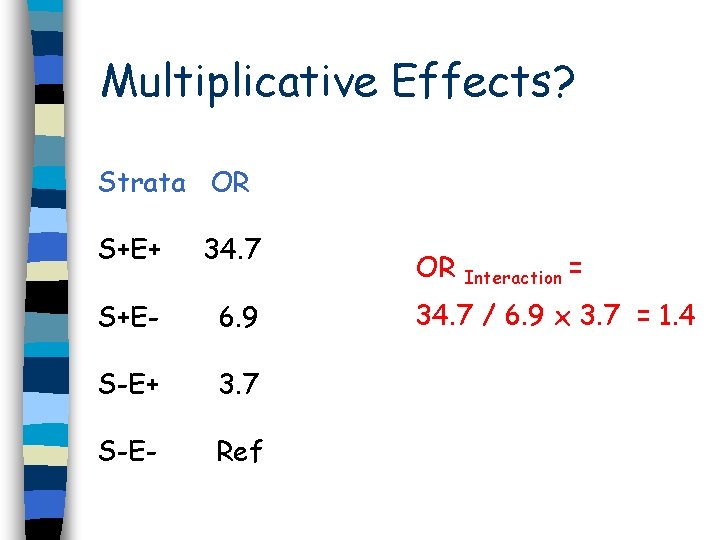
Multiplicative Effects? Strata OR S+E+ 34. 7 S+E- 6. 9 S-E+ 3. 7 S-E- Ref OR Interaction = 34. 7 / 6. 9 x 3. 7 = 1. 4
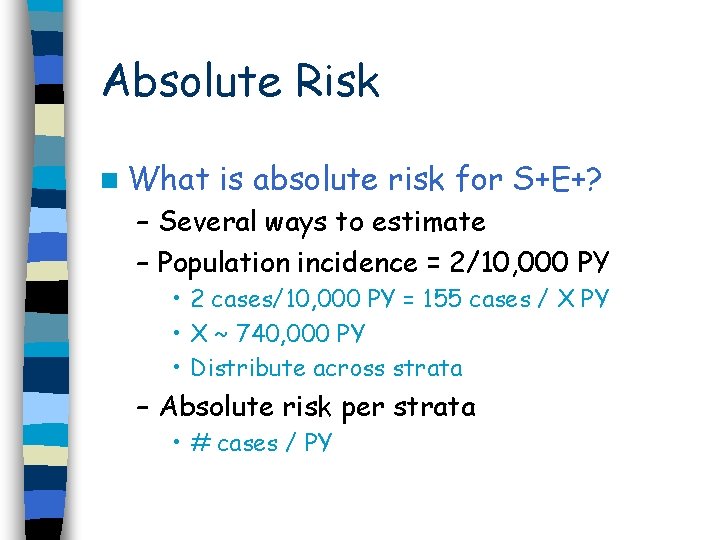
Absolute Risk n What is absolute risk for S+E+? – Several ways to estimate – Population incidence = 2/10, 000 PY • 2 cases/10, 000 PY = 155 cases / X PY • X ~ 740, 000 PY • Distribute across strata – Absolute risk per strata • # cases / PY
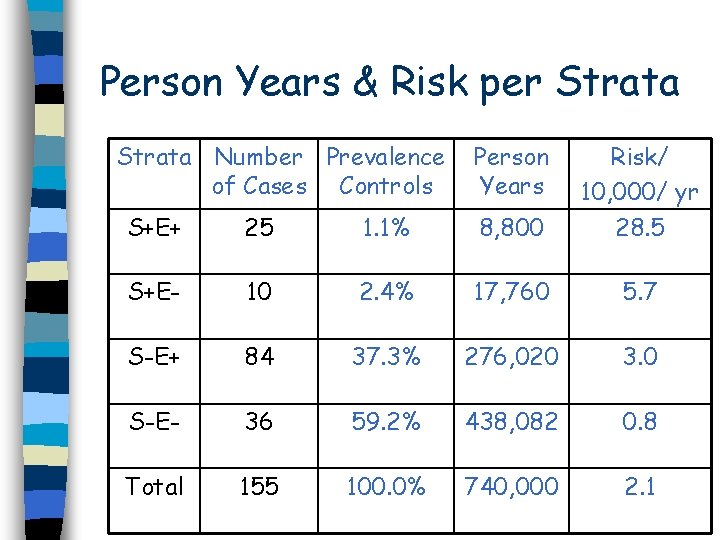
Person Years & Risk per Strata Number Prevalence of Cases Controls Person Years S+E+ 25 1. 1% 8, 800 Risk/ 10, 000/ yr 28. 5 S+E- 10 2. 4% 17, 760 5. 7 S-E+ 84 37. 3% 276, 020 3. 0 S-E- 36 59. 2% 438, 082 0. 8 Total 155 100. 0% 740, 000 2. 1
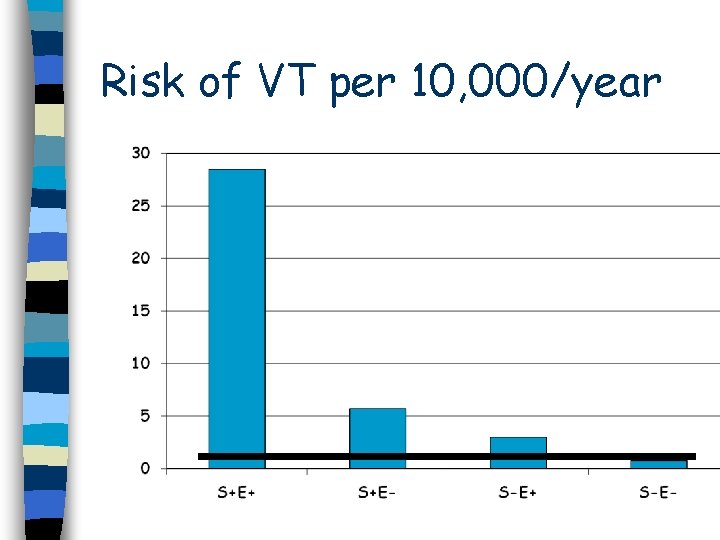
Risk of VT per 10, 000/year
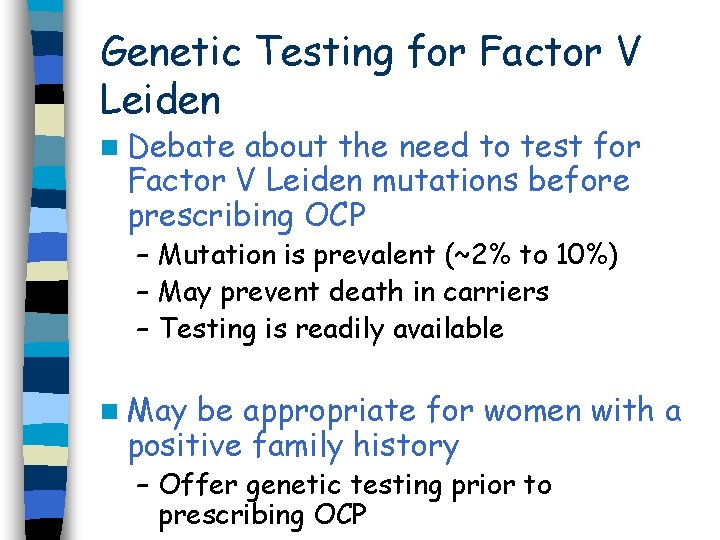
Genetic Testing for Factor V Leiden n Debate about the need to test for Factor V Leiden mutations before prescribing OCP – Mutation is prevalent (~2% to 10%) – May prevent death in carriers – Testing is readily available n May be appropriate for women with a positive family history – Offer genetic testing prior to prescribing OCP
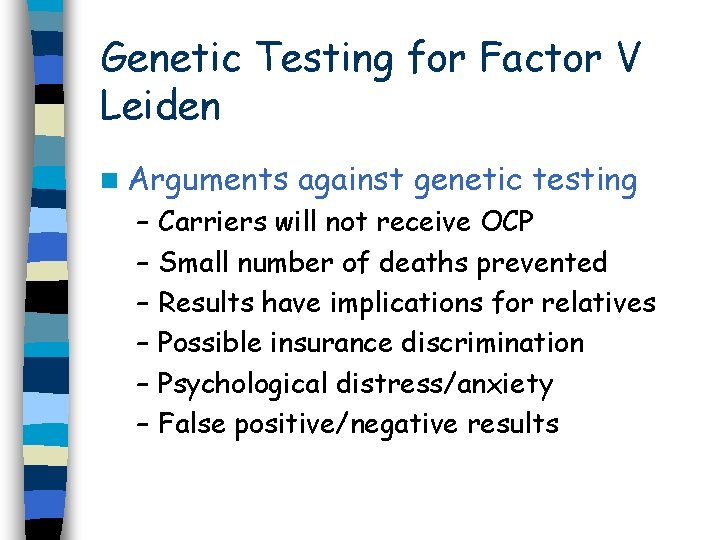
Genetic Testing for Factor V Leiden n Arguments – – – against genetic testing Carriers will not receive OCP Small number of deaths prevented Results have implications for relatives Possible insurance discrimination Psychological distress/anxiety False positive/negative results
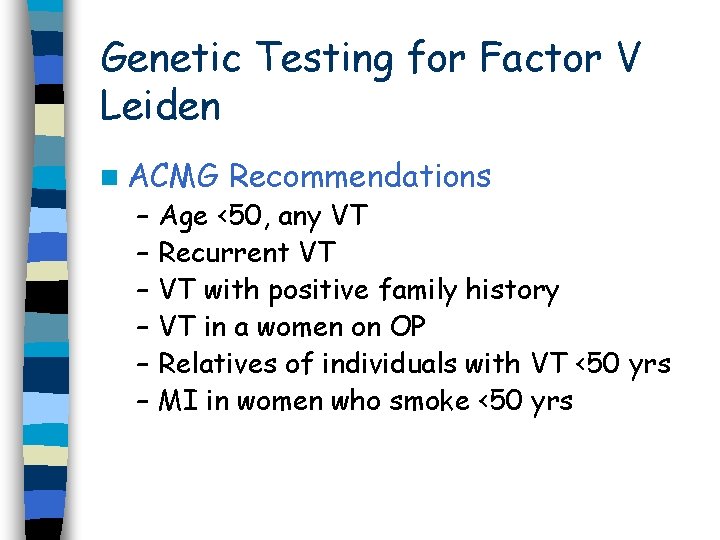
Genetic Testing for Factor V Leiden n ACMG – – – Recommendations Age <50, any VT Recurrent VT VT with positive family history VT in a women on OP Relatives of individuals with VT <50 yrs MI in women who smoke <50 yrs

Individuals with Factor V Leiden Mutation n Study of 110 mutation positive individuals identified in a North Carolina, US lab between 9/95 and 10/01 – Mean age 41 -60 yrs; 92% Caucasian; 46% female; 37% had income >$70, 000 n Assessed knowledge, satisfaction, information needs, resources, & health perception – Quantitative and qualitative methods J Thromb Haemost 2003; 1: 2335
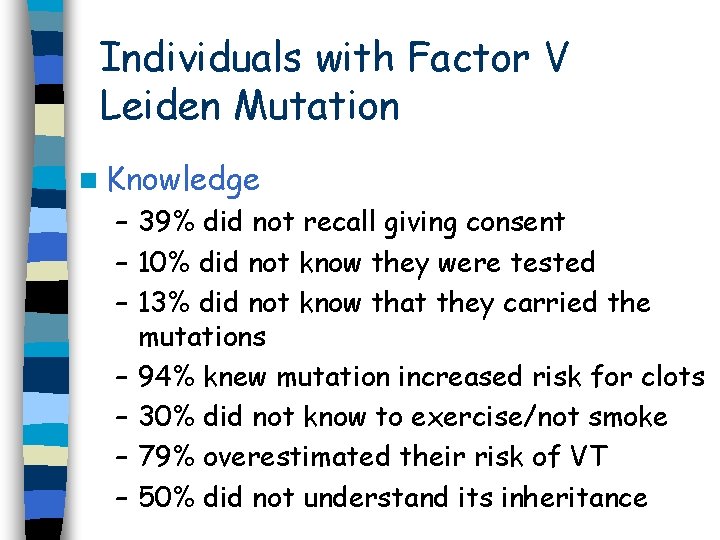
Individuals with Factor V Leiden Mutation n Knowledge – 39% did not recall giving consent – 10% did not know they were tested – 13% did not know that they carried the mutations – 94% knew mutation increased risk for clots – 30% did not know to exercise/not smoke – 79% overestimated their risk of VT – 50% did not understand its inheritance
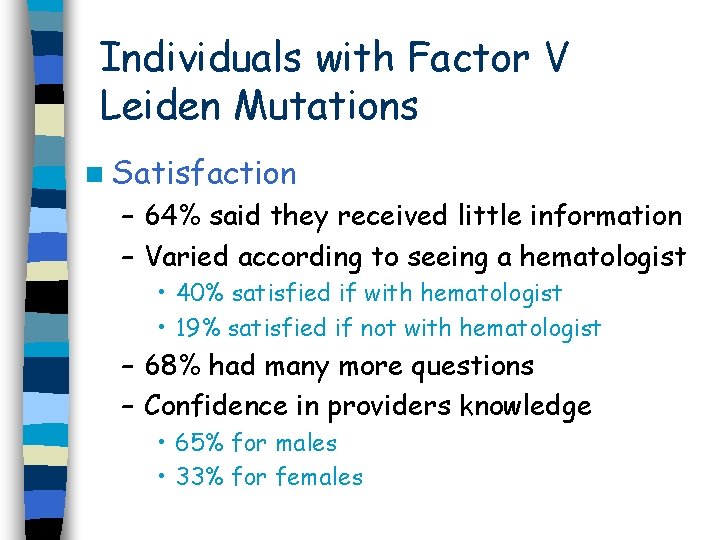
Individuals with Factor V Leiden Mutations n Satisfaction – 64% said they received little information – Varied according to seeing a hematologist • 40% satisfied if with hematologist • 19% satisfied if not with hematologist – 68% had many more questions – Confidence in providers knowledge • 65% for males • 33% for females
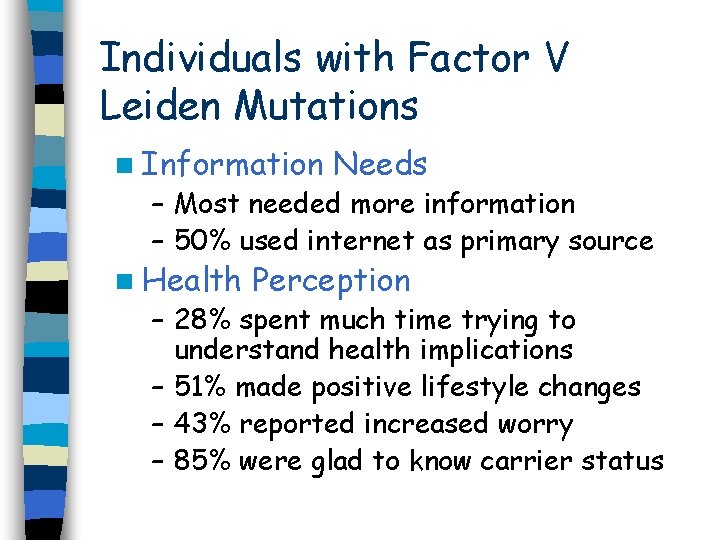
Individuals with Factor V Leiden Mutations n Information Needs – Most needed more information – 50% used internet as primary source n Health Perception – 28% spent much time trying to understand health implications – 51% made positive lifestyle changes – 43% reported increased worry – 85% were glad to know carrier status
Implications for Future n Patients interested in genetic testing for any condition need genetic counseling: – – – Genetic and environmental risk factors Disclosure Meaning of test results Other risks/benefits Follow-up
References n American College of Medical Genetics Consensus Statement on Factor V Leiden Mutation Testing. Genet Med 2001; 3: 139148. n Bank I, Scavenius MPRB, Buller H, et al. Social aspects of genetic testing for factor V leiden mutation in healthy individuals and their importance for daily practice. Thrombosis Research 2004; 113: 7 -12.
References n Botto LD, Khoury MJ. Commentary: facing the challenge of gene-environment interaction: the 2 x 4 table. Am J Epidemiol 2001; 153: 1016 -1020 n Burton PR, Tobin MD, Hopper JL. Key concepts in genetic epidemiology. Lancet 2005; 366: 941 -951.
References n Clayton D, Mc. Keigue PM. Epidemiological methods for studying genes and environmental factors in complex diseases. Lancet 2001; 358: 1356 -1360. n Gordis L. Epidemiology. WB Saunders Co. , Phildelphia, 1996. n Hellmann EA, Leslie ND, Moll S. Knowledge and educational needs of individuals with the factor V Leiden mutation. J Thromb Haemost 2003; 1: 2335 -2339.
References n Vandenbroucke JP, Koster T, Briet E, et al. Increased risk of venous thrombosis in oral contraceptive users who are carriers of factor V Leiden mutation. Lancet 1994; 344: 1453 -1547. n Vandenbroucke JP, van der Meer FJM, Helmerhorst FM, et al. Factor V Leiden: should we screen oral contraceptive users and pregnant women? BMJ 1996; 313: 11271130.
- Slides: 38