
Gene Regulation Lac operon Intro What causes gene
- Slides: 22
Gene Regulation “Lac operon”
Intro • What causes gene products to be synthesized in some cells under some conditions, but not in others? A large part of research in molecular biology in aimed at trying to determine this. We are going to talk about a few basic systems, but a whole course could easily be devoted to the subject. • For most genes, the essential regulation point is transcription: whether the gene is transcribed or not. Regulation also occurs at other points: availability of the DNA to be transcribed at all, whether the m. RNA is translated, stability of the m. RNA, how quickly the protein is degraded, etc.
Gene Regulation in Prokaryotes • The first system of gene regulation that was understood was the lac operon in E. coli, worked out by Francois Jacob and Jacques Monod in 1962. Many other prokaryotic genes are regulated in a similar fashion, and the basic principles carry over into eukaryotes. • The lac operon codes for enzymes involved in the degradation of lactose. Lactose is a disaccharide that can be used as food in the absence of glucose. A lac- mutant is a chemoauxotroph that can’t use lactose.
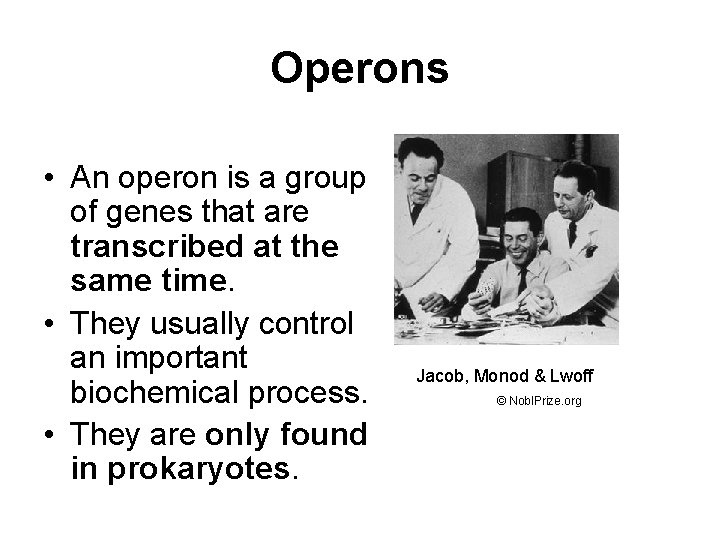
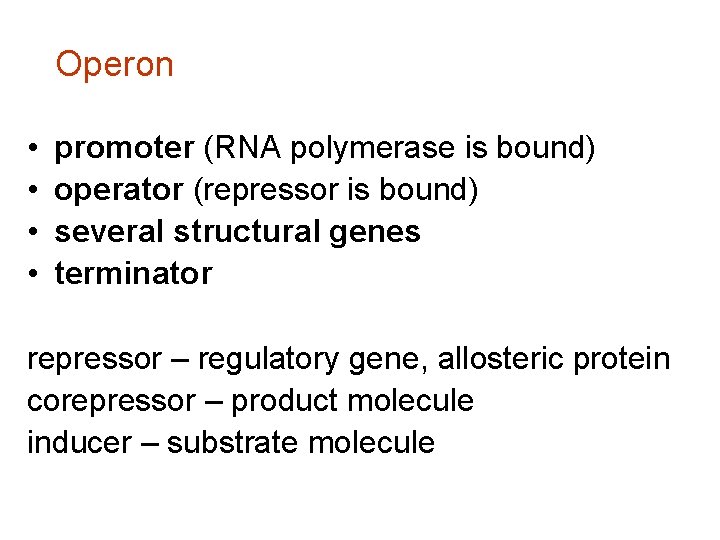
Operons • An operon is a group of genes that are transcribed at the same time. • They usually control an important biochemical process. • They are only found in prokaryotes. Jacob, Monod & Lwoff © Nobl. Prize. org
Operon • • promoter (RNA polymerase is bound) operator (repressor is bound) several structural genes terminator repressor – regulatory gene, allosteric protein corepressor – product molecule inducer – substrate molecule
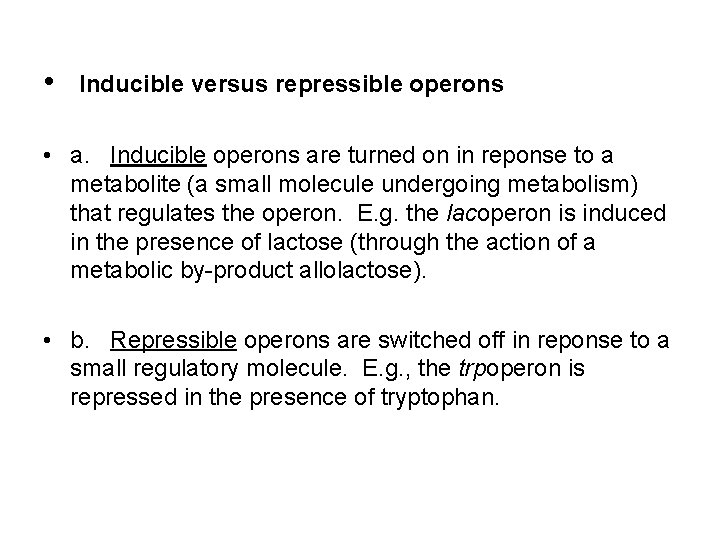
• Inducible versus repressible operons • a. Inducible operons are turned on in reponse to a metabolite (a small molecule undergoing metabolism) that regulates the operon. E. g. the lacoperon is induced in the presence of lactose (through the action of a metabolic by-product allolactose). • b. Repressible operons are switched off in reponse to a small regulatory molecule. E. g. , the trpoperon is repressed in the presence of tryptophan.
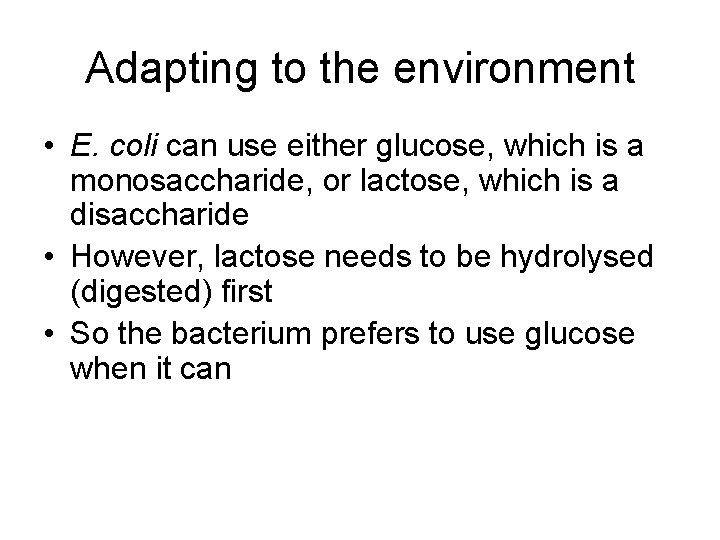
Adapting to the environment • E. coli can use either glucose, which is a monosaccharide, or lactose, which is a disaccharide • However, lactose needs to be hydrolysed (digested) first • So the bacterium prefers to use glucose when it can
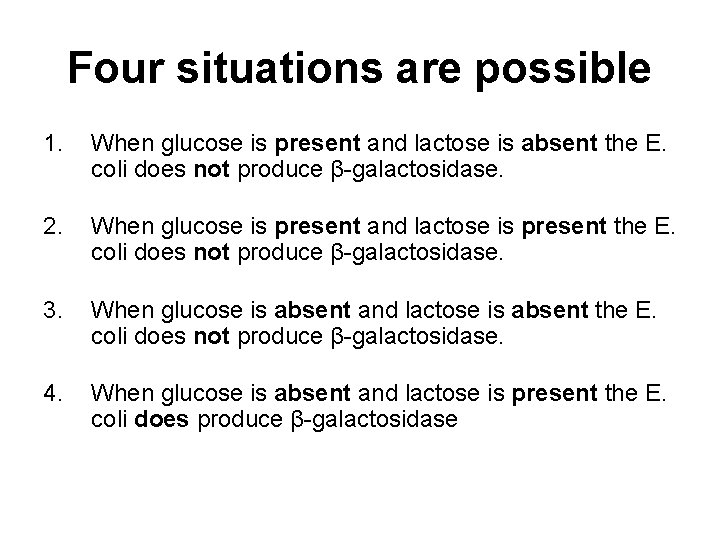
Four situations are possible 1. When glucose is present and lactose is absent the E. coli does not produce β-galactosidase. 2. When glucose is present and lactose is present the E. coli does not produce β-galactosidase. 3. When glucose is absent and lactose is absent the E. coli does not produce β-galactosidase. 4. When glucose is absent and lactose is present the E. coli does produce β-galactosidase
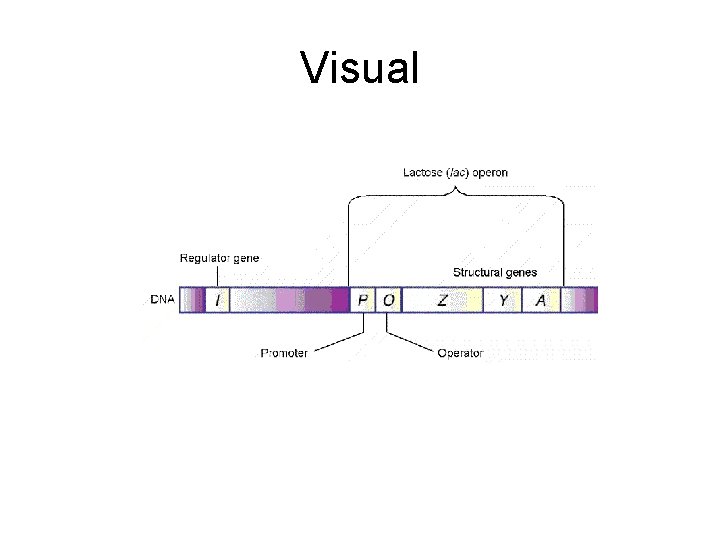
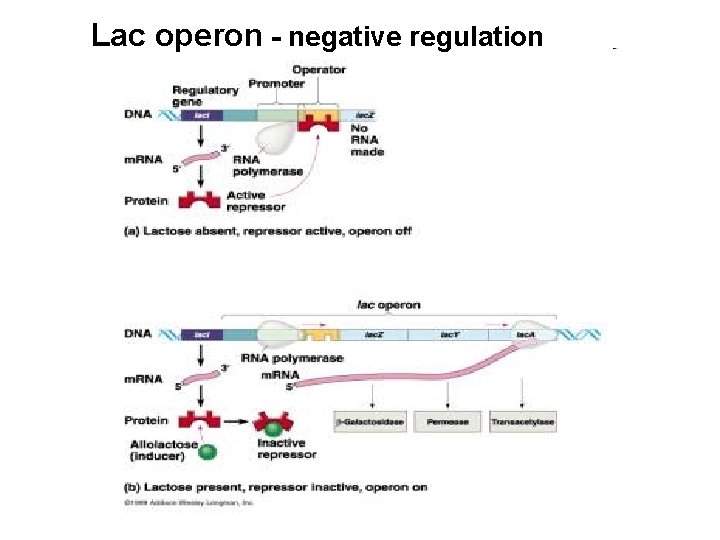
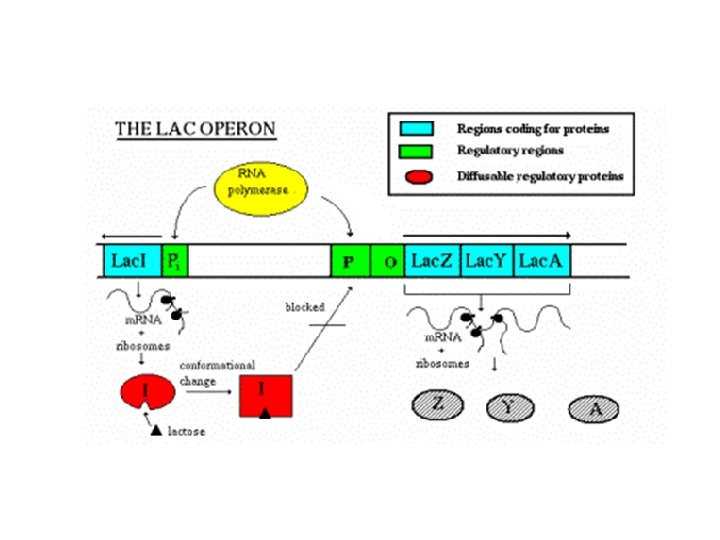
Structure of the lac Operon • The lac operon consists of 3 protein-coding genes plus associated control regions. • The 3 genes are called z, y, and a. lac. Z codes for the enzyme beta-galactosidase, which splits lactose into glucose plus galactose. lac. Y codes for a “permease” protein that allows lactose to enter the cell, and lac. A codes for an enzyme that acetylates lactose. Together these three genes are called the “structural genes”. We will mainly focus on lac. Z. • All 3 genes of the lac operon are transcribed on the same messenger RNA. Ribosomes translate the 3 proteins independently. This is a feature of prokaryotes that is only very rarely seen in eukaryotes, where 1 gene per m. RNA is the rule.
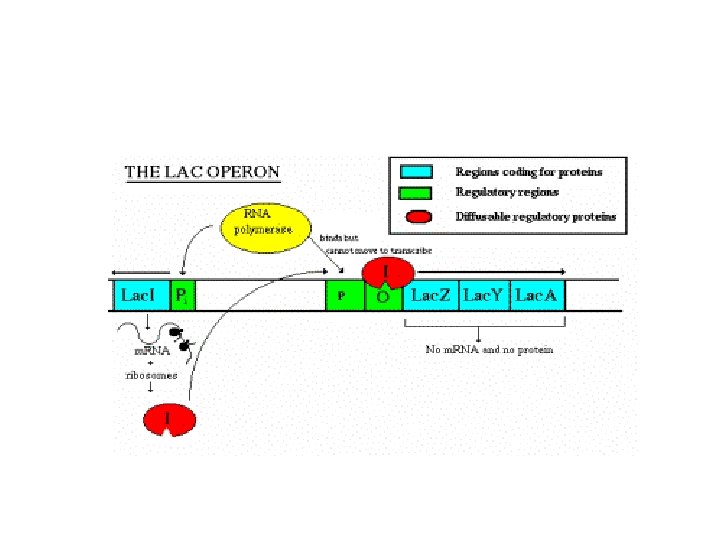
Control Regions • Near the lac operon is another gene, called lac. I, or just “i”. It codes for the lac repressor protein, which plays an essential role in lac operon control. The lac repressor gene is expressed “constitutively”, meaning that it is always on (but at a low level). It is a completely separate gene, producing a different m. RNA than the lac operon. • Just upstream from the transcription start point in the lac operon are two regions called the operator (o) and the promoter (p). Neither region codes for protein: they act as binding sites on the DNA for important proteins. • The promoter is the site where RNA polymerase binds to start transcription. Promoters are found upstream from all protein-coding genes. • The operator is where the actual control occurs.
Visual
Control • The lac repressor protein (made by lac. I) has 2 states: it can either bind to lactose (technically, to a lactose derivative called allolactose) or it can bind to the operator region of the lac operon. • In the presence of lactose, the repressor binds to it, and the repressor-lactose complexes float freely in the cytoplasm away from the DNA. In this situation, RNA polymerase can bind to the promoter, and the gene is transcribed. It makes beta-galactosidase which digests the lactose. • In the absence of lactose, the repressor binds to the operator DNA. The repressor is a large molecule, and when it is bound to the operator, RNA polymerase is blocked from reaching the promoter. The lac operon is not transcribed, and no beta-galactosidase is made. • If lactose appears, the operon is said to be “induced”. The lactose binds to the repressor, which then falls off the operator and allows transcription to occur.
Lac operon - negative regulation
Negative and Positive Regulation • As described above, the lac operon is negatively regulated: the regulatory protein (repressor) causes transcription to stop. • Positive regulation, where the regulatory protein causes transcription to start, is more common. • The lac operon also contains an example of positive regulation, called “catabolite repression”. E. coli would prefer to use glucose as its food source. In the presence of glucose, the lac operon (and other similar genes) are turned off, even if lactose is present in the medium.
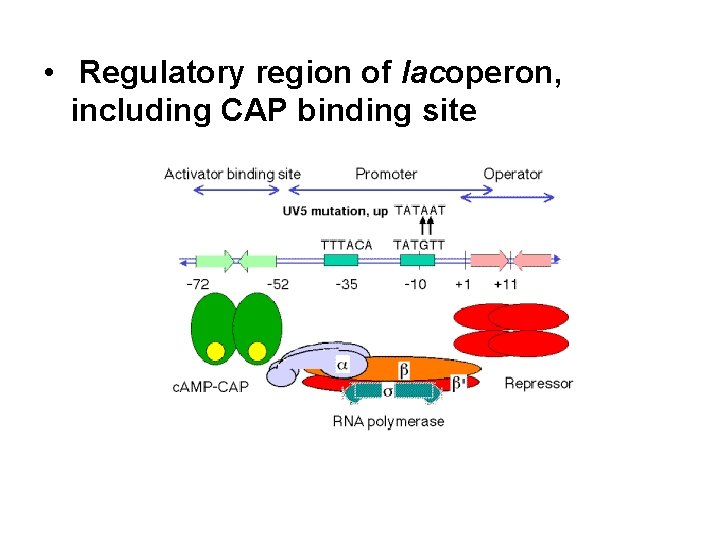
Binding of c. AMP-CAP to its site will enhance efficiency of transcription initiation at promoter • a. The lacpromoter is not a particularly strong promoter. The sequence at -10, TATGTT, does not match the consensus (TATAAT) at two positions. • • b. In the presence of c. AMP-CAP, the RNA polymerase will initiate transcription more efficiently.
• Regulatory region of lacoperon, including CAP binding site
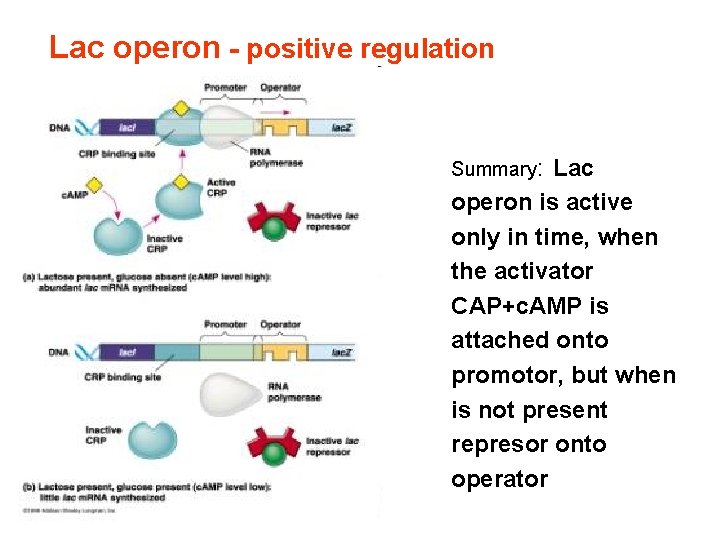
Lac operon - positive regulation Summary: Lac operon is active only in time, when the activator CAP+c. AMP is attached onto promotor, but when is not present represor onto operator
Catabolite Repression • Catabolite repression uses a regulatory protein called CAP (catabolite activator protein). It also uses the small molecule cyclic AMP (c. AMP). • c. AMP is made from ATP. When the glucose level in the cell is high, the c. AMP level is low, because glucose inhibits synthesis of c. AMP. When the glucose level is low, the c. AMP level is high. • c. AMP combines with the CAP protein to form a complex that binds to part of the lac operon promoter. This complex bends the DNA in a way that makes it much easier for RNA polymerase to bind to the promoter. This allows transcription to occur, but only if the lac repressor isn’t present. • Thus, low glucose levels cause high c. AMP levels. When c. AMP is high, it combines with CAP The CAP-c. AMP complex then binds to the promoter to allow transcription to occur. • This is positive regulation because the binding of CAP to the DNA causes transcription to occur.
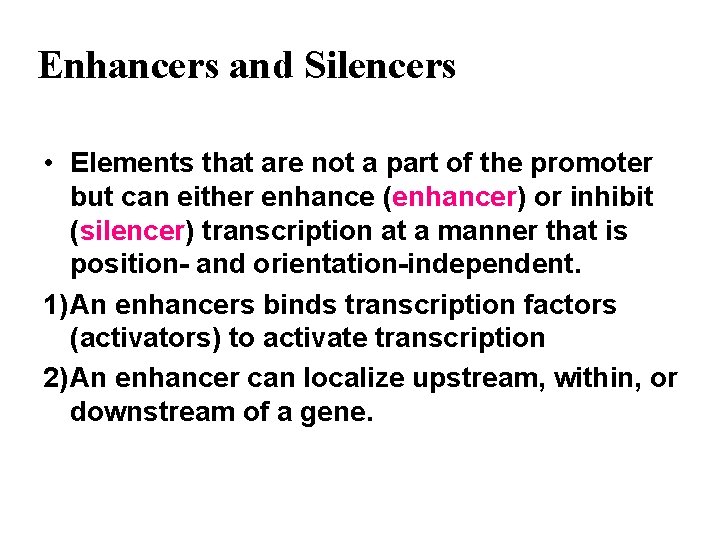
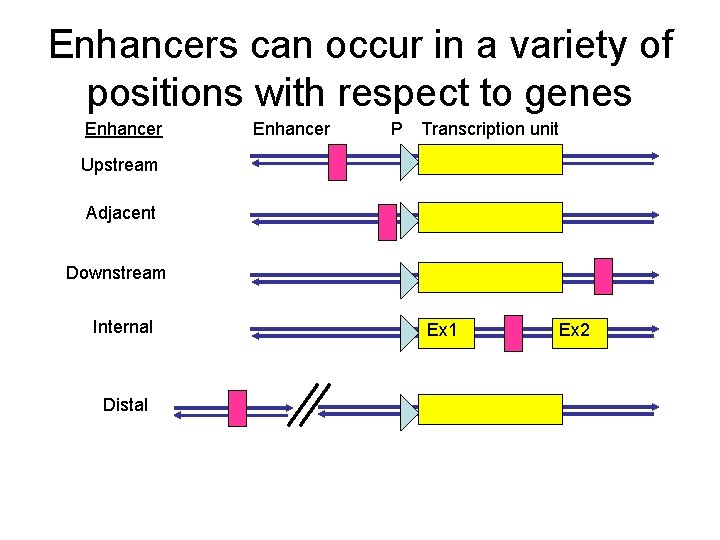
Enhancers and Silencers • Elements that are not a part of the promoter but can either enhance (enhancer) or inhibit (silencer) transcription at a manner that is position- and orientation-independent. 1) An enhancers binds transcription factors (activators) to activate transcription 2) An enhancer can localize upstream, within, or downstream of a gene.
Enhancers can occur in a variety of positions with respect to genes Enhancer P Transcription unit Upstream Adjacent Downstream Internal Distal Ex 1 Ex 2