
Gene Regulation 1 Organisms have lots of genetic

- Slides: 23
Gene Regulation 1 • Organisms have lots of genetic information, but they don’t necessarily want to use all of it (or use it fully) at one particular time. • Eukaryotes: Development, differentiation, and homeostasis – In going from zygote to fetus, e. g. , many genes are used that are then turned off. – Liver cells, brain cells, use only certain genes – Cells respond to internal, external signals
Gene regulation continued • Prokaryotes: respond rapidly to environment – Transcription and translation are expensive • Each nucleotide = 2 ATP in transcription • Several GTP/ATP per amino acid in translation • If protein is not needed, don’t waste energy! – Changes in food availability, environmental conditions lead to differential gene expression • Degradation genes turned on to use C source • Bacteria respond to surfaces, new flagella etc. • Quorum sensing: sufficient # of individuals turns on genes. 2
On/off, up/down, together • Sometimes genes are off completely and never transcribed again; some are just turned up or down – Eukaryotic genes typically turned up and down a little compared to huge increases for prokaryotes. • Genes that are “on” all the time = Constitutive • Many genes can be regulated “coordinately” – Eukaryotes: genes may be scattered about, turned up or down by competing signals. – Prokaryotes: genes often grouped in operons, several genes transcribed together in 1 m. RNA. 3
How is gene expression controlled? 4 1. Transcription: most common step in control. 2. RNA processing: only in eukaryotes. • Alternate splicing changes type/amount of protein. 3. Translation: prokaryotes, stops transl. early. 4. Stability of m. RNA: longer lived, more product. 5. Post-translational: change protein after it’s made. Process precursor or add PO 4 group. 6. DNA rearrangements. Genes change position relative to promoters, or exons shuffled.
Gene regulation in Prokaryotes • Bacteria were models for working out the basic mechanisms, but eukaryotes are different. • Some genes are constitutive, others go from extremely low expression (“off”) to high expression when “turned on”. • Many genes are coordinately regulated. – Operon: consecutive genes regulated, transcribed together; polycistronic m. RNA. – Regulon: genes scattered, but regulated together. 5
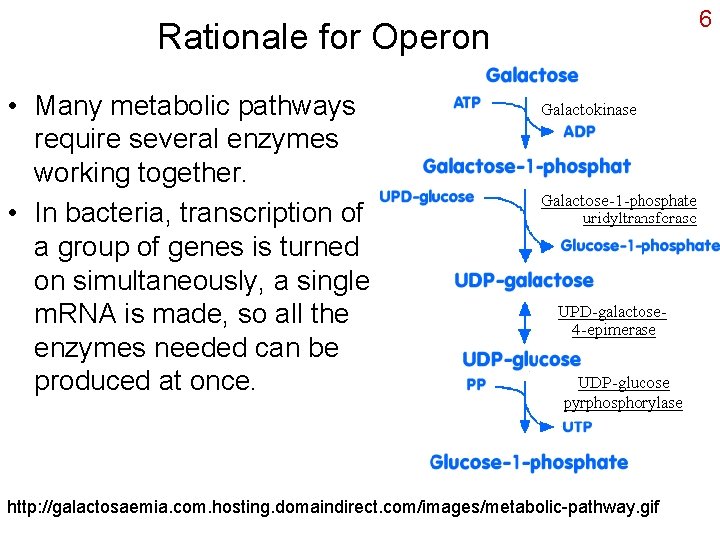
Rationale for Operon • Many metabolic pathways require several enzymes working together. • In bacteria, transcription of a group of genes is turned on simultaneously, a single m. RNA is made, so all the enzymes needed can be produced at once. http: //galactosaemia. com. hosting. domaindirect. com/images/metabolic-pathway. gif 6
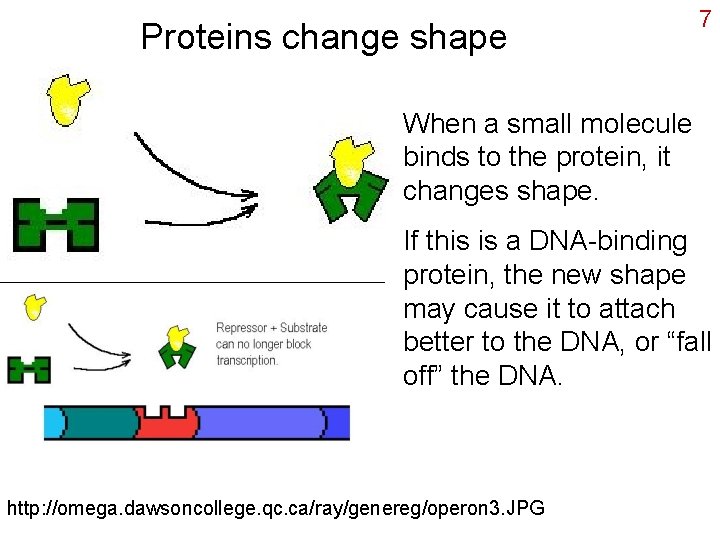
Proteins change shape 7 When a small molecule binds to the protein, it changes shape. If this is a DNA-binding protein, the new shape may cause it to attach better to the DNA, or “fall off” the DNA. http: //omega. dawsoncollege. qc. ca/ray/genereg/operon 3. JPG
Definitions concerning operon regulation • Control can be Positive or Negative 8 – Positive control means a protein binds to the DNA which increases transcription. – Negative control means a protein binds to the DNA which decreases transcription. • Induction – Process in which genes normally off get turned on. – Usually associated with catabolic genes. • Repression – Genes normally on get turned off. – Usually associated with anabolic genes.
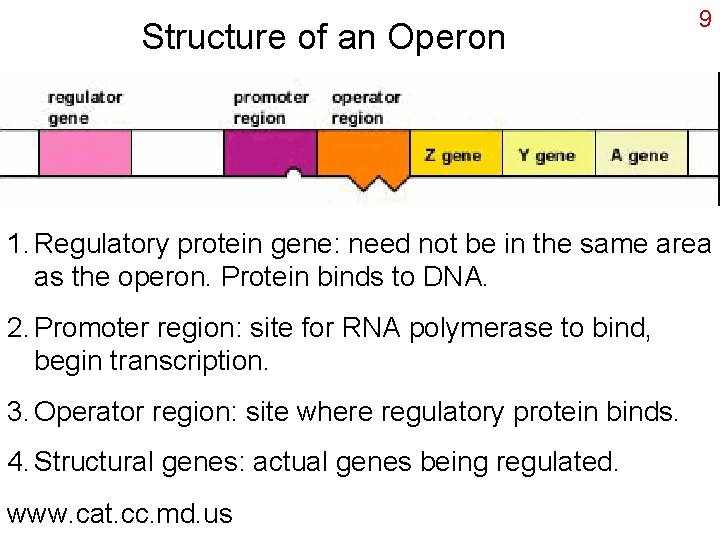
Structure of an Operon 9 1. Regulatory protein gene: need not be in the same area as the operon. Protein binds to DNA. 2. Promoter region: site for RNA polymerase to bind, begin transcription. 3. Operator region: site where regulatory protein binds. 4. Structural genes: actual genes being regulated. www. cat. cc. md. us
Animations • • 10 http: //www. cat. cc. md. us/courses/bio 141/lecguide/unit 4/genetics/protsyn/regulation/ionoind. html http: //www. cat. cc. md. us/courses/bio 141/lecguide/unit 4/genetics/protsyn/regulation/ioind. html • Animation showing the effects of the lactose repressor on the lac operon. • Cut and paste addresses into your browser; will give you some idea of how repressor proteins interact with operator regions to control transcription.
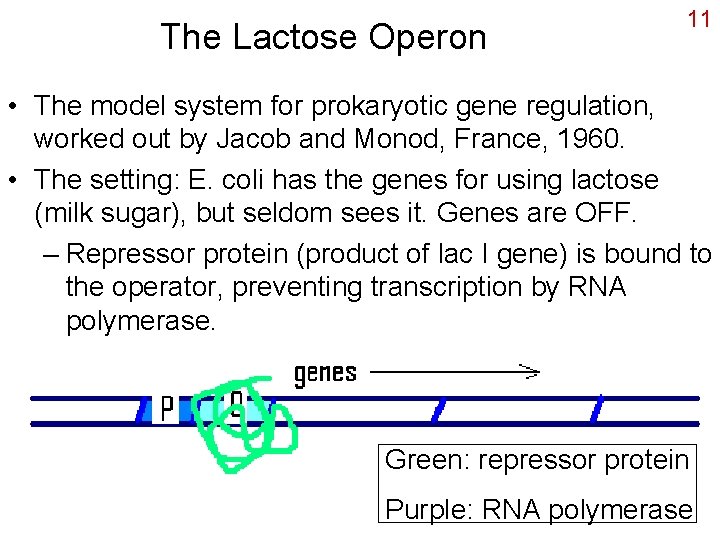
The Lactose Operon 11 • The model system for prokaryotic gene regulation, worked out by Jacob and Monod, France, 1960. • The setting: E. coli has the genes for using lactose (milk sugar), but seldom sees it. Genes are OFF. – Repressor protein (product of lac I gene) is bound to the operator, preventing transcription by RNA polymerase. Green: repressor protein Purple: RNA polymerase
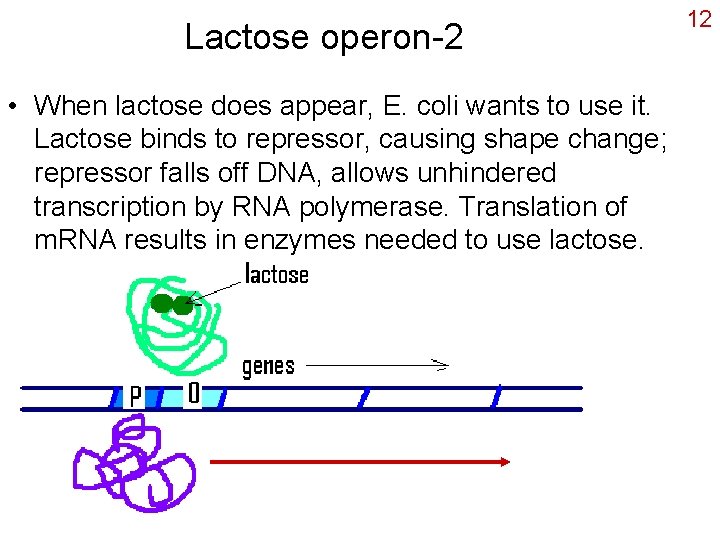
Lactose operon-2 • When lactose does appear, E. coli wants to use it. Lactose binds to repressor, causing shape change; repressor falls off DNA, allows unhindered transcription by RNA polymerase. Translation of m. RNA results in enzymes needed to use lactose. 12
Lactose operon definitions 13 • Control is Negative – When repressor protein is bound to the DNA, transcription is shut off. • This operon is inducible – Lactose is normally not available as a carbon source; genes are “shut off” – In bacteria, many similar operons exist for using other organic molecules. – Genes for transporting the sugar, breaking it down are produced.
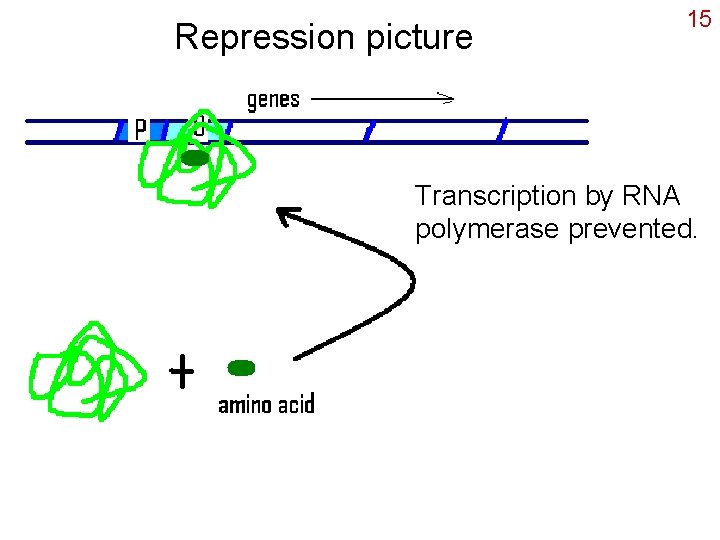
Repressible operons 14 • Operon codes for enzymes that make a needed amino acid (for example); genes are “on”. – Repressor protein is NOT attached to DNA – Transcription of genes for enzymes needed to make amino acid is occurring. • The change: amino acid is now available in the culture medium. Enzymes normally needed for making it are no longer needed. – Amino acid, now abundant in cell, binds to repressor protein which changes shape, causing it to BIND to operator region of DNA. Transcription is stopped. • This is also Negative regulation (protein + DNA = off).
Repression picture 15 Transcription by RNA polymerase prevented.
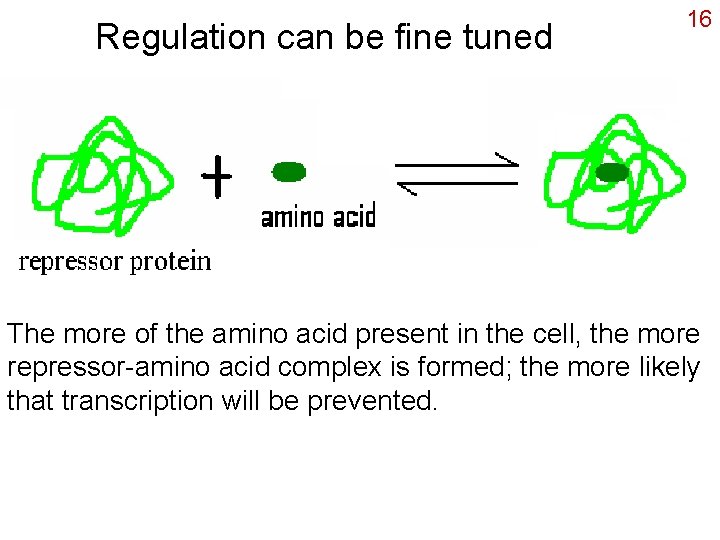
Regulation can be fine tuned 16 The more of the amino acid present in the cell, the more repressor-amino acid complex is formed; the more likely that transcription will be prevented.
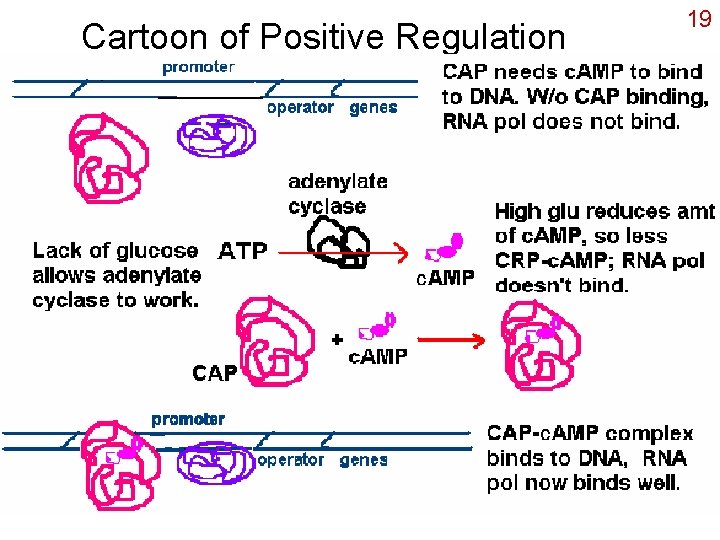
Positive regulation 17 • Binding of a regulatory protein to the DNA increases (turns on) transcription. – More common in eukaryotes. • Prokaryotic example: the CAP-c. AMP system – Catabolite-activating Protein – c. AMP: ATP derivative, acts as signal molecule – When CAP binds to c. AMP, creates a complex that binds to DNA, turning ON transcription. – Whethere is enough c. AMP in the cell to combine with CAP depends on glucose conc.
Positive regulation-2 18 • Glucose is preferred nutrient source – Other sugars (lactose, etc. ) are not. • Glucose inhibits activity of adenylate cyclase, the enzyme that makes c. AMP from ATP. • When glucose is high, c. AMP is low, less c. AMP is available to bind to CAP. – CAP is “free”, doesn’t bind to DNA, genes not on. • When glucose is low, c. AMP is high – Lots of c. AMP, so CAP-c. AMP forms, genes on. • Works in conjunction with induction.
Cartoon of Positive Regulation 19
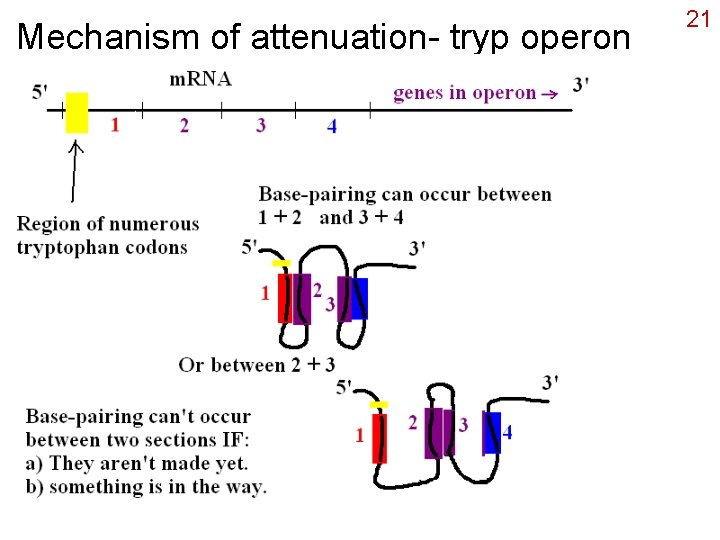
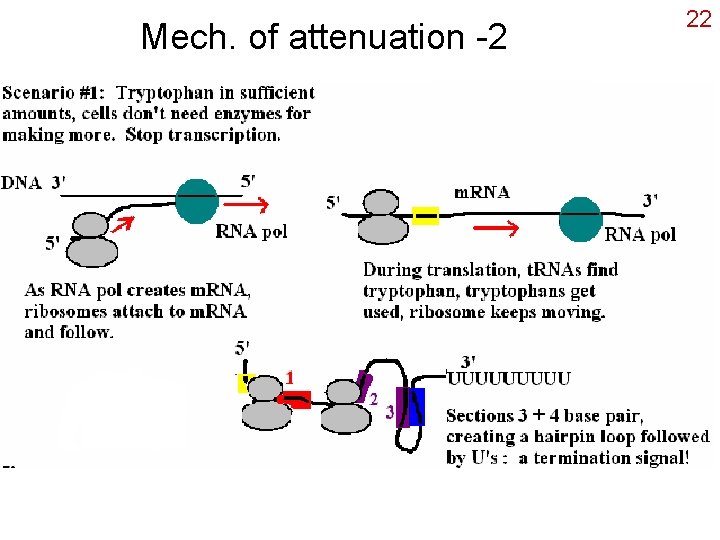
Attenuation: fine tuning repression 20 • Attenuation occurs in prokaryotic repressible operons. Happens when transcription is on. • Regulation at the level of translation • Several things important: – Depends on base-pairing between complementary sequences of m. RNA – Requires simultaneous transcription/translation – Involves delays in progression of ribosomes on m. RNA
Mechanism of attenuation- tryp operon 21
Mech. of attenuation -2 22
Attenuation-3 23