
Gene prediction is based on understanding how to
Gene prediction. . . is based on understanding how to interpret the genetic code ● DNA to Protein ● 6 -frame translations ● codon bias and the identification of coding potential ● bioinformatic tools that use coding potential to identify genes is further based on alignments with known entities (previously identified genes and proteins) The following slides contain activities and some supporting text to explain and enhance understanding in the first content areas described above. Alignment to Blast and HHpred comparison tools are not part of this slide set. 1
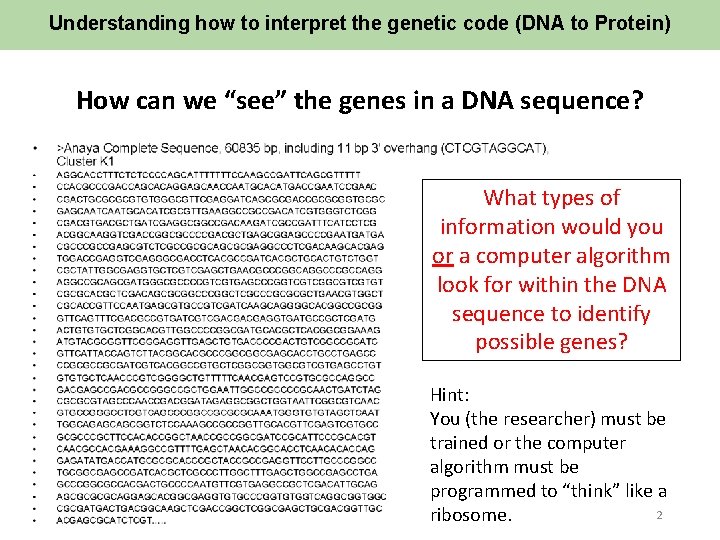
Understanding how to interpret the genetic code (DNA to Protein) How can we “see” the genes in a DNA sequence? What types of information would you or a computer algorithm look for within the DNA sequence to identify possible genes? Hint: You (the researcher) must be trained or the computer algorithm must be programmed to “think” like a 2 ribosome.

Understanding how to interpret the genetic code (DNA to Protein) How are nucleotide sequences translated to proteins? Which strand of DNA below most closely resembles the messenger RNA after transcription? ds. DNA coding strand 5’ A G C C C G A T G T G A C C G A G G T T G A T G C C G T T C G C T 3’ T C G G G C T A C A C T G G C T C C A A C T A C G G C A A G C G A template strand m. RNA 5’A G C C C G A T U G U G A C C G A G G U U G A U G C C G U U C G C U The top strand beginning with 5’ to the left is the strand most like the m. RNA. The m. RNA is transcribed from the bottom template strand with 3’ to the left. The top stand is called the coding strand because the sequence corresponds to the codons that are translated into amino acids. Now that you know how this works in the cell, we’ll skip transcription and translate the coding strand directly to amino acids when analyzing translation options. 3

Understanding how to interpret the genetic code (DNA to Protein) By Genomics Education Programme - Process of transcription, CC BY 2. 0, https: //commons. wikimedia. org/w/index. php? curid=50542917 4

Understanding how to interpret the genetic code (6 -frame translations) There are six different ways to translate each double-stranded DNA sequence. Six-frame translation view of double-stranded (ds) DNA. This segment of DNA starts with nucleotide basepair 1 and continues to basepair 175. Both above and below the DNA sequence are letters representing Amino Acids. The top row of DNA sequence is translated in the forward direction (from left to right), whereas the bottom sequence is translated in the reverse direction (from right to left). Notice that the Amino Acid that is produced depends on which 3 basepair codon is translated. Depending on which is the first base in the codon, each DNA strand can be translated to amino acids in three different ways. Thus, since there are two strands of DNA there are six possible translations of this molecule of DNA. Likely, the ribosome will only translate along one of the lines at a time rather than jump back and forth. 5

Understanding how to interpret the genetic code (6 -frame translations) Identify Stop and Start codons to locate Open Reading Frames STOP Codons = TAG, TAA, TGA START Codons = ATG (GTG, TTG) For more information consult your bio textbook or https: //www. nature. com/scitable/topicpage/translation-dna-tomrna-to-protein-393 6

Understanding how to interpret the genetic code (6 -frame translations) Identify Stop and Start codons to locate Open Reading Frames • An Open Reading Frame (ORF) is the DNA sequence located between a start and a stop codon. • Not every ORF codes for a protein http: //slideplayer. com/slide/5750865/19/images/22/Lecture+3. +Gene+Finding+and+Sequence+Annotation. jpg 7
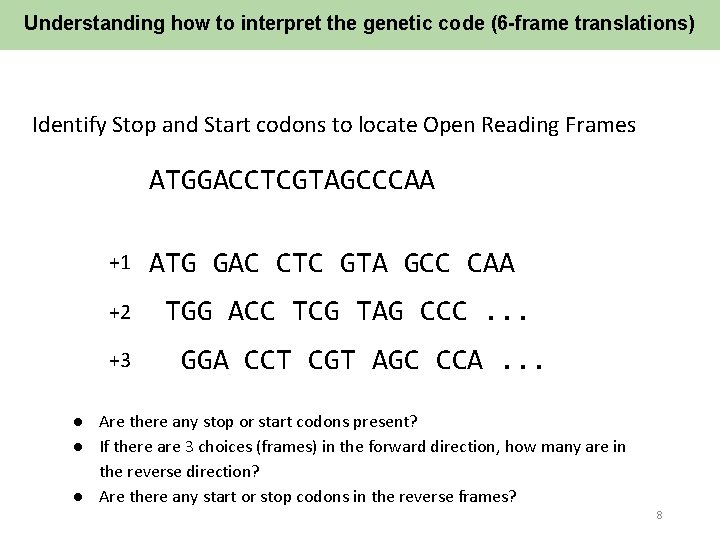
Understanding how to interpret the genetic code (6 -frame translations) Identify Stop and Start codons to locate Open Reading Frames ATGGACCTCGTAGCCCAA +1 +2 +3 ATG GAC CTC GTA GCC CAA TGG ACC TCG TAG CCC. . . GGA CCT CGT AGC CCA. . . ● Are there any stop or start codons present? ● If there are 3 choices (frames) in the forward direction, how many are in the reverse direction? ● Are there any start or stop codons in the reverse frames? 8

Understanding how to interpret the genetic code (6 -frame translations) Instructions: 1. Using the coding DNA strand below, separate the nucleotides into codons for each reading frame (+1, +2, +3, -1, -2, -3). 2. Use your codon chart to translate the first 5 amino acids in each reading frame. Use the 1 -letter code for each amino acid. 3. Use a highlighter to indicate any potential starts (ATG, TTG, GTG) +3 +2 +1 5’ A G C C C G A T G T G A C C G A G G T T G A T G C C G T T C G C T 3’ T C G G G C T A C A C T G G C T C C A A C T A C G G C A A G C G A 3’ 5’ -1 -2 -3 9
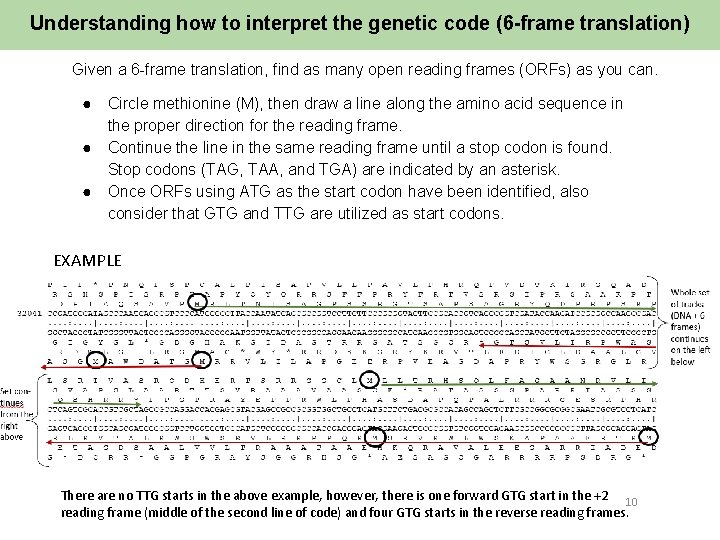
Understanding how to interpret the genetic code (6 -frame translation) Given a 6 -frame translation, find as many open reading frames (ORFs) as you can. ● ● ● Circle methionine (M), then draw a line along the amino acid sequence in the proper direction for the reading frame. Continue the line in the same reading frame until a stop codon is found. Stop codons (TAG, TAA, and TGA) are indicated by an asterisk. Once ORFs using ATG as the start codon have been identified, also consider that GTG and TTG are utilized as start codons. EXAMPLE There are no TTG starts in the above example, however, there is one forward GTG start in the +2 10 reading frame (middle of the second line of code) and four GTG starts in the reverse reading frames.

Understanding how to interpret the genetic code (6 -frame translation) A 6 -frame translation of the entire phage genome being studied is available through a variety of bioinformatic tools used for gene annotation. The following slides show sample outputs from. . . ● DNA Master, ● Gene. Mark, ● PECAAN, and the ● DNA Master Frames window. 11
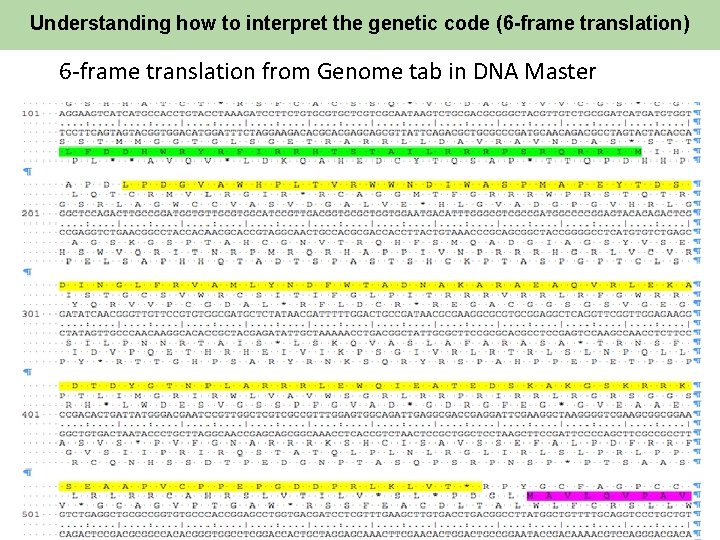
Understanding how to interpret the genetic code (6 -frame translation) 6 -frame translation from Genome tab in DNA Master 12
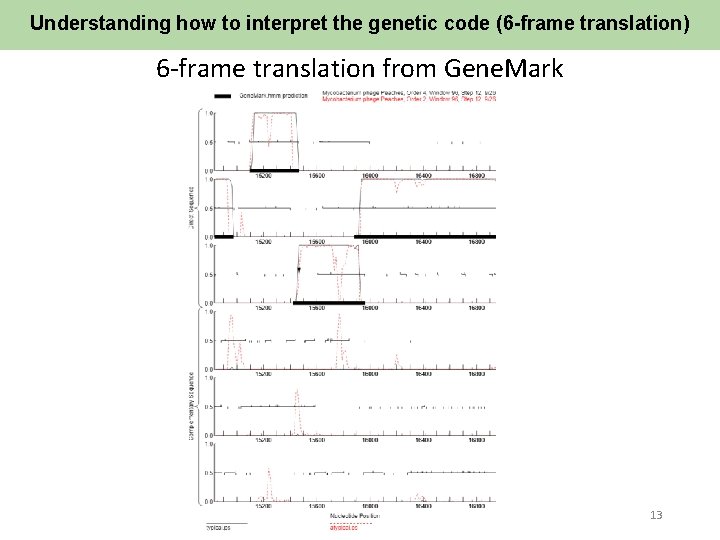
Understanding how to interpret the genetic code (6 -frame translation) 6 -frame translation from Gene. Mark 13
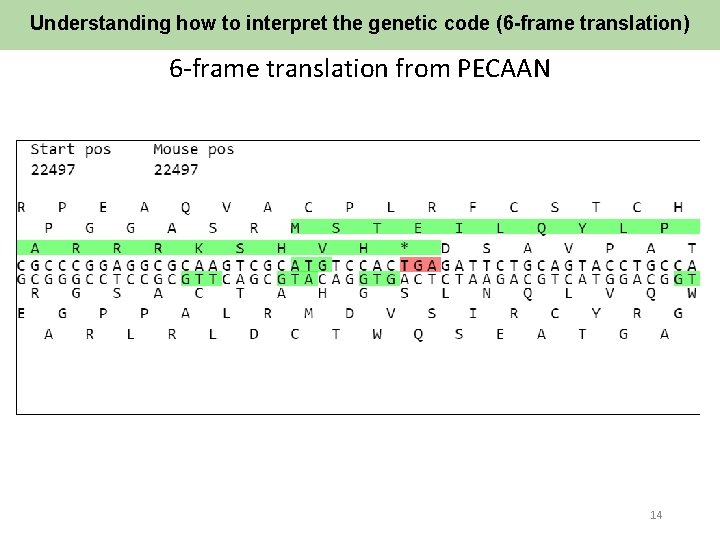
Understanding how to interpret the genetic code (6 -frame translation) 6 -frame translation from PECAAN 14
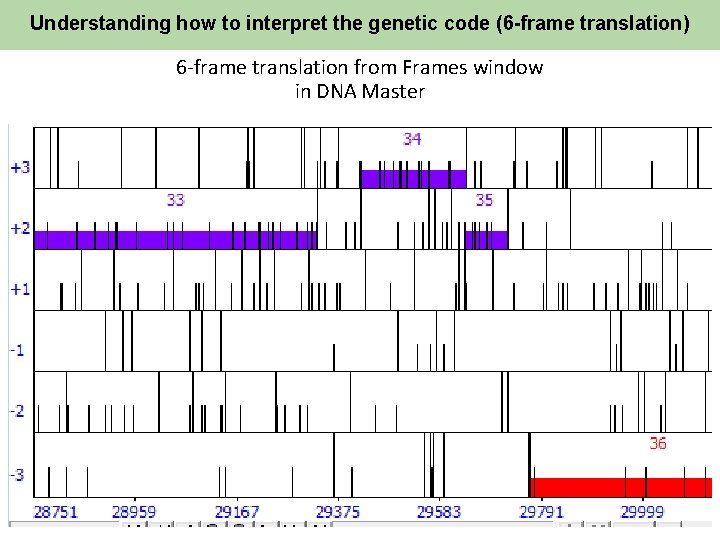
Understanding how to interpret the genetic code (6 -frame translation) 6 -frame translation from Frames window in DNA Master 15
Understanding how to interpret the genetic code (6 -frame translation) According to the Guiding Principles of genome annotation in any segment of DNA, typically one frame in one strand is used for a protein-coding gene. That is, each double-stranded segment of DNA is generally part of only one gene. Also, genes do not often overlap by more than a few basepairs, although up to about 30 bp is legitimate. Gene density of phage genomes is very high, so genes tend to be tightly packed. Thus, there are typically not large non-coding gaps between genes. Once ORFs have been identified there are some basic guidelines to follow to determine which ORFs contain genes. The first three guiding principles used to identify phage genes are above. The remaining slides tackle the idea of coding potential and the bioinformatic tools used to illuminate ORFs that have good coding potential. 16
Understanding how to interpret the genetic code (coding potential) Codon Bias determines the Coding Potential of an Open Reading Frame Multiple ORFs can be identified within the 6 -frame translation from a single strand of DNA, but not all ORFs are translated to proteins. One way the decision about which ORFs are translated can be made is by understanding codon bias. Since most amino acids are encoded by more than one codon, most organisms exhibit a codon preference or “bias” and use certain codons far more frequently than others. Once the organism’s codon bias is determined those ORFs that use the preferred codons are the ones that are most likely to be translated. 17
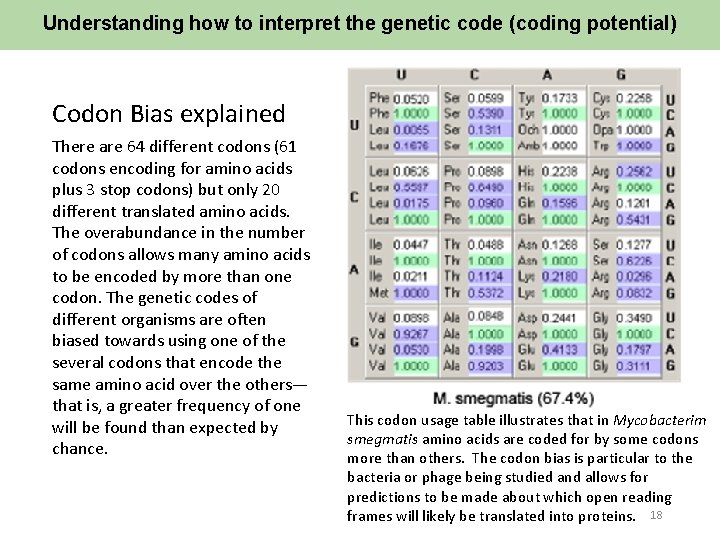
Understanding how to interpret the genetic code (coding potential) Codon Bias explained There are 64 different codons (61 codons encoding for amino acids plus 3 stop codons) but only 20 different translated amino acids. The overabundance in the number of codons allows many amino acids to be encoded by more than one codon. The genetic codes of different organisms are often biased towards using one of the several codons that encode the same amino acid over the others— that is, a greater frequency of one will be found than expected by chance. This codon usage table illustrates that in Mycobacterim smegmatis amino acids are coded for by some codons more than others. The codon bias is particular to the bacteria or phage being studied and allows for predictions to be made about which open reading frames will likely be translated into proteins. 18
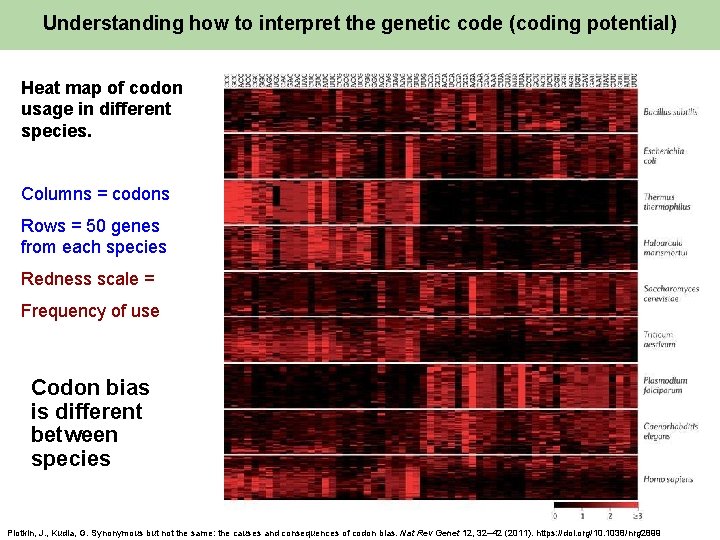
Understanding how to interpret the genetic code (coding potential) Heat map of codon usage in different species. Columns = codons Rows = 50 genes from each species Redness scale = Frequency of use Codon bias is different between species Plotkin, J. , Kudla, G. Synonymous but not the same: the causes and consequences of codon bias. Nat Rev Genet 12, 32– 42 (2011). https: //doi. org/10. 1038/nrg 2899
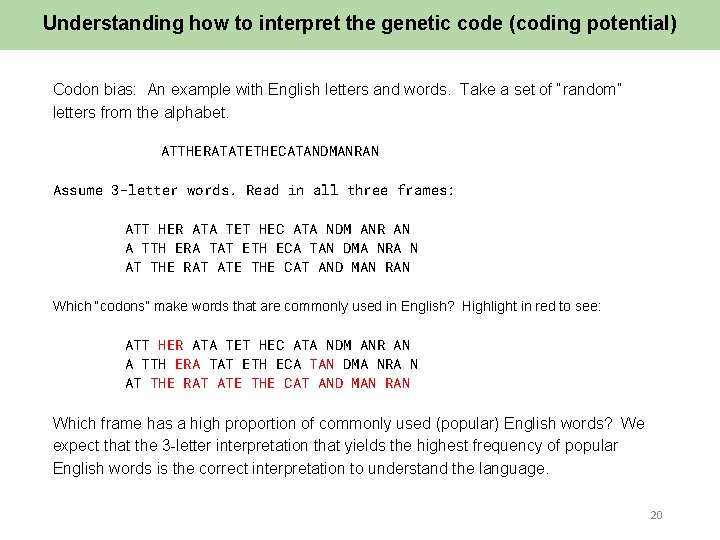
Understanding how to interpret the genetic code (coding potential) Codon bias: An example with English letters and words. Take a set of “random” letters from the alphabet. ATTHERATATETHECATANDMANRAN Assume 3 -letter words. Read in all three frames: ATT HER ATA TET HEC ATA NDM ANR AN A TTH ERA TAT ETH ECA TAN DMA NRA N AT THE RAT ATE THE CAT AND MAN RAN Which “codons” make words that are commonly used in English? Highlight in red to see: ATT HER ATA TET HEC ATA NDM ANR AN A TTH ERA TAT ETH ECA TAN DMA NRA N AT THE RAT ATE THE CAT AND MAN RAN Which frame has a high proportion of commonly used (popular) English words? We expect that the 3 -letter interpretation that yields the highest frequency of popular English words is the correct interpretation to understand the language. 20
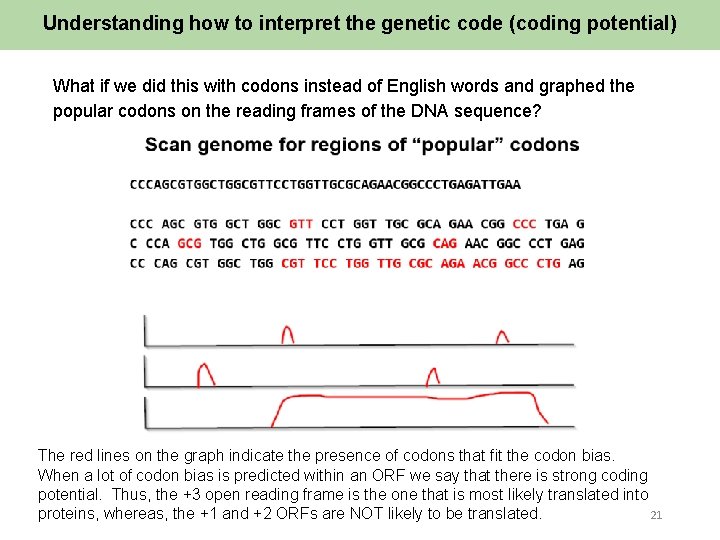
Understanding how to interpret the genetic code (coding potential) What if we did this with codons instead of English words and graphed the popular codons on the reading frames of the DNA sequence? The red lines on the graph indicate the presence of codons that fit the codon bias. When a lot of codon bias is predicted within an ORF we say that there is strong coding potential. Thus, the +3 open reading frame is the one that is most likely translated into 21 proteins, whereas, the +1 and +2 ORFs are NOT likely to be translated.
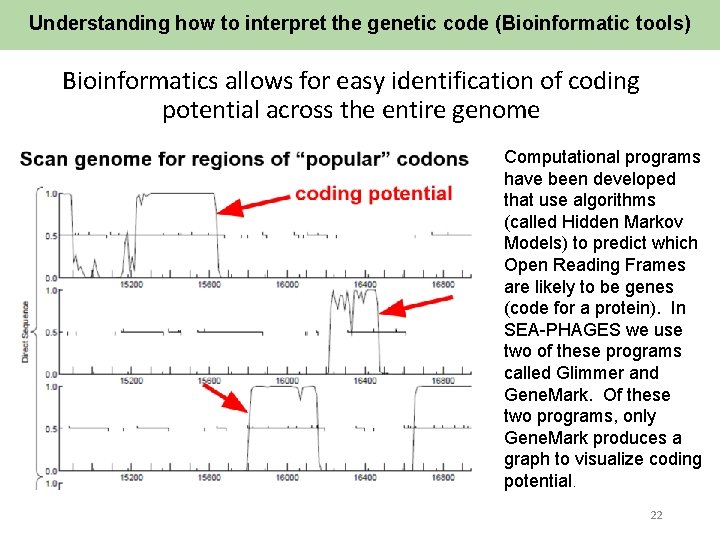
Understanding how to interpret the genetic code (Bioinformatic tools) Bioinformatics allows for easy identification of coding potential across the entire genome Computational programs have been developed that use algorithms (called Hidden Markov Models) to predict which Open Reading Frames are likely to be genes (code for a protein). In SEA-PHAGES we use two of these programs called Glimmer and Gene. Mark. Of these two programs, only Gene. Mark produces a graph to visualize coding potential. 22
Understanding how to interpret the genetic code (Bioinformatic tools) Use the following link to seaphages. org to view a tutorial video on interpreting Gene. Mark graphs https: //seaphages. org/video/90/ According to to thethe Guiding Principles of of genome annotation According Guiding Principles genome annotation coding potential data are, byby far, thethe strongest pieces of of data forfor coding potential data are, strongest pieces data predicting genes. protein-coding genes will have coding predicting genes. Most protein-coding genes have coding potential predicted byby Glimmer, Gene. Mark. S (self), or or potential predicted Glimmer, Gene. Mark. S (self), Gene. Mark. Host. sites should bebe chosen to to include allall coding Gene. Mark. Host. Start sites should chosen include coding potential. 23
Understanding how to interpret the genetic code (Bioinformatic tools) Reflection activity: Students new to the idea of bioinformatics as research may not realize its validity as science nor its broad application. Below are a few articles that may help to facilitate some discussion in this area. Links: https: //elifesciences. org/articles/47381 https: //link. springer. com/article/10. 1007/s 00216 -019 -02074 -9 Question Bank: Discussion prompts 24
- Slides: 24