
Gene Mutations Sickle Shaped Red Blood Cells What
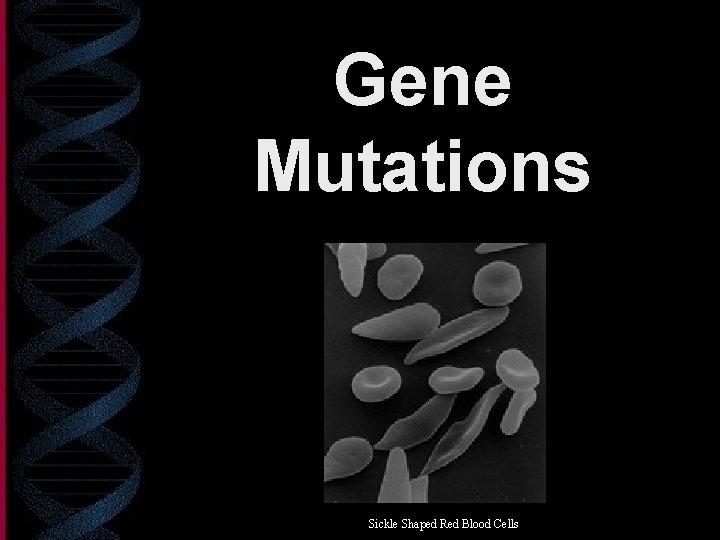
Gene Mutations Sickle Shaped Red Blood Cells
What is a gene mutation? © Mutations are changes in genetic material – changes in DNA code – thus a change in a gene(s) © In gene mutations, the DNA code will have a base (or more) missing, added, or exchanged in a codon.

How common are mutations? ©Mutations occurs at a frequency of about 1 in every 1 billion base pairs ©Everybody has about 6 mutations in each cell in their body!
If I have that many mutations, why don’t I look weird? © Mutations are not always seen. The affected gene may still function. © Mutations may be harmful. © Mutations may be beneficial. © Mutations may have no effect on the organism.
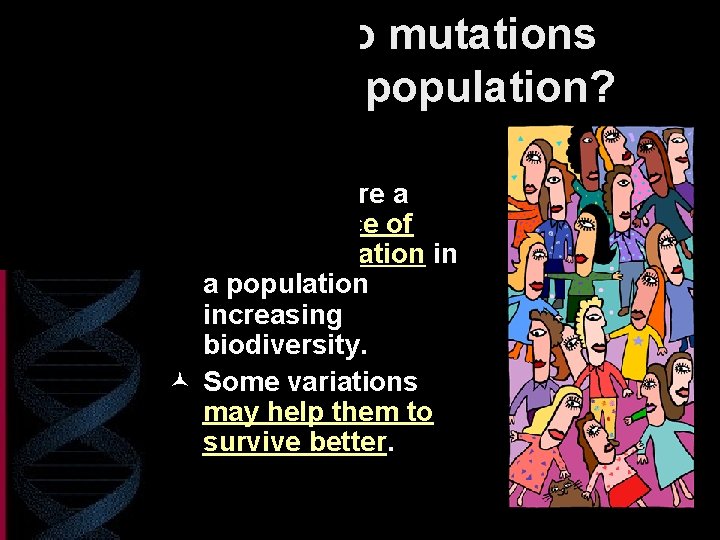
How do mutations affect a population? © Mutations are a major source of genetic variation in a population increasing biodiversity. © Some variations may help them to survive better.
How are mutations inherited? © Only mutations in gametes (egg & sperm) are passed onto offspring. © Mutations in body cells only affect the organism in which they occur and are not passed onto offspring.
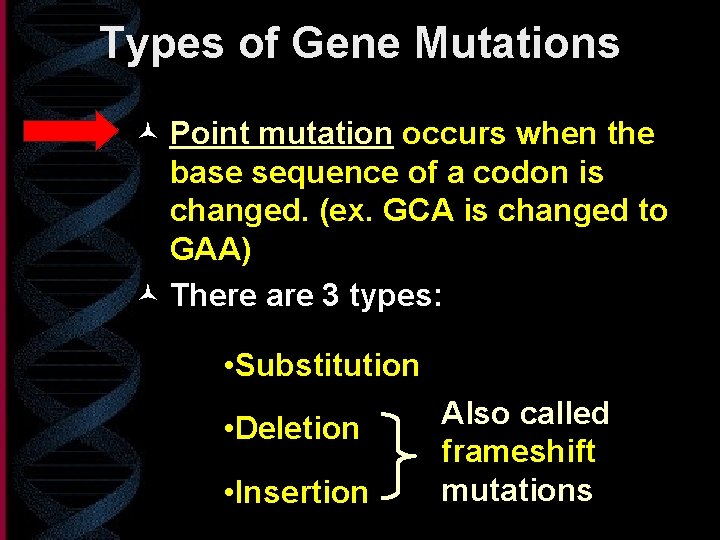
Types of Gene Mutations © Point mutation occurs when the base sequence of a codon is changed. (ex. GCA is changed to GAA) © There are 3 types: • Substitution • Deletion • Insertion Also called frameshift mutations
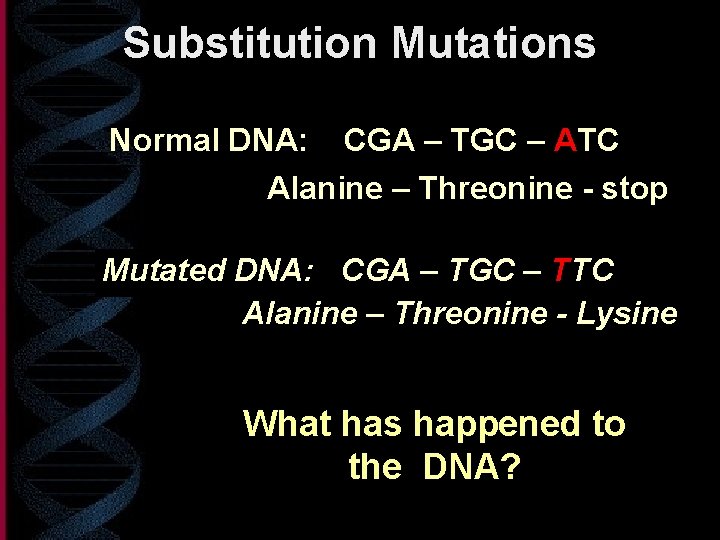
Substitution Mutations Normal DNA: CGA – TGC – ATC Alanine – Threonine - stop Mutated DNA: CGA – TGC – TTC Alanine – Threonine - Lysine What This What Theis has will adenine a substitution happened happen wastoto replaced the amino mutation with DNA? acids? thymine
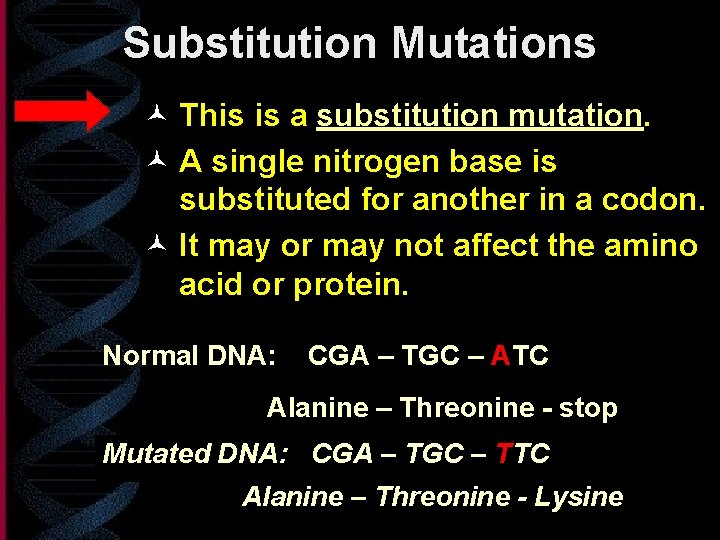
Substitution Mutations © This is a substitution mutation. © A single nitrogen base is substituted for another in a codon. © It may or may not affect the amino acid or protein. Normal DNA: CGA – TGC – ATC Alanine – Threonine - stop Mutated DNA: CGA – TGC – TTC Alanine – Threonine - Lysine
TRY THIS! © On your notebook paper write: The cat ate the rat © Change one letter in the sentence to represent a substitution mutation. © Think-Pair-Share
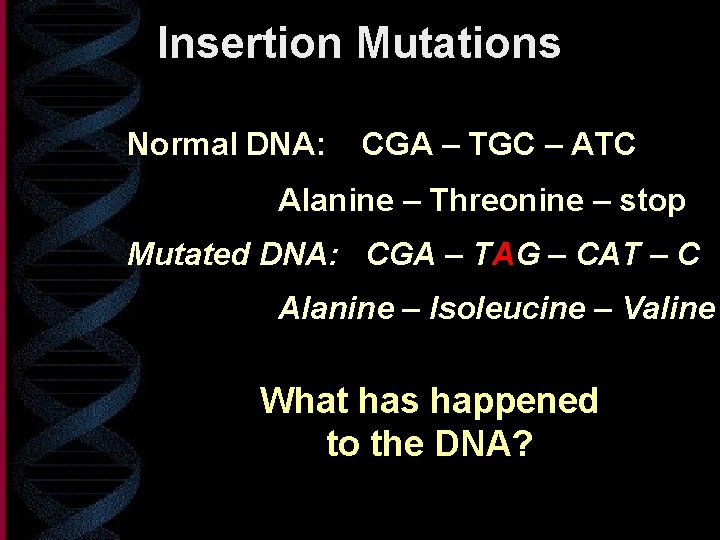
Insertion Mutations Normal DNA: CGA – TGC – ATC Alanine – Threonine – stop Mutated DNA: CGA – TAG – CAT – C Alanine – Isoleucine – Valine An This adenine is an was insertion inserted What will has happened to the mutation, thereby pushing also a type all the of amino to the acids? DNA? other frameshift bases over mutation. a frame.
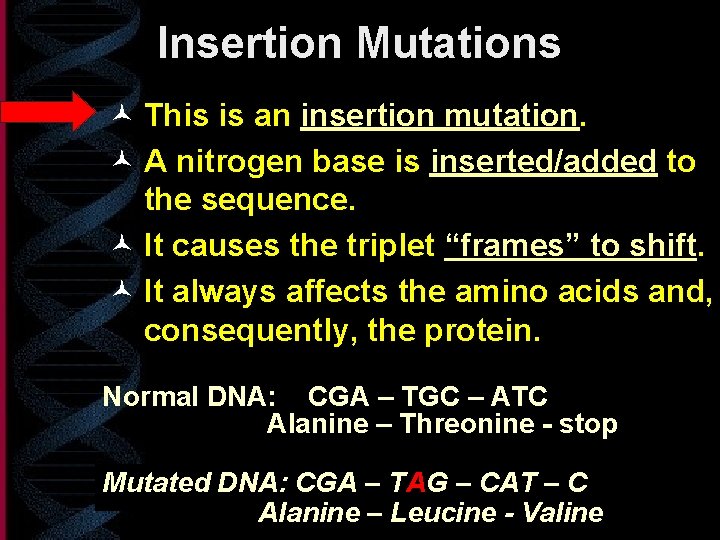
Insertion Mutations © This is an insertion mutation. © A nitrogen base is inserted/added to the sequence. © It causes the triplet “frames” to shift. © It always affects the amino acids and, consequently, the protein. Normal DNA: CGA – TGC – ATC Alanine – Threonine - stop Mutated DNA: CGA – TAG – CAT – C Alanine – Leucine - Valine
TRY THIS! © On your notebook paper write: The cat ate the rat. © Insert a letter into any word above. © Rewrite the sentence. Each word must have only 3 letters to represent the codon. © Discuss the effects on the insertion. © Think-Pair-Share
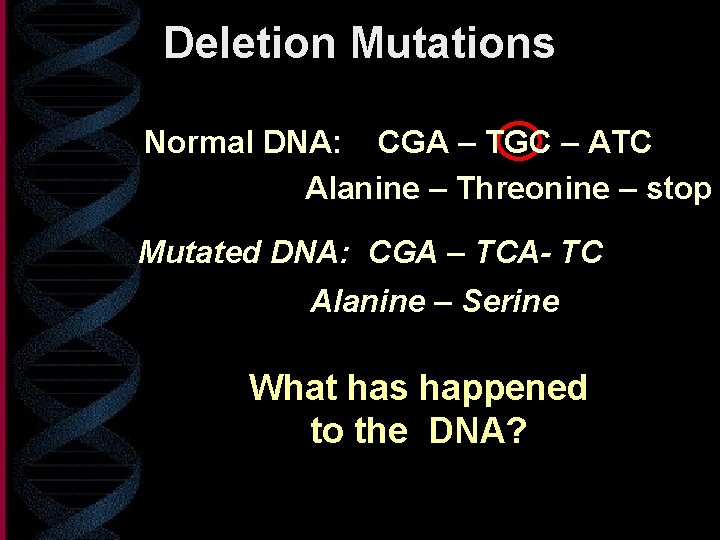
Deletion Mutations Normal DNA: CGA – TGC – ATC Alanine – Threonine – stop Mutated DNA: CGA – TCA- TC Alanine – Serine This What A What guanine iswill called has happen was happened a deleted, deletion to the mutation, thereby amino to the pushing also acids? DNA? a type all the of bases frameshift downmutation. a frame.
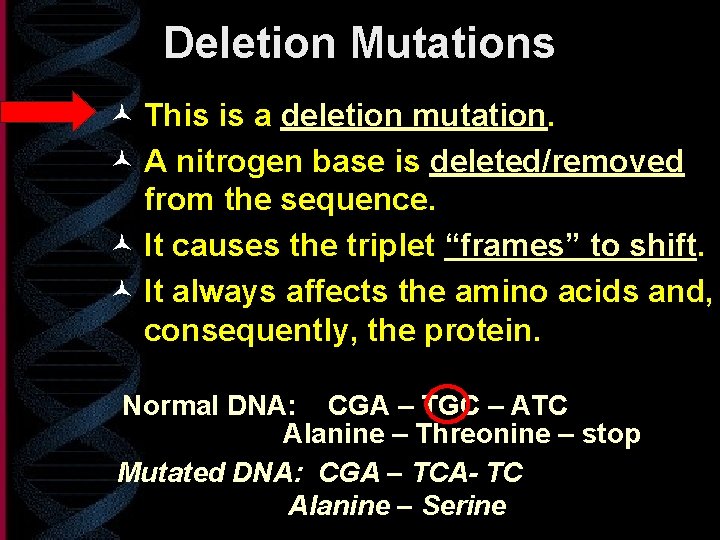
Deletion Mutations © This is a deletion mutation. © A nitrogen base is deleted/removed from the sequence. © It causes the triplet “frames” to shift. © It always affects the amino acids and, consequently, the protein. Normal DNA: CGA – TGC – ATC Alanine – Threonine – stop Mutated DNA: CGA – TCA- TC Alanine – Serine
TRY THIS! © Write the sentence on your paper: The cat ate the rat. © Delete one letter from any word. © Rewrite the sentence. Remember: each word can only have 3 letters. © Think-Pair-Share
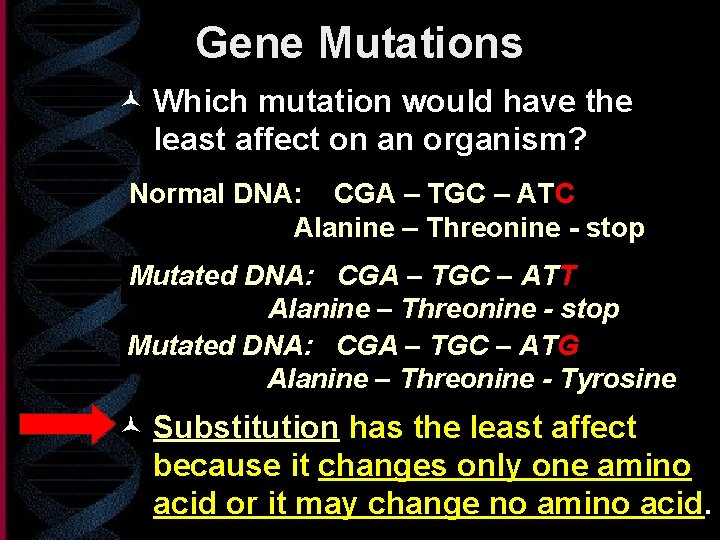
Gene Mutations © Which mutation would have the least affect on an organism? Normal DNA: CGA – TGC – ATC Alanine – Threonine - stop Mutated DNA: CGA – TGC – ATT Alanine – Threonine - stop Mutated DNA: CGA – TGC – ATG Alanine – Threonine - Tyrosine © Substitution has the least affect because it changes only one amino acid or it may change no amino acid.
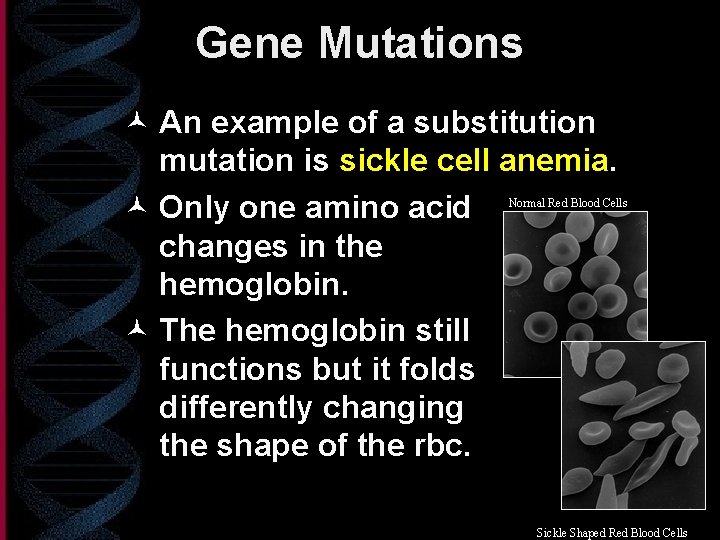
Gene Mutations © An example of a substitution mutation is sickle cell anemia. © Only one amino acid changes in the hemoglobin. © The hemoglobin still functions but it folds differently changing the shape of the rbc. Normal Red Blood Cells Sickle Shaped Red Blood Cells
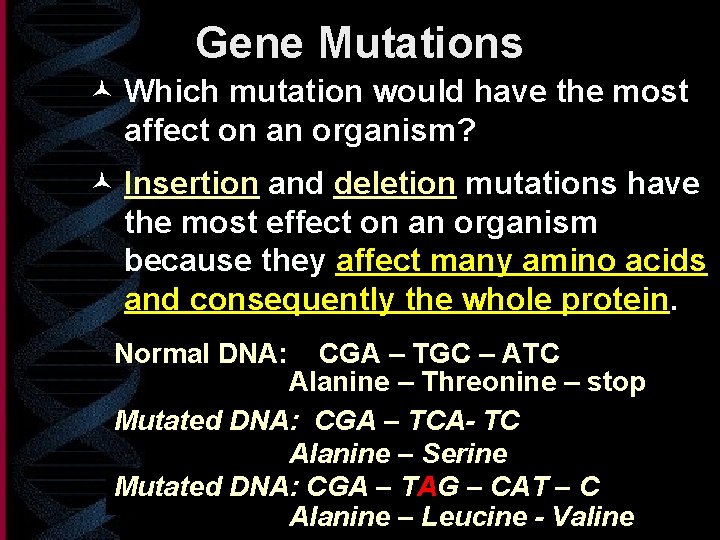
Gene Mutations © Which mutation would have the most affect on an organism? © Insertion and deletion mutations have the most effect on an organism because they affect many amino acids and consequently the whole protein. Normal DNA: CGA – TGC – ATC Alanine – Threonine – stop Mutated DNA: CGA – TCA- TC Alanine – Serine Mutated DNA: CGA – TAG – CAT – C Alanine – Leucine - Valine
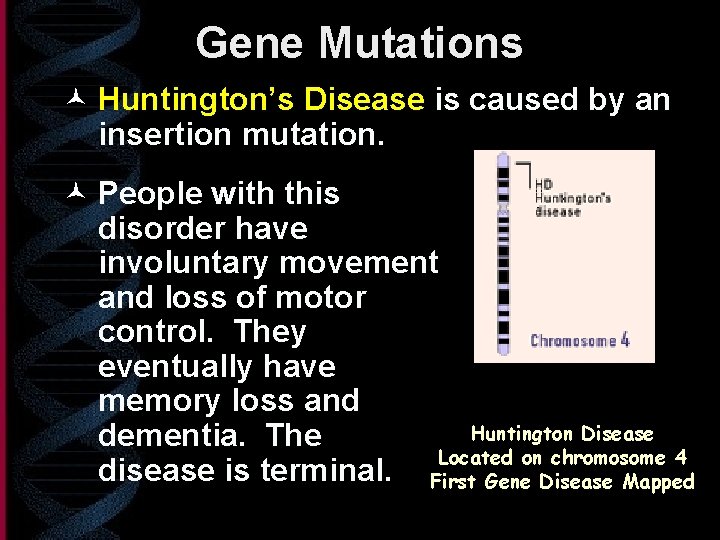
Gene Mutations © Huntington’s Disease is caused by an insertion mutation. © People with this disorder have involuntary movement and loss of motor control. They eventually have memory loss and Huntington Disease dementia. The Located on chromosome 4 disease is terminal. First Gene Disease Mapped
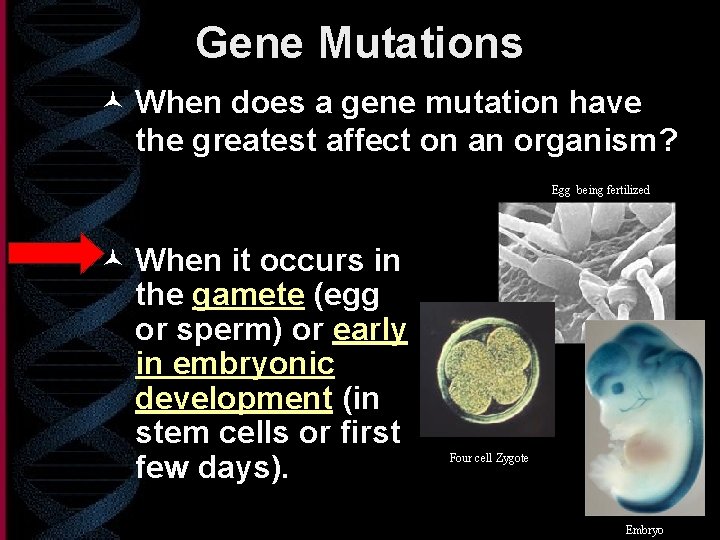
Gene Mutations © When does a gene mutation have the greatest affect on an organism? Egg being fertilized © When it occurs in the gamete (egg or sperm) or early in embryonic development (in stem cells or first few days). Four cell Zygote Embryo
Mutagens © What causes mutations? natural errors or an environmental event © What is a mutagen? something that causes the DNA code to change (mutate) – x-ray, chemicals, UV light, radiation, etc © What happens to a person who has a mutation?
Works Cited © Egg Being Fertilized, Four Cell Zygote, by permission, Richard A. Bowen, Colorado State University, http: //arbl. cvmbs. colostate. edu/hbooks/p athphys/reprod/fert/index. html © Embryo, Department of Energy, http: //www. jgi. doe. gov/science/highlights /nobrega 1004. html
Works Cited © DNA Background Graphic, Pictures of DNA, http: //academy. d 20. co. edu/kadets/lundberg/dn a. html © Normal & Sickle-shaped Red Blood Cells , (Photos courtesy of Drs. Noguchi, Rodgers, and Schechter of NIDDK. ), Clinical Center News, National Institute of Health, http: //clinicalcenter. nih. gov/about/newsle tter/1999/nov 99/index. html
- Slides: 24