
Gene flow and genetic differentiation This population is



- Slides: 31
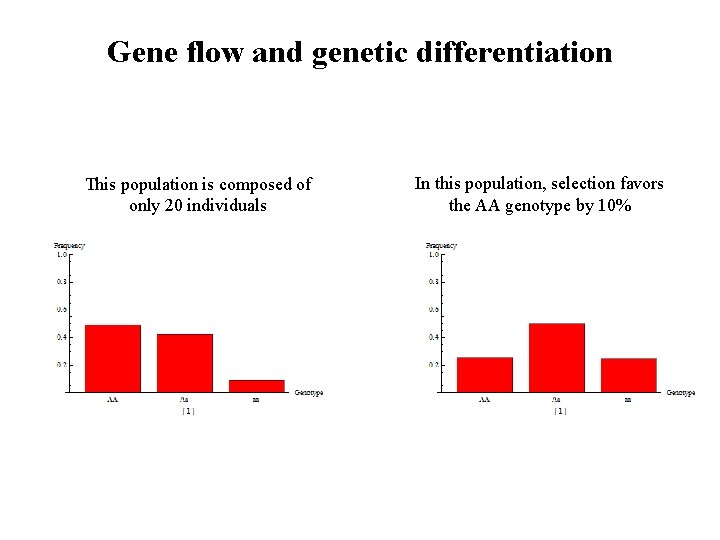
Gene flow and genetic differentiation This population is composed of only 20 individuals In this population, selection favors the AA genotype by 10%
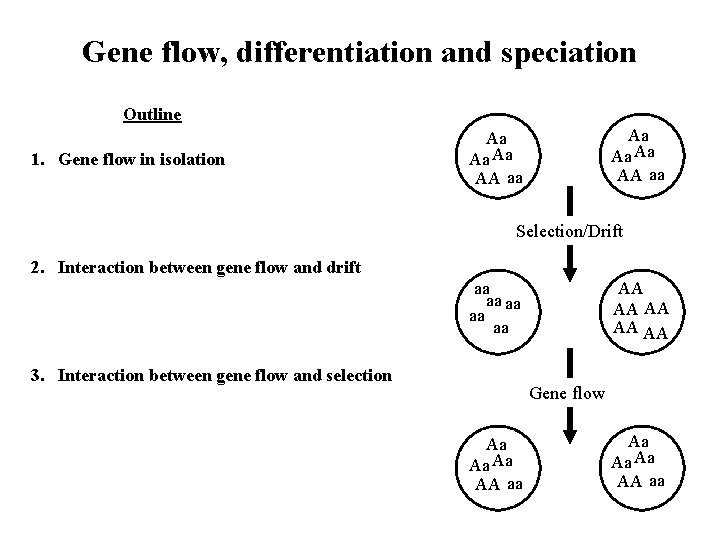
Gene flow, differentiation and speciation Outline 1. Gene flow in isolation Aa Aa Aa AA aa Selection/Drift 2. Interaction between gene flow and drift aa aa aa 3. Interaction between gene flow and selection AA AA AA Gene flow Aa Aa Aa AA aa
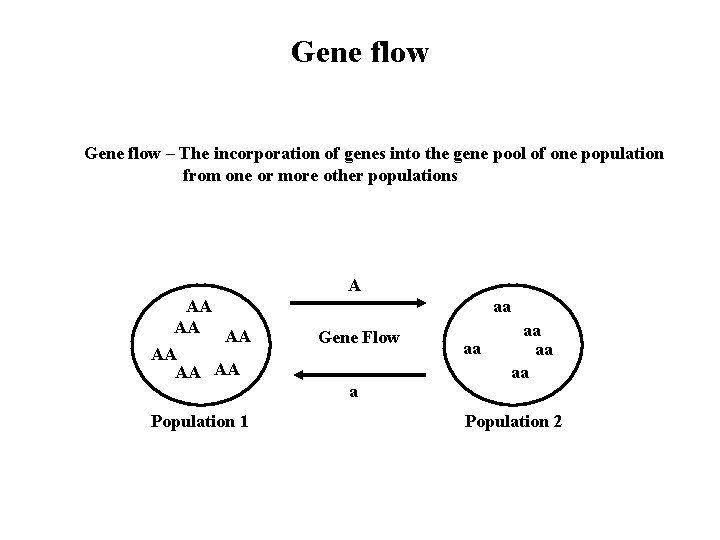
Gene flow – The incorporation of genes into the gene pool of one population from one or more other populations A AA AA AA Population 1 aa Gene Flow a aa aa Population 2
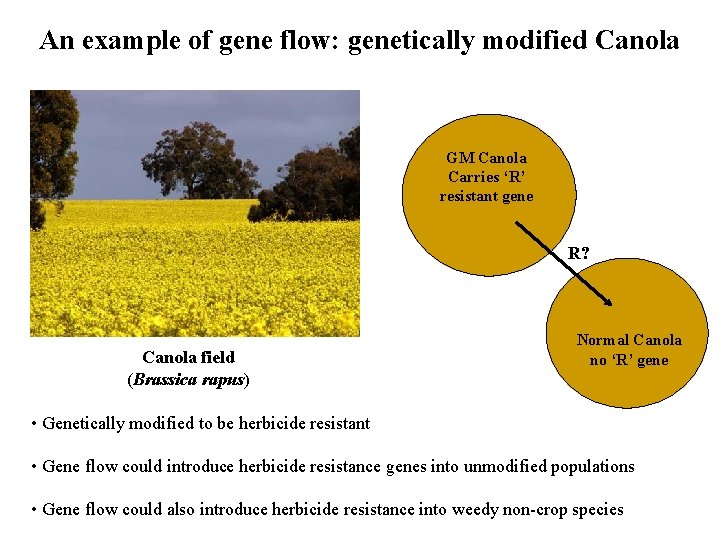
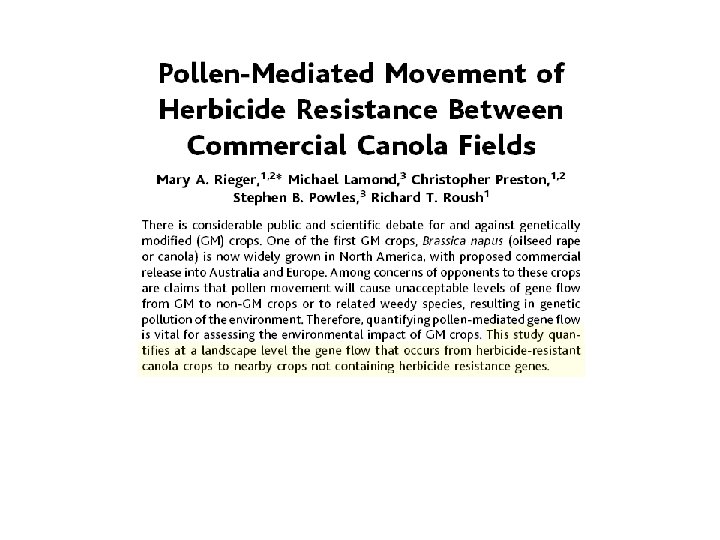
An example of gene flow: genetically modified Canola GM Canola Carries ‘R’ resistant gene R? Canola field (Brassica rapus) Normal Canola no ‘R’ gene • Genetically modified to be herbicide resistant • Gene flow could introduce herbicide resistance genes into unmodified populations • Gene flow could also introduce herbicide resistance into weedy non-crop species
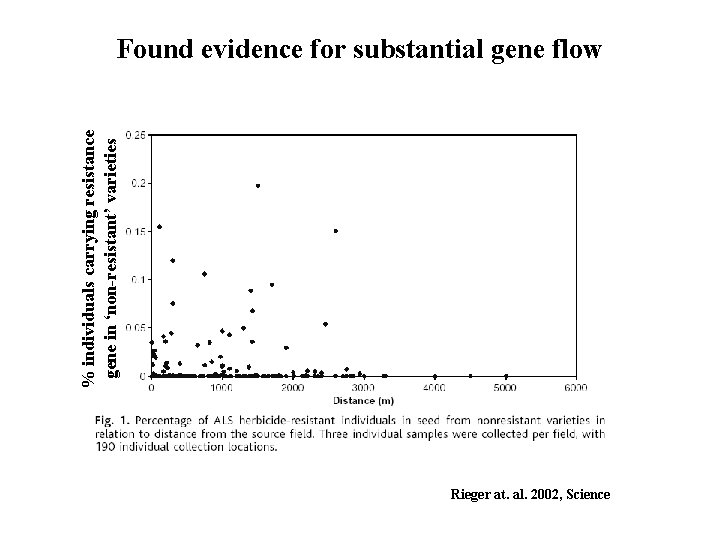
% individuals carrying resistance gene in ‘non-resistant’ varieties Found evidence for substantial gene flow Rieger at. al. 2002, Science
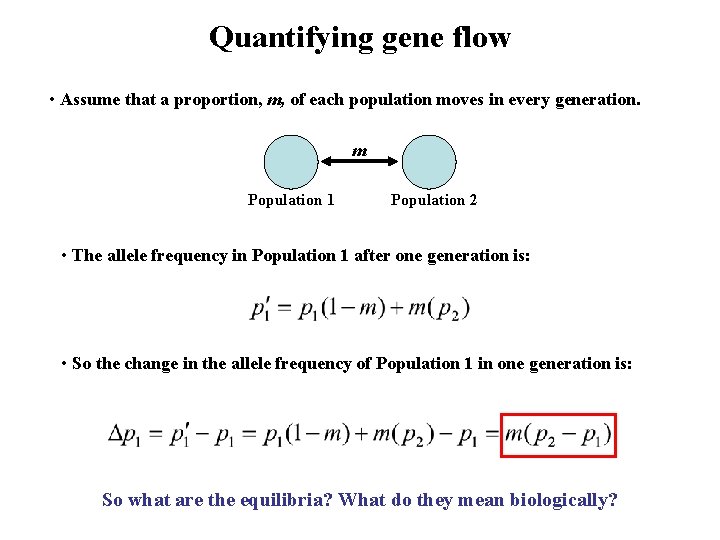
Quantifying gene flow • Assume that a proportion, m, of each population moves in every generation. m Population 1 Population 2 • The allele frequency in Population 1 after one generation is: • So the change in the allele frequency of Population 1 in one generation is: So what are the equilibria? What do they mean biologically?
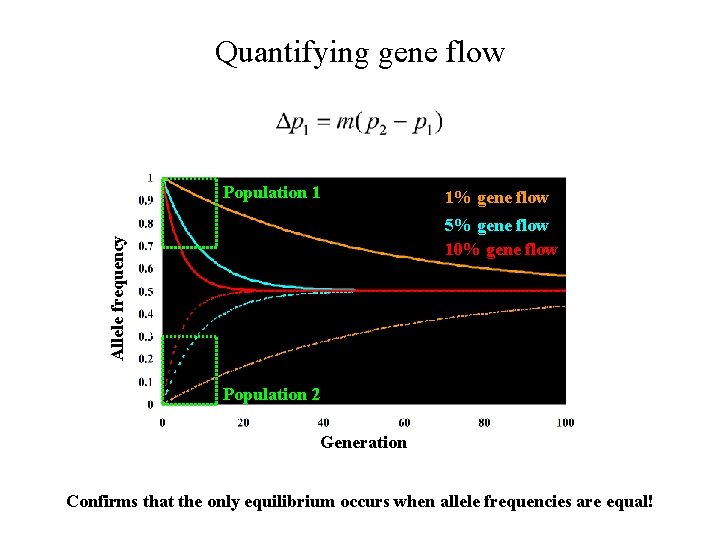
Quantifying gene flow Population 1 1% gene flow Allele frequency 5% gene flow 10% gene flow Population 2 Generation Confirms that the only equilibrium occurs when allele frequencies are equal!
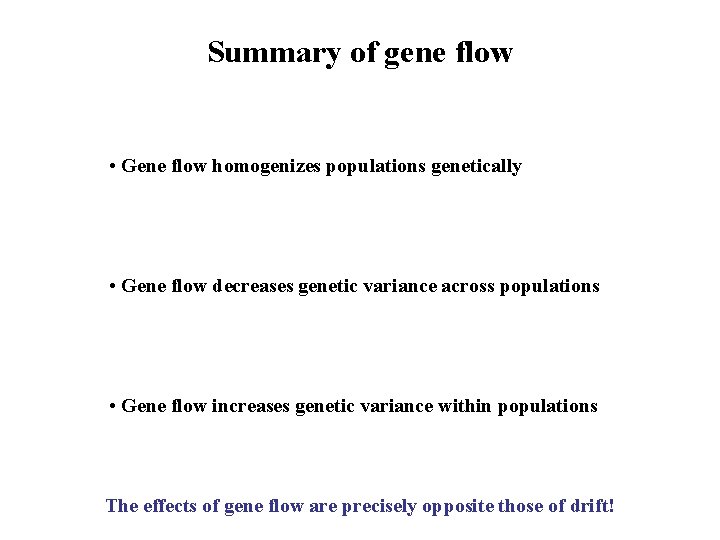
Summary of gene flow • Gene flow homogenizes populations genetically • Gene flow decreases genetic variance across populations • Gene flow increases genetic variance within populations The effects of gene flow are precisely opposite those of drift!
Gene flow and drift Lets start by ignoring selection and consider ‘neutral’ genetic loci • In finite populations, drift should cause populations to differentiate genetically • Gene flow will cause these same populations to become homogenized • How will these opposing forces balance out?
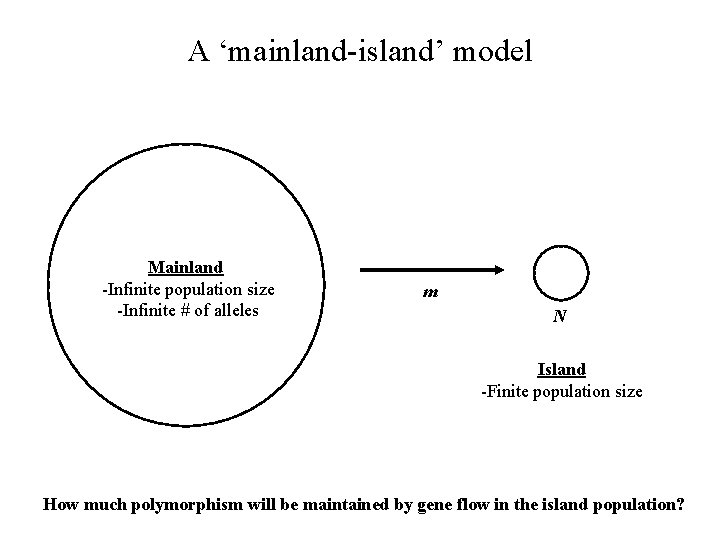
A ‘mainland-island’ model Mainland -Infinite population size -Infinite # of alleles m N Island -Finite population size How much polymorphism will be maintained by gene flow in the island population?
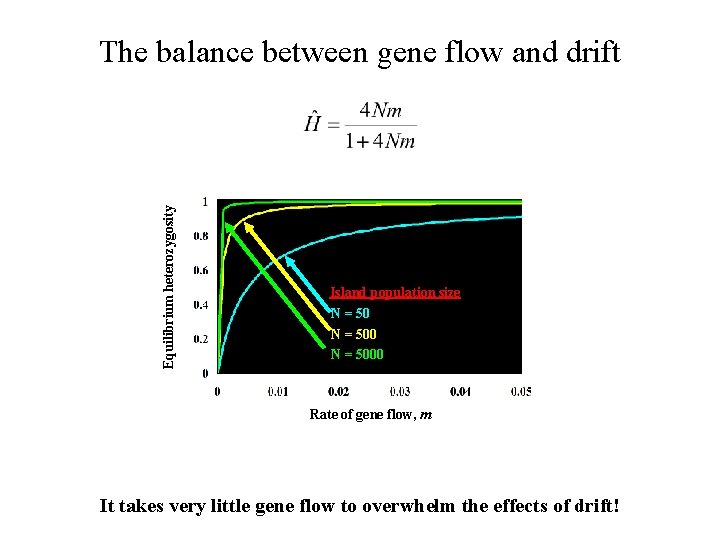
Equilibrium heterozygosity The balance between gene flow and drift Island population size N = 5000 Rate of gene flow, m It takes very little gene flow to overwhelm the effects of drift!
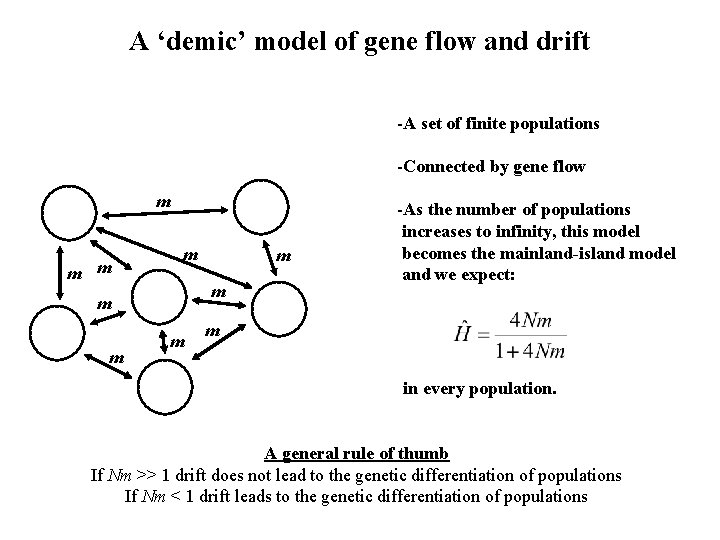
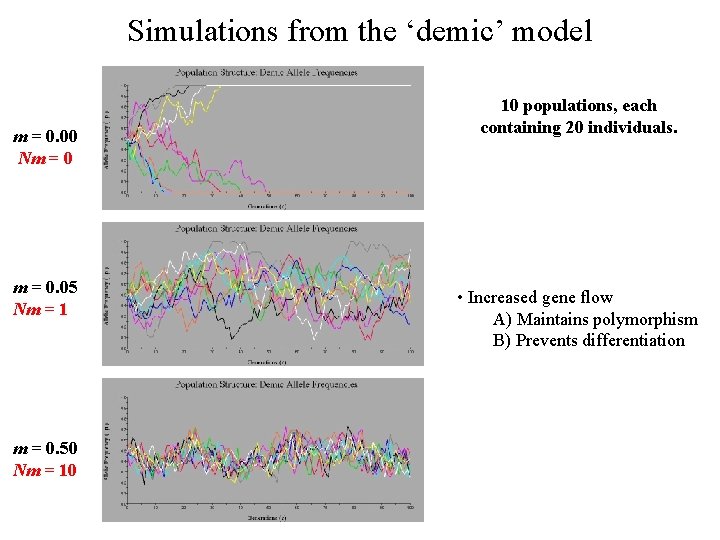
A ‘demic’ model of gene flow and drift -A set of finite populations -Connected by gene flow m m m m m -As the number of populations increases to infinity, this model becomes the mainland-island model and we expect: m in every population. A general rule of thumb If Nm >> 1 drift does not lead to the genetic differentiation of populations If Nm < 1 drift leads to the genetic differentiation of populations
Simulations from the ‘demic’ model m = 0. 00 Nm = 0. 05 Nm = 1 m = 0. 50 Nm = 10 10 populations, each containing 20 individuals. • Increased gene flow A) Maintains polymorphism B) Prevents differentiation
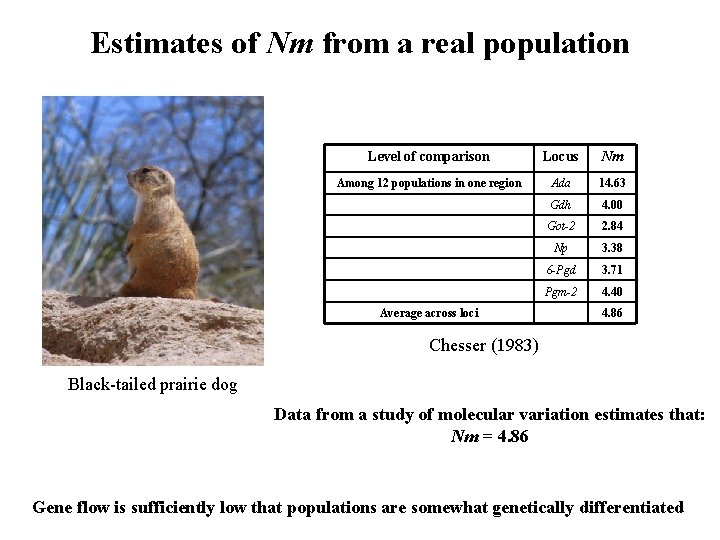
Estimates of Nm from a real population Level of comparison Locus Nm Among 12 populations in one region Ada 14. 63 Gdh 4. 00 Got-2 2. 84 Np 3. 38 6 -Pgd 3. 71 Pgm-2 4. 40 Average across loci 4. 86 Chesser (1983) Black-tailed prairie dog Data from a study of molecular variation estimates that: Nm = 4. 86 Gene flow is sufficiently low that populations are somewhat genetically differentiated
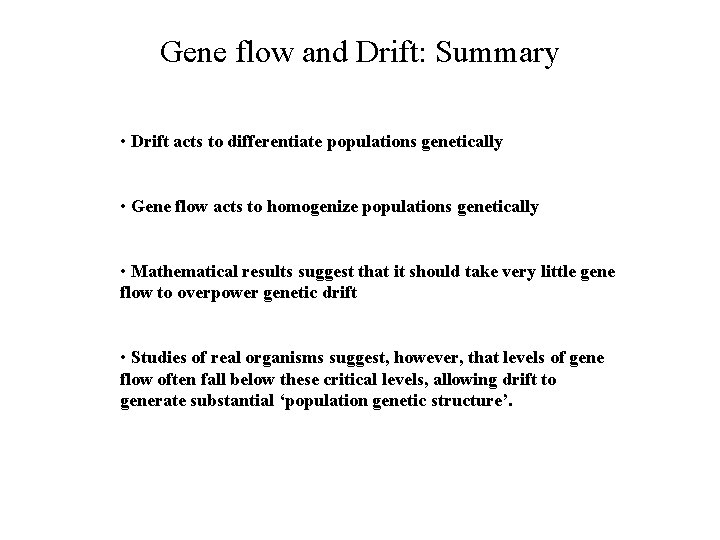
Gene flow and Drift: Summary • Drift acts to differentiate populations genetically • Gene flow acts to homogenize populations genetically • Mathematical results suggest that it should take very little gene flow to overpower genetic drift • Studies of real organisms suggest, however, that levels of gene flow often fall below these critical levels, allowing drift to generate substantial ‘population genetic structure’.
Gene flow and selection Lets now consider loci that are exposed to natural selection • Natural selection causes populations to diverge genetically as individual populations adapt to local ecological conditions • Gene flow will cause these same populations to become homogenized, impeding local adaptation through natural selection • How will these opposing forces balance out?
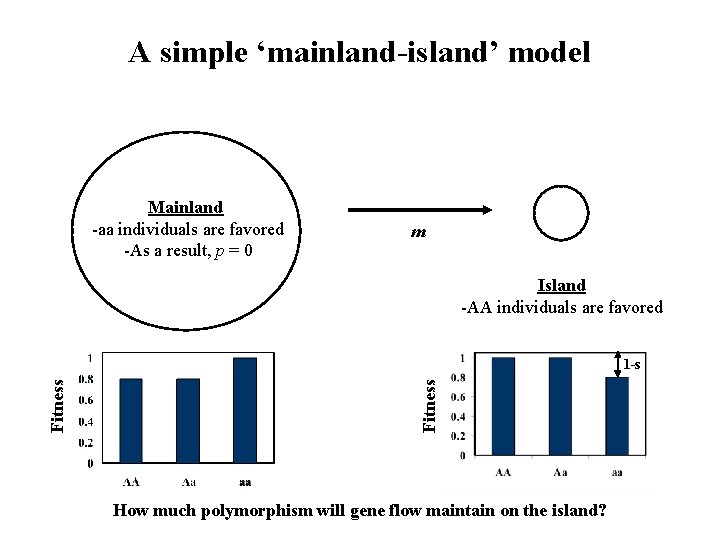
A simple ‘mainland-island’ model Mainland -aa individuals are favored -As a result, p = 0 m Island -AA individuals are favored Fitness 1 -s How much polymorphism will gene flow maintain on the island?
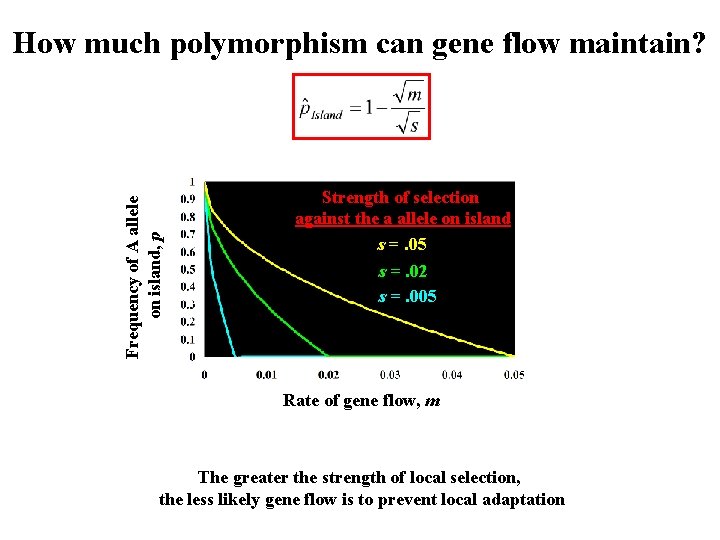
Frequency of A allele on island, p How much polymorphism can gene flow maintain? Strength of selection against the a allele on island s =. 05 s =. 02 s =. 005 Rate of gene flow, m The greater the strength of local selection, the less likely gene flow is to prevent local adaptation
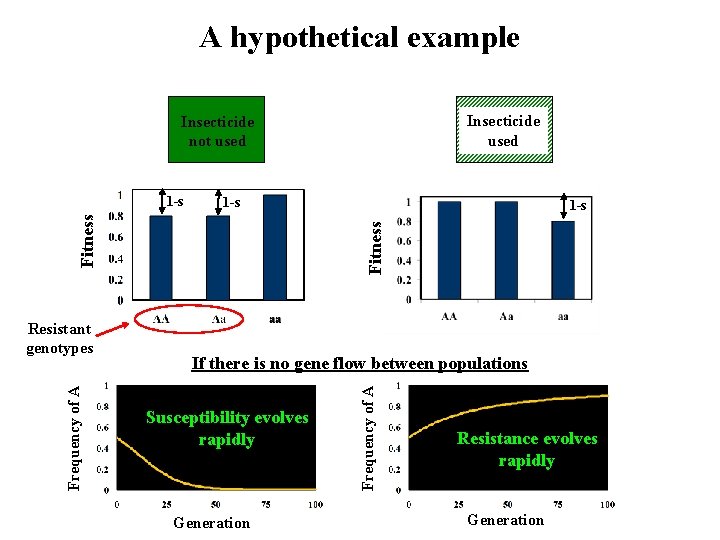
A hypothetical example Insecticide used Insecticide not used 1 -s If there is no gene flow between populations Susceptibility evolves rapidly Generation Frequency of A Resistant genotypes 1 -s Fitness 1 -s Resistance evolves rapidly Generation
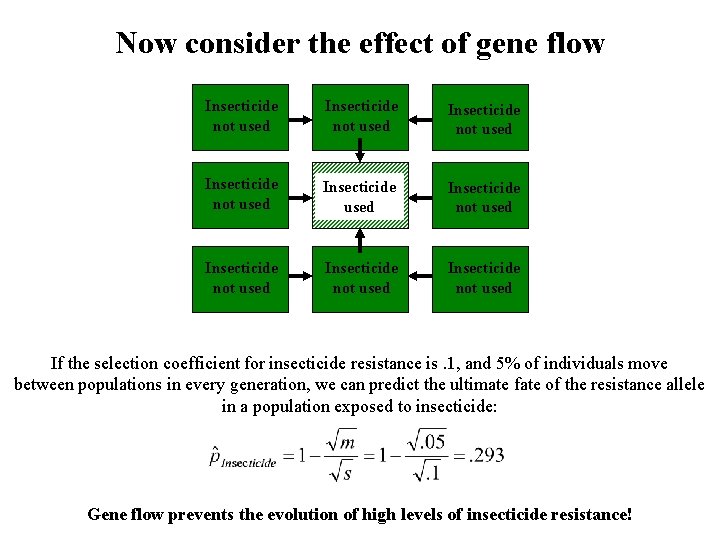
Now consider the effect of gene flow Insecticide not used Insecticide used Insecticide not used If the selection coefficient for insecticide resistance is. 1, and 5% of individuals move between populations in every generation, we can predict the ultimate fate of the resistance allele in a population exposed to insecticide: Gene flow prevents the evolution of high levels of insecticide resistance!
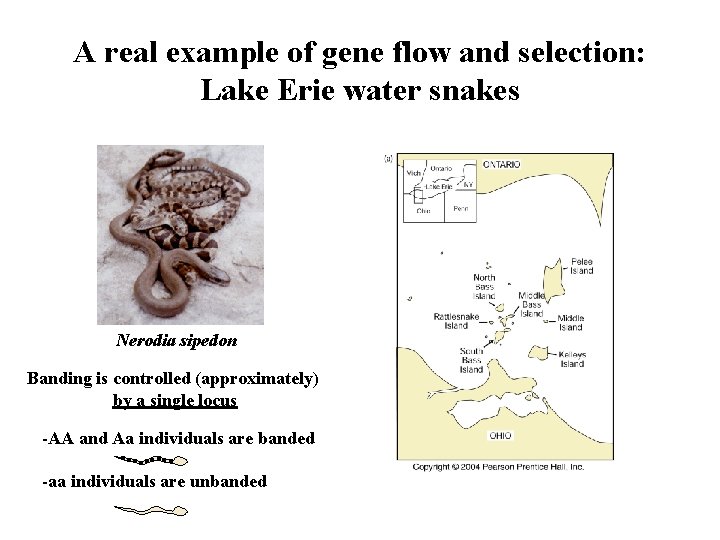
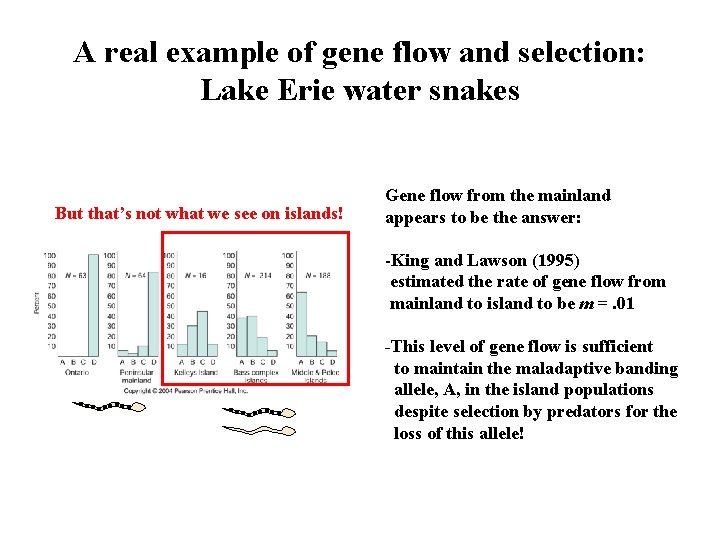
A real example of gene flow and selection: Lake Erie water snakes Nerodia sipedon Banding is controlled (approximately) by a single locus -AA and Aa individuals are banded -aa individuals are unbanded
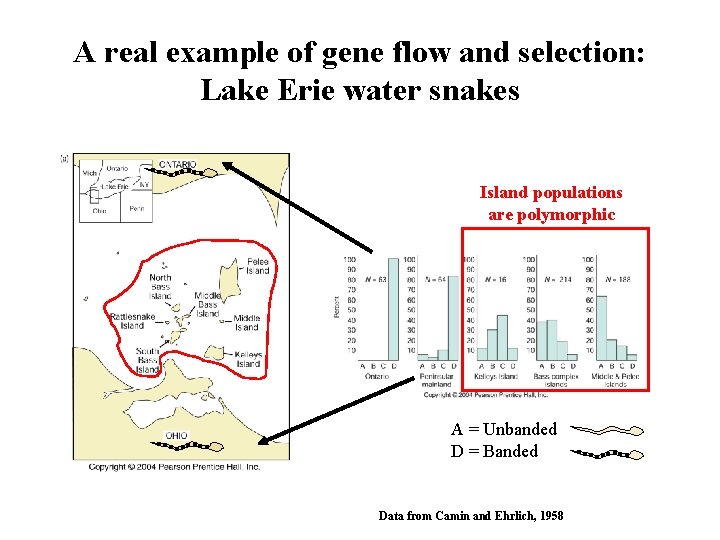
A real example of gene flow and selection: Lake Erie water snakes Island populations are polymorphic A = Unbanded D = Banded Data from Camin and Ehrlich, 1958
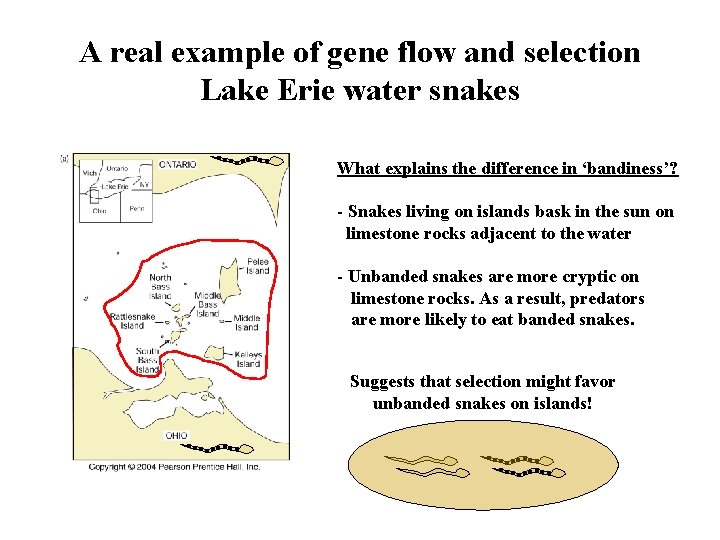
A real example of gene flow and selection Lake Erie water snakes What explains the difference in ‘bandiness’? - Snakes living on islands bask in the sun on limestone rocks adjacent to the water - Unbanded snakes are more cryptic on limestone rocks. As a result, predators are more likely to eat banded snakes. Suggests that selection might favor unbanded snakes on islands!
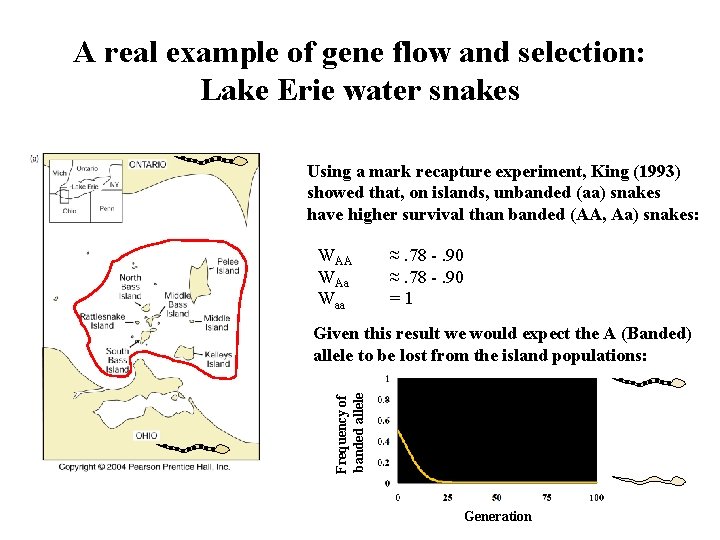
A real example of gene flow and selection: Lake Erie water snakes Using a mark recapture experiment, King (1993) showed that, on islands, unbanded (aa) snakes have higher survival than banded (AA, Aa) snakes: WAA WAa Waa ≈. 78 -. 90 =1 Frequency of banded allele Given this result we would expect the A (Banded) allele to be lost from the island populations: Generation
A real example of gene flow and selection: Lake Erie water snakes But that’s not what we see on islands! Gene flow from the mainland appears to be the answer: -King and Lawson (1995) estimated the rate of gene flow from mainland to island to be m =. 01 -This level of gene flow is sufficient to maintain the maladaptive banding allele, A, in the island populations despite selection by predators for the loss of this allele!
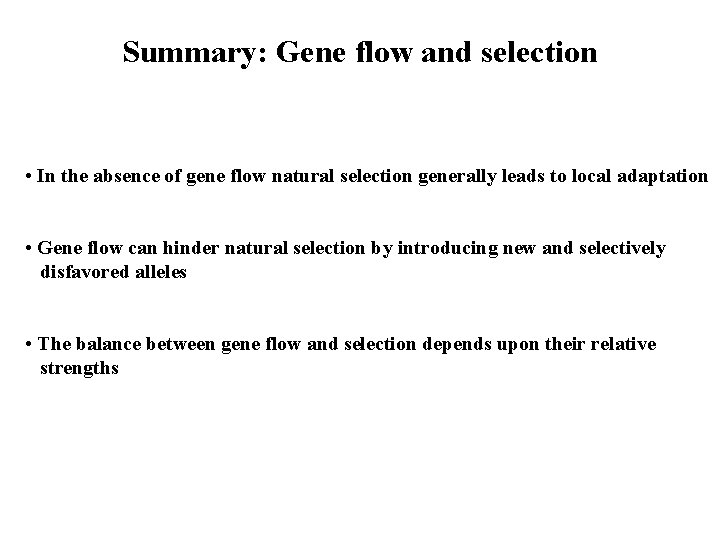
Summary: Gene flow and selection • In the absence of gene flow natural selection generally leads to local adaptation • Gene flow can hinder natural selection by introducing new and selectively disfavored alleles • The balance between gene flow and selection depends upon their relative strengths
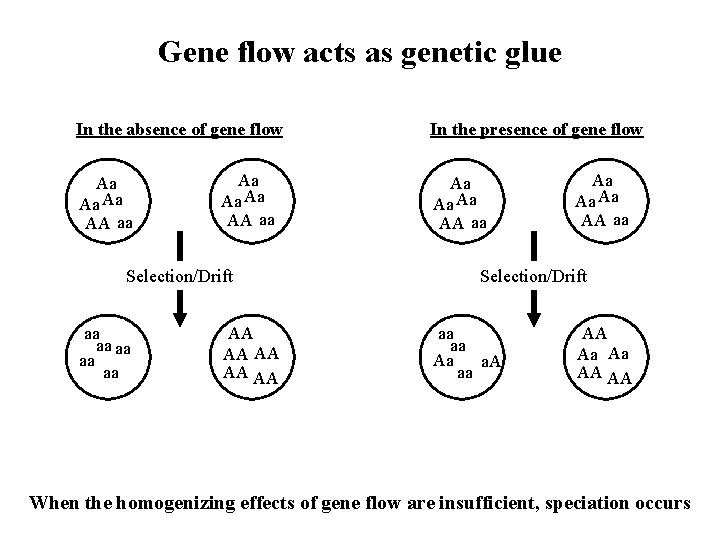
Gene flow acts as genetic glue In the absence of gene flow Aa Aa Aa AA aa Selection/Drift aa aa aa AA AA AA In the presence of gene flow Aa Aa Aa AA aa Selection/Drift aa aa Aa a. A aa AA Aa Aa AA AA When the homogenizing effects of gene flow are insufficient, speciation occurs
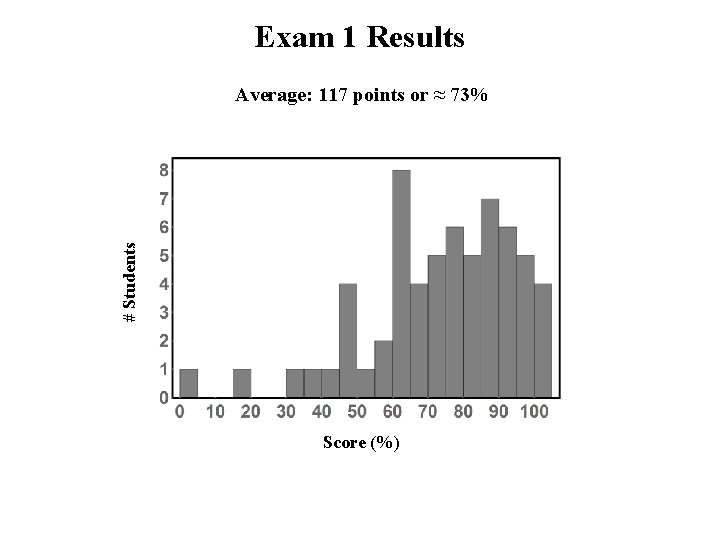
Exam 1 Results # Students Average: 117 points or ≈ 73% Score (%)
Practice Question
Practice Question