
Gender Power And Embodiment Subjectificaiton normativity and resistance
Gender, Power, And Embodiment Subjectificaiton, normativity, and resistance

Key Themes for this Week ¡How is gender shaped by power in its Foucauldian forms? ¡How is gender related to discourse, subjectification, and embodiment? ¡What do we mean by gender performativity & docile bodies? ¡What’s biology have to do with all of this? And how does biology get us back to discourse (specifically, medicalization of gender)?
¡ What’s your gender? ¡ When did you decide that? ¡ How much say do you have in your gender? ¡ Is there anything about your gender or gender role that you don’t like, or that gets in your way? ¡ Are there one or two qualities about another gender that are appealing to you, enough so that you’d like to incorporate those qualities into your daily life? ¡ What would happen to your life if you did that? ¡ What would your gender be then? ¡ How do you think people would respond to you? ¡ How would you feel if they did that? ¡ What, if anything, are you being denied on account of your gender? ¡ What, if anything, does a person of another gender have that you can’t have? (borrowed from Kate Bornstein “Gender Terror, Gender Rage”, pp. 240 -241) Dispelling Beauty Myths: Gender Norms

Bartky & Foucault (Femininity & the Modernization of Patriarchal Power) ¡Bentham’s Panopticon: ¡ power should be invisible & unverifiable (Foucault, p. 200201)

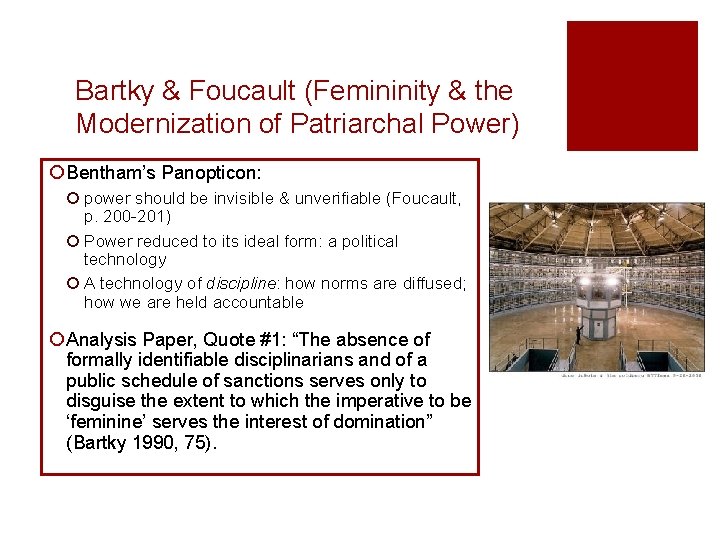
Bartky & Foucault (Femininity & the Modernization of Patriarchal Power) ¡ Bentham’s Panopticon: ¡ power should be invisible & unverifiable (Foucault, p. 200 -201) ¡ Power reduced to its ideal form: a political technology ¡ A technology of discipline: how norms are diffused; how we are held accountable ¡ Analysis Paper, Quote #1: “The absence of formally identifiable disciplinarians and of a public schedule of sanctions serves only to disguise the extent to which the imperative to be ‘feminine’ serves the interest of domination” (Bartky 1990, 75).
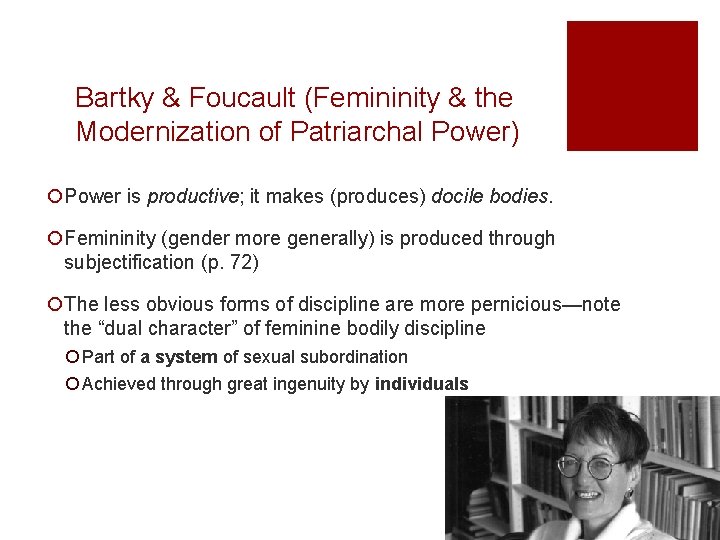
Bartky & Foucault (Femininity & the Modernization of Patriarchal Power) ¡Power is productive; it makes (produces) docile bodies. ¡Femininity (gender more generally) is produced through subjectification (p. 72) ¡The less obvious forms of discipline are more pernicious—note the “dual character” of feminine bodily discipline ¡ Part of a system of sexual subordination ¡ Achieved through great ingenuity by individuals

Bartky & Foucault (Femininity & the Modernization of Patriarchal Power) ¡ Gender is always “classed” ¡ There is privilege within—a hierarchy of—femininities ¡ Does this resonate? ¡ Where is masculinity in this framework? ¡ Reading Analysis Quote #2: “Women…have a stake in the perpetuation of their skills, whatever it may have cost to acquire them and quite apart from the question whether, as a gender, they would have been better off had they never had to acquire them in the first place. Hence, feminism, especially a genuinely radical feminism that questions the patriarchal construction of the female body, threatens women with a certain de-skilling, something people normally resist…” (Bartky 1990, 77). ¡ I. e. : “why aren’t all women feminists? ” ¡ The only truly liberatory feminist praxis is one which seeks "a radical and as yet unimagined transformation of the female body. " (Bartky 1990, 78)
Spade: Disciplinary Power & Gender Embodiment ¡ Medical discourse and “gender fortification” (Fausto-Sterling 2012, 10). ¡ Reading Analysis Quote #6: “To adopt the medical understanding of transsexuality is to agree that SRS is the unfortunate treatment of an unfortunate condition, to accept that gender norm adherence is fortunate and healthy, and to undermine threat to a dichotomous gender system which trans experience can pose” (Spade 2006 [2000], 329). ¡ Reading Analysis Quote #4: ““Containing gender distress within ‘transsexualism’ functions to naturalize and make ‘healthy’ dichotomized, birth-assigned gender performance” (Spade 2006[2000], 319). ¡ Status/gender created: power produces “sex” as a problem to be managed; produces categories we all have to negotiate ¡ Medical discourse isn’t relying on gender norms; it’s creating them.
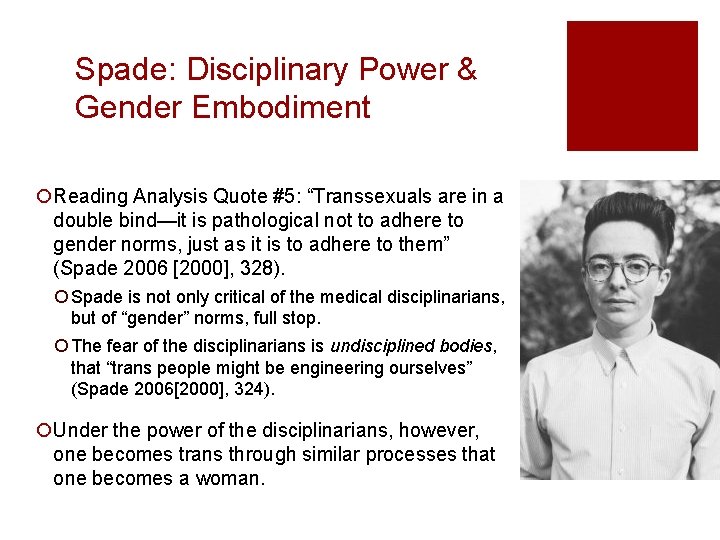
Spade: Disciplinary Power & Gender Embodiment ¡Reading Analysis Quote #5: “Transsexuals are in a double bind—it is pathological not to adhere to gender norms, just as it is to adhere to them” (Spade 2006 [2000], 328). ¡ Spade is not only critical of the medical disciplinarians, but of “gender” norms, full stop. ¡ The fear of the disciplinarians is undisciplined bodies, that “trans people might be engineering ourselves” (Spade 2006[2000], 324). ¡Under the power of the disciplinarians, however, one becomes trans through similar processes that one becomes a woman.
Defining Queer Theory ¡ To live in opposition to hegemonic norms ¡ “To queer” (verb/set of actions) rather than “to be queer” (noun/identity or nameable standpoint) ¡ Radical deconstruction ¡ Analyzing conceptual oppositions that shape thought (Derrida) ¡ Emphasis on the inherent instability of terms (not a reordering of hierarchy) ¡ Radical subversion ¡ Some tensions between feminism and queer theory: ¡ Sexual practices ≠ source of identity ¡ Sex acts = a vehicle of resistance rather than (or in addition to) practice(s) of subordination

¡“It is a rather amazing fact that, of the very many dimensions along which the genital activity of one person can be differentiated from that of another (dimensions that include preference for certain acts, certain zones or sensations, certain physical types, a certain frequency, certain symbolic investments, certain relations of age or power…. ) precisely one, the gender of the object choice, emerged from the turn of the century, and has remained, as the dimension denoted by the now ubiquitous category of ‘sexual orientation. ’” (Sedgwick, cited in Sullivan p. 38)
Defining Queer Theory ¡To live in opposition to hegemonic norms ¡“To queer” (verb/set of actions) rather than “to be queer” (noun/identity or nameable standpoint) ¡Radical deconstruction ¡Radical subversion ¡Some tensions between feminism and queer theory ¡Foucauldian view: resistance is inseparable from power ¡ And resistance is not the same thing as ‘liberation’
Butler: “Critically Queer” ¡ Butler brings queer theory into a feminist analysis of gender power and gender resistance. ¡ IF gender = effect of reiterative acts that congeal over time to produce something that looks natural ¡ THEN acts are a source of instability as well as regularity—there is no original model of ‘gender’ that they reflect ¡ Gendered subject = an effect of action. ¡ Gendered Norms = regulatory fictions. ¡ Fausto-Sterling: bodies are not bounded; emotional and sensory experiences become embodied. ¡ Reading Analysis Quote #3: The practice by which gender occurs, the embodying of norms, is a compulsory practice, a forcible production, but not for that reason fully determining” (Butler 1993, 231). ¡ Drag (Paris Is Burning Clip) ¡ In what sense is this ‘deconstructing’ identity? ¡ Is this form of drag ‘subversive’? ¡ Performance v. Performativity (and the ‘queer art of failure’, Halberstam) ¡ The production of material subjects through processes of recognition.
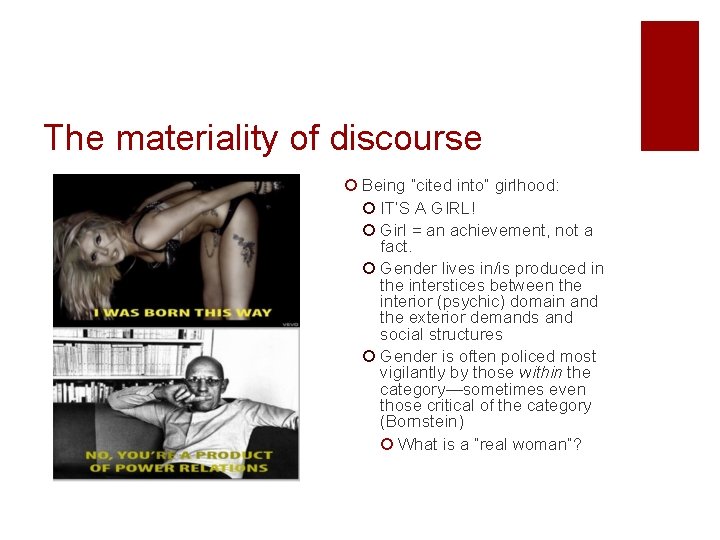
The materiality of discourse ¡ Being “cited into” girlhood: ¡ IT’S A GIRL! ¡ Girl = an achievement, not a fact. ¡ Gender lives in/is produced in the interstices between the interior (psychic) domain and the exterior demands and social structures ¡ Gender is often policed most vigilantly by those within the category—sometimes even those critical of the category (Bornstein) ¡ What is a “real woman”?

A Summary Mapping ¡Write: a one-sentence summary of this week’s reading/lecture materials. ¡ (What did you learn? What do you feel like you have a good handle on? ) ¡Write: one question you still have. ¡ (Is there something you’re still not sure of/any points about which you are uncertain of the meaning or significance? )
![Additional Sources Cited ¡Foucault, Michel. 1995[1975]. Discipline and Punish: The Birth of the Prison.](http://slidetodoc.com/presentation_image_h2/866460df65e1f70435b7fdf598a16cbd/image-18.jpg "Additional Sources Cited ¡Foucault, Michel. 1995[1975]. Discipline and Punish: The Birth of the Prison.")
Additional Sources Cited ¡Foucault, Michel. 1995[1975]. Discipline and Punish: The Birth of the Prison. Vintage Books. ¡Halberstam, Judith. 2011. The Queer Art of Failure. Durham, NC: Duke University Press. ¡Sullivan, Nikki. 2003. A Critical Introduction to Queer Theory. New York: NYU Press.
- Slides: 18