
Gender Policy Monitoring in Swiss Higher Education Institutions
- Slides: 23
Gender Policy Monitoring in Swiss Higher Education Institutions UNECE Work Session on Gender Statistics Use of gender statistics in policymaking and policy monitoring Neuchâtel, Switzerland, 15 – 17 May 2019 Vera Herrmann, Elena Zafarana, Mehmet Aksözen, Merlina Bajic Swiss Federal Statistical Office UNECE Conference of European Statisticians | Work Session 5 on Gender Statistics | Neuchâtel, 15 – 17 May 2019 | Note from the Swiss Statistical Office 1
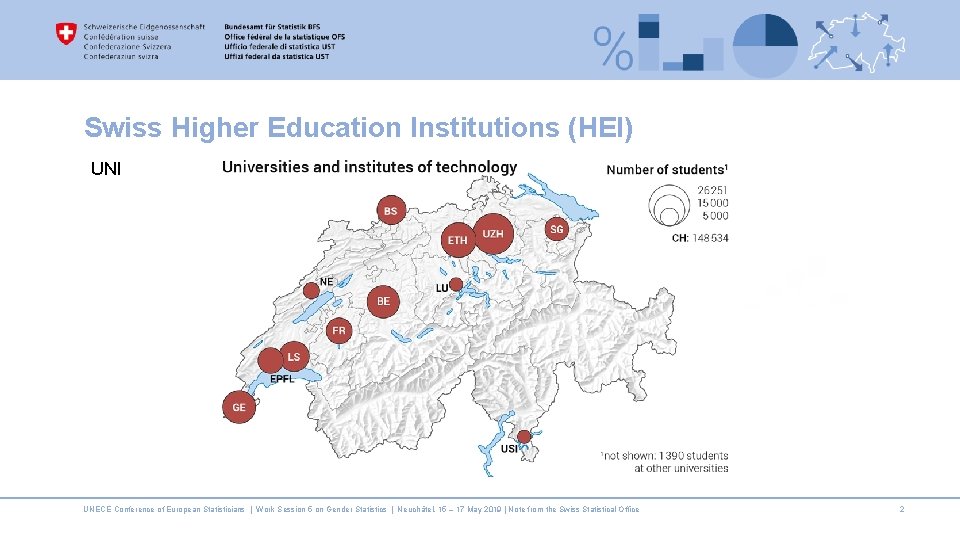
Swiss Higher Education Institutions (HEI) UNI UNECE Conference of European Statisticians | Work Session 5 on Gender Statistics | Neuchâtel, 15 – 17 May 2019 | Note from the Swiss Statistical Office 2
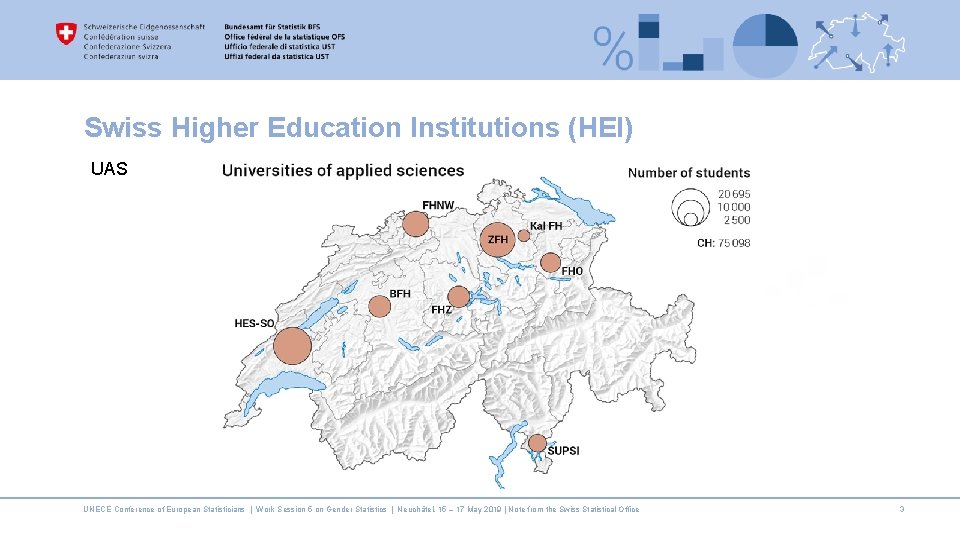
Swiss Higher Education Institutions (HEI) UAS UNECE Conference of European Statisticians | Work Session 5 on Gender Statistics | Neuchâtel, 15 – 17 May 2019 | Note from the Swiss Statistical Office 3
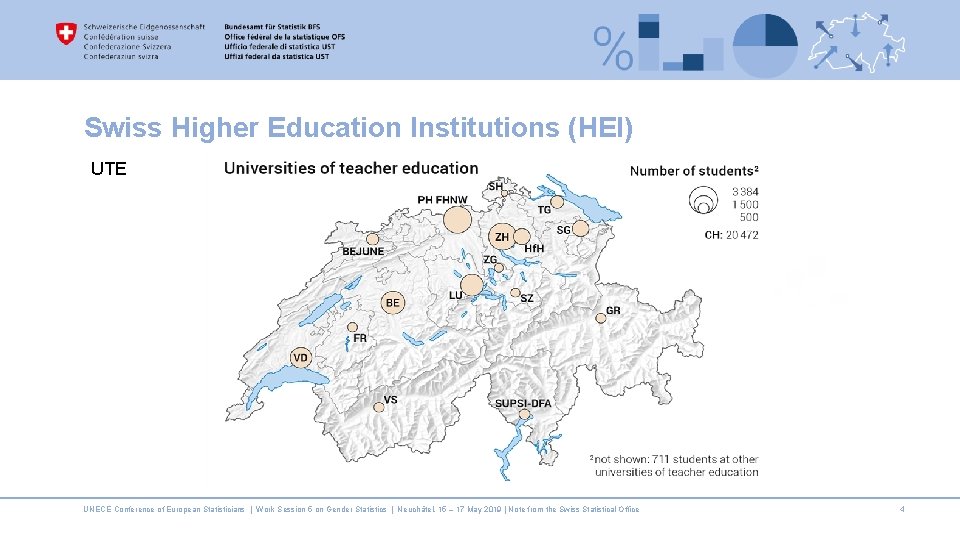
Swiss Higher Education Institutions (HEI) UTE UNECE Conference of European Statisticians | Work Session 5 on Gender Statistics | Neuchâtel, 15 – 17 May 2019 | Note from the Swiss Statistical Office 4
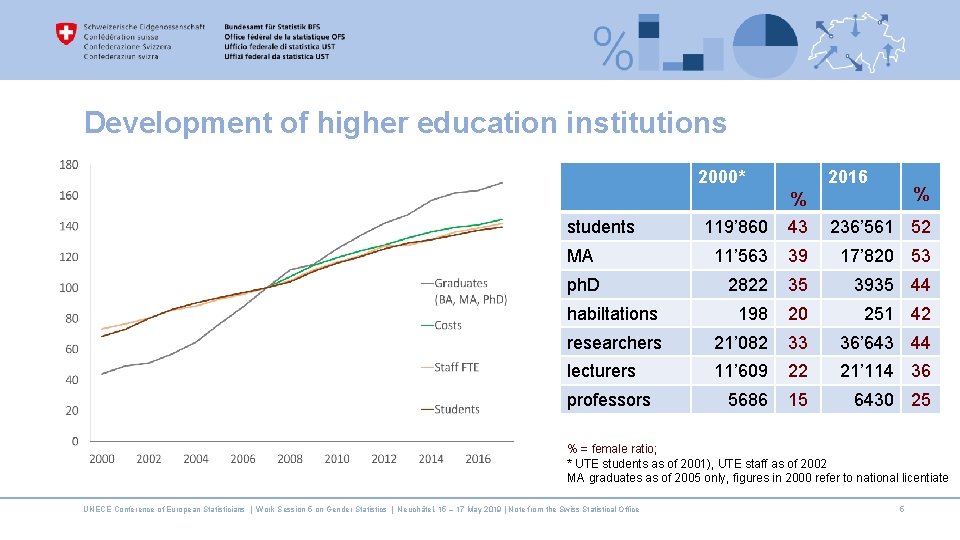
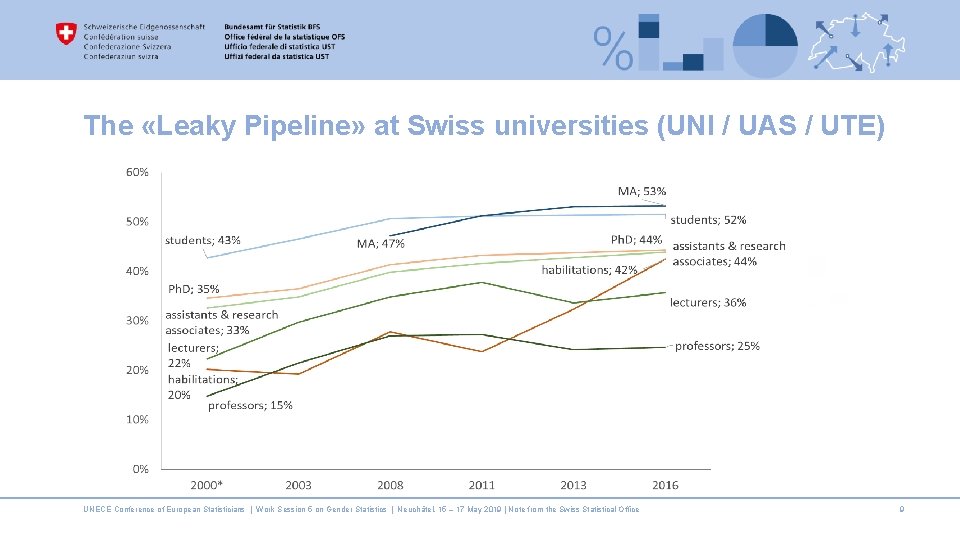
Development of higher education institutions 2000* 2016 % % 119’ 860 43 236’ 561 52 11’ 563 39 17’ 820 53 2822 35 3935 44 habiltations 198 20 251 42 researchers 21’ 082 33 36’ 643 44 lecturers 11’ 609 22 21’ 114 36 5686 15 6430 25 students MA ph. D professors % = female ratio; * UTE students as of 2001), UTE staff as of 2002 MA graduates as of 2005 only, figures in 2000 refer to national licentiate UNECE Conference of European Statisticians | Work Session 5 on Gender Statistics | Neuchâtel, 15 – 17 May 2019 | Note from the Swiss Statistical Office 5
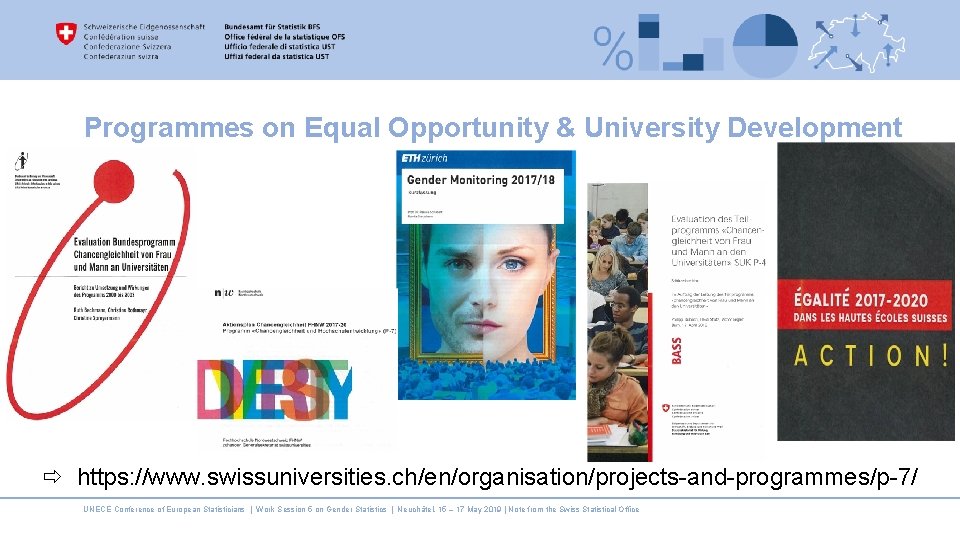
Programmes on Equal Opportunity & University Development https: //www. swissuniversities. ch/en/organisation/projects-and-programmes/p-7/ UNECE Conference of European Statisticians | Work Session 5 on Gender Statistics | Neuchâtel, 15 – 17 May 2019 | Note from the Swiss Statistical Office
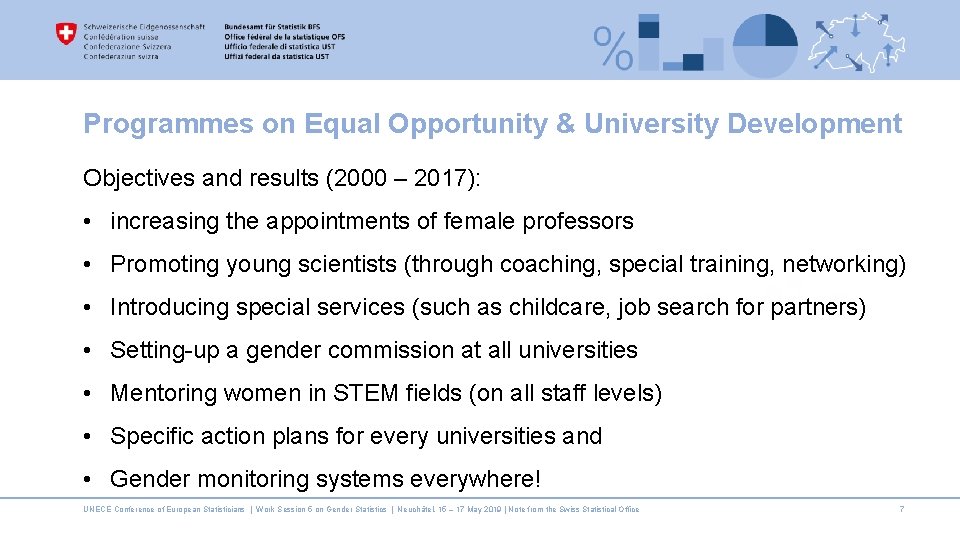
Programmes on Equal Opportunity & University Development Objectives and results (2000 – 2017): • increasing the appointments of female professors • Promoting young scientists (through coaching, special training, networking) • Introducing special services (such as childcare, job search for partners) • Setting-up a gender commission at all universities • Mentoring women in STEM fields (on all staff levels) • Specific action plans for every universities and • Gender monitoring systems everywhere! UNECE Conference of European Statisticians | Work Session 5 on Gender Statistics | Neuchâtel, 15 – 17 May 2019 | Note from the Swiss Statistical Office 7
Official statistics and its role in gender monitoring «Statistics can be a powerful tool to increase awareness of gender issues. Many people who have believed that the academe is reasonable gender equal have been convinced about the opposite when confronted with ‘hard facts’ on what the situation actually looks like» (FESTA programme 2016: 24) Swiss University Information System (© Swiss Statistical Office - SHIS) https: //www. bfs. admin. ch/bfs/en/home/statistics/education-science. html UNECE Conference of European Statisticians | Work Session 5 on Gender Statistics | Neuchâtel, 15 – 17 May 2019 | Note from the Swiss Statistical Office 8
The «Leaky Pipeline» at Swiss universities (UNI / UAS / UTE) UNECE Conference of European Statisticians | Work Session 5 on Gender Statistics | Neuchâtel, 15 – 17 May 2019 | Note from the Swiss Statistical Office 9
Longitudinal analysis on female career patterns at Swiss HEI Introduction and methodological considerations • • • Starting from the year 2013 a unique identifier has been assigned to each person (SS-number) Five year time span (2013 -2017) Only academic staff: «Professors» , «Lecturers and teaching staff» , «Research associates» , «Assistants and Ph. D students» Only people aged 45 or younger (2017) Only people who have worked at a university for the whole 5 -year period Change in the variable «personnel category» between 2013 and 2017 (two time points) UNECE Conference of European Statisticians | Work Session 5 on Gender Statistics | Neuchâtel, 15 – 17 May 2019 | Note from the Swiss Statistical Office 10
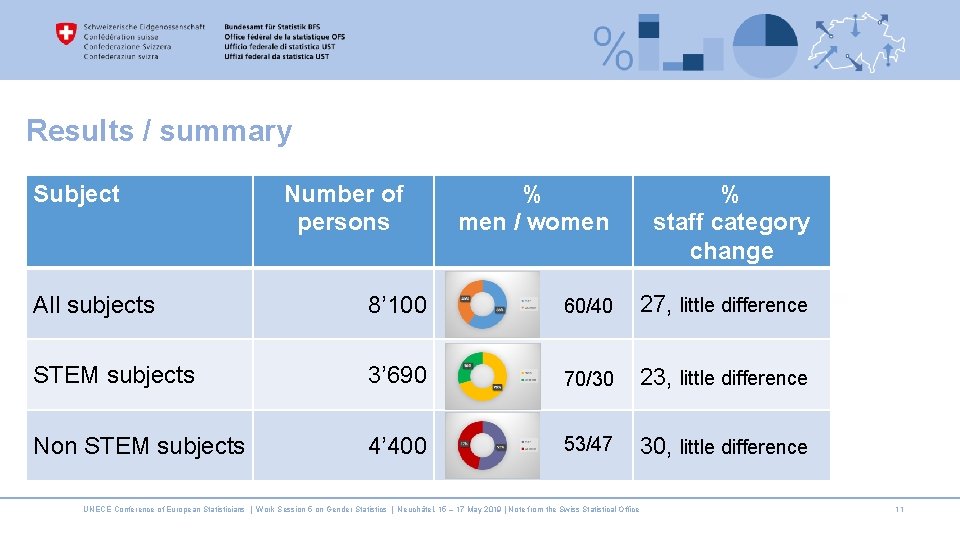
Results / summary Subject Number of persons % men / women % staff category change All subjects 8’ 100 60/40 27, little difference STEM subjects 3’ 690 70/30 23, little difference Non STEM subjects 4’ 400 53/47 30, little difference UNECE Conference of European Statisticians | Work Session 5 on Gender Statistics | Neuchâtel, 15 – 17 May 2019 | Note from the Swiss Statistical Office 11
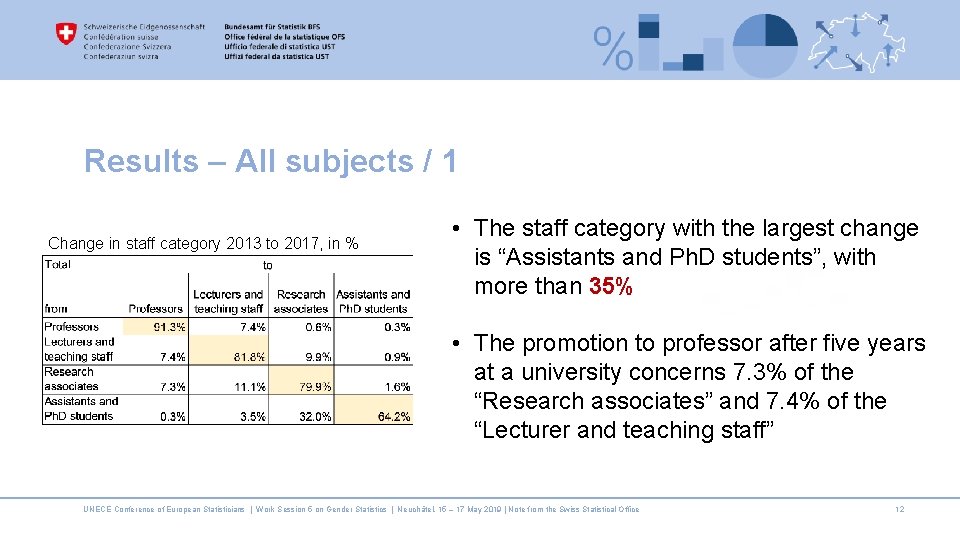
Results – All subjects / 1 Change in staff category 2013 to 2017, in % • The staff category with the largest change is “Assistants and Ph. D students”, with more than 35% • The promotion to professor after five years at a university concerns 7. 3% of the “Research associates” and 7. 4% of the “Lecturer and teaching staff” UNECE Conference of European Statisticians | Work Session 5 on Gender Statistics | Neuchâtel, 15 – 17 May 2019 | Note from the Swiss Statistical Office 12
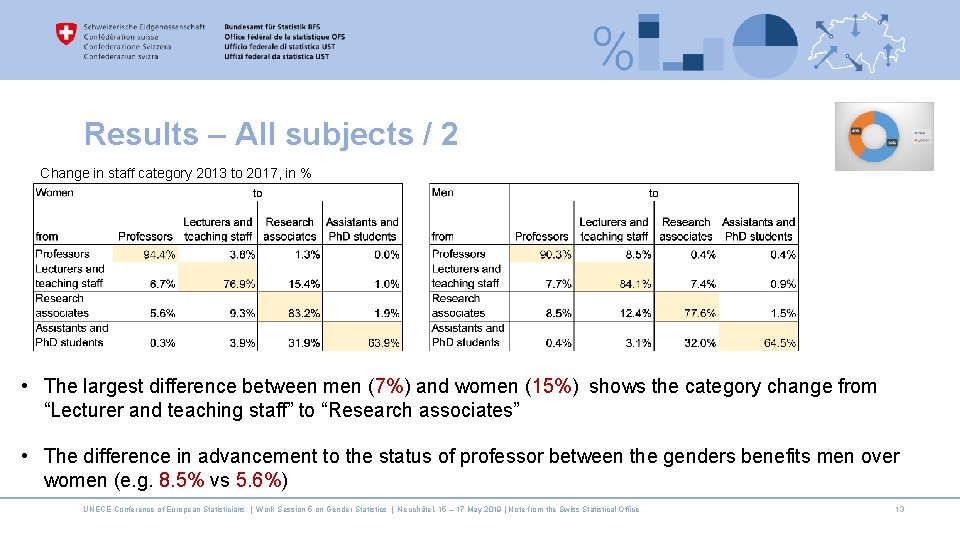
Results – All subjects / 2 Change in staff category 2013 to 2017, in % • The largest difference between men (7%) and women (15%) shows the category change from “Lecturer and teaching staff” to “Research associates” • The difference in advancement to the status of professor between the genders benefits men over women (e. g. 8. 5% vs 5. 6%) UNECE Conference of European Statisticians | Work Session 5 on Gender Statistics | Neuchâtel, 15 – 17 May 2019 | Note from the Swiss Statistical Office 13
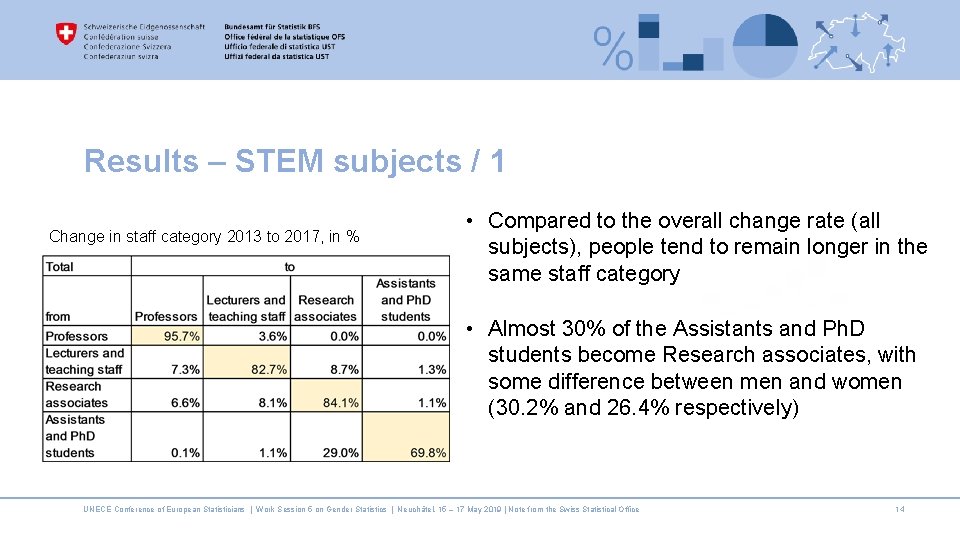
Results – STEM subjects / 1 Change in staff category 2013 to 2017, in % • Compared to the overall change rate (all subjects), people tend to remain longer in the same staff category • Almost 30% of the Assistants and Ph. D students become Research associates, with some difference between men and women (30. 2% and 26. 4% respectively) UNECE Conference of European Statisticians | Work Session 5 on Gender Statistics | Neuchâtel, 15 – 17 May 2019 | Note from the Swiss Statistical Office 14
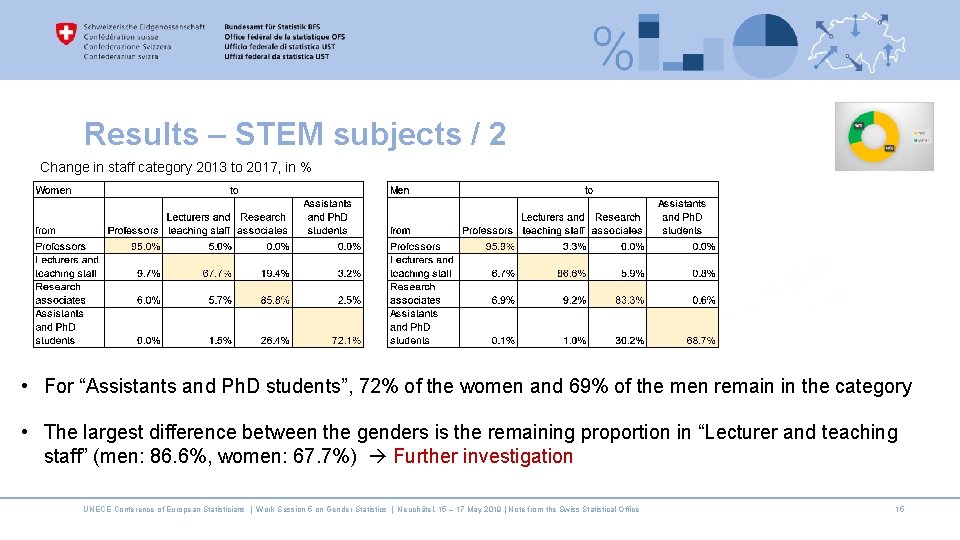
Results – STEM subjects / 2 Change in staff category 2013 to 2017, in % • For “Assistants and Ph. D students”, 72% of the women and 69% of the men remain in the category • The largest difference between the genders is the remaining proportion in “Lecturer and teaching staff” (men: 86. 6%, women: 67. 7%) Further investigation UNECE Conference of European Statisticians | Work Session 5 on Gender Statistics | Neuchâtel, 15 – 17 May 2019 | Note from the Swiss Statistical Office 15
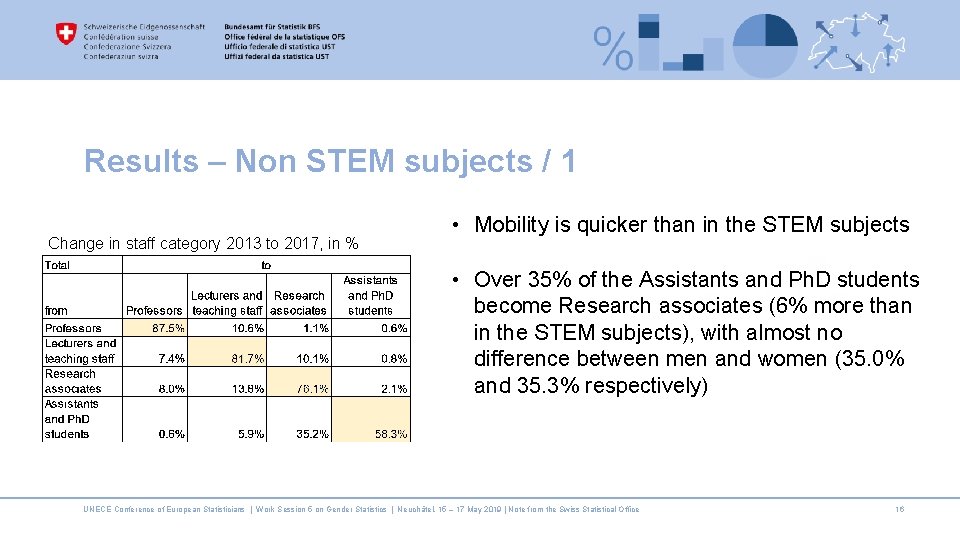
Results – Non STEM subjects / 1 Change in staff category 2013 to 2017, in % • Mobility is quicker than in the STEM subjects • Over 35% of the Assistants and Ph. D students become Research associates (6% more than in the STEM subjects), with almost no difference between men and women (35. 0% and 35. 3% respectively) UNECE Conference of European Statisticians | Work Session 5 on Gender Statistics | Neuchâtel, 15 – 17 May 2019 | Note from the Swiss Statistical Office 16
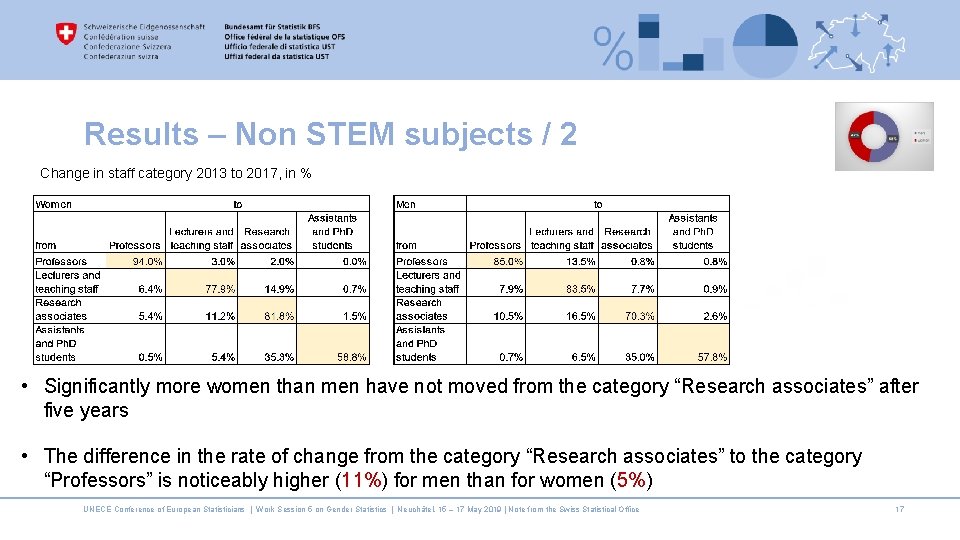
Results – Non STEM subjects / 2 Change in staff category 2013 to 2017, in % • Significantly more women than men have not moved from the category “Research associates” after five years • The difference in the rate of change from the category “Research associates” to the category “Professors” is noticeably higher (11%) for men than for women (5%) UNECE Conference of European Statisticians | Work Session 5 on Gender Statistics | Neuchâtel, 15 – 17 May 2019 | Note from the Swiss Statistical Office 17
Conclusions / 1 • The first findings of our analysis reveal that mobility among the staff categories after five years at a Swiss University (2013 -2017) is often similar in both genders across the various academic fields • It seems that some progress has been made in relation to the equality of career chances of the men and women who have stayed in the Swiss university system for the whole period 2013 -2017 UNECE Conference of European Statisticians | Work Session 5 on Gender Statistics | Neuchâtel, 15 – 17 May 2019 | Note from the Swiss Statistical Office 18
Conclusions / 2 However: • The transition to higher positions appears to be harder for women that for males • The gender gap in the university headcounts persists and is sometimes quite wide UNECE Conference of European Statisticians | Work Session 5 on Gender Statistics | Neuchâtel, 15 – 17 May 2019 | Note from the Swiss Statistical Office 19
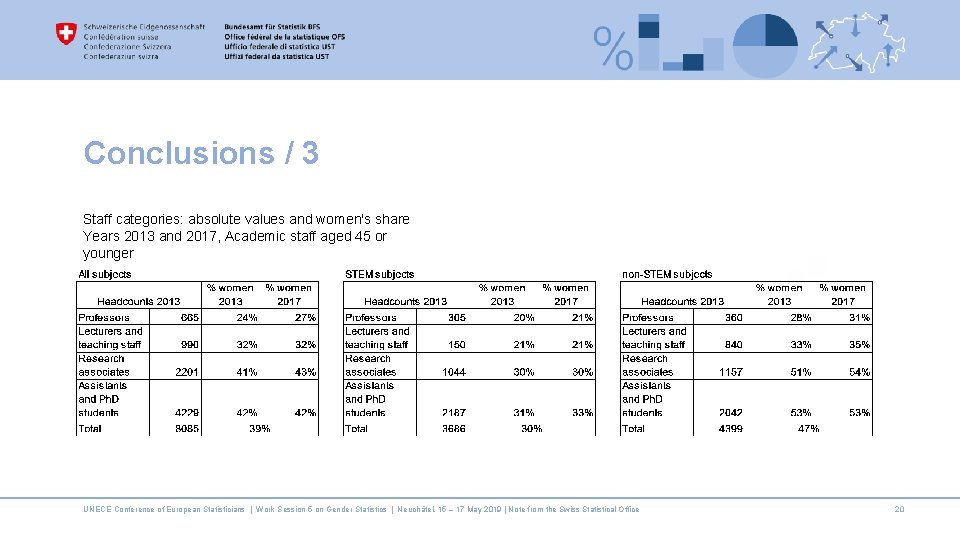
Conclusions / 3 Staff categories: absolute values and women's share Years 2013 and 2017, Academic staff aged 45 or younger UNECE Conference of European Statisticians | Work Session 5 on Gender Statistics | Neuchâtel, 15 – 17 May 2019 | Note from the Swiss Statistical Office 20
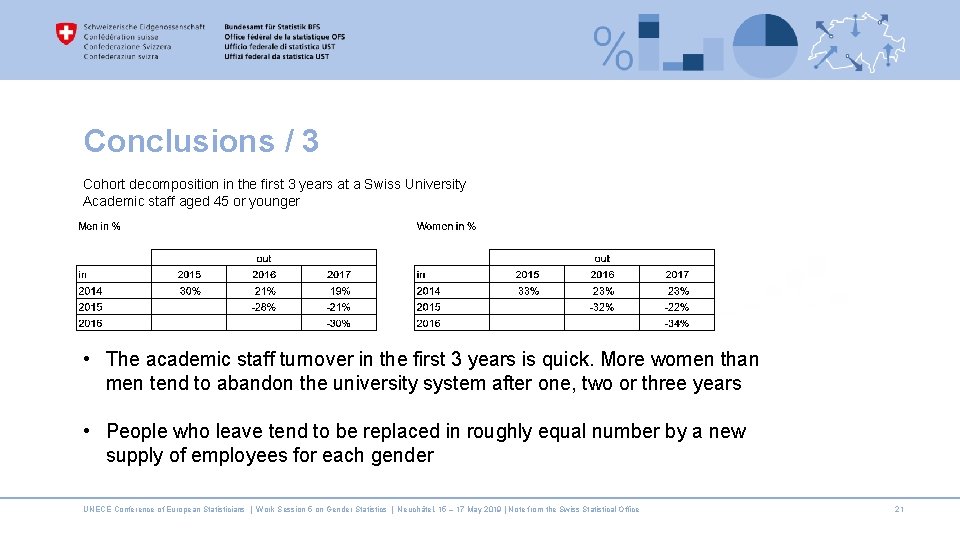
Conclusions / 3 Cohort decomposition in the first 3 years at a Swiss University Academic staff aged 45 or younger • The academic staff turnover in the first 3 years is quick. More women than men tend to abandon the university system after one, two or three years • People who leave tend to be replaced in roughly equal number by a new supply of employees for each gender UNECE Conference of European Statisticians | Work Session 5 on Gender Statistics | Neuchâtel, 15 – 17 May 2019 | Note from the Swiss Statistical Office 21
Ideas for further investigation • Breakdown in smaller age classes (e. g. : 25 -35 and 35 -45) • Analysis by type of activity between the staff categories (in FTE) • Analysis of reasons for slower mobility in the STEM subjects • Analysis of reasons for abandonnment in the first years (additional survey needed) UNECE Conference of European Statisticians | Work Session 5 on Gender Statistics | Neuchâtel, 15 – 17 May 2019 | Note from the Swiss Statistical Office 22
Thank you for your attention UNECE Conference of European Statisticians | Work Session 5 on Gender Statistics | Neuchâtel, 15 – 17 May 2019 | Note from the Swiss Statistical Office 23