
GENDER MAINSTREAMING IN DEVELOPMENT SUPPORT PROGRAMMES OF the
- Slides: 28
GENDER MAINSTREAMING IN DEVELOPMENT SUPPORT • PROGRAMMES OF the dti 21 st August 2014 Presentation to the Portfolio Committee on Women 23 th June 2015 1
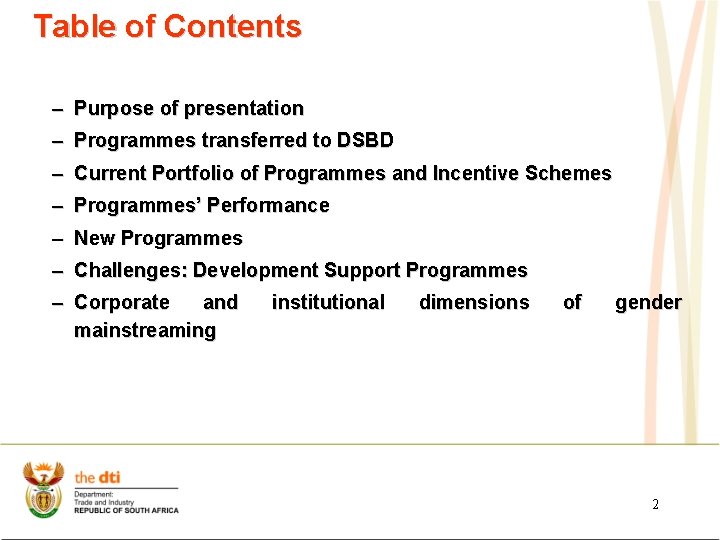
Table of Contents – Purpose of presentation – Programmes transferred to DSBD – Current Portfolio of Programmes and Incentive Schemes – Programmes’ Performance – New Programmes – Challenges: Development Support Programmes – Corporate and mainstreaming institutional dimensions of gender 2
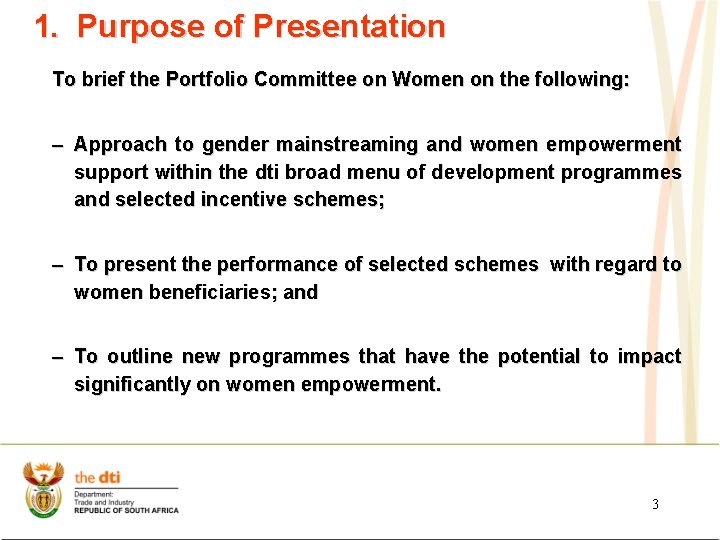
1. Purpose of Presentation To brief the Portfolio Committee on Women on the following: – Approach to gender mainstreaming and women empowerment support within the dti broad menu of development programmes and selected incentive schemes; – To present the performance of selected schemes with regard to women beneficiaries; and – To outline new programmes that have the potential to impact significantly on women empowerment. 3
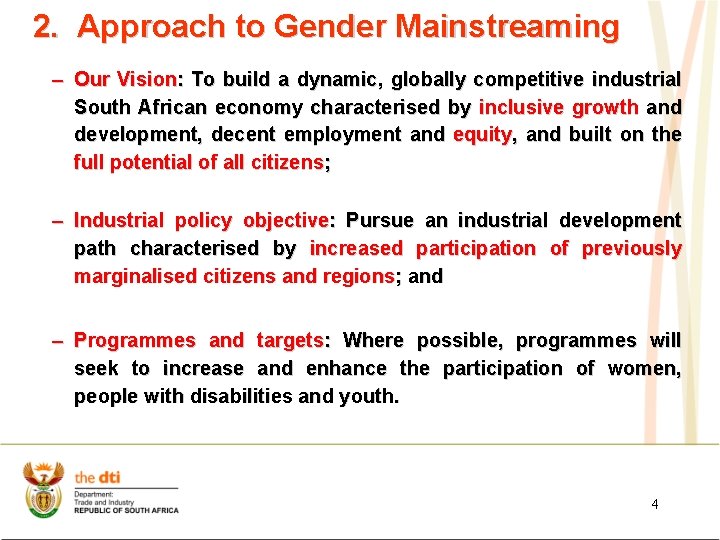
2. Approach to Gender Mainstreaming – Our Vision: To build a dynamic, globally competitive industrial South African economy characterised by inclusive growth and development, decent employment and equity, and built on the full potential of all citizens; – Industrial policy objective: Pursue an industrial development path characterised by increased participation of previously marginalised citizens and regions; and – Programmes and targets: Where possible, programmes will seek to increase and enhance the participation of women, people with disabilities and youth. 4
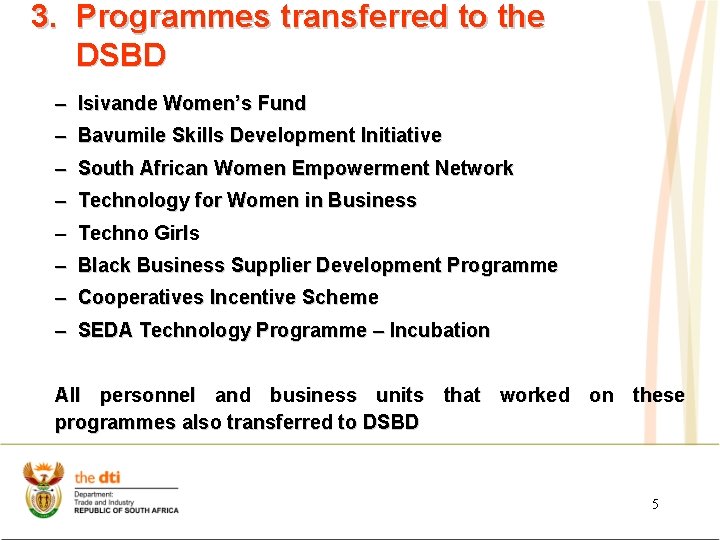
3. Programmes transferred to the DSBD – Isivande Women’s Fund – Bavumile Skills Development Initiative – South African Women Empowerment Network – Technology for Women in Business – Techno Girls – Black Business Supplier Development Programme – Cooperatives Incentive Scheme – SEDA Technology Programme – Incubation All personnel and business units that worked on these programmes also transferred to DSBD 5
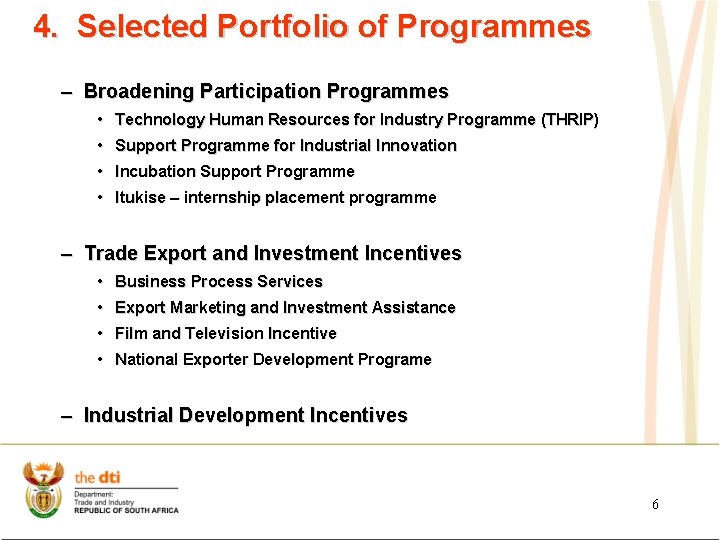
4. Selected Portfolio of Programmes – Broadening Participation Programmes • Technology Human Resources for Industry Programme (THRIP) • Support Programme for Industrial Innovation • Incubation Support Programme • Itukise – internship placement programme – Trade Export and Investment Incentives • Business Process Services • Export Marketing and Investment Assistance • Film and Television Incentive • National Exporter Development Programe – Industrial Development Incentives 6
5. Performance of Selected Programmes 7
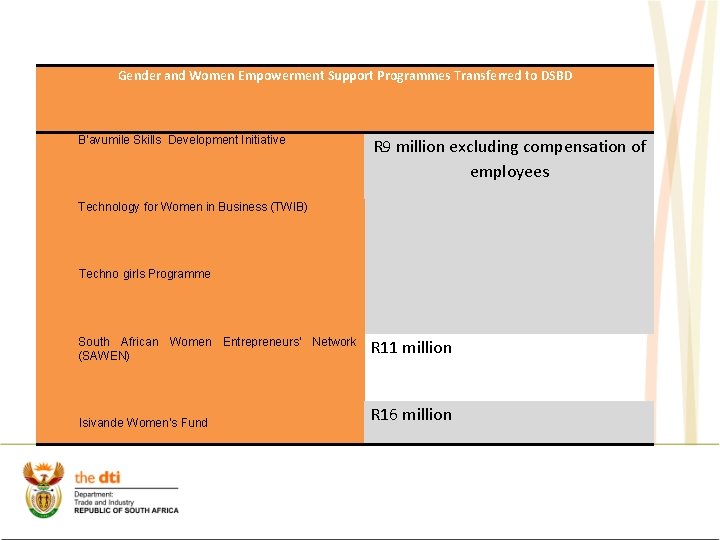
Gender and Women Empowerment Support Programmes Transferred to DSBD B'avumile Skills Development Initiative R 9 million excluding compensation of employees Technology for Women in Business (TWIB) Techno girls Programme South African Women Entrepreneurs' Network (SAWEN) Isivande Women’s Fund R 11 million R 16 million
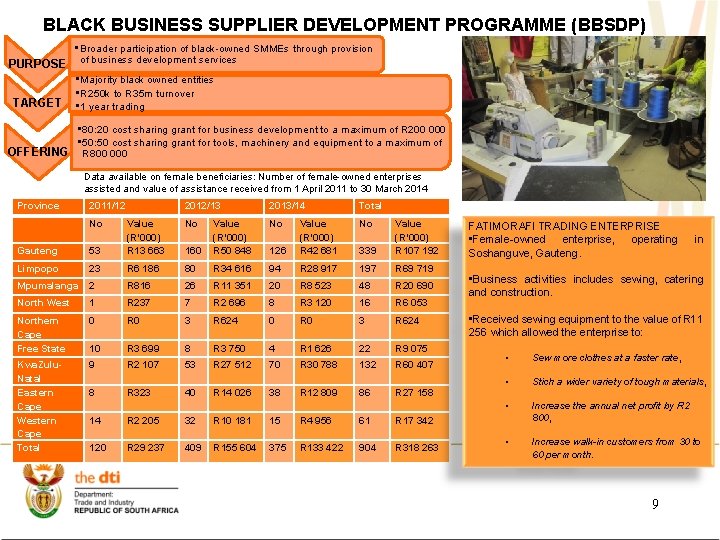
BLACK BUSINESS SUPPLIER DEVELOPMENT PROGRAMME (BBSDP) PURPOSE TARGET • Broader participation of black-owned SMMEs through provision of business development services • Majority black owned entities • R 250 k to R 35 m turnover • 1 year trading • 80: 20 cost sharing grant for business development to a maximum of R 200 000 • 50: 50 cost sharing grant for tools, machinery and equipment to a maximum of OFFERING R 800 000 Data available on female beneficiaries: Number of female-owned enterprises assisted and value of assistance received from 1 April 2011 to 30 March 2014 Province 2011/12 2012/13 2013/14 Total No No 126 Value (R’ 000) R 42 681 No 160 Value (R’ 000) R 50 848 No 53 Value (R’ 000) R 13 663 339 Value (R’ 000) R 107 192 Gauteng Limpopo 23 R 6 186 80 R 34 616 94 R 28 917 197 R 69 719 Mpumalanga 2 R 816 26 R 11 351 20 R 8 523 48 R 20 690 North West 1 R 237 7 R 2 696 8 R 3 120 16 R 6 053 Northern Cape Free State 0 R 0 3 R 624 10 R 3 699 8 R 3 750 4 R 1 626 22 R 9 075 Kwa. Zulu. Natal Eastern Cape Western Cape Total 9 R 2 107 53 R 27 512 70 R 30 788 132 R 60 407 8 R 323 40 R 14 026 38 R 12 809 86 R 27 158 14 R 2 205 32 R 10 181 15 R 4 956 61 R 17 342 120 R 29 237 409 R 155 604 375 R 133 422 904 R 318 263 FATIMORAFI TRADING ENTERPRISE • Female-owned enterprise, operating Soshanguve, Gauteng. in • Business activities includes sewing, catering and construction. • Received sewing equipment to the value of R 11 256 which allowed the enterprise to: • Sew more clothes at a faster rate, • Stich a wider variety of tough materials, • Increase the annual net profit by R 2 800, • Increase walk-in customers from 30 to 60 per month. 9
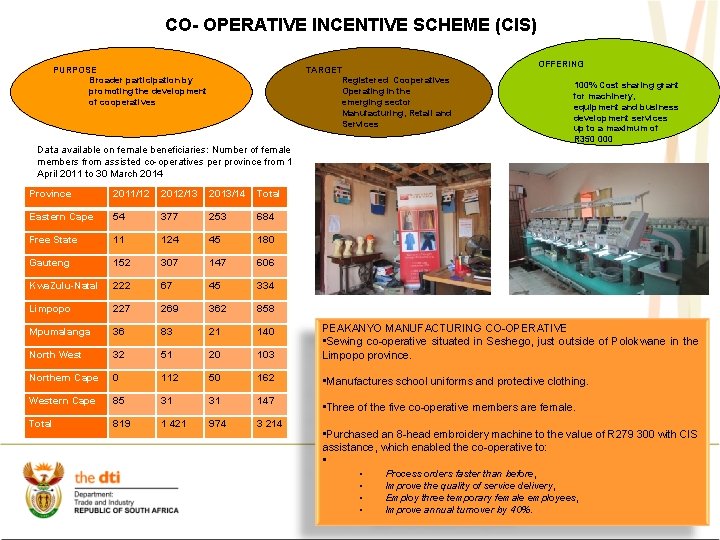
CO- OPERATIVE INCENTIVE SCHEME (CIS) PURPOSE Broader participation by promoting the development of cooperatives TARGET Registered Cooperatives Operating in the emerging sector Manufacturing, Retail and Services Data available on female beneficiaries: Number of female members from assisted co-operatives per province from 1 April 2011 to 30 March 2014 OFFERING 100% Cost sharing grant for machinery, equipment and business development services up to a maximum of R 350 000 Province 2011/12 2012/13 2013/14 Total Eastern Cape 54 377 253 684 Free State 11 124 45 180 Gauteng 152 307 147 606 Kwa. Zulu-Natal 222 67 45 334 Limpopo 227 269 362 858 Mpumalanga 36 83 21 140 North West 32 51 20 103 PEAKANYO MANUFACTURING CO-OPERATIVE • Sewing co-operative situated in Seshego, just outside of Polokwane in the Limpopo province. Northern Cape 0 112 50 162 • Manufactures school uniforms and protective clothing. Western Cape 85 31 31 147 Total 819 1 421 974 3 214 • Three of the five co-operative members are female. • Purchased an 8 -head embroidery machine to the value of R 279 300 with CIS assistance, which enabled the co-operative to: • • • Process orders faster than before, Improve the quality of service delivery, Employ three temporary female employees, Improve annual turnover by 40%. 10
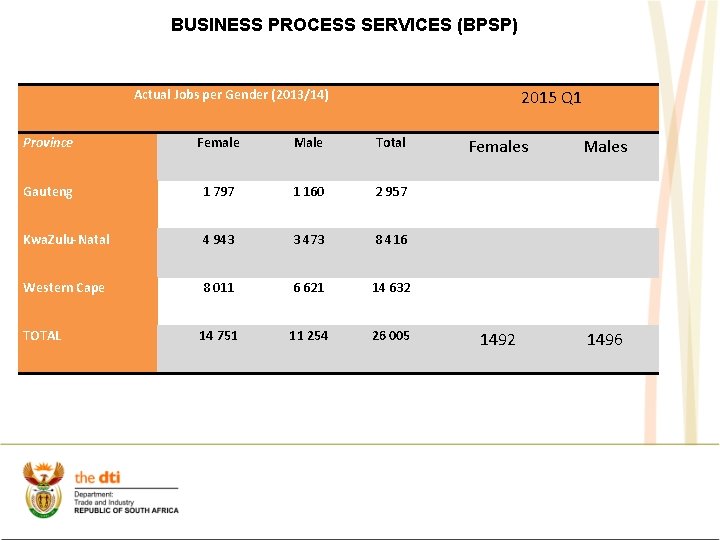
BUSINESS PROCESS SERVICES (BPSP) Actual Jobs per Gender (2013/14) 2015 Q 1 Province Female Male Total Gauteng 1 797 1 160 2 957 Kwa. Zulu-Natal 4 943 3 473 8 416 Western Cape 8 011 6 621 14 632 TOTAL 14 751 11 254 26 005 Females Males 1492 1496
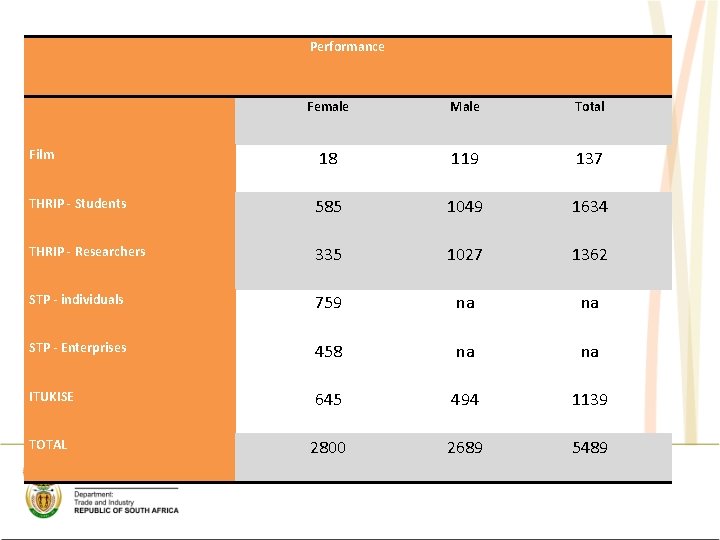
Performance Female Male Total 18 119 137 THRIP - Students 585 1049 1634 THRIP - Researchers 335 1027 1362 STP - individuals 759 na na STP - Enterprises 458 na na ITUKISE 645 494 1139 TOTAL 2800 2689 5489 Film
EXPORT MARKETING AND INVESTMENT ASSISTANCE (EMIA) The Export Marketing and Investment Assistance (EMIA) is an incentive offered by the Department of Trade and Industry. It seeks to partially compensate exporters for costs incurred in respect of the following: • Developing export markets for South African Products and Services; • Recruiting Foreign Direct Investment into South Africa • Identifying new export markets through market research. EMIA’s contribution to the Department’s mandate is that of directing financial resources towards efforts aimed at increasing South Africa’s capability and capacity to promote exports of products and services into targeted high growth markets and maintain its share in the traditional markets.
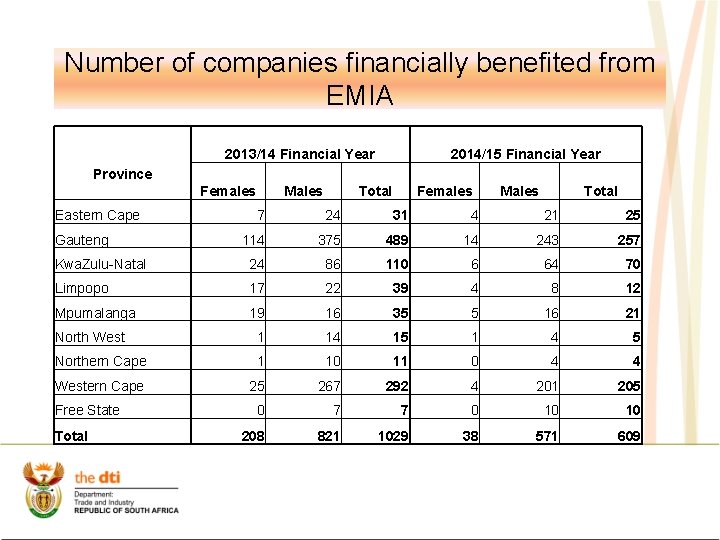
Number of companies financially benefited from EMIA 2013/14 Financial Year Province Eastern Cape Females Males 2014/15 Financial Year Total Females Males Total 7 24 31 4 21 25 114 375 489 14 243 257 Kwa. Zulu-Natal 24 86 110 6 64 70 Limpopo 17 22 39 4 8 12 Mpumalanga 19 16 35 5 16 21 North West 1 14 15 1 4 5 Northern Cape 1 10 11 0 4 4 Western Cape 25 267 292 4 201 205 0 7 7 0 10 10 208 821 1029 38 571 609 Gauteng Free State Total
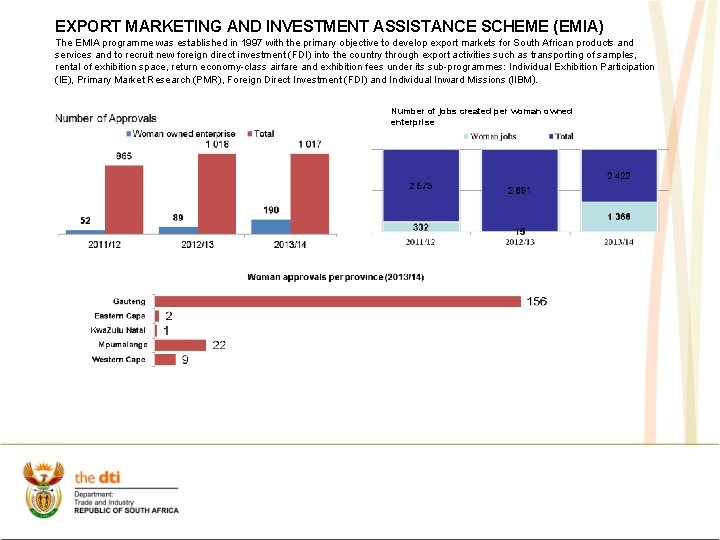
EXPORT MARKETING AND INVESTMENT ASSISTANCE SCHEME (EMIA) The EMIA programme was established in 1997 with the primary objective to develop export markets for South African products and services and to recruit new foreign direct investment (FDI) into the country through export activities such as transporting of samples, rental of exhibition space, return economy-class airfare and exhibition fees under its sub-programmes: Individual Exhibition Participation (IE), Primary Market Research (PMR), Foreign Direct Investment (FDI) and Individual Inward Missions (IIBM). Number of jobs created per woman owned enterprise
The National Exporter Development Programme (NEDP) Vision A well-resourced, efficient and effective exporter development Programme that delivers appropriately skilled exporters and that contributes to the number of global exporters and the value of exports growing consistently over time. Mission • Develop a pool of export-ready companies • Contribute to export growth, developing new markets and new export products through extensive capacity building, provision of information and implementation of special projects, incl. participation in ITI’s, Pavilions and Trade Missions • Ensure that there are effective resources available nationally for exporter development • Provide leadership, facilitate collaboration and effective communication between all the stakeholders from both the private and public sectors • Monitor and ensure continuous improvement of the programme 16
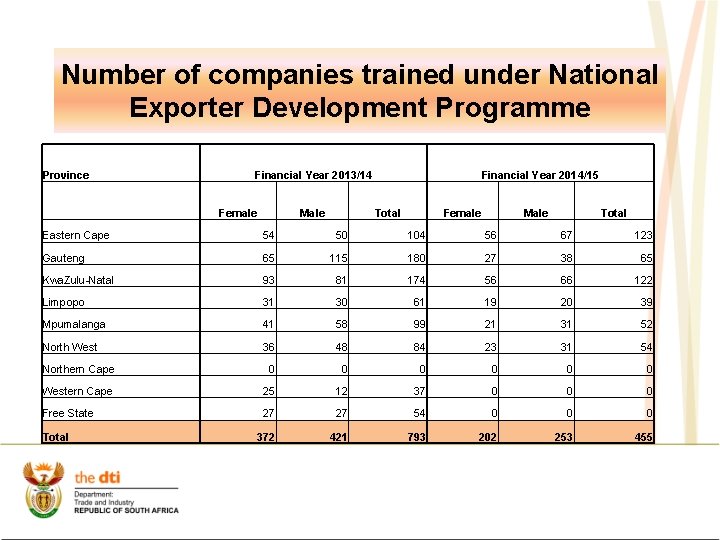
Number of companies trained under National Exporter Development Programme Province Financial Year 2013/14 Female Male Financial Year 2014/15 Total Female Male Total Eastern Cape 54 50 104 56 67 123 Gauteng 65 115 180 27 38 65 Kwa. Zulu-Natal 93 81 174 56 66 122 Limpopo 31 30 61 19 20 39 Mpumalanga 41 58 99 21 31 52 North West 36 48 84 23 31 54 Northern Cape 0 0 0 Western Cape 25 12 37 0 0 0 Free State 27 27 54 0 0 0 372 421 793 202 253 455 Total
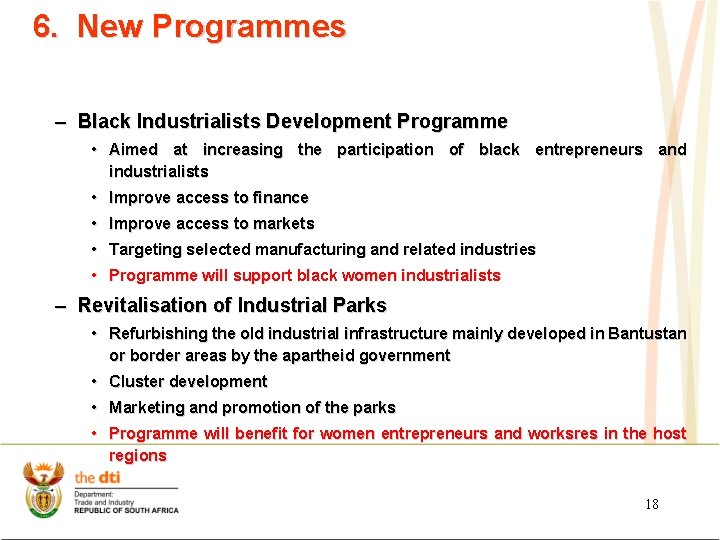
6. New Programmes – Black Industrialists Development Programme • Aimed at increasing the participation of black entrepreneurs and industrialists • Improve access to finance • Improve access to markets • Targeting selected manufacturing and related industries • Programme will support black women industrialists – Revitalisation of Industrial Parks • Refurbishing the old industrial infrastructure mainly developed in Bantustan or border areas by the apartheid government • Cluster development • Marketing and promotion of the parks • Programme will benefit for women entrepreneurs and worksres in the host regions 18
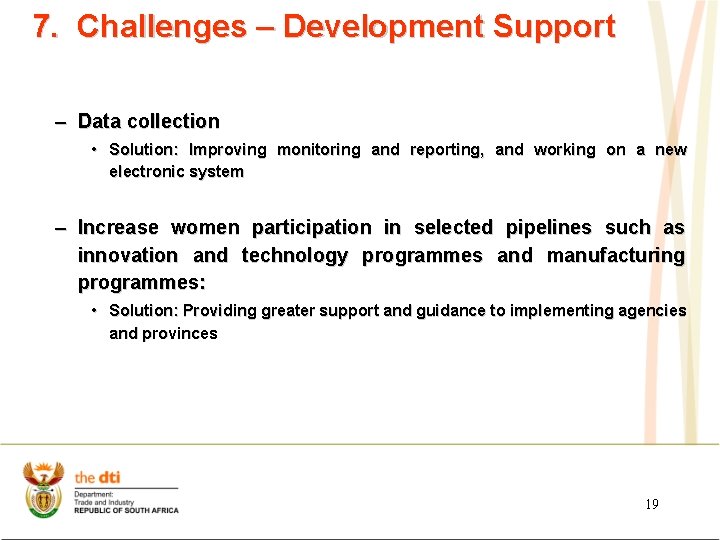
7. Challenges – Development Support – Data collection • Solution: Improving monitoring and reporting, and working on a new electronic system – Increase women participation in selected pipelines such as innovation and technology programmes and manufacturing programmes: • Solution: Providing greater support and guidance to implementing agencies and provinces 19
8. Corporate and Institutional Dimensions of Gender Mainstreaming 20
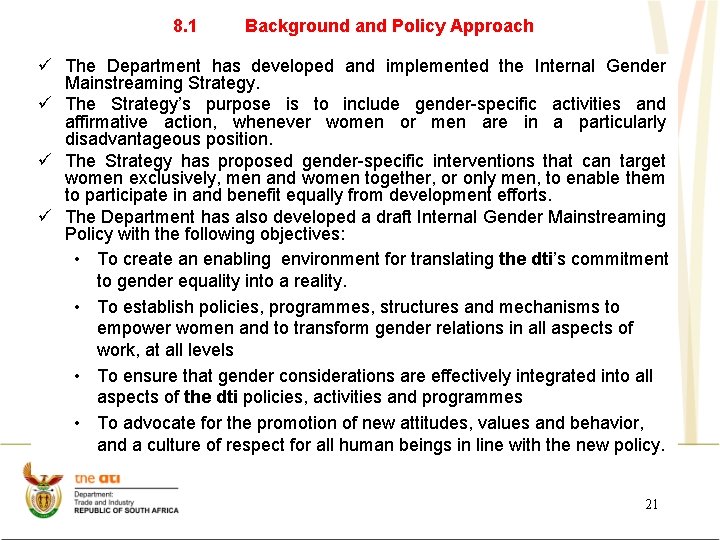
8. 1 Background and Policy Approach ü The Department has developed and implemented the Internal Gender Mainstreaming Strategy. ü The Strategy’s purpose is to include gender-specific activities and affirmative action, whenever women or men are in a particularly disadvantageous position. ü The Strategy has proposed gender-specific interventions that can target women exclusively, men and women together, or only men, to enable them to participate in and benefit equally from development efforts. ü The Department has also developed a draft Internal Gender Mainstreaming Policy with the following objectives: • To create an enabling environment for translating the dti’s commitment to gender equality into a reality. • To establish policies, programmes, structures and mechanisms to empower women and to transform gender relations in all aspects of work, at all levels • To ensure that gender considerations are effectively integrated into all aspects of the dti policies, activities and programmes • To advocate for the promotion of new attitudes, values and behavior, and a culture of respect for all human beings in line with the new policy. 21
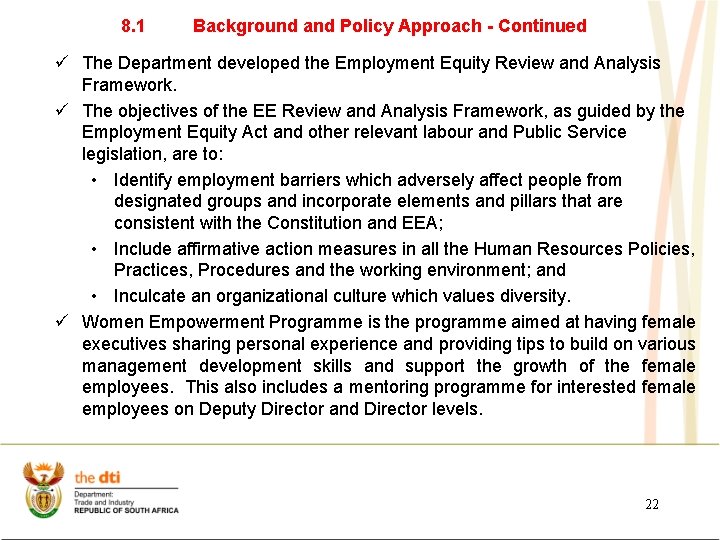
8. 1 Background and Policy Approach - Continued ü The Department developed the Employment Equity Review and Analysis Framework. ü The objectives of the EE Review and Analysis Framework, as guided by the Employment Equity Act and other relevant labour and Public Service legislation, are to: • Identify employment barriers which adversely affect people from designated groups and incorporate elements and pillars that are consistent with the Constitution and EEA; • Include affirmative action measures in all the Human Resources Policies, Practices, Procedures and the working environment; and • Inculcate an organizational culture which values diversity. ü Women Empowerment Programme is the programme aimed at having female executives sharing personal experience and providing tips to build on various management development skills and support the growth of the female employees. This also includes a mentoring programme for interested female employees on Deputy Director and Director levels. 22
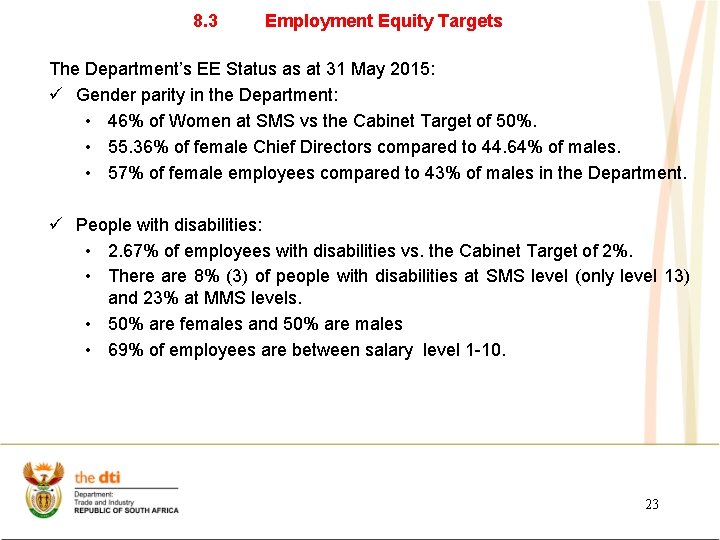
8. 3 Employment Equity Targets The Department’s EE Status as at 31 May 2015: ü Gender parity in the Department: • 46% of Women at SMS vs the Cabinet Target of 50%. • 55. 36% of female Chief Directors compared to 44. 64% of males. • 57% of female employees compared to 43% of males in the Department. ü People with disabilities: • 2. 67% of employees with disabilities vs. the Cabinet Target of 2%. • There are 8% (3) of people with disabilities at SMS level (only level 13) and 23% at MMS levels. • 50% are females and 50% are males • 69% of employees are between salary level 1 -10. 23
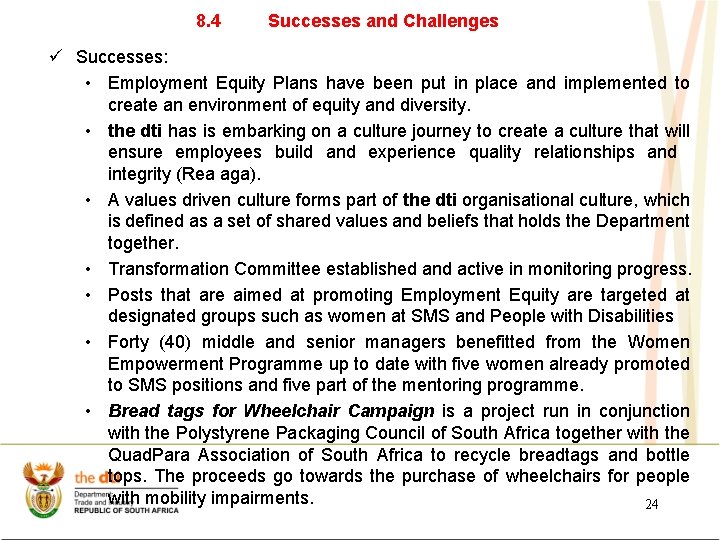
8. 4 Successes and Challenges ü Successes: • Employment Equity Plans have been put in place and implemented to create an environment of equity and diversity. • the dti has is embarking on a culture journey to create a culture that will ensure employees build and experience quality relationships and integrity (Rea aga). • A values driven culture forms part of the dti organisational culture, which is defined as a set of shared values and beliefs that holds the Department together. • Transformation Committee established and active in monitoring progress. • Posts that are aimed at promoting Employment Equity are targeted at designated groups such as women at SMS and People with Disabilities • Forty (40) middle and senior managers benefitted from the Women Empowerment Programme up to date with five women already promoted to SMS positions and five part of the mentoring programme. • Bread tags for Wheelchair Campaign is a project run in conjunction with the Polystyrene Packaging Council of South Africa together with the Quad. Para Association of South Africa to recycle breadtags and bottle tops. The proceeds go towards the purchase of wheelchairs for people with mobility impairments. 24
8. 4 • • Successes and Challenges - Continued Women are also trained on Foreign Economic Representative (FER) skills in preparation for recruitment and posting at foreign missions. The performance agreements of senior managers include the implementation of Employment Equity. The Departmental Retention Policy was reviewed to allow for specific categories of retention such as women in middle and senior management. The amendment of the Departmental Leave Policy to include Cultural Leave is one of the innovative ideas that embrace diversity. The Department also conducted an Employment Equity Survey and developed an implementation plan based on the findings and recommendations of the survey. Other innovative initiatives that the Department has put in place as part of implementing the EEA and embracing diversity include educational seminars and workshops that focus on topics ranging from health talks to counselling programmes. Assistive devices and reasonable accommodation provided to employees with a disability. 25
8. 4 Successes and Challenges - Continued ü Challenges: • Non-compliance in terms of targeted recruitment by some Divisions. • Perceptions and stereotypes on cultural and gender diversity in certain areas of the work environment. • Poor attendance of Gender Forum meetings by members and lower level staff attending. • Some Divisional Representatives from the Transformation Committee not afforded the opportunity to implement transformation resolutions in their Divisions due to their levels. 26
8. 5 Overview of the Gender Focal Point ü The Department has a Gender Focal Point appointed at Deputy Director level. ü The post is located under the Chief Directorate: Human Resources and Learning Centre at the Corporate Services Division. ü The position is responsible for Employment Equity and Transformation which incorporate Gender, Disability and Employment Equity and monitoring and reporting on these matters. ü Two Assistant Director posts are available in the Sub-directorate who renders support in terms of internal gender mainstreaming and disability management. 27
THANK YOU 28