
Gender Inequality Marxist and Feminist views Week 8

- Slides: 29
Gender Inequality: Marxist and Feminist views Week 8 Gender and Society
Recap • Social construction of gender • Considered the role of different structures such as education and work in the construction of gender • Liberal feminism Equality / Difference debate
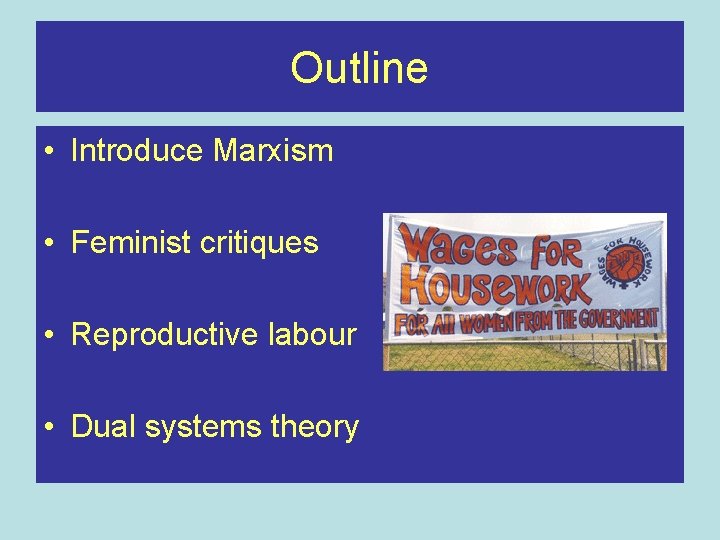
Outline • Introduce Marxism • Feminist critiques • Reproductive labour • Dual systems theory
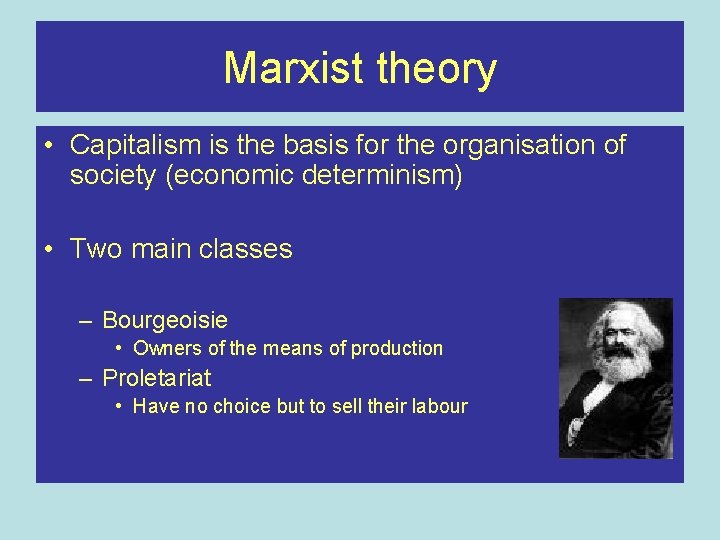
Marxist theory • Capitalism is the basis for the organisation of society (economic determinism) • Two main classes – Bourgeoisie • Owners of the means of production – Proletariat • Have no choice but to sell their labour
Marxist theory • Wage labour is key to production • Profits arise through exploitation (surplus value) • Classes produced through relations of production
Marxist theory • The workers transform raw materials to make profits. • Profits go to the shareowners and directors
Engels • ‘Origins of the Family, Private Property and the State’ 1884 • New forms of production allowed men to gain ‘surplus’ leading to wealth and power • Monogamous marriage developed to allow men to pass on property • Sex oppression is also class oppression
Engels ‘In the great majority of cases today, at least in the possessing classes, the husband is obliged to earn a living and support his family, and that in itself gives him a position of supremacy, without any need for special legal titles and privileges. Within the family he is the bourgeois and the wife represents the proletariat…. With the transfer of the means of production into common ownership, the single family ceases to be the economic unit of society. Private housekeeping is transformed into a social industry’ • http: //www. marxists. org/archive/marx/works/1884/originfamily/ch 02 d. htm
Engels on Marriage • Marriage is based on economic conditions • Although constructed as a voluntary contract it is coerced by the organisation of society. • Bourgeoisie wives are similar to prostitutes they sell their bodies to one man rather than many
Marxist theory • To what extent do you think this model is a useful way of understanding society?
‘The woman question’ • 1960 s revised interest in Marx and Engles’ writings • But it didn’t seem to account very well for women. • Two strands of feminism emerged – Adding theory of reproduction to that of production • Marxist feminism – Dual systems theories - capitalism & patriarchy • Socialist feminism
Theory of Reproduction • Marxism is based on a divide relating to the relationship to the means of production • Bourgeoisie • Proletariat • Women’s domestic work does not fit into this picture
Theory of Reproduction • Women’s labour is important in two dimensions – Their labour in the home is necessary for workers to be employed – They physically give birth to the next generation of workers
Reproducing the labour force • Capitalism requires workers • • Women have to give birth and care for children in order to restock the labour force
Marxist feminism ‘Relations of production, grounded as they are in a deeply ideological division of labour, cannot be investigated through economic categories alone. (…) the capitalist division of labour is not determined by technical requirements alone’. Barrett M (1980) Women’s Oppression Today London, Verso
Marxist feminism • Capitalism is the primary cause of women’s oppression • Reforming or ending capitalism is the primary goal
• Talk to the person sitting next to you about the to extent to which you think capitalism may be responsible for women’s oppression.
Limitations • Theorising reproduction went some way to explaining women’s position, but it could not answer many questions – Why were/are women oppressed in noncapitalist countries? – Why are women paid less than men? – Why are women responsible for domestic sphere?
Socialist feminism • For socialist feminism, Marxist ideas on class oppression are important • But they do not fully explain women’s position • Developed dual systems approach • Different combinations of capitalism and patriarchy
Capitalism and patriarchy • Hartmann shows that capitalism and patriarchy often work against each other but do not destroy each other • Capitalism and patriarchy may have competing interests and need to adjust to each other.
Reproducing for capitalism • If women did not work in the home then workers could not sell their labour – Eat, sleep, keep healthy etc • If workers had to pay for these services then wages would have to go up
Not class alone • Women’s oppression is related to their class position – Not paid properly for their labour either in or out of the home • But patriarchal privilege is also a central structure to society • Racism also recognised as interrelating to class and gender oppression
Patriarchal Capitalism • Traditional heterosexual families developed within an institutionalized sexual hierarchy • Women have primary responsibility for the home and children • Women may be excluded from the marketplace (unpaid housewives) • Women could be hired at lower wages than men because their primary responsibility was considered to be home and family.
To overcome gender inequality • Class oppression through reform/ending capitalism • Patriarchal oppression through challenging the traditional family
Area of interest/activism • Socialist feminist concentrates on the material and historical conditions in which women live – Heterosexuality is a structure that needs to be understood as part of women’s oppression – Employment conditions and recognising women’s unpaid work – State involvement in perpetuating women’s position (welfare organisation) – Access to contraception and abortion essential for women’s autonomy
• Do you think the ideas of socialist feminism are more likely to explain women’s position in society?
Comparison to Liberal Feminism • Liberal feminism concentrates of formal mechanisms in the public sphere to challenge inequality – A level playing field? • It does not challenge the structure of society itself. • Marxist/Socialist feminism argue that the structure needs to change to end inequality
Summary • Considered how feminist theory has interrelated with Marxism • Outline concept of ‘Reproduction’ of the workforce • Considered dual systems theories of capitalism and patriarchy
Next week • Looking at radical feminism • Considering concept of patriarchy in more detail • Outlining the ‘continuum of sexual violence’