
GENDER EQUALITY n Gender equality means equal treatment
- Slides: 13
GENDER EQUALITY n Gender equality means equal treatment of women and men in laws and policies, and equal access to resources and services within families, communities and society at large.
GENDER EQUITY n Gender equity means fairness and justice in the distribution of benefits and responsibilities between women and men. It often requires women-specific programmes and policies to end existing inequalities.
Approaches to Equality
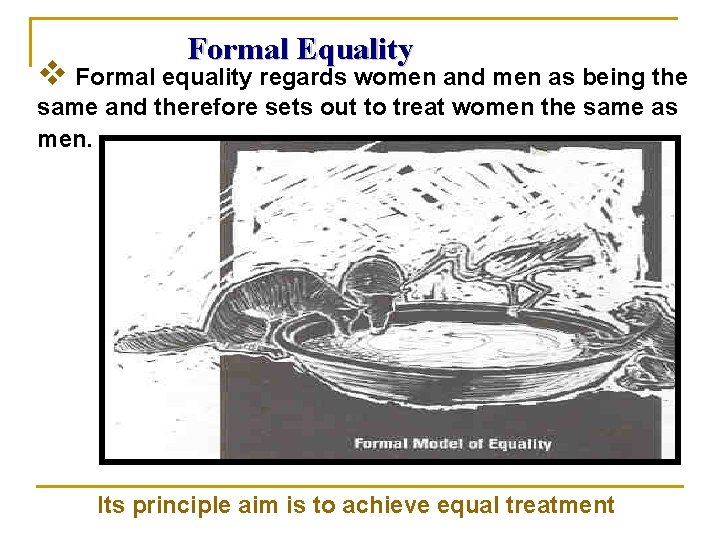
Formal Equality v Formal equality regards women and men as being the same and therefore sets out to treat women the same as men. Its principle aim is to achieve equal treatment
Formal Equality v. Formal equality does not take into account biological and gender differences between men & women. v. Its ‘neutral’ standards are in fact based on male experiences and standards. By imposing male standards on women, it excludes or disables women from equal access, opportunities and participation. v. It promotes “gender bias and blindness” which reinforces dominant standards based on male experiences & interests.
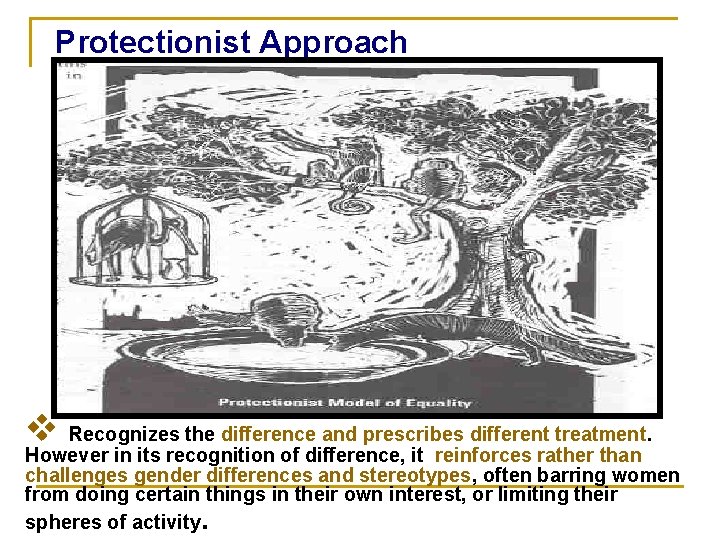
Protectionist Approach v Recognizes the difference and prescribes different treatment. However in its recognition of difference, it reinforces rather than challenges gender differences and stereotypes, often barring women from doing certain things in their own interest, or limiting their spheres of activity .
Protectionist approach v Approach is “likes are to be treated alike”, and in recognition of gender differences, it seeks to treat women differently. v Eg. women are prohibited from night work/migrating because it is considered to be unsafe for them. Or for instance, preference to women for jobs such as nursing, teaching based on a naturalised understanding of women’s nursing and caring roles. v Rather than focus on the external, structural or systemic cause for subordination and stereotyping of women, this approach endorses rather than corrects it. v The approach is dis-empowering as it accepts difference as ‘natural’ rather than socially constructed. It perpetuates the differences and the disadvantages that come with it.
Substantive Equality Approach Substantive equality approach recognizes that some people are in an unequal position & have to be treated differently from others in order for them to benefit equally. E. g. if night work is involved, the Environment should be made safe for women to work. It is concerned not just with equal opportunity but also with equality of results. E. g. to remove gender stereotyping in job market, it calls for an Equal Opportunities policy to give women and other marginalised groups a priority in jobs and positions from which they have historically been excluded, if they meet the required qualifications
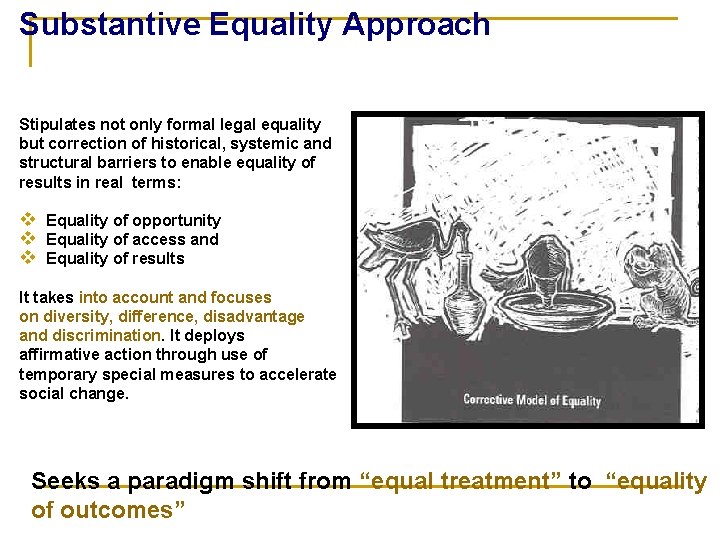
Substantive Equality Approach Stipulates not only formal legal equality but correction of historical, systemic and structural barriers to enable equality of results in real terms: v Equality of opportunity v Equality of access and v Equality of results It takes into account and focuses on diversity, difference, disadvantage and discrimination. It deploys affirmative action through use of temporary special measures to accelerate social change. Seeks a paradigm shift from “equal treatment” to “equality of outcomes”
MILLENNIUM DEVELOPMENT GOALS n n n Goal 2: Achieve Universal Primary Education Target 3. Ensure that by 2015 children everywhere, boys and girls alike, will be able to complete a full course of primary schooling. Goal 3. Promote Gender Equality and Empower Women Target 4. Eliminate gender disparity in primary and secondary education, preferably by 2005, and at all levels of education no later than 2015. 12
GENDER SENSITIVITY & GENDER SENSITIZATION n is the ability to recognize gender issues, and especially the ability to recognize women's different perceptions and interests arising from their different social location and different gender roles. Gender sensitivity is often used to mean the same as gender awareness, although gender awareness can also mean the extra ability to recognize gender issues which remain "hidden" from those with a more conventional point of view. But here we define gender sensitivity as the beginning of gender awareness, where the latter is more analytical, more critical and more "questioning" of gender disparities.