
Gender Equality in Germany A RECENT FOCUS ON
- Slides: 6
Gender Equality in Germany A RECENT FOCUS ON ECONOMIC PARTICIPATION
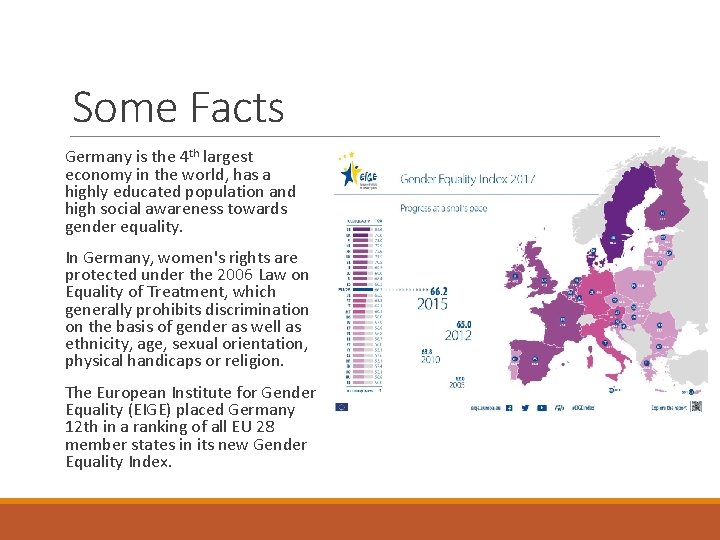
Some Facts Germany is the 4 th largest economy in the world, has a highly educated population and high social awareness towards gender equality. In Germany, women's rights are protected under the 2006 Law on Equality of Treatment, which generally prohibits discrimination on the basis of gender as well as ethnicity, age, sexual orientation, physical handicaps or religion. The European Institute for Gender Equality (EIGE) placed Germany 12 th in a ranking of all EU 28 member states in its new Gender Equality Index.
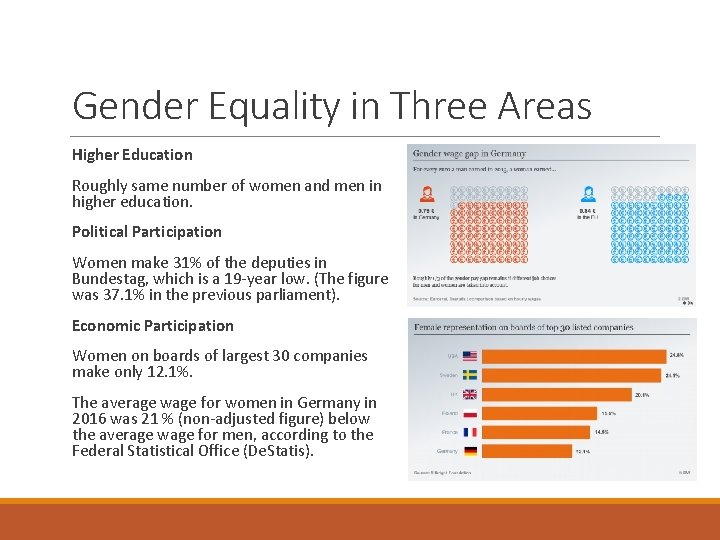
Gender Equality in Three Areas Higher Education Roughly same number of women and men in higher education. Political Participation Women make 31% of the deputies in Bundestag, which is a 19 -year low. (The figure was 37. 1% in the previous parliament). Economic Participation Women on boards of largest 30 companies make only 12. 1%. The average wage for women in Germany in 2016 was 21 % (non-adjusted figure) below the average wage for men, according to the Federal Statistical Office (De. Statis).
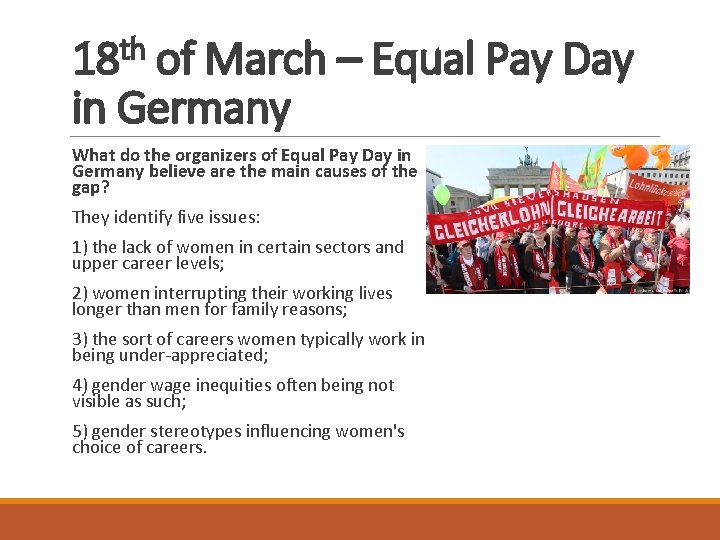
th 18 of March – Equal Pay Day in Germany What do the organizers of Equal Pay Day in Germany believe are the main causes of the gap? They identify five issues: 1) the lack of women in certain sectors and upper career levels; 2) women interrupting their working lives longer than men for family reasons; 3) the sort of careers women typically work in being under-appreciated; 4) gender wage inequities often being not visible as such; 5) gender stereotypes influencing women's choice of careers.
Measures towards Gender Equality 2015 – Gender Quota Law for Large Companies: This requires large companies to allocate 30 percent of non-executive board seats to women. 2016 - Wage Transparency Law of 2016: This law allows women to ask employers to provide information about average rates of pay for men and women in specific tasks. There are limits to these legal protections. The Transparency Law, for instance, applies only to large companies with more than 200 employees. And at the upper rungs of the corporate ladder, it is very difficult to identify enough male and female peers for comparison.
Thank you for your attention!