
Gender Equality Act 2020 What it means for
- Slides: 15
Gender Equality Act 2020 What it means for us
Contents The case for change Why legislation to support gender equality is important Background on the Gender Equality Act 2020 Key obligations under the Act Workplace gender audits Gender Equality Action Plans Gender impact assessments Progress reports Resourcing our Gender Equality Action Plan Timeline of obligations The Public Sector Gender Equality Commissioner Compliance with the Act
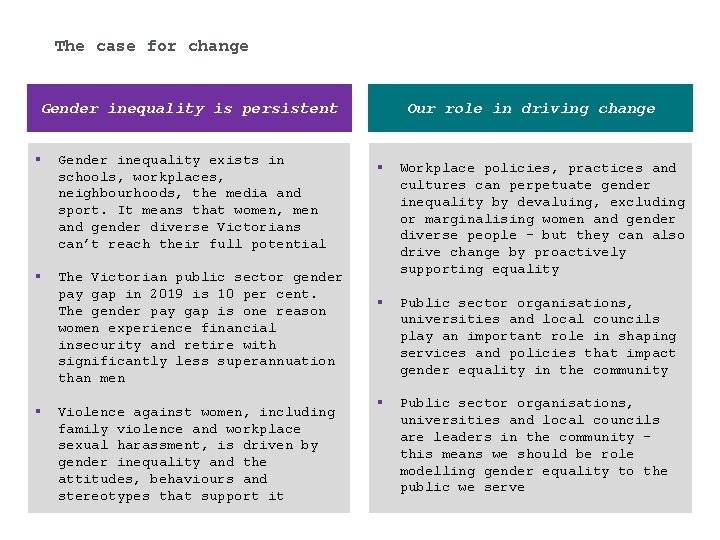
The case for change Gender inequality is persistent § Gender inequality exists in schools, workplaces, neighbourhoods, the media and sport. It means that women, men and gender diverse Victorians can’t reach their full potential § The Victorian public sector gender pay gap in 2019 is 10 per cent. The gender pay gap is one reason women experience financial insecurity and retire with significantly less superannuation than men § Violence against women, including family violence and workplace sexual harassment, is driven by gender inequality and the attitudes, behaviours and stereotypes that support it Our role in driving change § Workplace policies, practices and cultures can perpetuate gender inequality by devaluing, excluding or marginalising women and gender diverse people – but they can also drive change by proactively supporting equality § Public sector organisations, universities and local councils play an important role in shaping services and policies that impact gender equality in the community § Public sector organisations, universities and local councils are leaders in the community – this means we should be role modelling gender equality to the public we serve
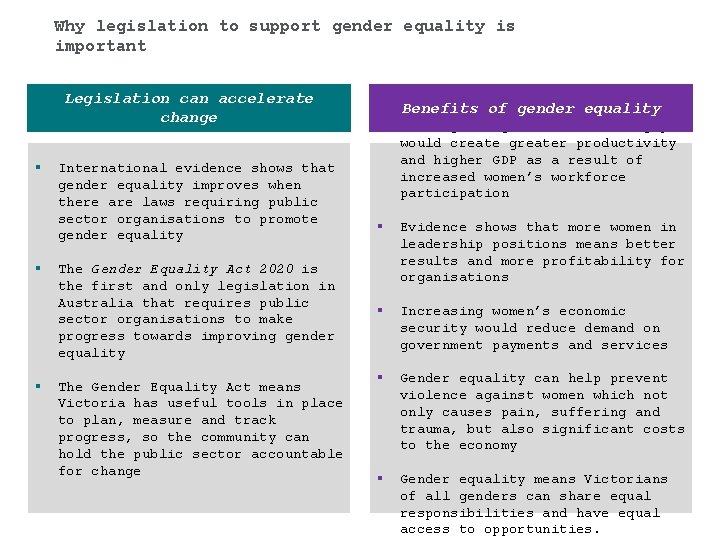
Why legislation to support gender equality is important Legislation can accelerate change § § § International evidence shows that gender equality improves when there are laws requiring public sector organisations to promote gender equality The Gender Equality Act 2020 is the first and only legislation in Australia that requires public sector organisations to make progress towards improving gender equality The Gender Equality Act means Victoria has useful tools in place to plan, measure and track progress, so the community can hold the public sector accountable for change Benefits of gender equality § Closing the gender workforce gap would create greater productivity and higher GDP as a result of increased women’s workforce participation § Evidence shows that more women in leadership positions means better results and more profitability for organisations § Increasing women’s economic security would reduce demand on government payments and services § Gender equality can help prevent violence against women which not only causes pain, suffering and trauma, but also significant costs to the economy § Gender equality means Victorians of all genders can share equal responsibilities and have equal access to opportunities.
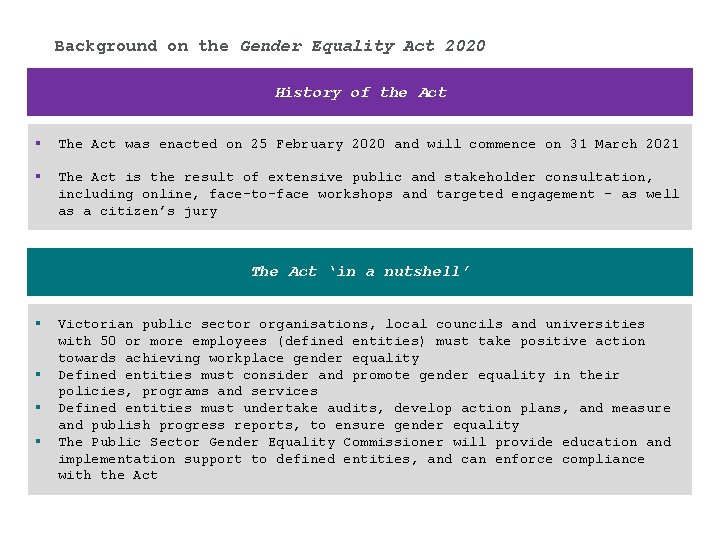
Background on the Gender Equality Act 2020 History of the Act § The Act was enacted on 25 February 2020 and will commence on 31 March 2021 § The Act is the result of extensive public and stakeholder consultation, including online, face-to-face workshops and targeted engagement – as well as a citizen’s jury The Act ‘in a nutshell’ § § Victorian public sector organisations, local councils and universities with 50 or more employees (defined entities) must take positive action towards achieving workplace gender equality Defined entities must consider and promote gender equality in their policies, programs and services Defined entities must undertake audits, develop action plans, and measure and publish progress reports, to ensure gender equality The Public Sector Gender Equality Commissioner will provide education and implementation support to defined entities, and can enforce compliance with the Act
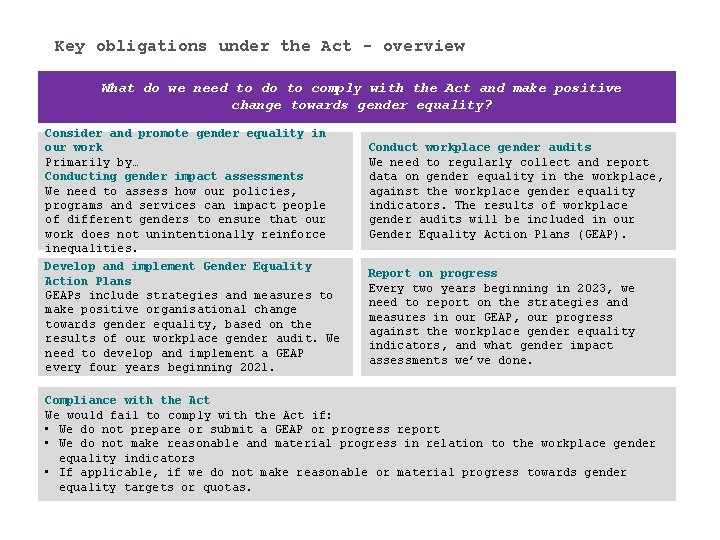
Key obligations under the Act - overview What do we need to do to comply with the Act and make positive change towards gender equality? Consider and promote gender equality in our work Primarily by… Conducting gender impact assessments We need to assess how our policies, programs and services can impact people of different genders to ensure that our work does not unintentionally reinforce inequalities. Develop and implement Gender Equality Action Plans GEAPs include strategies and measures to make positive organisational change towards gender equality, based on the results of our workplace gender audit. We need to develop and implement a GEAP every four years beginning 2021. Conduct workplace gender audits We need to regularly collect and report data on gender equality in the workplace, against the workplace gender equality indicators. The results of workplace gender audits will be included in our Gender Equality Action Plans (GEAP). Report on progress Every two years beginning in 2023, we need to report on the strategies and measures in our GEAP, our progress against the workplace gender equality indicators, and what gender impact assessments we’ve done. Compliance with the Act We would fail to comply with the Act if: • We do not prepare or submit a GEAP or progress report • We do not make reasonable and material progress in relation to the workplace gender equality indicators • If applicable, if we do not make reasonable or material progress towards gender equality targets or quotas.
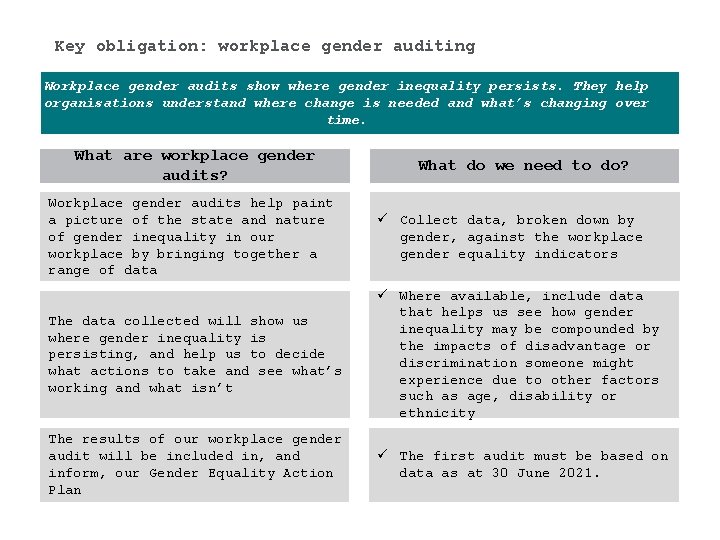
Key obligation: workplace gender auditing Workplace gender audits show where gender inequality persists. They help organisations understand where change is needed and what’s changing over time. What are workplace gender audits? What do we need to do? Workplace gender audits help paint a picture of the state and nature of gender inequality in our workplace by bringing together a range of data ü Collect data, broken down by gender, against the workplace gender equality indicators The data collected will show us where gender inequality is persisting, and help us to decide what actions to take and see what’s working and what isn’t ü Where available, include data that helps us see how gender inequality may be compounded by the impacts of disadvantage or discrimination someone might experience due to other factors such as age, disability or ethnicity The results of our workplace gender audit will be included in, and inform, our Gender Equality Action Plan ü The first audit must be based on data as at 30 June 2021.
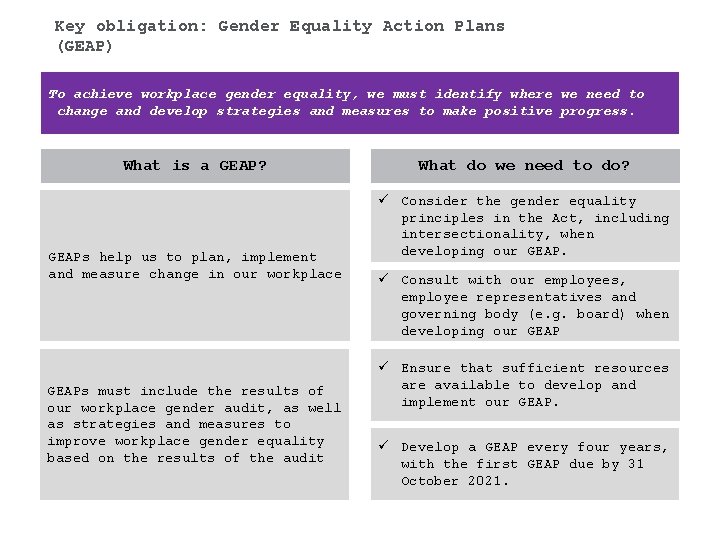
Key obligation: Gender Equality Action Plans (GEAP) To achieve workplace gender equality, we must identify where we need to change and develop strategies and measures to make positive progress. What is a GEAP? GEAPs help us to plan, implement and measure change in our workplace GEAPs must include the results of our workplace gender audit, as well as strategies and measures to improve workplace gender equality based on the results of the audit What do we need to do? ü Consider the gender equality principles in the Act, including intersectionality, when developing our GEAP. ü Consult with our employees, employee representatives and governing body (e. g. board) when developing our GEAP ü Ensure that sufficient resources are available to develop and implement our GEAP. ü Develop a GEAP every four years, with the first GEAP due by 31 October 2021.
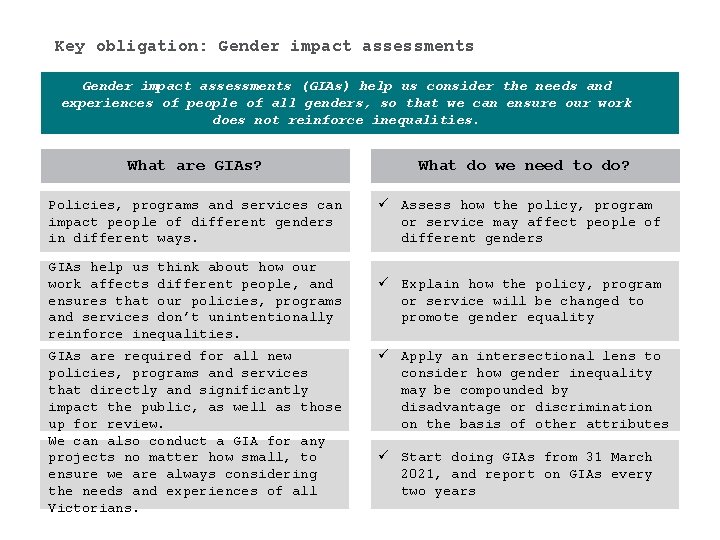
Key obligation: Gender impact assessments (GIAs) help us consider the needs and experiences of people of all genders, so that we can ensure our work does not reinforce inequalities. What are GIAs? What do we need to do? Policies, programs and services can impact people of different genders in different ways. ü Assess how the policy, program or service may affect people of different genders GIAs help us think about how our work affects different people, and ensures that our policies, programs and services don’t unintentionally reinforce inequalities. ü Explain how the policy, program or service will be changed to promote gender equality GIAs are required for all new policies, programs and services that directly and significantly impact the public, as well as those up for review. We can also conduct a GIA for any projects no matter how small, to ensure we are always considering the needs and experiences of all Victorians. ü Apply an intersectional lens to consider how gender inequality may be compounded by disadvantage or discrimination on the basis of other attributes ü Start doing GIAs from 31 March 2021, and report on GIAs every two years
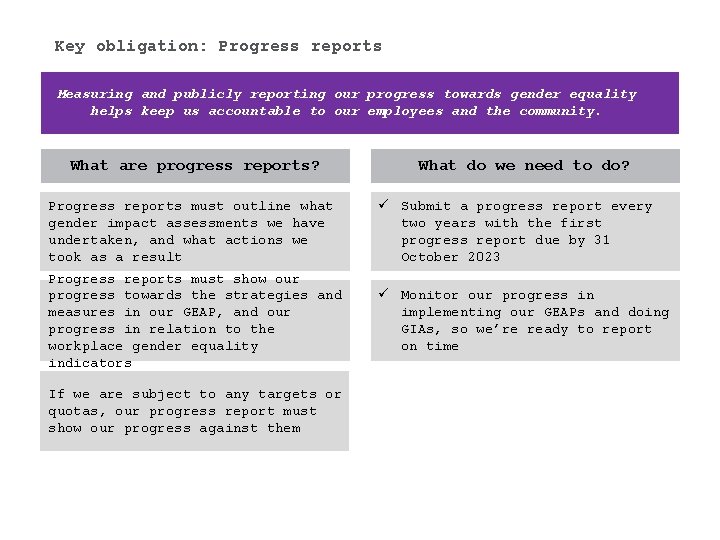
Key obligation: Progress reports Measuring and publicly reporting our progress towards gender equality helps keep us accountable to our employees and the community. What are progress reports? What do we need to do? Progress reports must outline what gender impact assessments we have undertaken, and what actions we took as a result ü Submit a progress report every two years with the first progress report due by 31 October 2023 Progress reports must show our progress towards the strategies and measures in our GEAP, and our progress in relation to the workplace gender equality indicators ü Monitor our progress in implementing our GEAPs and doing GIAs, so we’re ready to report on time If we are subject to any targets or quotas, our progress report must show our progress against them
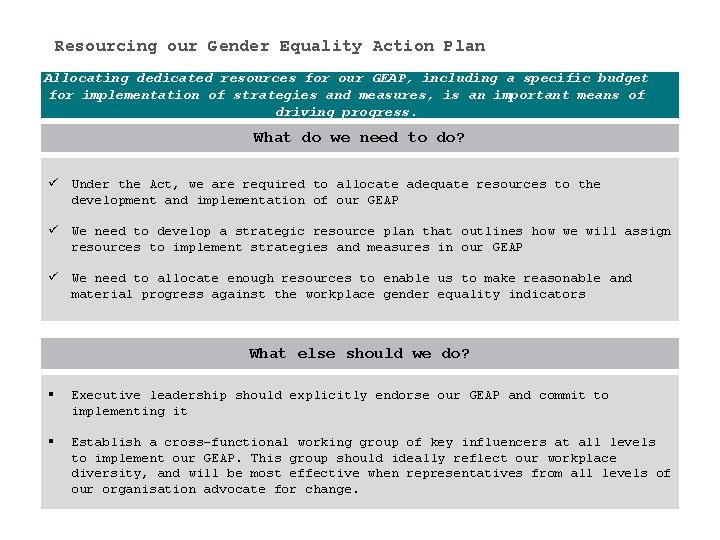
Resourcing our Gender Equality Action Plan Allocating dedicated resources for our GEAP, including a specific budget for implementation of strategies and measures, is an important means of driving progress. What do we need to do? ü Under the Act, we are required to allocate adequate resources to the development and implementation of our GEAP ü We need to develop a strategic resource plan that outlines how we will assign resources to implement strategies and measures in our GEAP ü We need to allocate enough resources to enable us to make reasonable and material progress against the workplace gender equality indicators What else should we do? § Executive leadership should explicitly endorse our GEAP and commit to implementing it § Establish a cross-functional working group of key influencers at all levels to implement our GEAP. This group should ideally reflect our workplace diversity, and will be most effective when representatives from all levels of our organisation advocate for change.
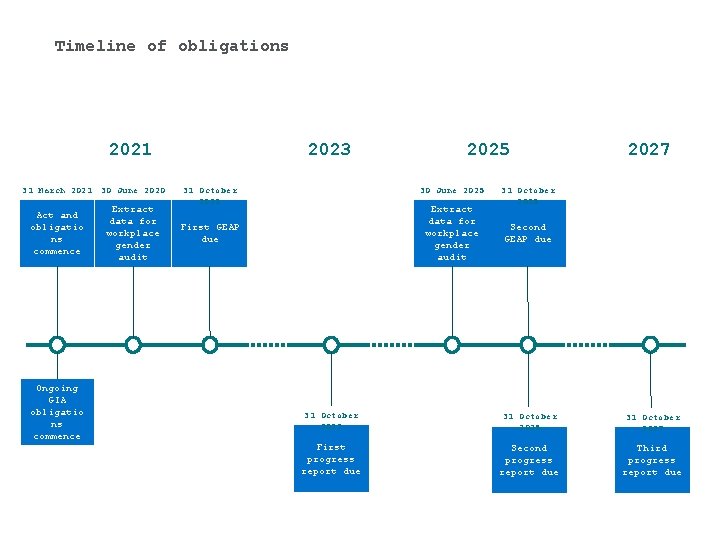
Timeline of obligations 2021 31 March 2021 30 June 2020 Act and obligatio ns commence Ongoing GIA obligatio ns commence Extract data for workplace gender audit 2023 31 October 2021 2025 30 June 2025 Extract data for workplace gender audit First GEAP due 2027 31 October 2025 Second GEAP due 31 October 2023 31 October 2025 31 October 2027 First progress report due Second progress report due Third progress report due
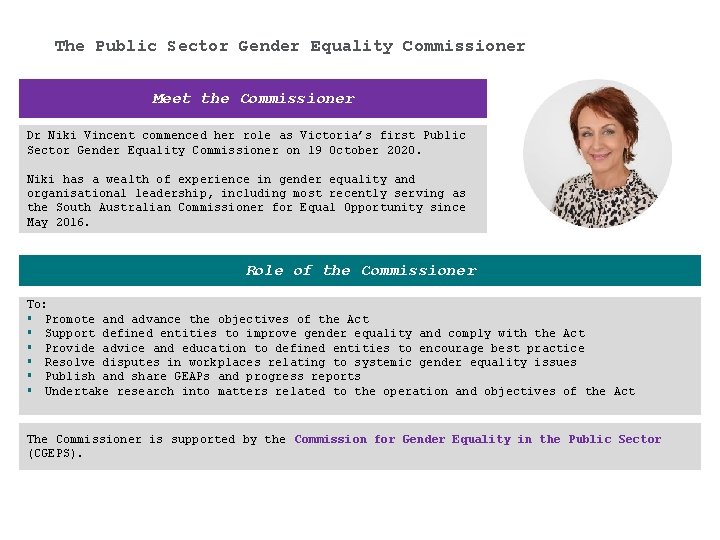
The Public Sector Gender Equality Commissioner Meet the Commissioner Dr Niki Vincent commenced her role as Victoria’s first Public Sector Gender Equality Commissioner on 19 October 2020. Niki has a wealth of experience in gender equality and organisational leadership, including most recently serving as the South Australian Commissioner for Equal Opportunity since May 2016. Role of the Commissioner To: § Promote and advance the objectives of the Act § Support defined entities to improve gender equality and comply with the Act § Provide advice and education to defined entities to encourage best practice § Resolve disputes in workplaces relating to systemic gender equality issues § Publish and share GEAPs and progress reports § Undertake research into matters related to the operation and objectives of the Act The Commissioner is supported by the Commission for Gender Equality in the Public Sector (CGEPS).
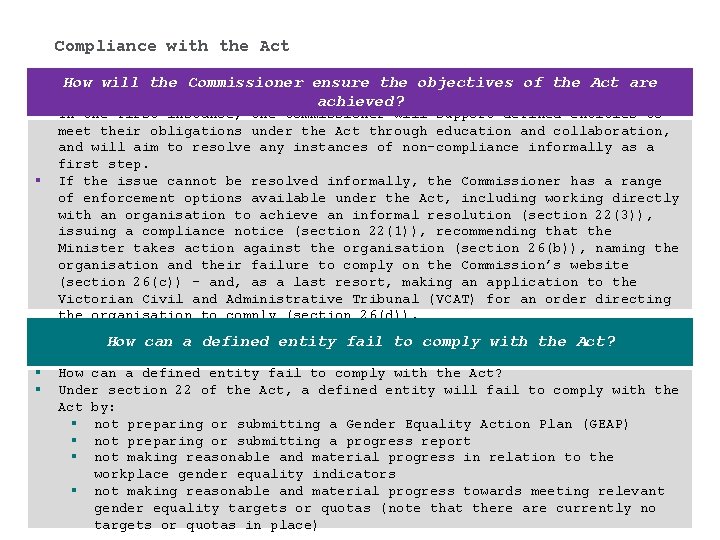
Compliance with the Act § § How will the Commissioner ensure the objectives of the Act are achieved? In the first instance, the Commissioner will support defined entities to meet their obligations under the Act through education and collaboration, and will aim to resolve any instances of non-compliance informally as a first step. If the issue cannot be resolved informally, the Commissioner has a range of enforcement options available under the Act, including working directly with an organisation to achieve an informal resolution (section 22(3)), issuing a compliance notice (section 22(1)), recommending that the Minister takes action against the organisation (section 26(b)), naming the organisation and their failure to comply on the Commission’s website (section 26(c)) – and, as a last resort, making an application to the Victorian Civil and Administrative Tribunal (VCAT) for an order directing the organisation to comply (section 26(d)). How can a defined entity fail to comply with the Act? § § How can a defined entity fail to comply with the Act? Under section 22 of the Act, a defined entity will fail to comply with the Act by: § not preparing or submitting a Gender Equality Action Plan (GEAP) § not preparing or submitting a progress report § not making reasonable and material progress in relation to the workplace gender equality indicators § not making reasonable and material progress towards meeting relevant gender equality targets or quotas (note that there are currently no targets or quotas in place)
The Commissioner is available to support us to comply with the Act and make meaningful progress towards gender equality. Information, guidance and resources are available on the website at genderequalitycommission. vic. gov. au We can contact the Commissioner at enquiries@genderequalitycommission. vic. gov. au