
Gender and Leadership in Media DANIELLE SOSVIELLE RACHEL
- Slides: 14
Gender and Leadership in Media DANIELLE SOSVIELLE, RACHEL BIRMINGHAM, KRISTINA MAXWELL, MADELINE WASLICK
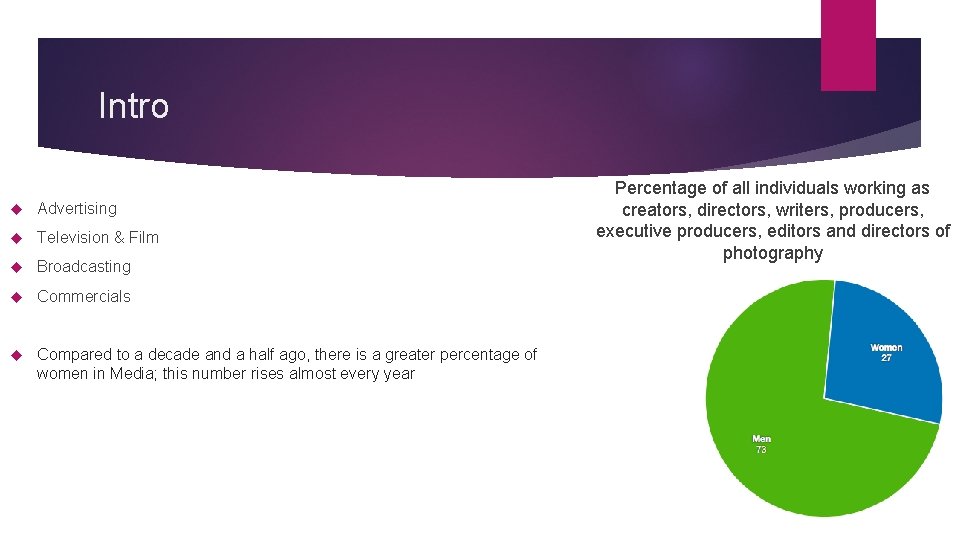
Intro Advertising Television & Film Broadcasting Commercials Compared to a decade and a half ago, there is a greater percentage of women in Media; this number rises almost every year Percentage of all individuals working as creators, directors, writers, producers, executive producers, editors and directors of photography
Gender in Advertising usually bases their decisions off of the philosophy that 'sex sells, ' and this will determine how each gender role is portrayed in advertising. Males are usually portrayed as hyper-masculine; usually with their shirt off. Females are usually portrayed as sex objects; usually doing a very sexual pose with lingerie. Women make up only 3% of creative directors in advertising. According to the Bureau of Labor Statistics, of the 582, 000 Americans employed in advertising in 2014, less then half are women. 70% of young female creatives says they have never worked with a female creative director or executive creative director. 10% of young male creatives are working in an all-male department. 70% of young female creatives are working in a 75% male-dominated department.
Analysis 91% of female consumers feel advertisers do not understand them. Females make 85% of all purchasing decisions, yet are woefully underrepresented in creative jobs in advertising. If females make up the majority of consumers, why aren't there more in advertisement positions? This causes the disconnect between females and current advertisements. Females will not be won over by the 'sex sells' philosophy. U. S. advertisement companies lack the diversity to compose successful advertisements. There used to be almost no females in the advertisement business back almost a decade or two ago. Women just started to gain 3% of advertisement leadership positions. Advertisement companies started incorporating women in order to reach a broader market. The lack of diversity of each gender (and race) is keeping the advertisement business from growing. https: //www. youtube. com/watch? v=2 Srp. ARP_M 0 o
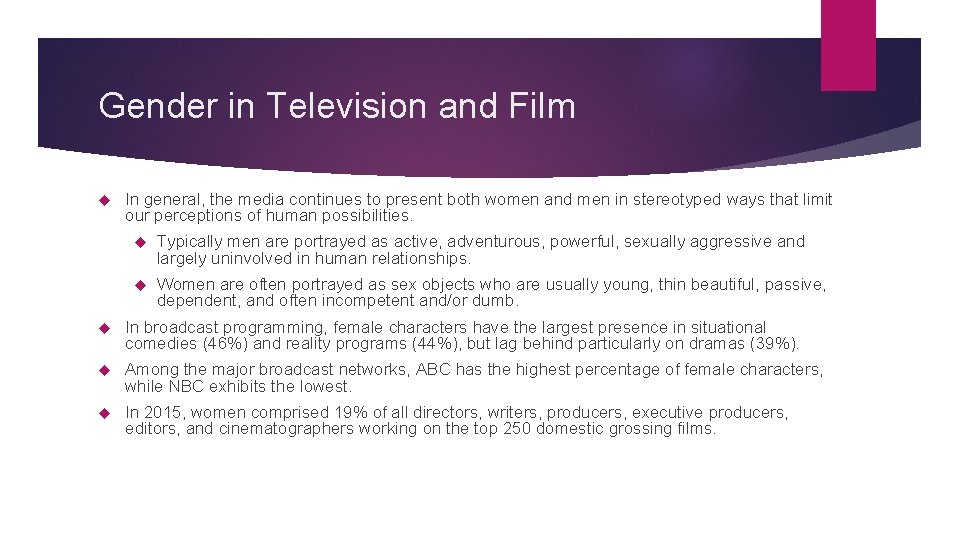
Gender in Television and Film In general, the media continues to present both women and men in stereotyped ways that limit our perceptions of human possibilities. Typically men are portrayed as active, adventurous, powerful, sexually aggressive and largely uninvolved in human relationships. Women are often portrayed as sex objects who are usually young, thin beautiful, passive, dependent, and often incompetent and/or dumb. In broadcast programming, female characters have the largest presence in situational comedies (46%) and reality programs (44%), but lag behind particularly on dramas (39%). Among the major broadcast networks, ABC has the highest percentage of female characters, while NBC exhibits the lowest. In 2015, women comprised 19% of all directors, writers, producers, executive producers, editors, and cinematographers working on the top 250 domestic grossing films.
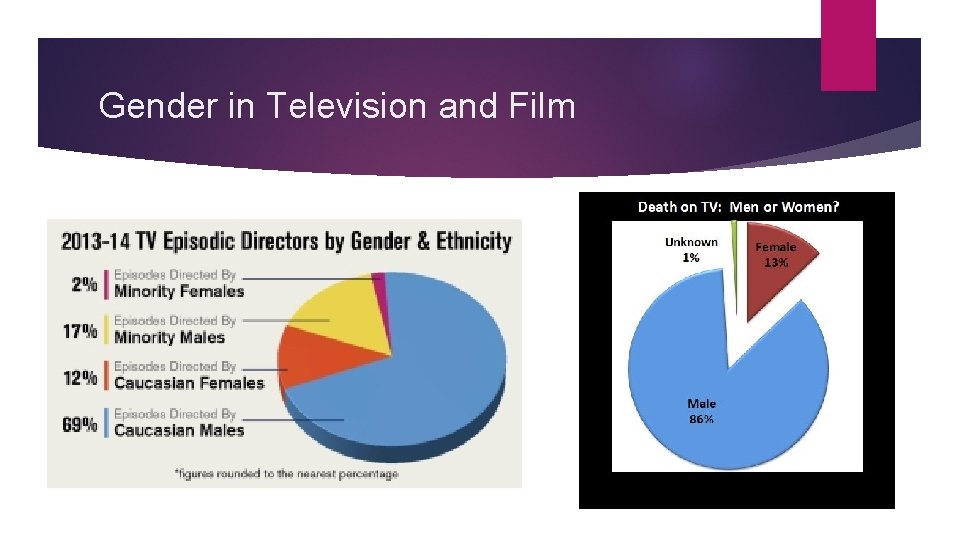
Gender in Television and Film
Analysis Women are often portrayed in television and film as incompetent sex objects, so they may be seen as such by those who write, produce, and direct these programs This could play into their underrepresentation Women are underrepresented in television and film Female directors, writers, producers, and executive producers are a rare occurrence in television and film (they only comprise about 19%) Actresses are more well represented (between 39% and 46% of television and movie characters are female)
Gender in Broadcasting and News 63. 4% of men are on-camera as anchors or reporters, while 36. 1% are women Female journalists are more likely to report on lifestyle, culture and health, while men are more likely to cover politics, criminal justice or technology Male correspondents at ABC, CBS, NBC, and PBS provide 66 percent of news reports At the nation’s 10 most widely circulated newspapers, men write 63 percent of the articles, compared to 37 percent for women “There are, most certainly, a handful of notable exceptions to the trend of men dominating media and it is important to note that a woman in the anchor seat is more than a symbol; she sends a message to viewers that women can lead a network broadcast — and that matters" Women are starting to become more well-known in broadcasting Ex: Erin Andrews
The Women's Media Center Works to make women visible and powerful in media Trains women leaders to be in the media Features women’s voices and stories on radio program The Women's Media Center proves that women are trying to work their way up in broadcasting No need for a "Men's Media Center" program
Analysis Geneva Overholser (Women's Media Center board member): “These findings confirm an ongoing truth that is not just disappointing, but unfortunate for all of us in so many ways. News media are at their best when they call upon the wisdom of all the people whom they serve, when they reflect everyone’s experience and bring in the hopes and dreams and fears of every sort of person. When media are overwhelmingly male (and still, alas, overwhelmingly white), they just aren't anywhere near as good as they could be. ” Stereotypes? Female writers report on lifestyle, culture and health (can men not give good advice on these topics)? Male writers report on politics, criminal justice or technology (do women not know enough about these topics)?
Gender in Commercials are a vast source of gender stereotyping because they target specific genders, stick to more traditional and exaggerated gender roles Women are more often presented in commercials, because they are seen as responsible for making everyday purchases. Men generally advertise cars, cigarettes, business products or investments Women are typically shown in a home environment and men are shown outdoors Usually a woman's entire figure will be shown and men will be more close up shots More and more commercials are directed to children. They indicate “the proper place” in the society for girls and boys. If men and women appear in the commercials together, they are mainly presented as a couple or marriage. In the situation of competition, women appear to be weaker than men (Lukas 2002).
Analysis Women are portrayed as a housewife, a mom or in a sexual way in commercials trying to sell an object to a man Men are portrayed as athletic, successful, professional, seducer with a beautiful woman by his side. Commercials are a big source of gender stereotyping because they exaggerate the roles that are "appropriate in society" for each gender. The way in which male and female roles are presented in commercials reflects the traditional notions of gender, where women are dominated by men (Pawlica, Widawska 2001).
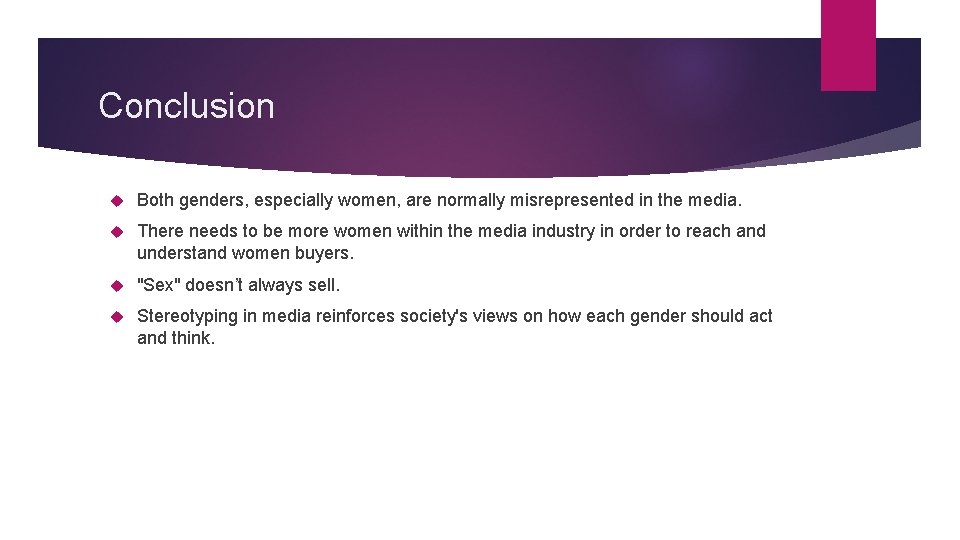
Conclusion Both genders, especially women, are normally misrepresented in the media. There needs to be more women within the media industry in order to reach and understand women buyers. "Sex" doesn’t always sell. Stereotyping in media reinforces society's views on how each gender should act and think.
Works Cited Wolska, Malgorzata. "Gender Sterotypes in Mass Media". Krytyka. org. 2011. Web. 12 April 2016. < http: //krytyka. org/gender-stereotypes-in-mass-media-case-study-analysis-of-the-gender-stereotypingphenomenon-in-tv-commercials/> Zeilinger, Julie. "WMC’s Research Shines Light on Gender Bias in Major U. S. Broadcast, Print, Online, & Wire Outlets. " The Women's Media Center. Press Center, 3 Apr. 2014. Web. Warner, Judith. "Fact Sheet: The Women's Leadership Gap. " Center for American Progress. 7 Mar. 2014. Web. 12 Apr. 2016. <https: //www. americanprogress. org/issues/women/report/2014/03/07/85457/fact-sheet-the-womens-leadership-gap/>. Grillo, Gina. "The Advertising Industry Needs Diverse Leadership to Thrive. " Advertising Agency Viewpoint RSS. 23 Apr. 2015. Web. 12 Apr. 2016. <http: //adage. com/article/agency-viewpoint/advertising-industry-diverse-leadership-thrive/297998/>. Hanan, Ali. "Five Facts That Show How the Advertising Industry Fails Women. " The Guardian News and Media, 03 Feb. 2016. Web. 12 Apr. 2016. <http: //www. theguardian. com/women-in-leadership/2016/feb/03/how-advertising-industry-fails-women>. Wood, Julia. "Gendered Media: The Influence of Media on Views of Gender". University of North Carolina at Chapel. 2015. Web. 12 April 2016. <https: //www. nyu. edu/classes/jackson/causes. of. gender. inequality/Readings/Wood%20 -%20 Gendered%20 Media%20%2094. pdf> "Reports and Statistics. " Women in Film & Television UK. Web. 13 Apr. 2016. <http: //www. wftv. org. uk/resources/reports-andstatistics>.