
Gender and IWRM How to integrate Gender Concerns
- Slides: 13
Gender and IWRM How to integrate Gender Concerns into IWRM By Soumaya Ibrahim
Tools for mainstreaming Gender At : 1. The Analysis phase 2. The Planning phase
Tools for the Gender Analysis • Gender Division of Labor Frequency and time spent • Access to and Control over resources and Benefits • Influencing Factors
Before the analysis the information is gathered through various v tools such as : Desk reviews Household Interviews Focus Group Discussion Direct Observation Semi-Structured Interviews Case Study Stakeholder workshop Trend Analysis Day-time Use Analysis
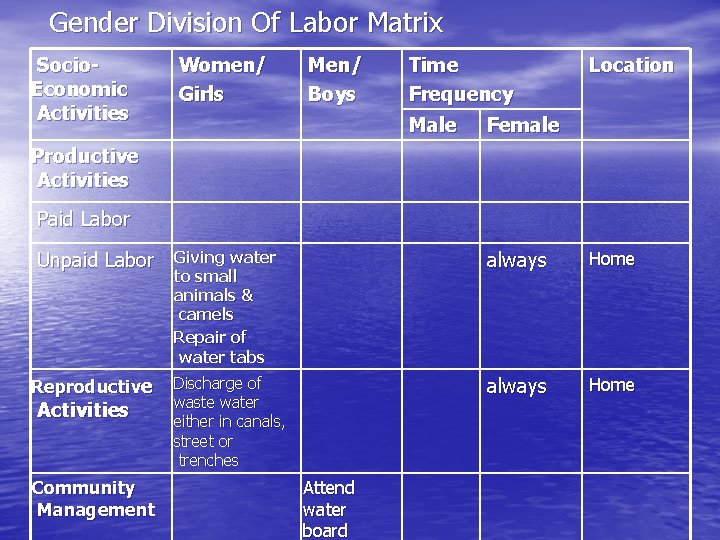
Gender Division Of Labor Matrix Socio. Economic Activities Women/ Girls Men/ Boys Time Frequency Male Location Female Productive Activities Paid Labor Unpaid Labor Giving water to small animals & camels Repair of water tabs always Home Reproductive Discharge of waste water either in canals, street or trenches always Home Activities Community Management Attend water board
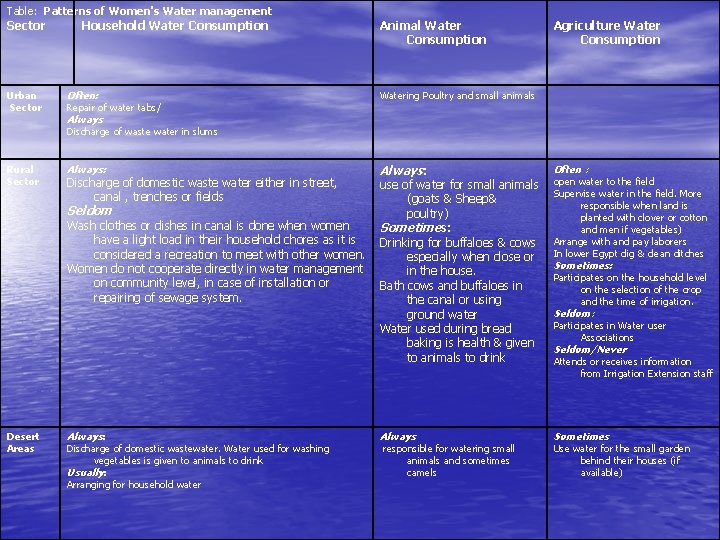
Table: Patterns of Women's Water management Sector Urban Sector Household Water Consumption Often: Repair of water tabs/ Animal Water Consumption Agriculture Water Consumption Watering Poultry and small animals Always Discharge of waste water in slums Rural Sector Always: Discharge of domestic waste water either in street, canal , trenches or fields Seldom Wash clothes or dishes in canal is done when women have a light load in their household chores as it is considered a recreation to meet with other women. Women do not cooperate directly in water management on community level, in case of installation or repairing of sewage system. Desert Areas Always: Discharge of domestic wastewater. Water used for washing vegetables is given to animals to drink Usually: Arranging for household water Always: Often : use of water for small animals (goats & Sheep& poultry) Sometimes: Drinking for buffaloes & cows especially when close or in the house. Bath cows and buffaloes in the canal or using ground water Water used during bread baking is health & given to animals to drink open water to the field Supervise water in the field. More responsible when land is planted with clover or cotton and men if vegetables) Arrange with and pay laborers In lower Egypt dig & clean ditches Always Sometimes responsible for watering small animals and sometimes camels Sometimes: Participates on the household level on the selection of the crop and the time of irrigation. Seldom: Participates in Water user Associations Seldom/Never Attends or receives information from Irrigation Extension staff Use water for the small garden behind their houses (if available)
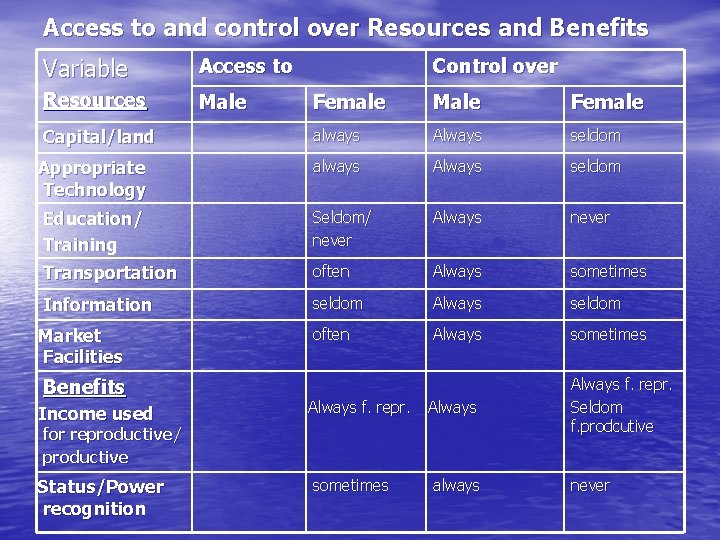
Access to and control over Resources and Benefits Variable Access to Resources Male Control over Female Male Female always Always seldom Education/ Training Seldom/ never Always never Transportation often Always sometimes Information seldom Always seldom often Always sometimes Capital/land Appropriate Technology Market Facilities Benefits Income used Always f. repr. Always for reproductive/ productive Status/Power recognition sometimes always Always f. repr. Seldom f. prodcutive never
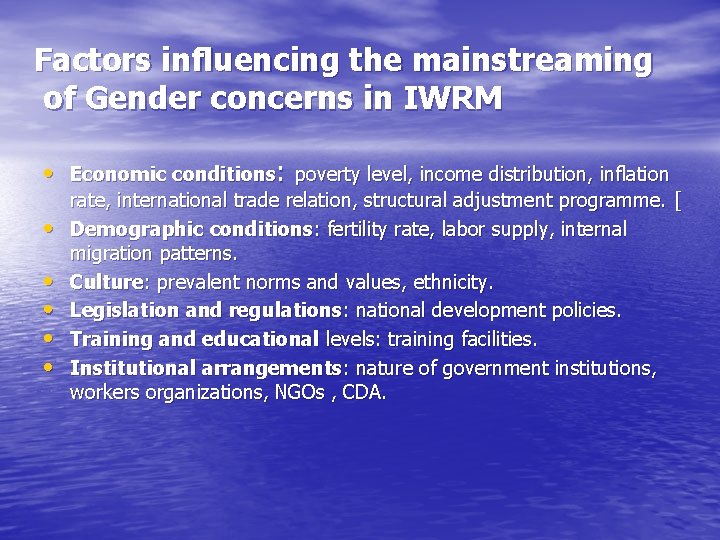
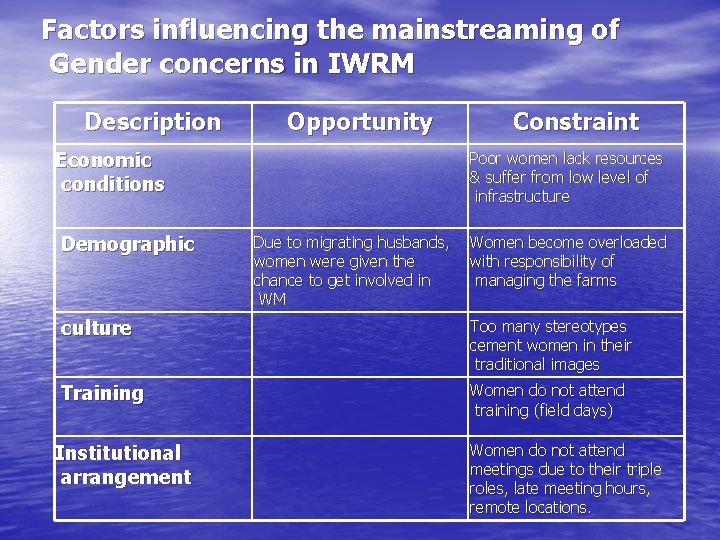
Factors influencing the mainstreaming of Gender concerns in IWRM • Economic conditions: poverty level, income distribution, inflation • • • rate, international trade relation, structural adjustment programme. [ Demographic conditions: fertility rate, labor supply, internal migration patterns. Culture: prevalent norms and values, ethnicity. Legislation and regulations: national development policies. Training and educational levels: training facilities. Institutional arrangements: nature of government institutions, workers organizations, NGOs , CDA.
Factors influencing the mainstreaming of Gender concerns in IWRM Description Opportunity Economic conditions Demographic Constraint Poor women lack resources & suffer from low level of infrastructure Due to migrating husbands, women were given the chance to get involved in WM Women become overloaded with responsibility of managing the farms culture Too many stereotypes cement women in their traditional images Training Women do not attend training (field days) Institutional arrangement Women do not attend meetings due to their triple roles, late meeting hours, remote locations.
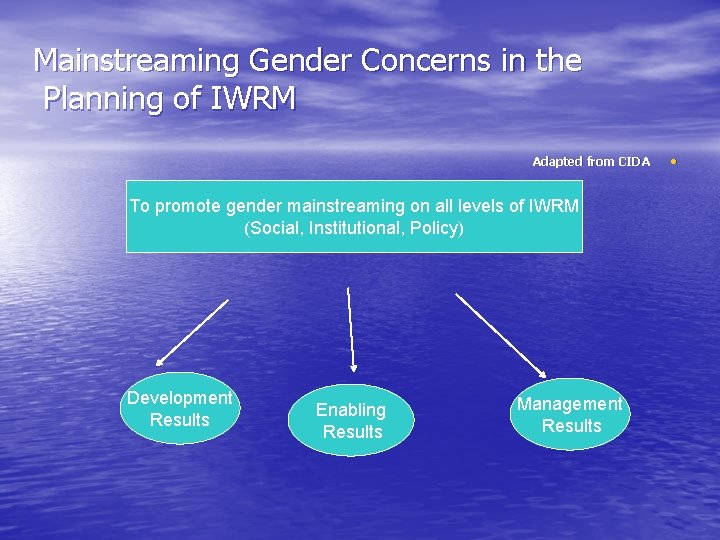
Mainstreaming Gender Concerns in the Planning of IWRM Adapted from CIDA To promote gender mainstreaming on all levels of IWRM (Social, Institutional, Policy) Development Results Enabling Results Management Results •
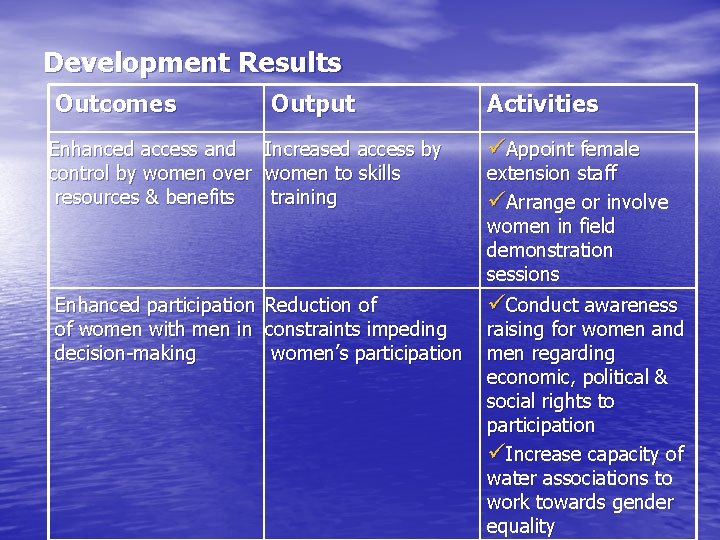
Development Results Outcomes Enhanced access and control by women over resources & benefits Enhanced participation of women with men in decision-making Output Activities Increased access by women to skills training üAppoint female Reduction of constraints impeding women’s participation üConduct awareness extension staff üArrange or involve women in field demonstration sessions raising for women and men regarding economic, political & social rights to participation üIncrease capacity of water associations to work towards gender equality
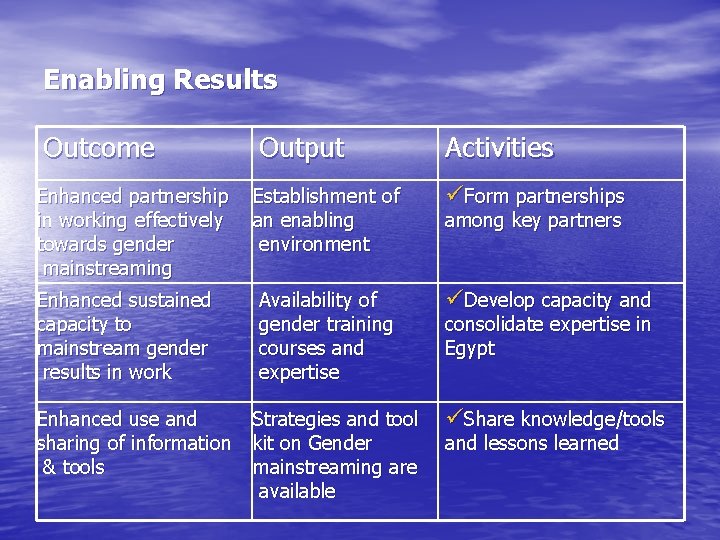
Enabling Results Outcome Enhanced partnership in working effectively towards gender mainstreaming Enhanced sustained capacity to mainstream gender results in work Enhanced use and sharing of information & tools Output Establishment of an enabling environment Availability of gender training courses and expertise Strategies and tool kit on Gender mainstreaming are available Activities üForm partnerships among key partners üDevelop capacity and consolidate expertise in Egypt üShare knowledge/tools and lessons learned
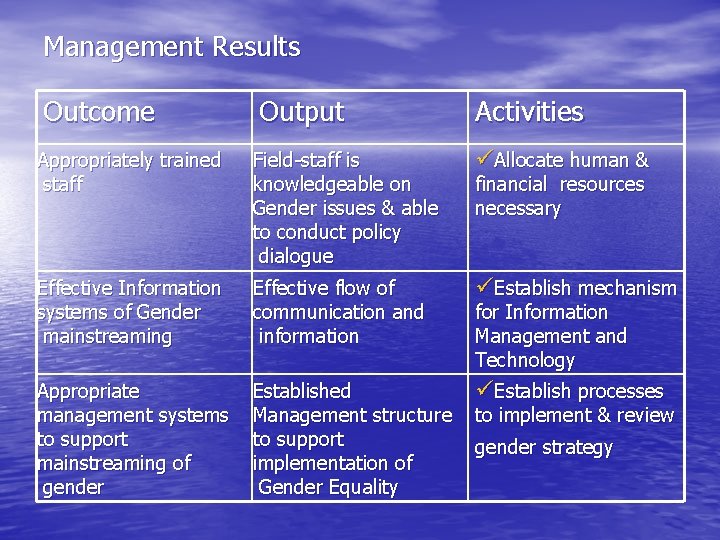
Management Results Outcome Output Activities Appropriately trained staff Field-staff is knowledgeable on Gender issues & able to conduct policy dialogue üAllocate human & Effective Information systems of Gender mainstreaming Effective flow of communication and information üEstablish mechanism Appropriate management systems to support mainstreaming of gender Established Management structure to support implementation of Gender Equality üEstablish processes financial resources necessary for Information Management and Technology to implement & review gender strategy