
Gender and Caste in India MARGINALIZATION OF DALIT
- Slides: 1
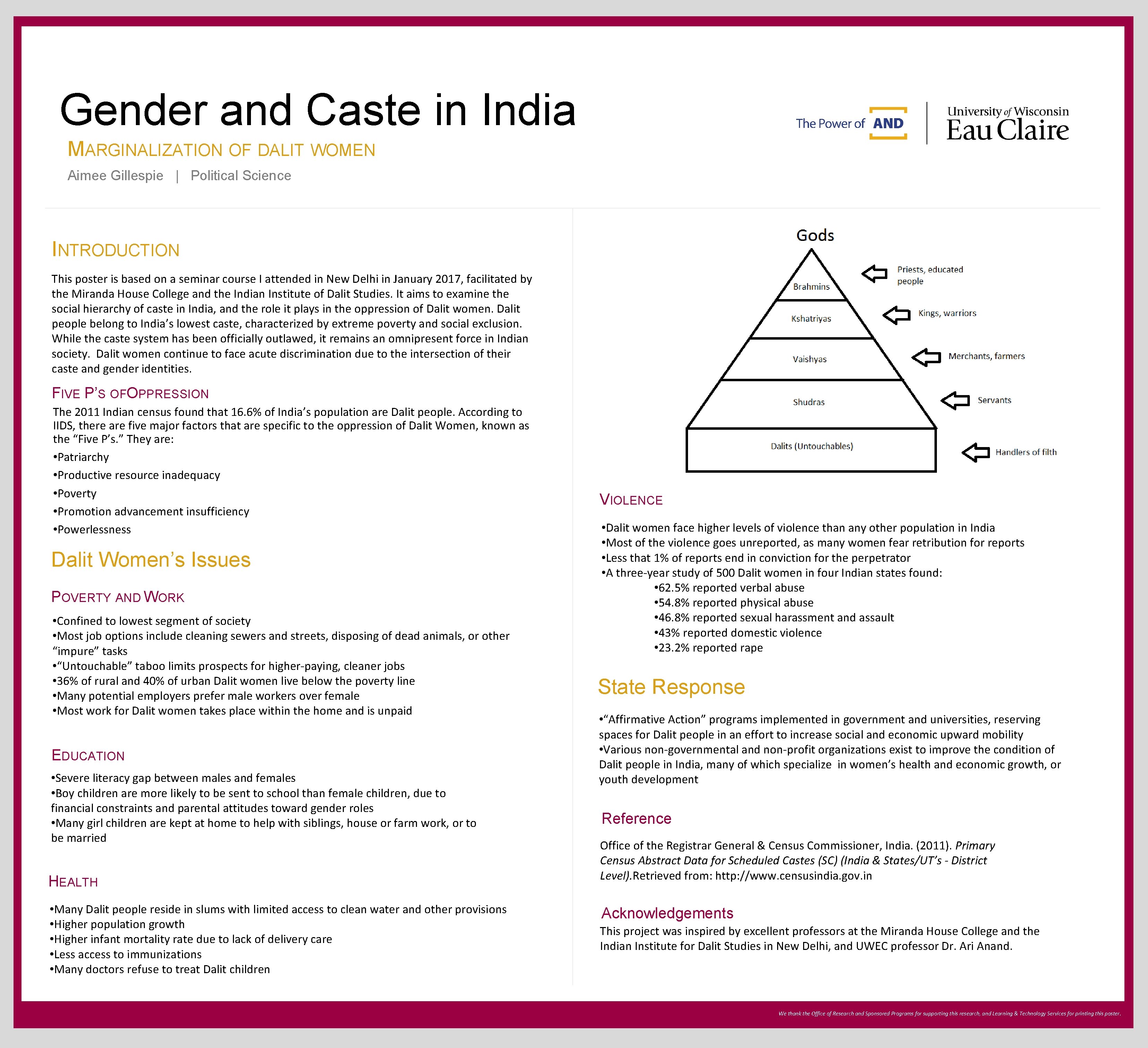
Gender and Caste in India MARGINALIZATION OF DALIT WOMEN Aimee Gillespie | Political Science INTRODUCTION This poster is based on a seminar course I attended in New Delhi in January 2017, facilitated by the Miranda House College and the Indian Institute of Dalit Studies. It aims to examine the social hierarchy of caste in India, and the role it plays in the oppression of Dalit women. Dalit people belong to India’s lowest caste, characterized by extreme poverty and social exclusion. While the caste system has been officially outlawed, it remains an omnipresent force in Indian society. Dalit women continue to face acute discrimination due to the intersection of their caste and gender identities. FIVE P’S OFOPPRESSION The 2011 Indian census found that 16. 6% of India’s population are Dalit people. According to IIDS, there are five major factors that are specific to the oppression of Dalit Women, known as the “Five P’s. ” They are: • Patriarchy • Productive resource inadequacy • Poverty • Promotion advancement insufficiency • Powerlessness Dalit Women’s Issues POVERTY AND WORK • Confined to lowest segment of society • Most job options include cleaning sewers and streets, disposing of dead animals, or other “impure” tasks • “Untouchable” taboo limits prospects for higher-paying, cleaner jobs • 36% of rural and 40% of urban Dalit women live below the poverty line • Many potential employers prefer male workers over female • Most work for Dalit women takes place within the home and is unpaid EDUCATION • Severe literacy gap between males and females • Boy children are more likely to be sent to school than female children, due to financial constraints and parental attitudes toward gender roles • Many girl children are kept at home to help with siblings, house or farm work, or to be married HEALTH • Many Dalit people reside in slums with limited access to clean water and other provisions • Higher population growth • Higher infant mortality rate due to lack of delivery care • Less access to immunizations • Many doctors refuse to treat Dalit children VIOLENCE • Dalit women face higher levels of violence than any other population in India • Most of the violence goes unreported, as many women fear retribution for reports • Less that 1% of reports end in conviction for the perpetrator • A three-year study of 500 Dalit women in four Indian states found: • 62. 5% reported verbal abuse • 54. 8% reported physical abuse • 46. 8% reported sexual harassment and assault • 43% reported domestic violence • 23. 2% reported rape State Response • “Affirmative Action” programs implemented in government and universities, reserving spaces for Dalit people in an effort to increase social and economic upward mobility • Various non-governmental and non-profit organizations exist to improve the condition of Dalit people in India, many of which specialize in women’s health and economic growth, or youth development Reference Office of the Registrar General & Census Commissioner, India. (2011). Primary Census Abstract Data for Scheduled Castes (SC) (India & States/UT’s - District Level). Retrieved from: http: //www. censusindia. gov. in Acknowledgements This project was inspired by excellent professors at the Miranda House College and the Indian Institute for Dalit Studies in New Delhi, and UWEC professor Dr. Ari Anand. We thank the Office of Research and Sponsored Programs for supporting this research, and Learning & Technology Services for printing this poster.