
Gender Analysis Frameworks Last Mile Workshop on 2


- Slides: 35
. Gender Analysis Frameworks Last Mile Workshop on 2 nd Generation CIDPs 20 February 2018 Nairobi
Session Structure The Fundamentals Tools for us to effectively conduct gender analysis
By the end you should be able to: ä Recognise the importance of gender analysis for project planning, implementation and evaluation ä Apply tools for gender analysis as part of development interventions
What goes wrong when you overlook gender issues in policy making… VIDEO: SALAR Starter Kit for Sustainable Gender Equality unequal allocation of resources between women and men, by prioritising programmes and policies that are not addressing women’s and men’s issues equally; gender-blind policies and programmes that might — in some cases — unintentionally maintain or reinforce gender inequalities or indirect discrimination.
Overview 1. Frameworks for Gender Analysis a) Harvard Analytical Framework b) Moser Framework c) Gender Analysis Matrix
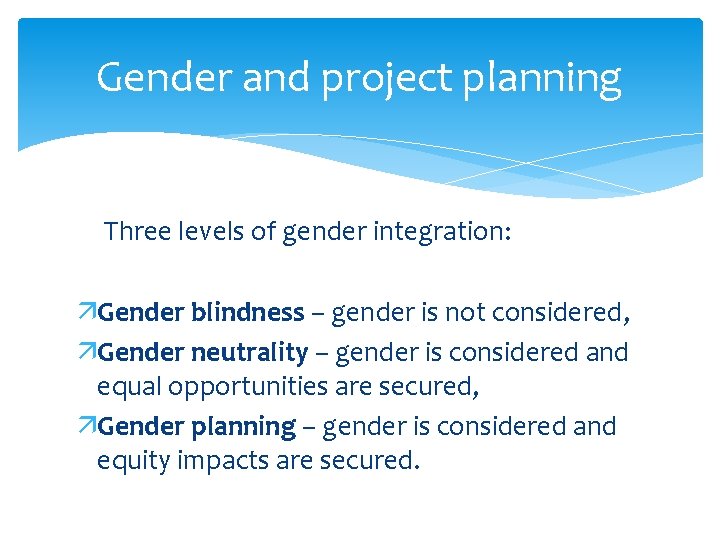
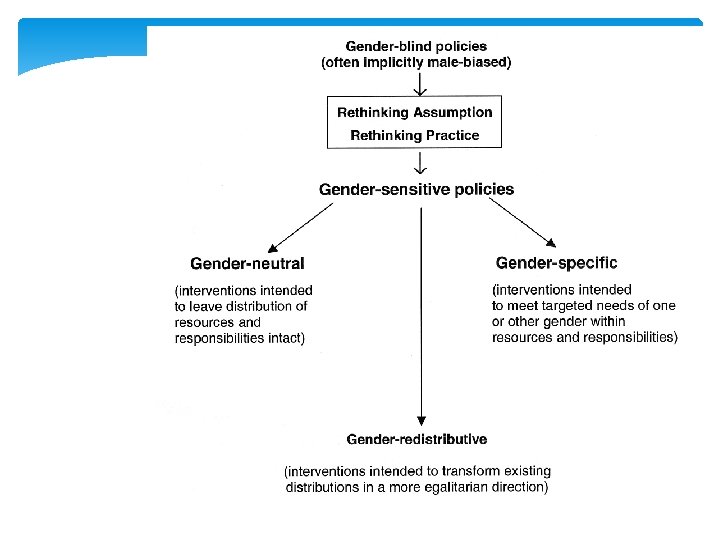
Gender and project planning Three levels of gender integration: äGender blindness – gender is not considered, äGender neutrality – gender is considered and equal opportunities are secured, äGender planning – gender is considered and equity impacts are secured.
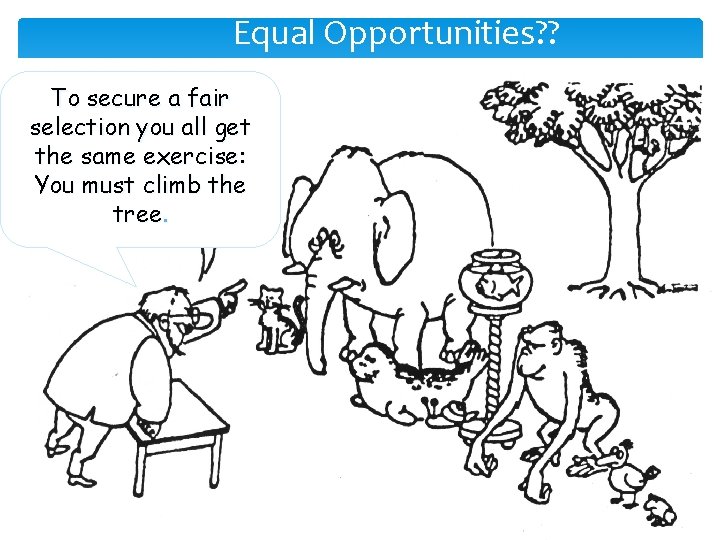
Equal Opportunities? ? To secure a fair selection you all get the same exercise: You must climb the tree.
Key points to keep in mind… Gender is a social construction depending upon time and culture. Therefore, gender roles are neither universal nor unchangeable. There is a global gender imbalance in favour of men. It is necessary to include gender planning in development interventions
Assumptions? ? (Implicit) assumptions about the household: The household consists of a nuclear family of husband, wife and 2 – 3 biological children. Within the household there is a clear division of labour based upon gender. The man is the breadwinner and the woman is the mother and housewife. Women’s work is unpaid housework, not crucial to the survival of the family
Further assumptions? ? (Implicit) assumptions about data collection: All techniques for data collection are equally valid for women and for men Conventional conceptual categories (ex. work) hold the same meaning for all people. Also other factors, such as: Timing of interviews, length of the reference period and language, influence data collected.
Gender Analysis Frameworks Source: UNDP Gender in Development Programme, Learning and Information Pack; Gender Analysis
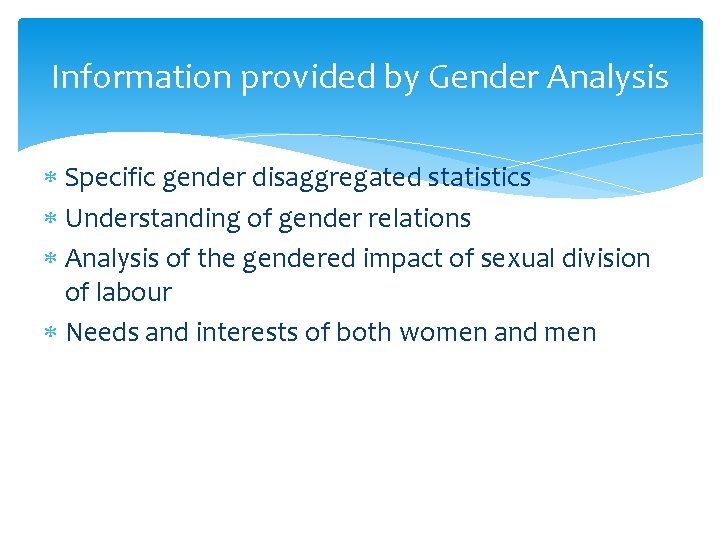
Information provided by Gender Analysis Specific gender disaggregated statistics Understanding of gender relations Analysis of the gendered impact of sexual division of labour Needs and interests of both women and men
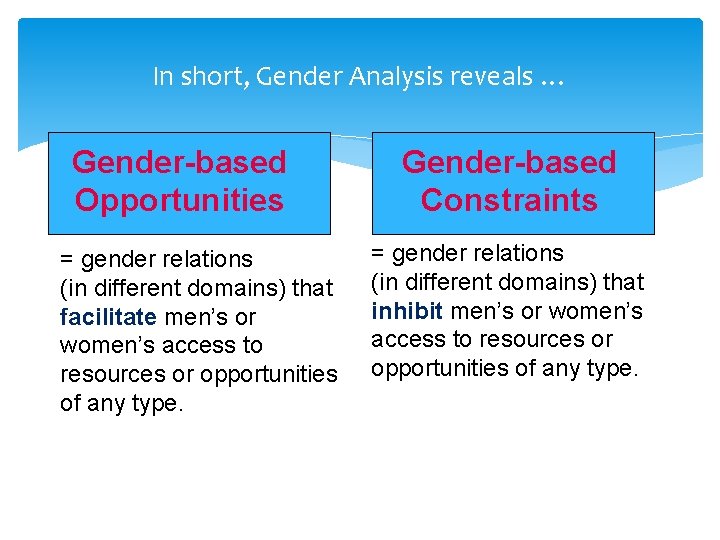
In short, Gender Analysis reveals … Gender-based Opportunities = gender relations (in different domains) that facilitate men’s or women’s access to resources or opportunities of any type. Gender-based Constraints = gender relations (in different domains) that inhibit men’s or women’s access to resources or opportunities of any type.
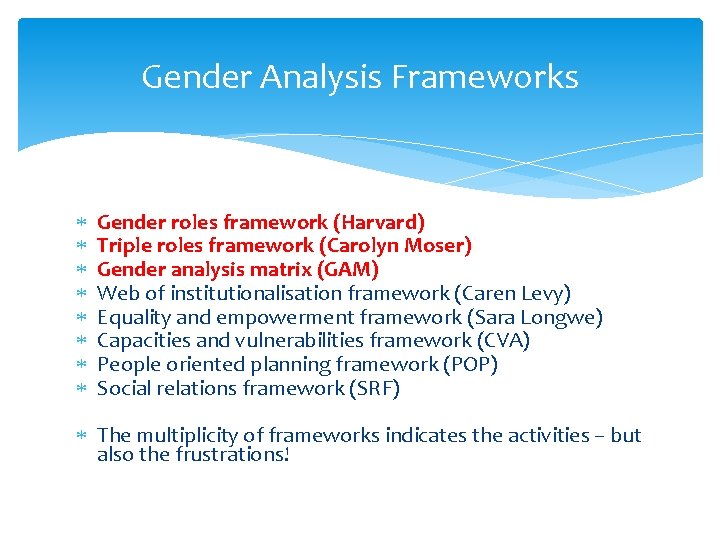
Gender Analysis Frameworks Gender roles framework (Harvard) Triple roles framework (Carolyn Moser) Gender analysis matrix (GAM) Web of institutionalisation framework (Caren Levy) Equality and empowerment framework (Sara Longwe) Capacities and vulnerabilities framework (CVA) People oriented planning framework (POP) Social relations framework (SRF) The multiplicity of frameworks indicates the activities – but also the frustrations!
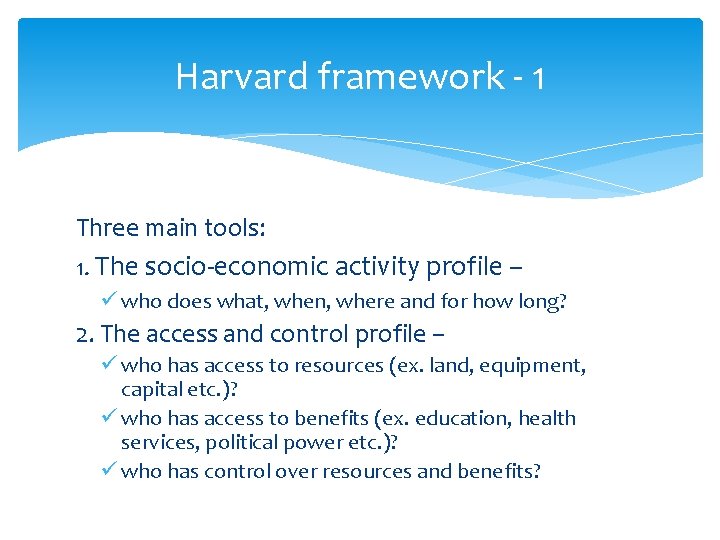
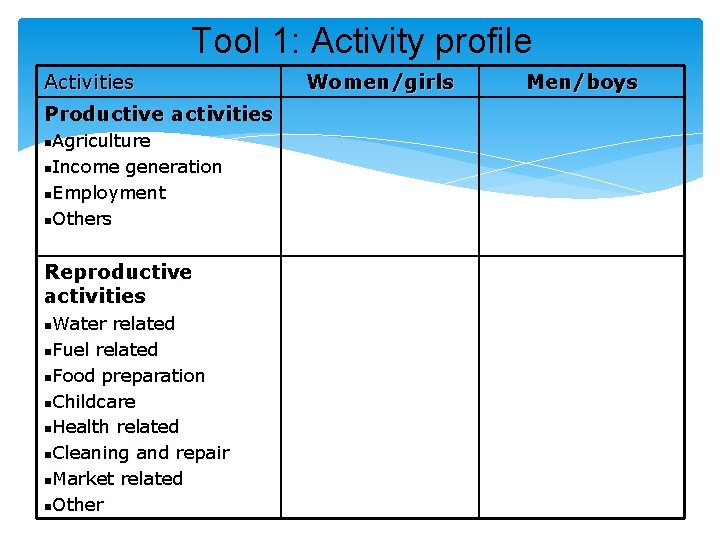
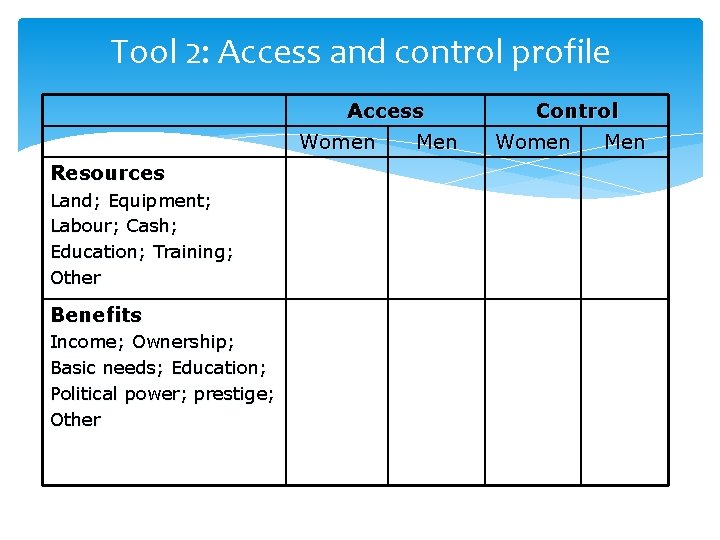
Harvard framework - 1 Three main tools: 1. The socio-economic activity profile – ü who does what, when, where and for how long? 2. The access and control profile – ü who has access to resources (ex. land, equipment, capital etc. )? ü who has access to benefits (ex. education, health services, political power etc. )? ü who has control over resources and benefits?
Tool 1: Activity profile Activities Productive activities n. Agriculture n. Income generation n. Employment n. Others Reproductive activities n. Water related n. Fuel related n. Food preparation n. Childcare n. Health related n. Cleaning and repair n. Market related n. Other Women/girls Men/boys
Tool 2: Access and control profile Access Women Resources Land; Equipment; Labour; Cash; Education; Training; Other Benefits Income; Ownership; Basic needs; Education; Political power; prestige; Other Men Control Women Men
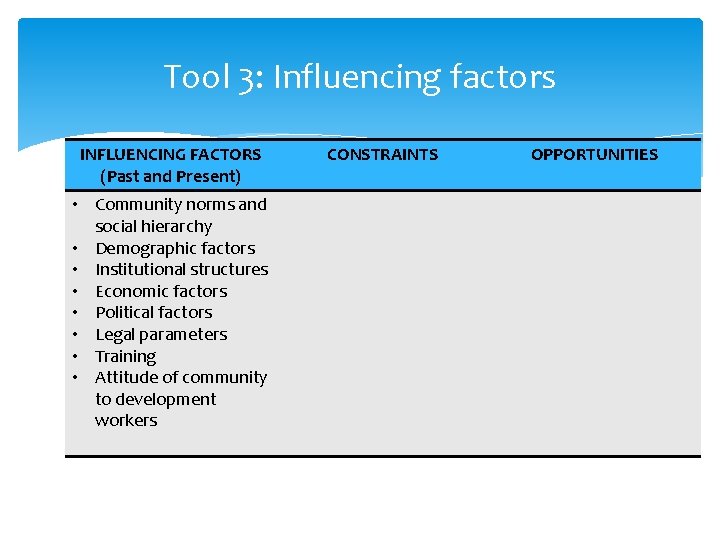
Tool 3: Influencing factors INFLUENCING FACTORS (Past and Present) • Community norms and social hierarchy • Demographic factors • Institutional structures • Economic factors • Political factors • Legal parameters • Training • Attitude of community to development workers CONSTRAINTS OPPORTUNITIES
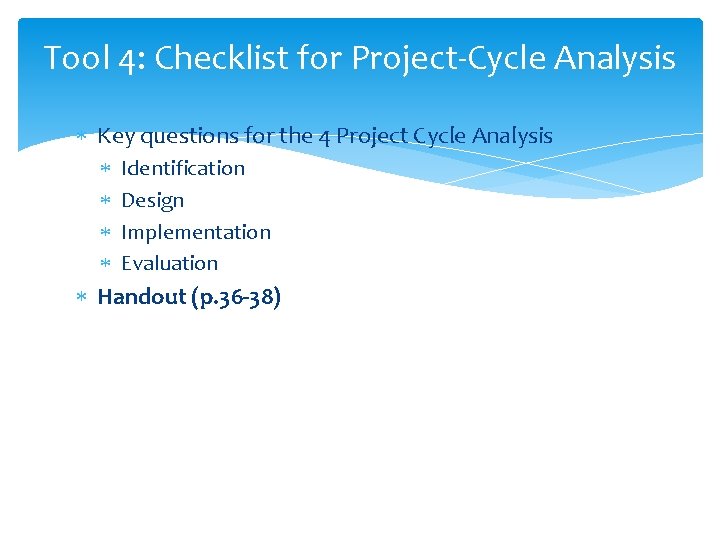
Tool 4: Checklist for Project-Cycle Analysis Key questions for the 4 Project Cycle Analysis Identification Design Implementation Evaluation Handout (p. 36 -38)
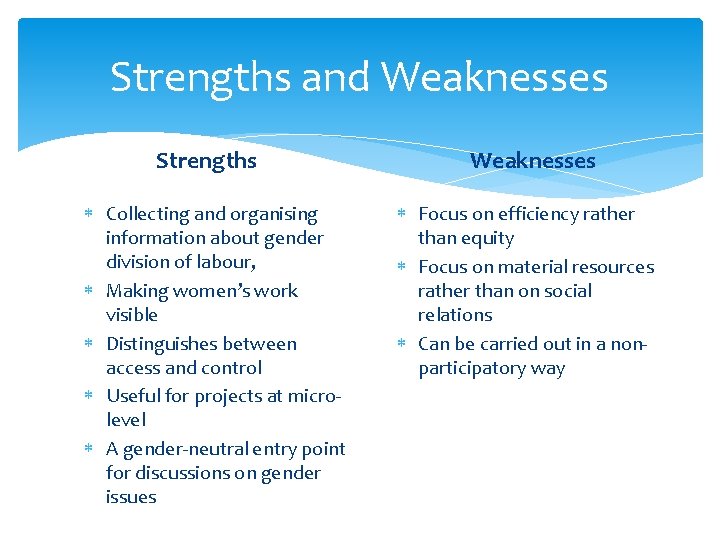
Strengths and Weaknesses Strengths Collecting and organising information about gender division of labour, Making women’s work visible Distinguishes between access and control Useful for projects at microlevel A gender-neutral entry point for discussions on gender issues Weaknesses Focus on efficiency rather than equity Focus on material resources rather than on social relations Can be carried out in a nonparticipatory way
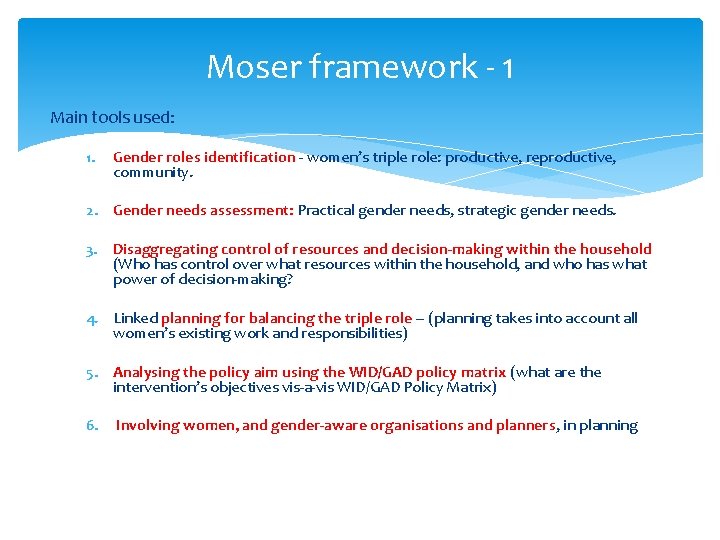
Moser framework - 1 Main tools used: 1. Gender roles identification - women’s triple role: productive, reproductive, community. 2. Gender needs assessment: Practical gender needs, strategic gender needs. 3. Disaggregating control of resources and decision-making within the household (Who has control over what resources within the household, and who has what power of decision-making? 4. Linked planning for balancing the triple role – (planning takes into account all women’s existing work and responsibilities) 5. Analysing the policy aim using the WID/GAD policy matrix (what are the intervention’s objectives vis-a-vis WID/GAD Policy Matrix) 6. Involving women, and gender-aware organisations and planners, in planning
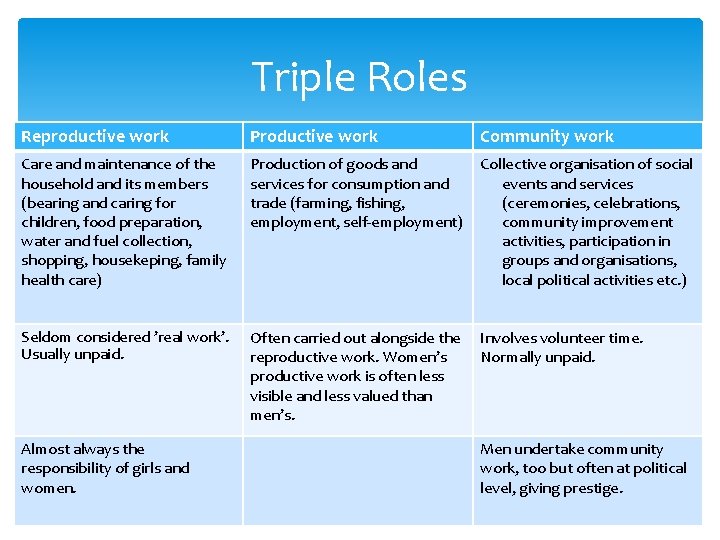
Triple Roles Reproductive work Productive work Community work Care and maintenance of the household and its members (bearing and caring for children, food preparation, water and fuel collection, shopping, housekeping, family health care) Production of goods and services for consumption and trade (farming, fishing, employment, self-employment) Collective organisation of social events and services (ceremonies, celebrations, community improvement activities, participation in groups and organisations, local political activities etc. ) Seldom considered ’real work’. Usually unpaid. Often carried out alongside the reproductive work. Women’s productive work is often less visible and less valued than men’s. Involves volunteer time. Normally unpaid. Almost always the responsibility of girls and women. Men undertake community work, too but often at political level, giving prestige.
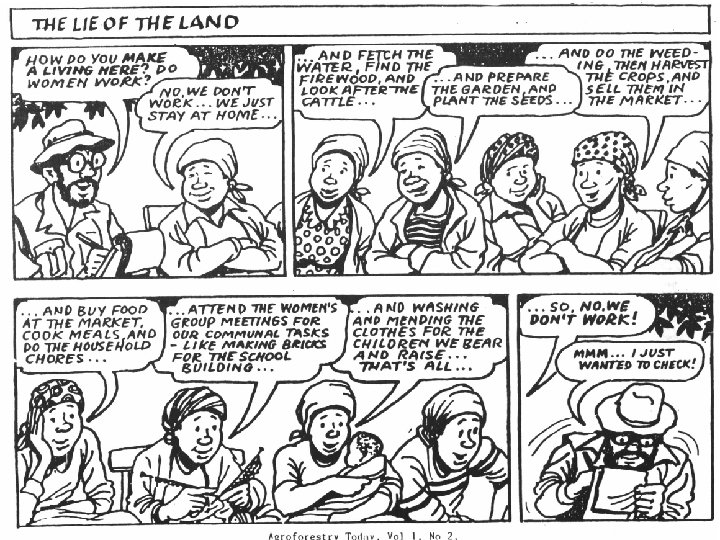
Women’s Work
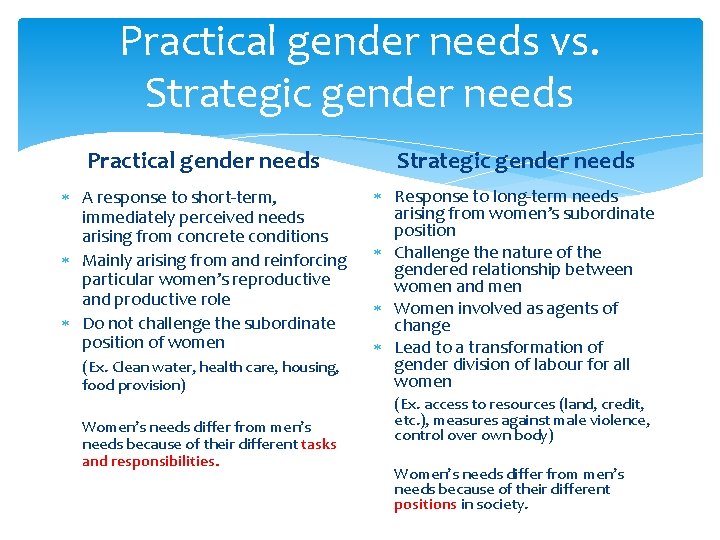
Practical gender needs vs. Strategic gender needs Practical gender needs Strategic gender needs A response to short-term, immediately perceived needs arising from concrete conditions Mainly arising from and reinforcing particular women’s reproductive and productive role Do not challenge the subordinate position of women Response to long-term needs arising from women’s subordinate position Challenge the nature of the gendered relationship between women and men Women involved as agents of change Lead to a transformation of gender division of labour for all women (Ex. Clean water, health care, housing, food provision) Women’s needs differ from men’s needs because of their different tasks and responsibilities. (Ex. access to resources (land, credit, etc. ), measures against male violence, control over own body) Women’s needs differ from men’s needs because of their different positions in society.
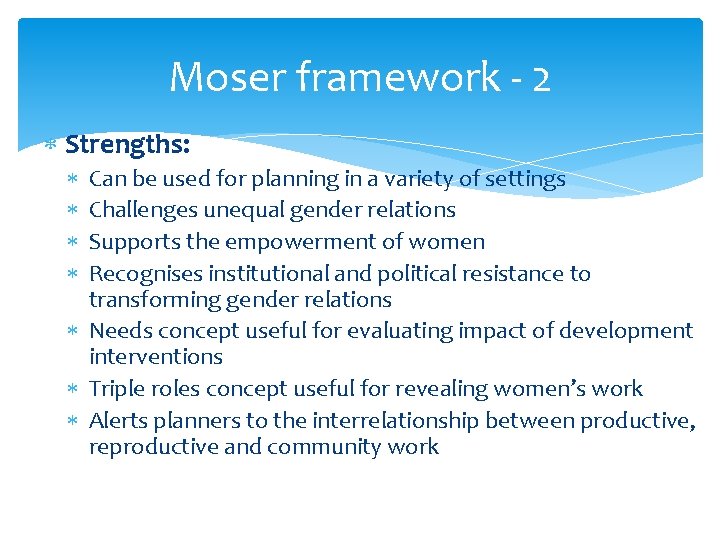
Moser framework - 2 Strengths: Can be used for planning in a variety of settings Challenges unequal gender relations Supports the empowerment of women Recognises institutional and political resistance to transforming gender relations Needs concept useful for evaluating impact of development interventions Triple roles concept useful for revealing women’s work Alerts planners to the interrelationship between productive, reproductive and community work
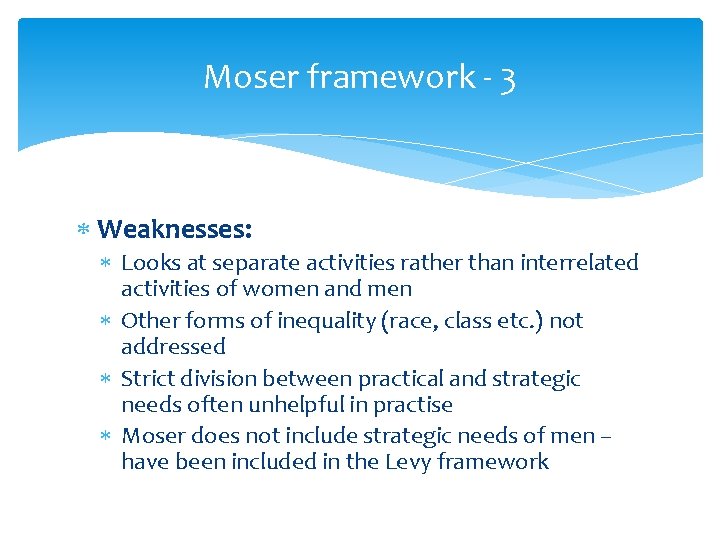
Moser framework - 3 Weaknesses: Looks at separate activities rather than interrelated activities of women and men Other forms of inequality (race, class etc. ) not addressed Strict division between practical and strategic needs often unhelpful in practise Moser does not include strategic needs of men – have been included in the Levy framework
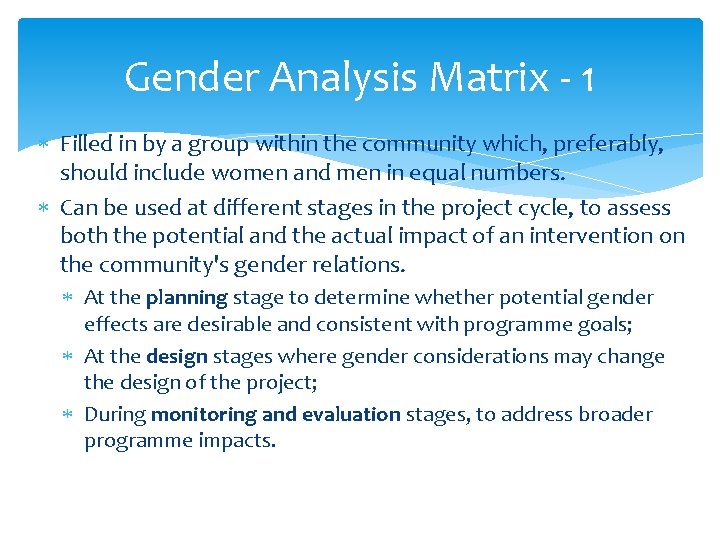
Gender Analysis Matrix - 1 Filled in by a group within the community which, preferably, should include women and men in equal numbers. Can be used at different stages in the project cycle, to assess both the potential and the actual impact of an intervention on the community's gender relations. At the planning stage to determine whether potential gender effects are desirable and consistent with programme goals; At the design stages where gender considerations may change the design of the project; During monitoring and evaluation stages, to address broader programme impacts.
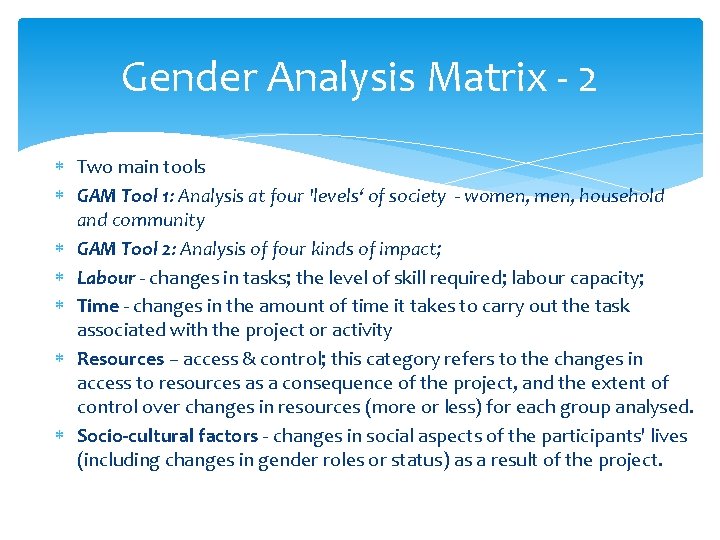
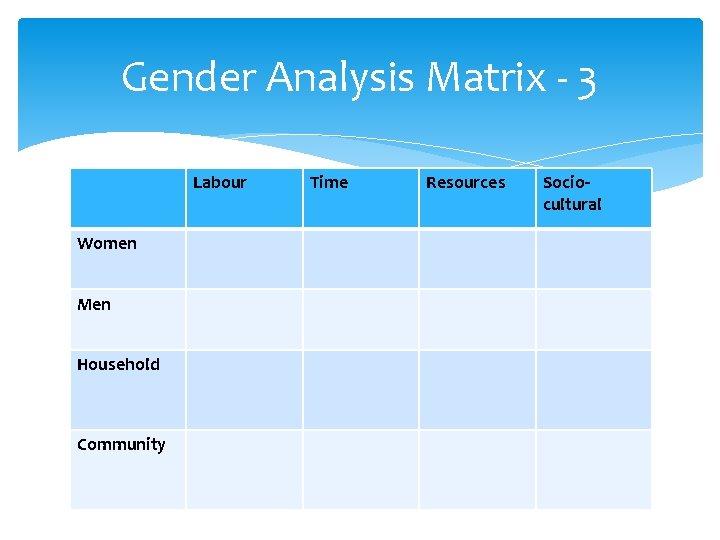
Gender Analysis Matrix - 2 Two main tools GAM Tool 1: Analysis at four 'levels‘ of society - women, household and community GAM Tool 2: Analysis of four kinds of impact; Labour - changes in tasks; the level of skill required; labour capacity; Time - changes in the amount of time it takes to carry out the task associated with the project or activity Resources – access & control; this category refers to the changes in access to resources as a consequence of the project, and the extent of control over changes in resources (more or less) for each group analysed. Socio-cultural factors - changes in social aspects of the participants' lives (including changes in gender roles or status) as a result of the project.
Gender Analysis Matrix - 3 Labour Women Men Household Community Time Resources Sociocultural
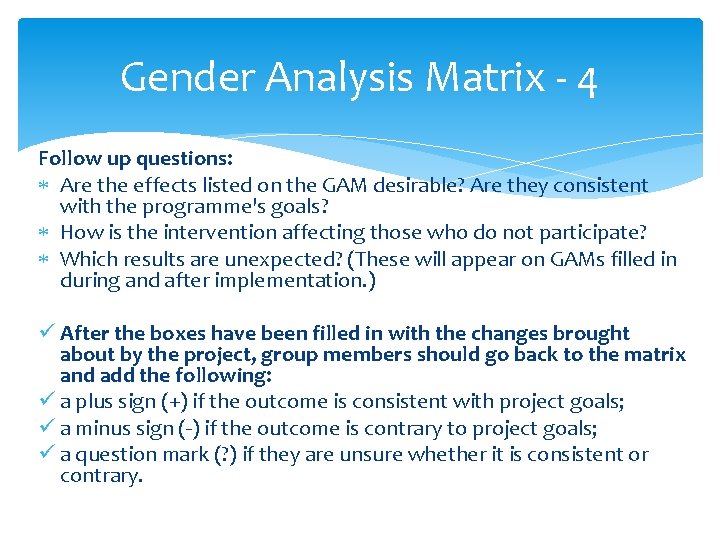
Gender Analysis Matrix - 4 Follow up questions: Are the effects listed on the GAM desirable? Are they consistent with the programme's goals? How is the intervention affecting those who do not participate? Which results are unexpected? (These will appear on GAMs filled in during and after implementation. ) ü After the boxes have been filled in with the changes brought about by the project, group members should go back to the matrix and add the following: ü a plus sign (+) if the outcome is consistent with project goals; ü a minus sign (-) if the outcome is contrary to project goals; ü a question mark (? ) if they are unsure whether it is consistent or contrary.
A word of caution!! Gender analysis should not be used as a rigid neutral technical tool imposed by outside ‘experts’ ! Women and men must be accorded an active decision-making role in their own development ! Gender analysis can never replace empathy and sensitivity in development work!
Thank you!