
GELHYPSE Project ELectrolysis for Hydrogen Production by way
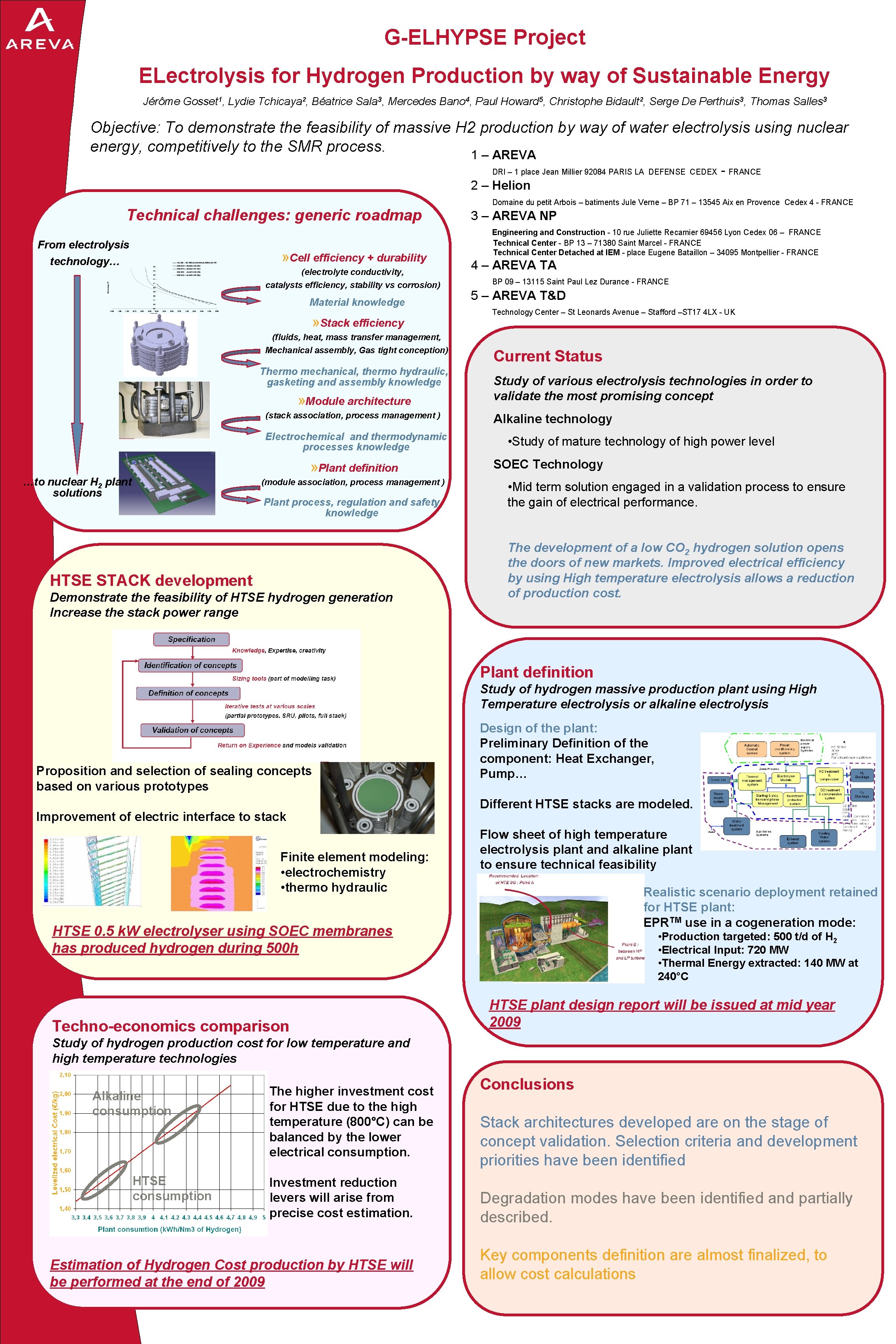
G-ELHYPSE Project ELectrolysis for Hydrogen Production by way of Sustainable Energy Jérôme Gosset 1, Lydie Tchicaya², Béatrice Sala 3, Mercedes Bano 4, Paul Howard 5, Christophe Bidault², Serge De Perthuis 3, Thomas Salles 3 Objective: To demonstrate the feasibility of massive H 2 production by way of water electrolysis using nuclear energy, competitively to the SMR process. 1 – AREVA DRI – 1 place Jean Millier 92084 PARIS LA DEFENSE CEDEX - FRANCE 2 – Helion Technical challenges: generic roadmap From electrolysis » Cell efficiency + durability technology… (electrolyte conductivity, catalysts efficiency, stability vs corrosion) Material knowledge » Stack efficiency (fluids, heat, mass transfer management, Mechanical assembly, Gas tight conception) Thermo mechanical, thermo hydraulic, gasketing and assembly knowledge » Module architecture (stack association, process management ) Electrochemical and thermodynamic processes knowledge » Plant definition …to nuclear H 2 plant solutions (module association, process management ) Plant process, regulation and safety knowledge HTSE STACK development Demonstrate the feasibility of HTSE hydrogen generation Increase the stack power range Domaine du petit Arbois – batiments Jule Verne – BP 71 – 13545 Aix en Provence Cedex 4 - FRANCE 3 – AREVA NP Engineering and Construction - 10 rue Juliette Recamier 69456 Lyon Cedex 06 – FRANCE Technical Center - BP 13 – 71380 Saint Marcel - FRANCE Technical Center Detached at IEM - place Eugene Bataillon – 34095 Montpellier - FRANCE 4 – AREVA TA BP 09 – 13115 Saint Paul Lez Durance - FRANCE 5 – AREVA T&D Technology Center – St Leonards Avenue – Stafford –ST 17 4 LX - UK Current Status Study of various electrolysis technologies in order to validate the most promising concept Alkaline technology • Study of mature technology of high power level SOEC Technology • Mid term solution engaged in a validation process to ensure the gain of electrical performance. The development of a low CO 2 hydrogen solution opens the doors of new markets. Improved electrical efficiency by using High temperature electrolysis allows a reduction of production cost. Plant definition Study of hydrogen massive production plant using High Temperature electrolysis or alkaline electrolysis Proposition and selection of sealing concepts based on various prototypes Improvement of electric interface to stack Finite element modeling: • electrochemistry • thermo hydraulic Design of the plant: Preliminary Definition of the component: Heat Exchanger, Pump… Different HTSE stacks are modeled. Flow sheet of high temperature electrolysis plant and alkaline plant to ensure technical feasibility Realistic scenario deployment retained for HTSE plant: EPRTM use in a cogeneration mode: HTSE 0. 5 k. W electrolyser using SOEC membranes has produced hydrogen during 500 h Techno-economics comparison • Production targeted: 500 t/d of H 2 • Electrical Input: 720 MW • Thermal Energy extracted: 140 MW at 240°C HTSE plant design report will be issued at mid year 2009 Study of hydrogen production cost for low temperature and high temperature technologies Alkaline consumption HTSE consumption The higher investment cost for HTSE due to the high temperature (800°C) can be balanced by the lower electrical consumption. Investment reduction levers will arise from precise cost estimation. Estimation of Hydrogen Cost production by HTSE will be performed at the end of 2009 Conclusions Stack architectures developed are on the stage of concept validation. Selection criteria and development priorities have been identified Degradation modes have been identified and partially described. Key components definition are almost finalized, to allow cost calculations
- Slides: 1