
Gel Dosimetry Technique for Measurements in High Dose
- Slides: 1
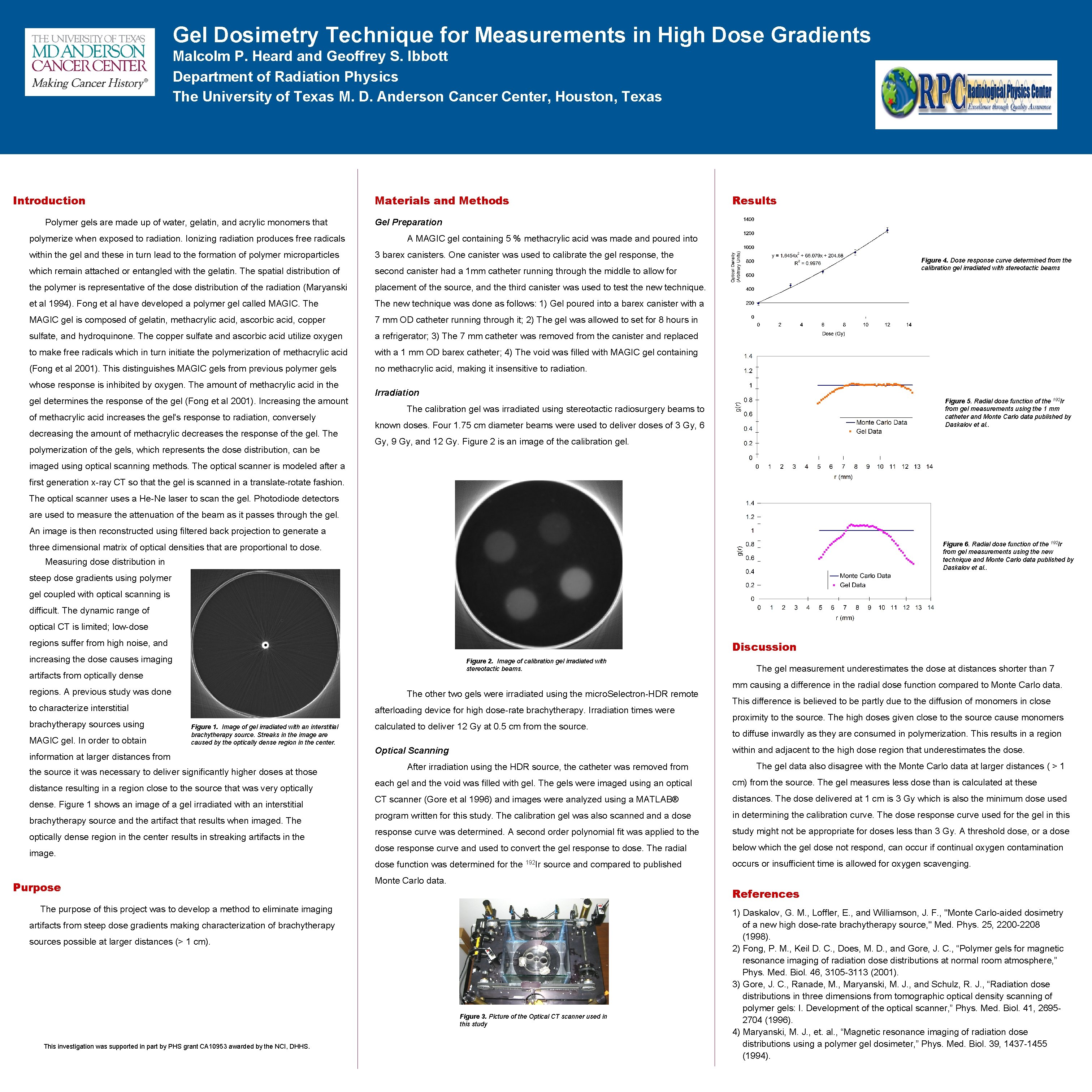
Gel Dosimetry Technique for Measurements in High Dose Gradients Malcolm P. Heard and Geoffrey S. Ibbott Department of Radiation Physics The University of Texas M. D. Anderson Cancer Center, Houston, Texas Introduction Materials and Methods Polymer gels are made up of water, gelatin, and acrylic monomers that polymerize when exposed to radiation. Ionizing radiation produces free radicals Gel Preparation A MAGIC gel containing 5 % methacrylic acid was made and poured into within the gel and these in turn lead to the formation of polymer microparticles 3 barex canisters. One canister was used to calibrate the gel response, the which remain attached or entangled with the gelatin. The spatial distribution of second canister had a 1 mm catheter running through the middle to allow for the polymer is representative of the dose distribution of the radiation (Maryanski placement of the source, and the third canister was used to test the new technique. et al 1994). Fong et al have developed a polymer gel called MAGIC. The new technique was done as follows: 1) Gel poured into a barex canister with a MAGIC gel is composed of gelatin, methacrylic acid, ascorbic acid, copper 7 mm OD catheter running through it; 2) The gel was allowed to set for 8 hours in sulfate, and hydroquinone. The copper sulfate and ascorbic acid utilize oxygen a refrigerator; 3) The 7 mm catheter was removed from the canister and replaced to make free radicals which in turn initiate the polymerization of methacrylic acid with a 1 mm OD barex catheter; 4) The void was filled with MAGIC gel containing (Fong et al 2001). This distinguishes MAGIC gels from previous polymer gels no methacrylic acid, making it insensitive to radiation. whose response is inhibited by oxygen. The amount of methacrylic acid in the gel determines the response of the gel (Fong et al 2001). Increasing the amount of methacrylic acid increases the gel's response to radiation, conversely decreasing the amount of methacrylic decreases the response of the gel. The polymerization of the gels, which represents the dose distribution, can be Results Figure 4. Dose response curve determined from the calibration gel irradiated with stereotactic beams Irradiation Figure 5. Radial dose function of the 192 Ir from gel measurements using the 1 mm catheter and Monte Carlo data published by Daskalov et al. . The calibration gel was irradiated using stereotactic radiosurgery beams to known doses. Four 1. 75 cm diameter beams were used to deliver doses of 3 Gy, 6 Gy, 9 Gy, and 12 Gy. Figure 2 is an image of the calibration gel. imaged using optical scanning methods. The optical scanner is modeled after a first generation x-ray CT so that the gel is scanned in a translate-rotate fashion. The optical scanner uses a He-Ne laser to scan the gel. Photodiode detectors are used to measure the attenuation of the beam as it passes through the gel. An image is then reconstructed using filtered back projection to generate a Figure 6. Radial dose function of the 192 Ir from gel measurements using the new technique and Monte Carlo data published by Daskalov et al. . three dimensional matrix of optical densities that are proportional to dose. Measuring dose distribution in steep dose gradients using polymer gel coupled with optical scanning is difficult. The dynamic range of optical CT is limited; low-dose regions suffer from high noise, and Discussion increasing the dose causes imaging Figure 2. Image of calibration gel irradiated with stereotactic beams. artifacts from optically dense regions. A previous study was done The other two gels were irradiated using the micro. Selectron-HDR remote to characterize interstitial brachytherapy sources using MAGIC gel. In order to obtain afterloading device for high dose-rate brachytherapy. Irradiation times were Figure 1. Image of gel irradiated with an interstitial brachytherapy source. Streaks in the image are caused by the optically dense region in the center. information at larger distances from the source it was necessary to deliver significantly higher doses at those distance resulting in a region close to the source that was very optically dense. Figure 1 shows an image of a gel irradiated with an interstitial brachytherapy source and the artifact that results when imaged. The optically dense region in the center results in streaking artifacts in the image. Purpose calculated to deliver 12 Gy at 0. 5 cm from the source. mm causing a difference in the radial dose function compared to Monte Carlo data. This difference is believed to be partly due to the diffusion of monomers in close proximity to the source. The high doses given close to the source cause monomers to diffuse inwardly as they are consumed in polymerization. This results in a region within and adjacent to the high dose region that underestimates the dose. Optical Scanning After irradiation using the HDR source, the catheter was removed from The gel data also disagree with the Monte Carlo data at larger distances ( > 1 each gel and the void was filled with gel. The gels were imaged using an optical cm) from the source. The gel measures less dose than is calculated at these CT scanner (Gore et al 1996) and images were analyzed using a MATLAB® distances. The dose delivered at 1 cm is 3 Gy which is also the minimum dose used program written for this study. The calibration gel was also scanned and a dose in determining the calibration curve. The dose response curve used for the gel in this response curve was determined. A second order polynomial fit was applied to the study might not be appropriate for doses less than 3 Gy. A threshold dose, or a dose response curve and used to convert the gel response to dose. The radial below which the gel dose not respond, can occur if continual oxygen contamination dose function was determined for the 192 Ir source and compared to published occurs or insufficient time is allowed for oxygen scavenging. Monte Carlo data. References The purpose of this project was to develop a method to eliminate imaging artifacts from steep dose gradients making characterization of brachytherapy sources possible at larger distances (> 1 cm). Figure 3. Picture of the Optical CT scanner used in this study This investigation was supported in part by PHS grant CA 10953 awarded by the NCI, DHHS. The gel measurement underestimates the dose at distances shorter than 7 1) Daskalov, G. M. , Loffler, E. , and Williamson, J. F. , "Monte Carlo-aided dosimetry of a new high dose-rate brachytherapy source, " Med. Phys. 25, 2200 -2208 (1998). 2) Fong, P. M. , Keil D. C. , Does, M. D. , and Gore, J. C. , “Polymer gels for magnetic resonance imaging of radiation dose distributions at normal room atmosphere, ” Phys. Med. Biol. 46, 3105 -3113 (2001). 3) Gore, J. C. , Ranade, M. , Maryanski, M. J. , and Schulz, R. J. , “Radiation dose distributions in three dimensions from tomographic optical density scanning of polymer gels: I. Development of the optical scanner, ” Phys. Med. Biol. 41, 26952704 (1996). 4) Maryanski, M. J. , et. al. , “Magnetic resonance imaging of radiation dose distributions using a polymer gel dosimeter, ” Phys. Med. Biol. 39, 1437 -1455 (1994).