
Gel Diffusion Experiment STEM EDCHM Nanotechnology 2015 Presented


- Slides: 44
Gel Diffusion Experiment STEM ED/CHM Nanotechnology 2015 Presented by Jennifer Welborn
Learning Goals In this activity, nanotech participants will: u See how food dyes and gelatin are used to model the delivery of nanoscale medicines to cells in the human body u Measure diffusion distances of 3 different colors of food dye by: Eye, photo image on a computer, ADI software (Analyzing Digital Images)
Diffusion and Teaching Standards This lab has content which is applicable to various disciplines/standards u. Physical Science/Chemistry: particle motion theory u. Biology: passive transport; cellular structure, etc. u. Ecology/Environmental Science: environmental effects on living systems u. Math: rates; proportions, data collection, measurement, precision/accuracy
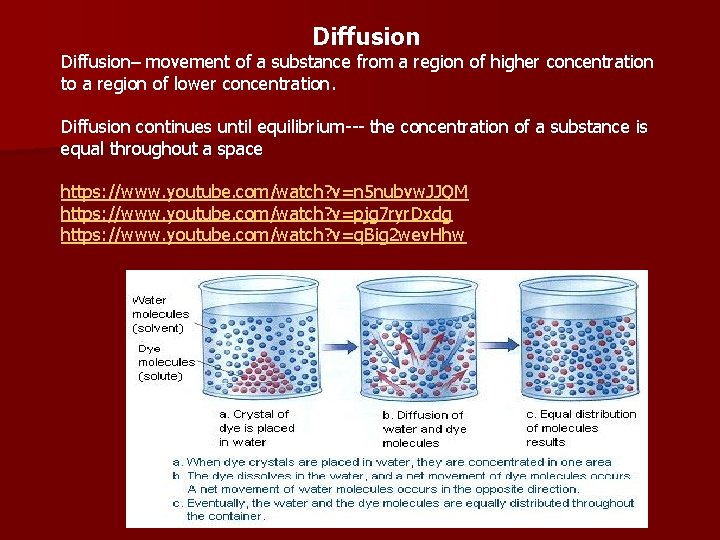
Diffusion– movement of a substance from a region of higher concentration to a region of lower concentration. Diffusion continues until equilibrium--- the concentration of a substance is equal throughout a space https: //www. youtube. com/watch? v=n 5 nubvw. JJQM https: //www. youtube. com/watch? v=pjg 7 ryr. Dxdg https: //www. youtube. com/watch? v=q. Big 2 wev. Hhw
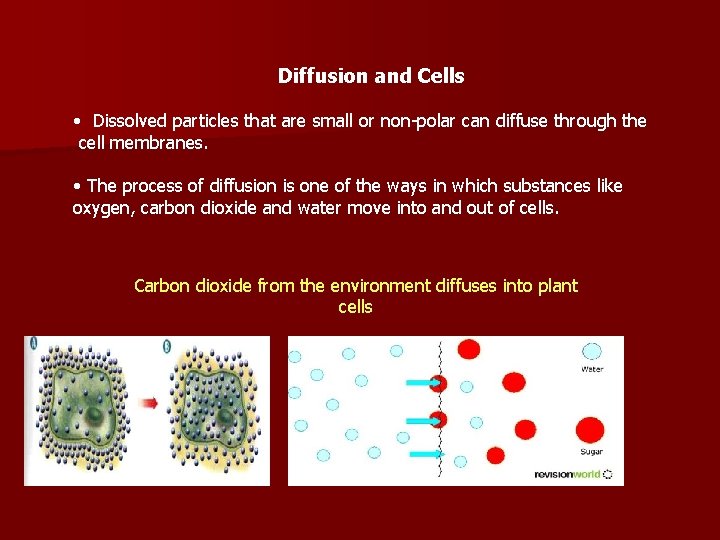
Diffusion and Cells • Dissolved particles that are small or non-polar can diffuse through the cell membranes. • The process of diffusion is one of the ways in which substances like oxygen, carbon dioxide and water move into and out of cells. Carbon dioxide from the environment diffuses into plant cells
Background For Lab Activity n The delivery of nanoscale medicines to cells in the human body requires diffusion through organs, tissues and cell membranes n This activity will explore the affect of particle size (molecular weight) on diffusion rates n Understanding molecular diffusion through human tissues is important for designing effective drug delivery systems
A Model for Nanomedicine Delivery n Measuring the diffusion of dyes in gelatin is a model for the transport of drugs in the extra-vascular space n Gelatin: biological polymeric material with similar properties to the connective extracellular matrix in tumor tissue n Dyes are similar in molecular weight and transport properties to chemotherapeutics
Some Uses of Nanoscale Particles in Medicine n Youtube video made by the Center for Hierarchical Manufactoring at UMASS, Amherst: n http: //www. youtube. com/watch? v=b. Uvi 5 e Qh. PTc n 5: 40 -7: 40 shows some of the uses of nano -scale particles in medicine.
Nanotechnology for Targeted Cancer Therapy n https: //www. youtube. com/watch? v=RBj. W wlnq 3 c. A n 5 -minutes
Experiment Overview n Gelatin will be cut into cylindrical disks, placed in Petri dishes and colored solutions will be added to the outer ring n The distance that the dye particles diffuse into the gelatin disks will be measured over time n The diffusion of the dyes will be compared to model the effect of molecular weight on movement of molecules in tumors
Lab Prep n Collect materials – – – – Petri Dishes Food Dye Syringes/10 ml graduated cylinders Paper Cups Plain Gelatin Crisco/Petroleum Jelly Baking Pan Biscuit cutter n Prepare Gel Disks – Determine amount of water needed to fill up a pan to a depth of 1 cm. – Dissolve gel into cold water (2 Pks/Cup/200 ml) – Microwave for 90 Sec. – Pour into pan which has been coated with petroleum jelly and let set.
Lab Procedure n Gel Disks – Cut disks--bisquit cutter – Thin coating of Petroleum jelly on inside bottom of Petri dish – Put gel disk –top side down and centered- on bottom of dish – Gently press disk to secure n Adding Dye – Mix dyes in cups – Inject one color/petri dish – No dye on top of gel – No seepage under gel – Do not move dishes after dye inserted
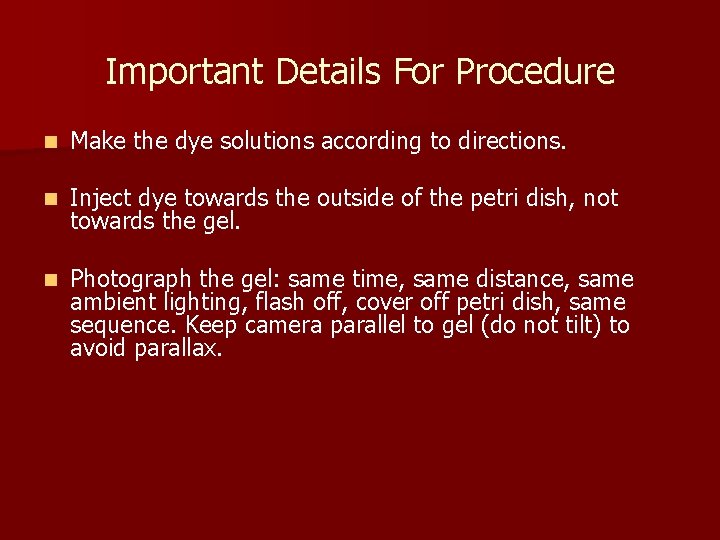
Important Details For Procedure n Make the dye solutions according to directions. n Inject dye towards the outside of the petri dish, not towards the gel. n Photograph the gel: same time, same distance, same ambient lighting, flash off, cover off petri dish, same sequence. Keep camera parallel to gel (do not tilt) to avoid parallax.
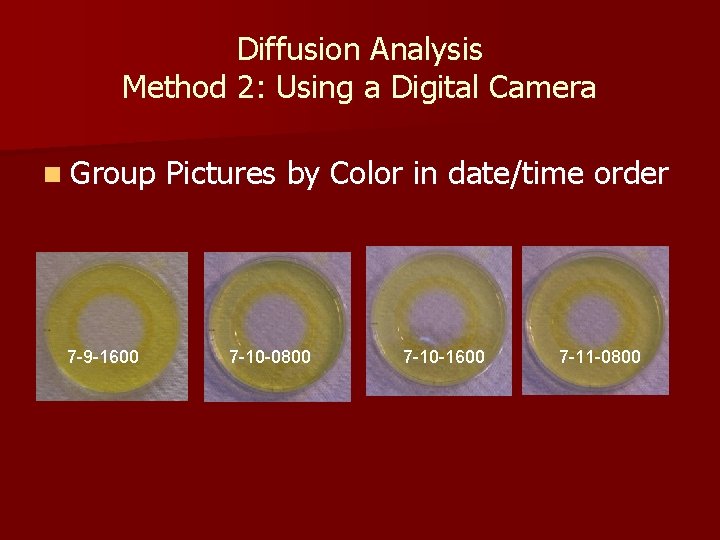
Data Collection n Method 1 -- By eye: measure (in mm) the distance each dye has diffused for each time interval. Record data in a data table or use excel spreadsheet n Method 2 --Using a digital camera: take photos of each petri dish at the same time each day, 8: 45 and 4: 45, from the same height and angle
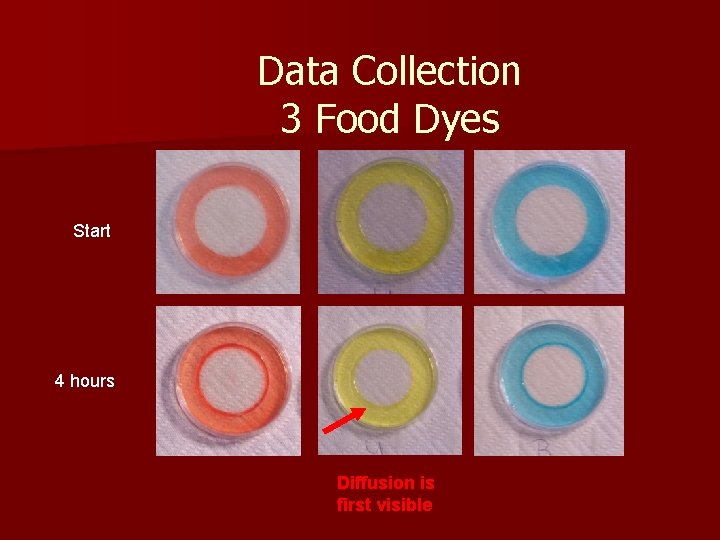
Data Collection 3 Food Dyes Start 4 hours Diffusion is first visible
Gel Diffusion Analysis
Gel Diffusion Analysis Method 1: Determining Rate of Diffusion by Eye
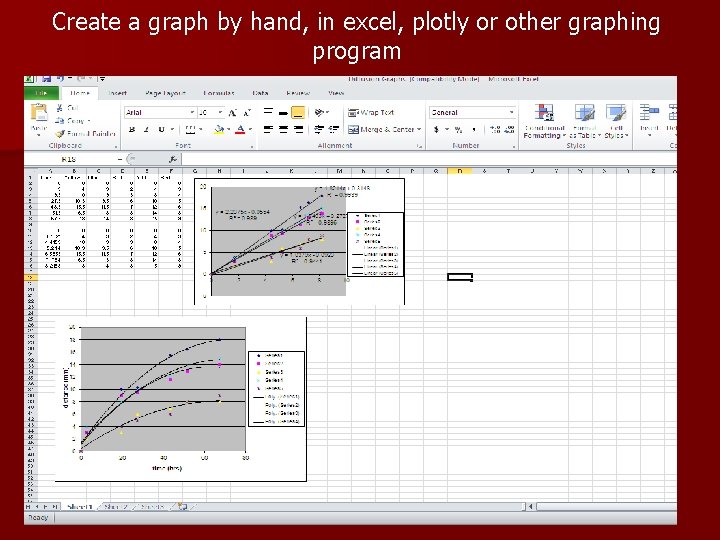
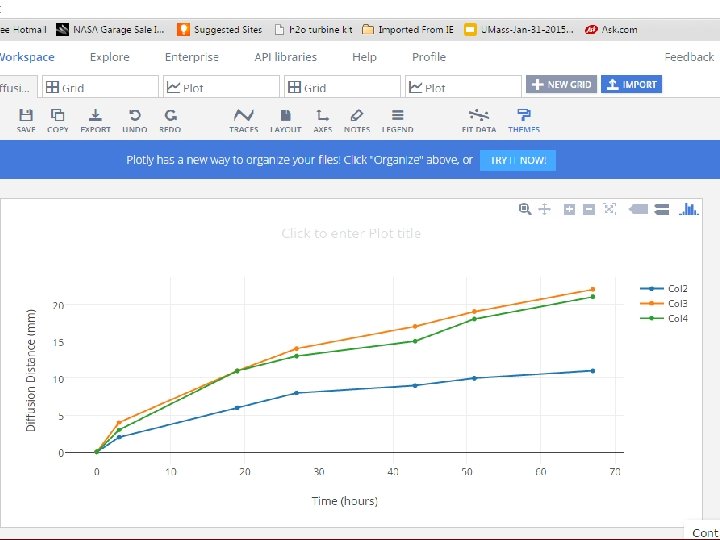
Create a graph by hand, in excel, plotly or other graphing program
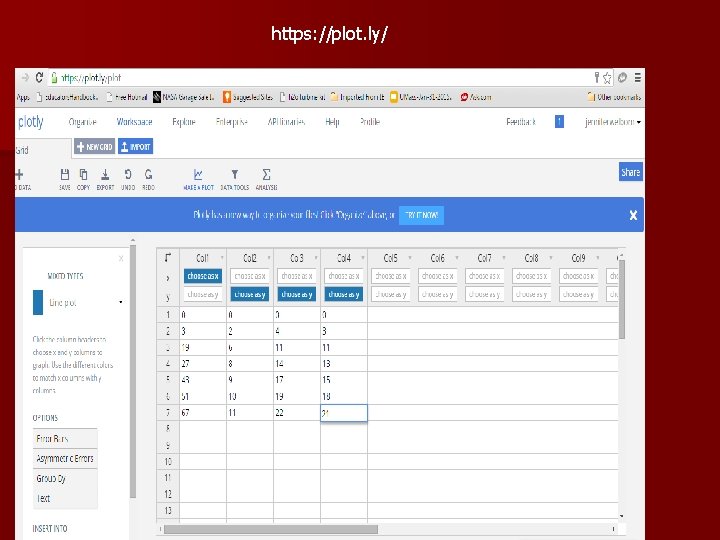
https: //plot. ly/
Diffusion Analysis Method 2: Using a Digital Camera n Group 7 -9 -1600 Pictures by Color in date/time order 7 -10 -0800 7 -10 -1600 7 -11 -0800
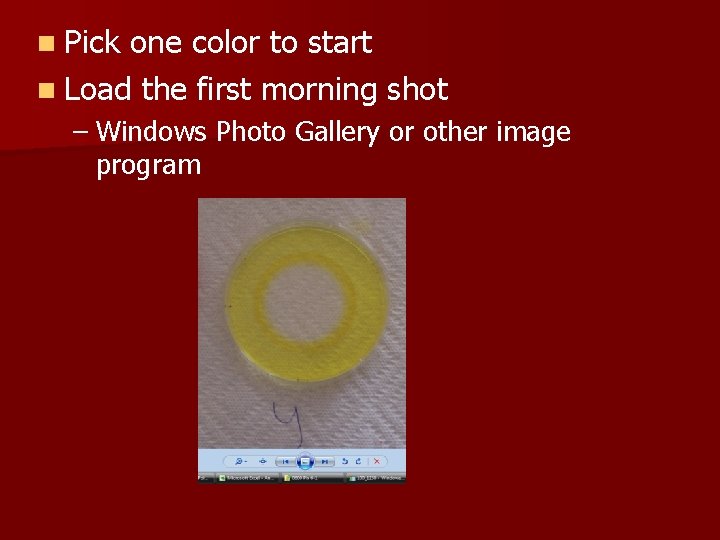
n Pick one color to start n Load the first morning shot – Windows Photo Gallery or other image program
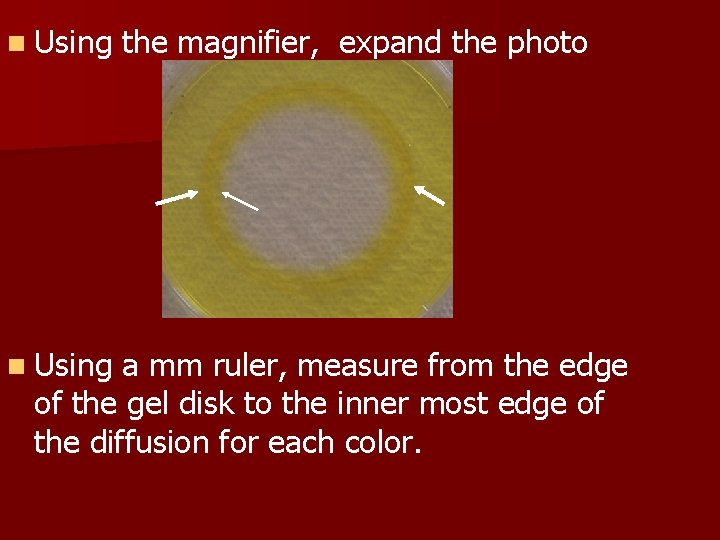
n Using the magnifier, expand the photo a mm ruler, measure from the edge of the gel disk to the inner most edge of the diffusion for each color.
u Calculate the diffusion distances for each dye and for each time period: --Gel diameter measurement (mm) on the computer screen/65 mm = multiplier. --Gel diffusion distance (mm) on screen x multiplier = actual distance. u Record calculated diffusion distances for each color and time period in a data table or spread sheet.
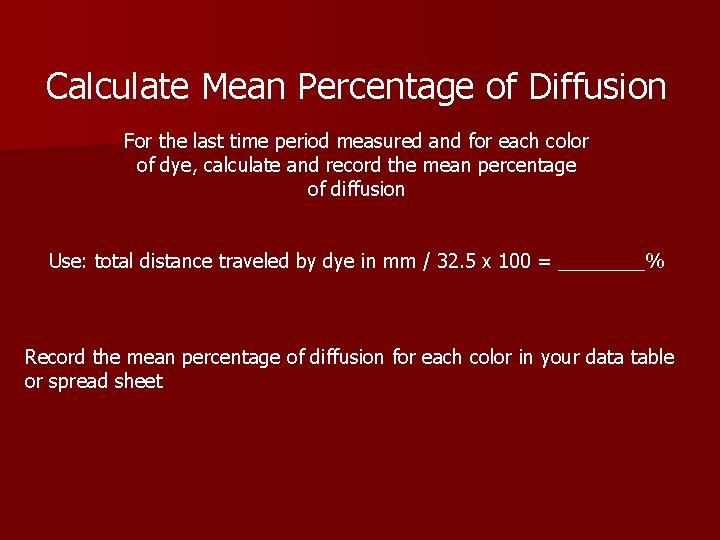
Calculate Mean Percentage of Diffusion For the last time period measured and for each color of dye, calculate and record the mean percentage of diffusion Use: total distance traveled by dye in mm / 32. 5 x 100 = ____% Record the mean percentage of diffusion for each color in your data table or spread sheet
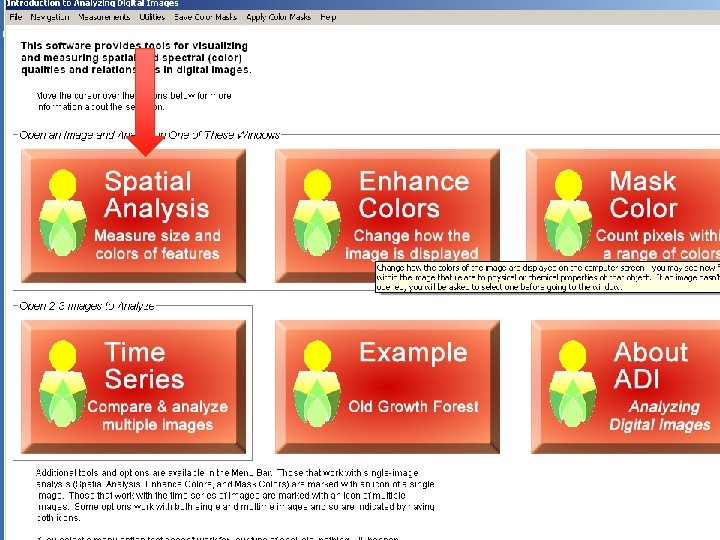
Diffusion Analysis Method 3: Using ADI (Analyzing Digital Images Software u Download DEW software from: http: //umassk 12. net/adi/ u Click on Analyzing Digital Images
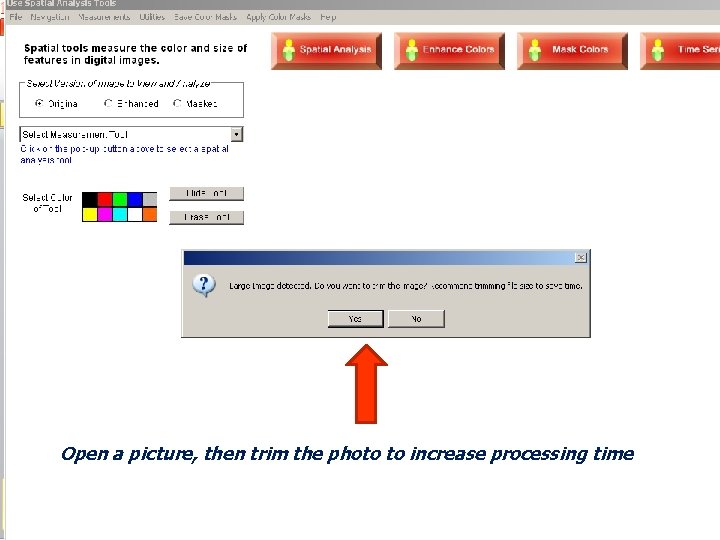
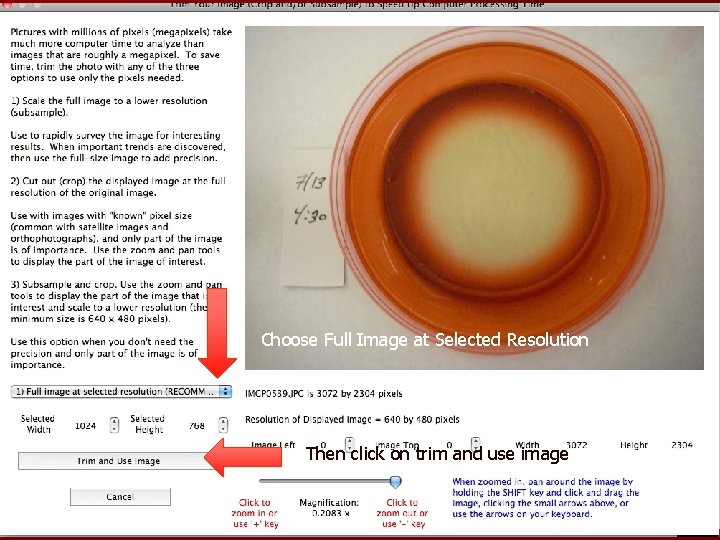
Open a picture, then trim the photo to increase processing time
Click on the drop down menu
Choose Full Image at Selected Resolution Then click on trim and use image
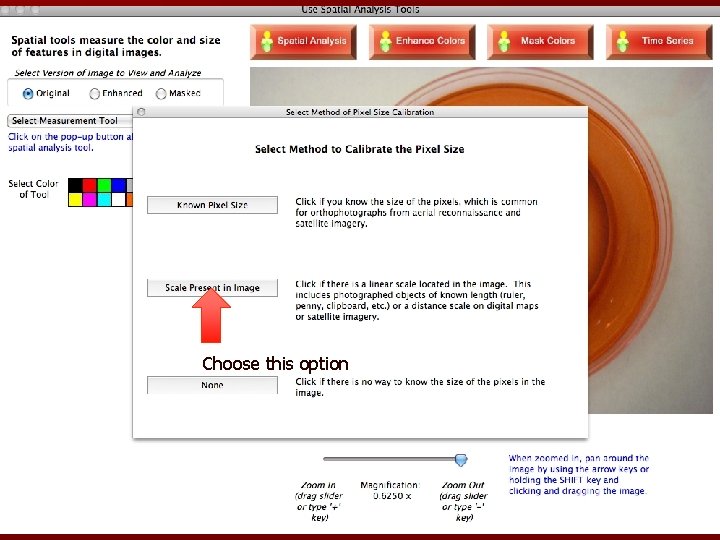
Choose this option
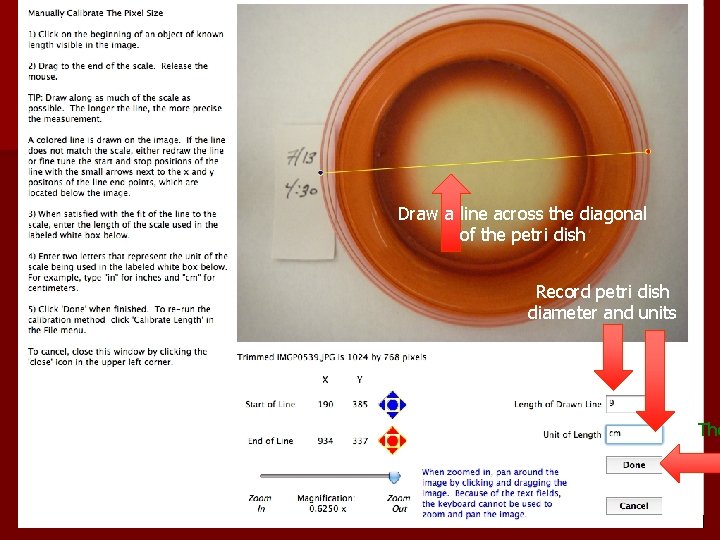
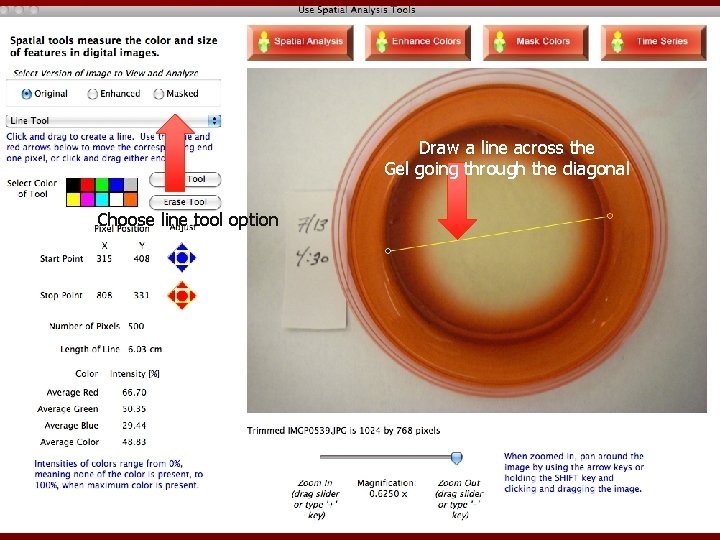
Draw a line across the diagonal of the petri dish Record petri dish diameter and units The
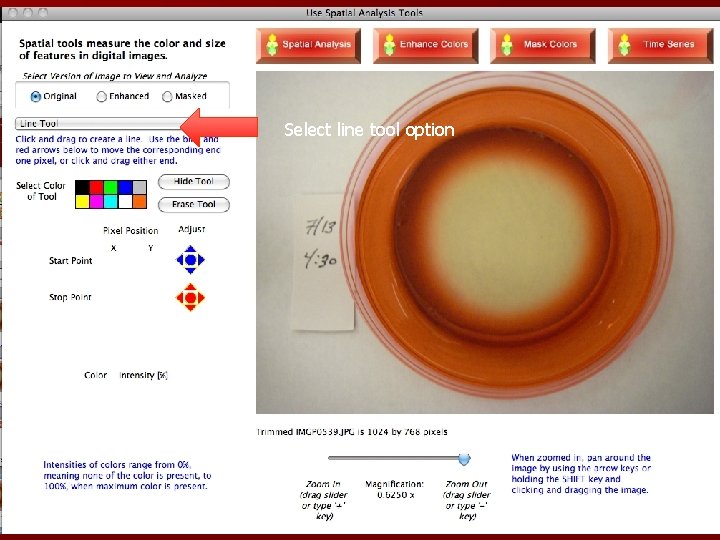
Select line tool option
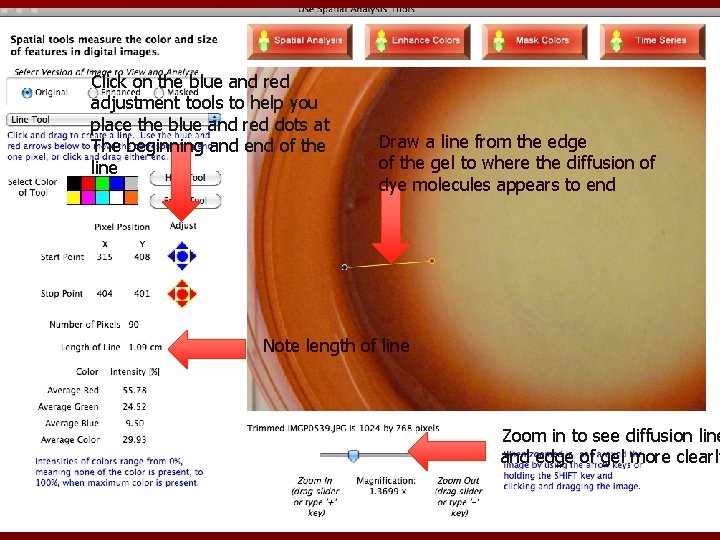
Click on the blue and red adjustment tools to help you place the blue and red dots at The beginning and end of the line Draw a line from the edge of the gel to where the diffusion of dye molecules appears to end Note length of line Zoom in to see diffusion line and edge of gel more clearly
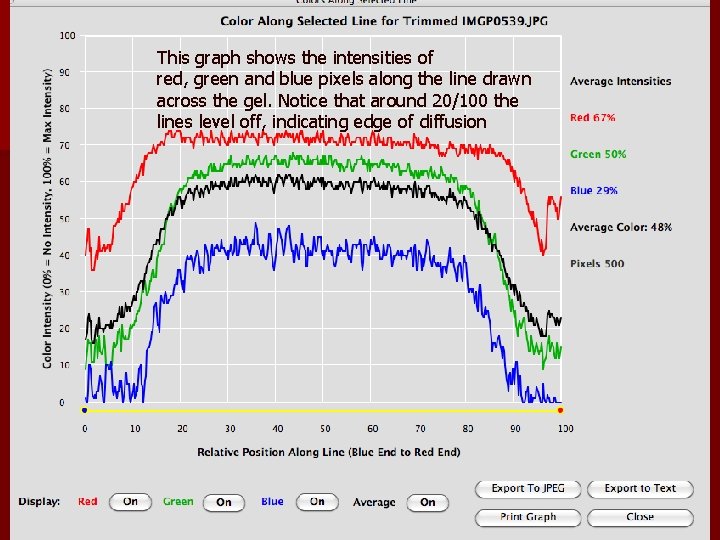
QUALITATIVE OBSERVATION OF DIFFUSION You can also use ADI software to see a qualitative graph of the diffusion of the yellow dye molecules at a particular time. You can compare the qualitative graph with the quantitative measurements. A qualitative graph also helps to see that diffusion is a dynamic process with a trend in movement but no clear end point.
Draw a line across the Gel going through the diagonal Choose line tool option
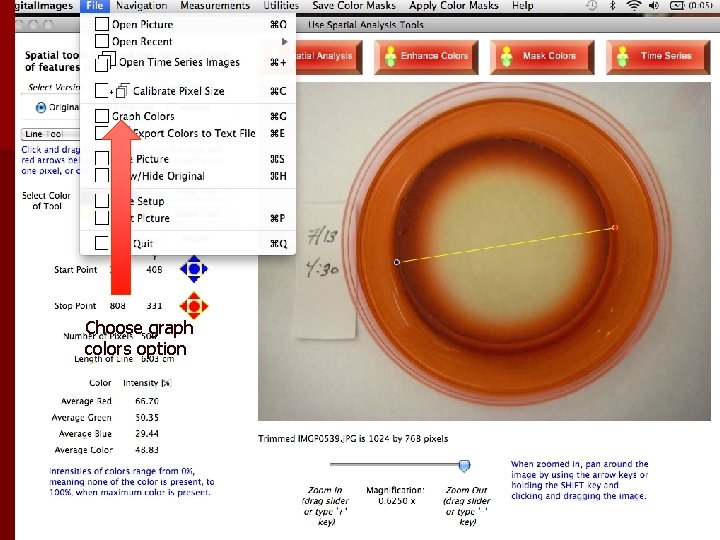
Choose graph colors option
This graph shows the intensities of red, green and blue pixels along the line drawn across the gel. Notice that around 20/100 the lines level off, indicating edge of diffusion
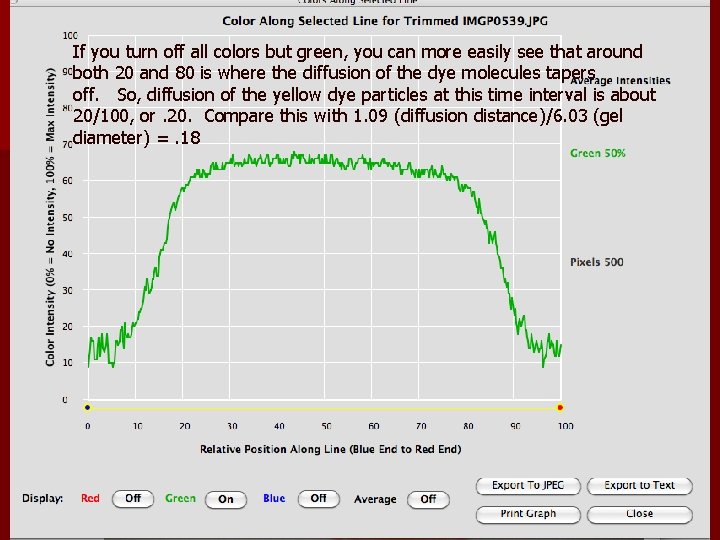
If you turn off all colors but green, you can more easily see that around both 20 and 80 is where the diffusion of the dye molecules tapers off. So, diffusion of the yellow dye particles at this time interval is about 20/100, or. 20. Compare this with 1. 09 (diffusion distance)/6. 03 (gel diameter) =. 18
Questions to consider n Which dyes diffused the fastest? n Does fast diffusion mean greater or poorer retention? n How could diffusion and retention be optimized? This is an important consideration for the delivery of nanoscale medication
Molecular Weights of The Food Colorings n Red n 40 Molecular Formula: C 18 H 14 N 2 Na 2 O 8 S 2 Molecular Weight: 496. 421900 [g/mol]
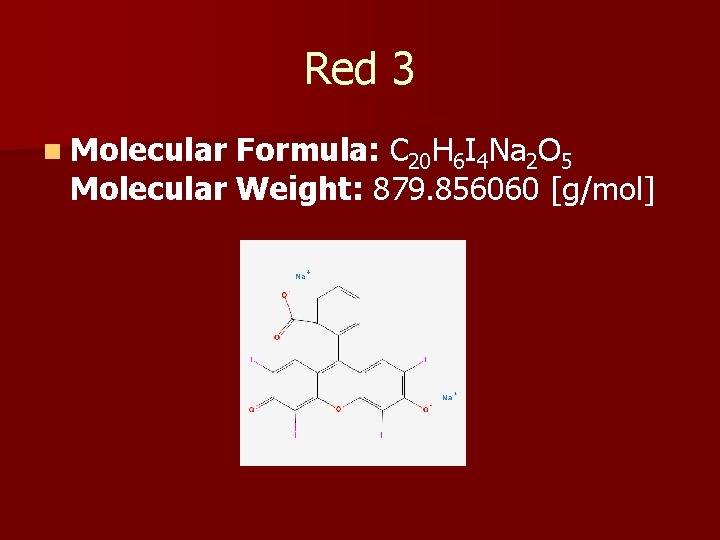
Red 3 n Molecular Formula: C 20 H 6 I 4 Na 2 O 5 Molecular Weight: 879. 856060 [g/mol]
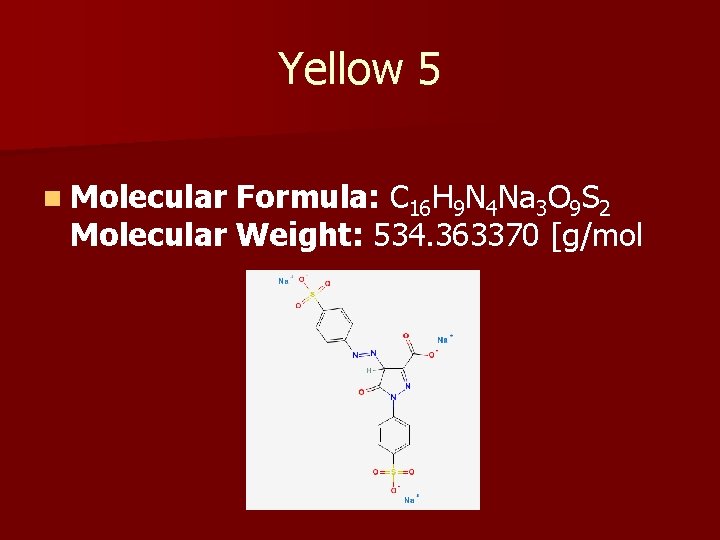
Yellow 5 n Molecular Formula: C 16 H 9 N 4 Na 3 O 9 S 2 Molecular Weight: 534. 363370 [g/mol
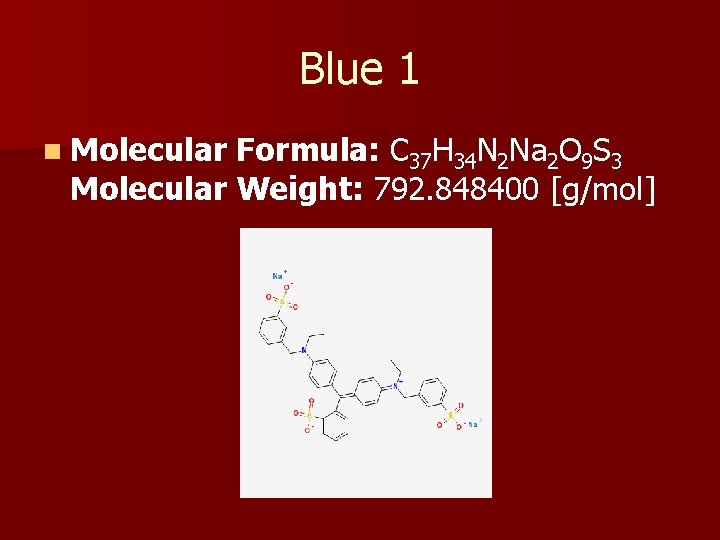
Blue 1 n Molecular Formula: C 37 H 34 N 2 Na 2 O 9 S 3 Molecular Weight: 792. 848400 [g/mol]