
Geely Volvo A global strategic fit Inge Ivarsson
Geely + Volvo A global strategic fit? Inge Ivarsson Professor of Economic Geography Centre of International Business Studies School of Economics, Business and Law Gothenburg university, Sweden
Volvo Cars Corp. (VCC) • 1926 established in Gothenburg (Sweden) • Earlier, car prod. in Gothenburg and Ghent (Belgium), engine plant in Skövde (Swe), small CKDs in Malaysia, Thailand • 1999 acquired by Ford Motor Co. (US) • 23 000 employees • Small scale-producer: globally ca 425 000 (2013) (c. f VW ca. 8, 5 milj) • Small market shares globally: <1% (Sweden 20%) • Traditionally biggest markets: USA, Sweden, UK and Other W. Europe
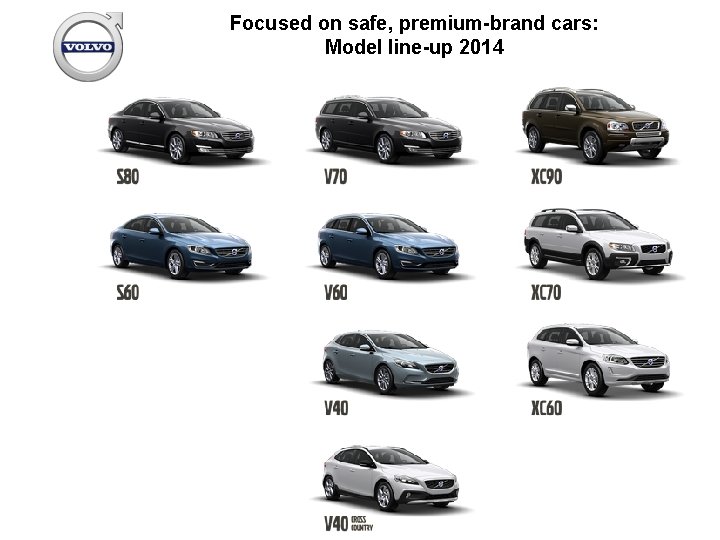
Focused on safe, premium-brand cars: Model line-up 2014
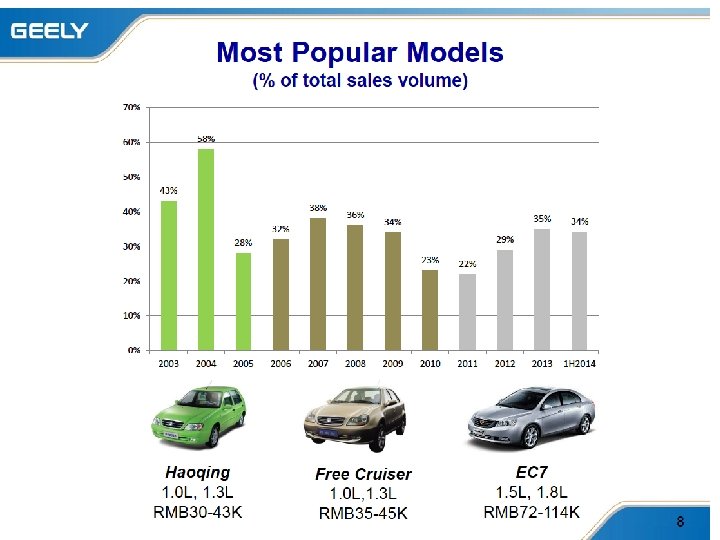
2010 VCC acquired by Zhejiang Geely Holding, China • Private company owned by the businessman Mr. Li Shufu. • Chinese firm listed in Hong Kong, incorporated in Cayman Islands • Headquartered in Hangzhou, Zhejiang Province, 18 000 employees • Only major Chinese car company without formal ties to the state • Owns the car brand Geely, with 8 assembly plants in China • Small sales volumes (2013): ca. 500 00 (excl. VCC), 2, 5% market share • 30 car models, ranging from C-class to SUVs • Traditionally focused on low-cost/budget segment (inland, rural areas):
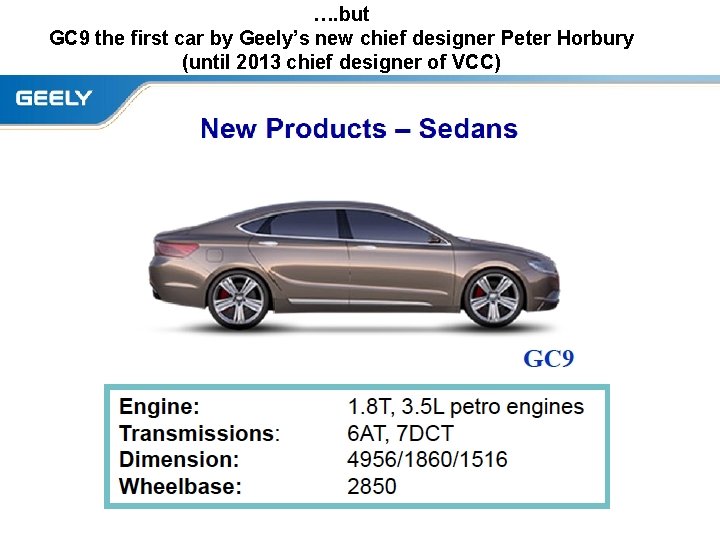
…. but GC 9 the first car by Geely’s new chief designer Peter Horbury (until 2013 chief designer of VCC)
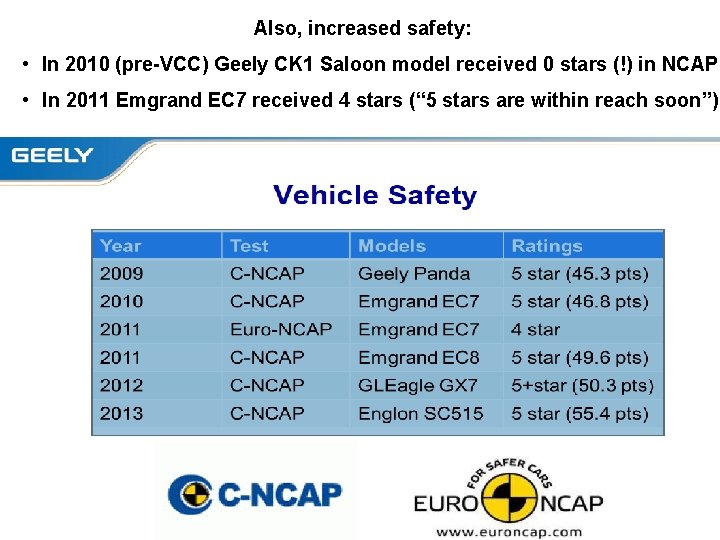
Also, increased safety: • In 2010 (pre-VCC) Geely CK 1 Saloon model received 0 stars (!) in NCAP • In 2011 Emgrand EC 7 received 4 stars (“ 5 stars are within reach soon”)
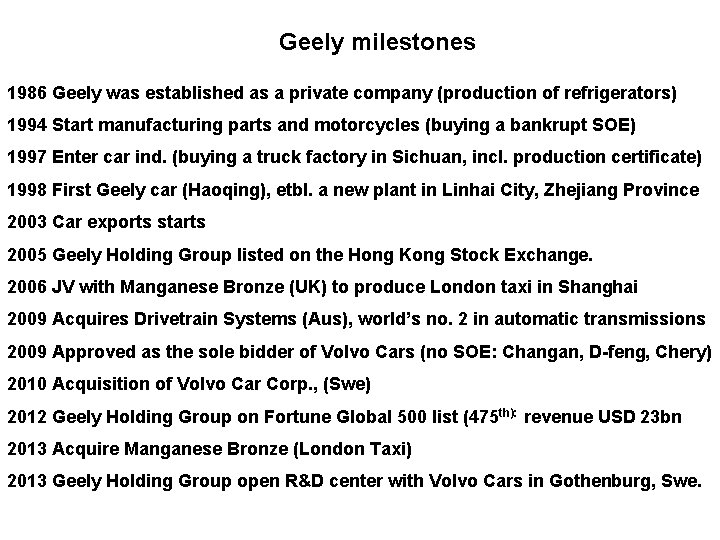
Geely milestones 1986 Geely was established as a private company (production of refrigerators) 1994 Start manufacturing parts and motorcycles (buying a bankrupt SOE) 1997 Enter car ind. (buying a truck factory in Sichuan, incl. production certificate) 1998 First Geely car (Haoqing), etbl. a new plant in Linhai City, Zhejiang Province 2003 Car exports starts 2005 Geely Holding Group listed on the Hong Kong Stock Exchange. 2006 JV with Manganese Bronze (UK) to produce London taxi in Shanghai 2009 Acquires Drivetrain Systems (Aus), world’s no. 2 in automatic transmissions 2009 Approved as the sole bidder of Volvo Cars (no SOE: Changan, D-feng, Chery) 2010 Acquisition of Volvo Car Corp. , (Swe) 2012 Geely Holding Group on Fortune Global 500 list (475 th): revenue USD 23 bn 2013 Acquire Manganese Bronze (London Taxi) 2013 Geely Holding Group open R&D center with Volvo Cars in Gothenburg, Swe.
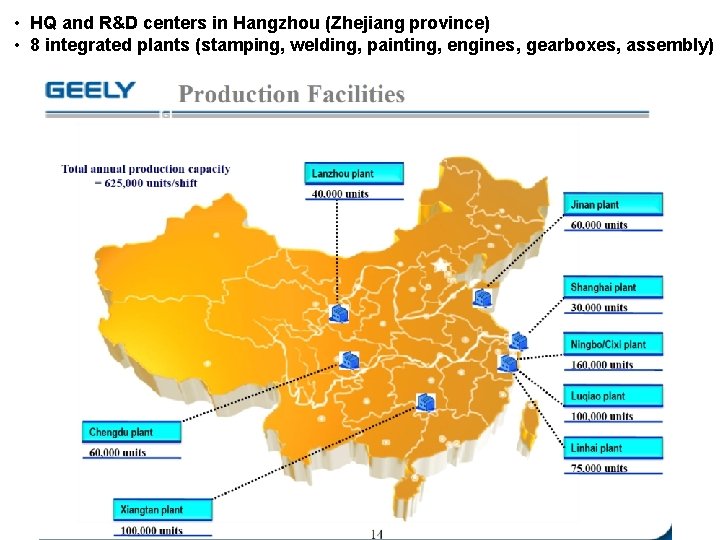
• HQ and R&D centers in Hangzhou (Zhejiang province) • 8 integrated plants (stamping, welding, painting, engines, gearboxes, assembly)
Geely’s acquisition of VCC is financed by a consortium, with a mix of private and public capital: • Mr Li Shufu (51%) • Jia'erwo Investment Co. (City of Jiading), Shanghai (12 %) • State Asset Operation Co. (Daqing City), Heilongjiang Province (37%)
The objective of the acquisition: • Build a large production capacity in China for the domestic market, • Taking advantage of the prestigious Volvo brand (also globally) • Upgrade existing Geely models (trad. low-cost), by learning from VCC (safety, product design, environmental techn. , functionality etc. ) • A rapid expansion of VCC in China, from a marginal presence
VCC Expansion in China • Until 2010 only a small assembly in China though JV with Ford/Mazda in Chongqing (volumes ca. 15 000, mainly Volvo S 80 L) • A high dependence on Ford for marketing sales, sourcing etc. VCCs new China organization: • New ambitious sales plan until 2020: o China sales 200 000 cars (2013 ca 60 000) o Global sales 800 000 cars (2013 ca 425 00) • New industrial footprint in place: o New Chinese HQ and R&D o 3 new factories o New sourcing and sales organization • Fast built-up (today ca 2000 empl. ): “mirror org. ” / ”matched-pair”
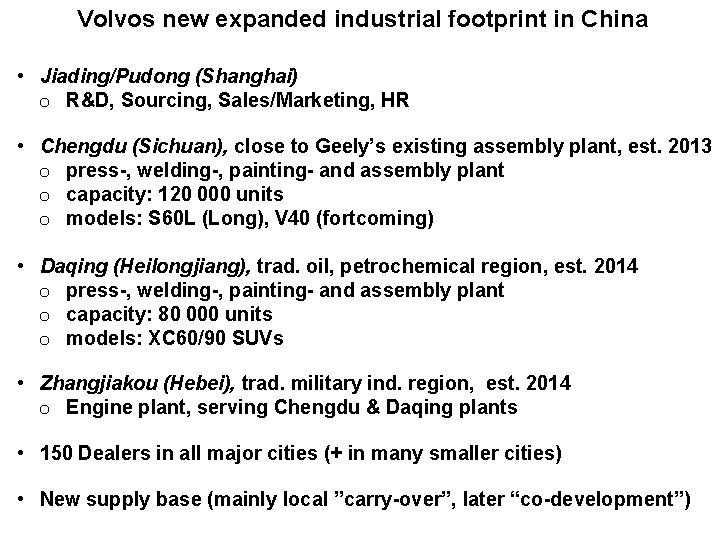
Volvos new expanded industrial footprint in China • Jiading/Pudong (Shanghai) o R&D, Sourcing, Sales/Marketing, HR • Chengdu (Sichuan), close to Geely’s existing assembly plant, est. 2013 o press-, welding-, painting- and assembly plant o capacity: 120 000 units o models: S 60 L (Long), V 40 (fortcoming) • Daqing (Heilongjiang), trad. oil, petrochemical region, est. 2014 o press-, welding-, painting- and assembly plant o capacity: 80 000 units o models: XC 60/90 SUVs • Zhangjiakou (Hebei), trad. military ind. region, est. 2014 o Engine plant, serving Chengdu & Daqing plants • 150 Dealers in all major cities (+ in many smaller cities) • New supply base (mainly local ”carry-over”, later “co-development”)
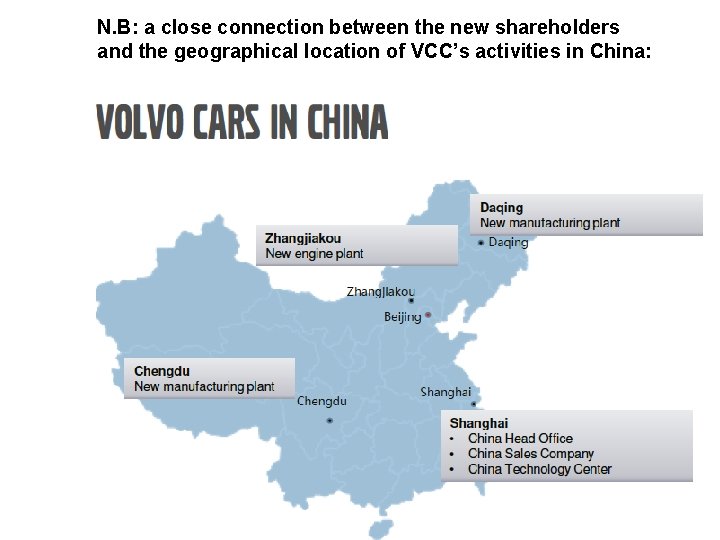
N. B: a close connection between the new shareholders and the geographical location of VCC’s activities in China:
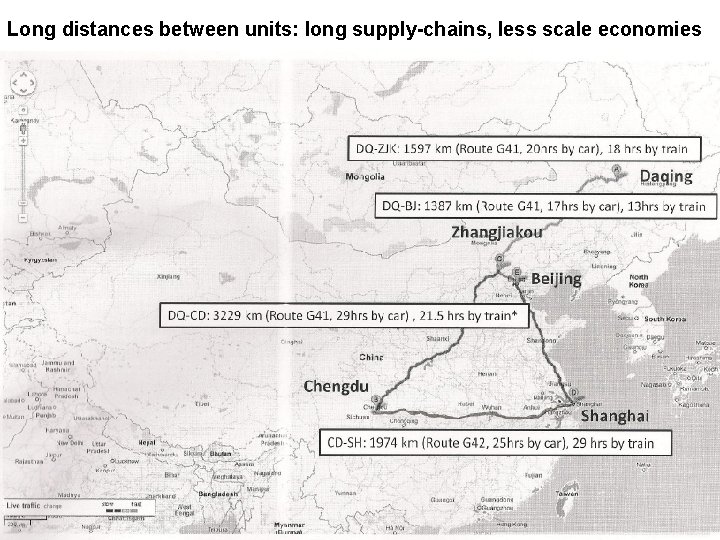
Long distances between units: long supply-chains, less scale economies
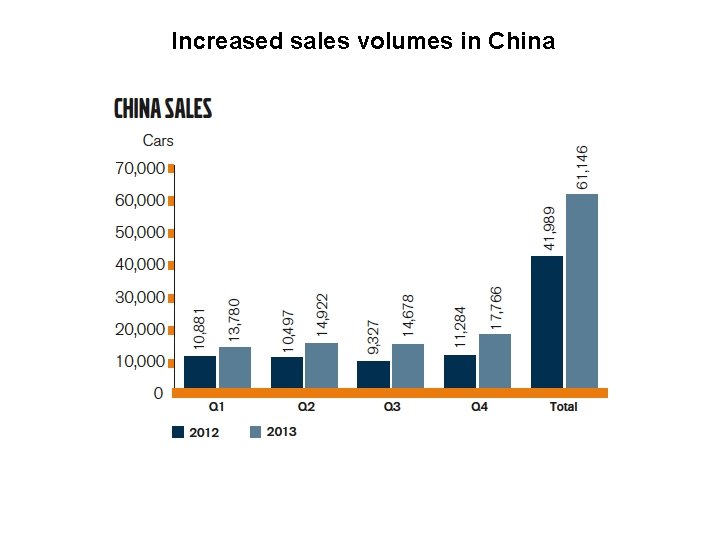
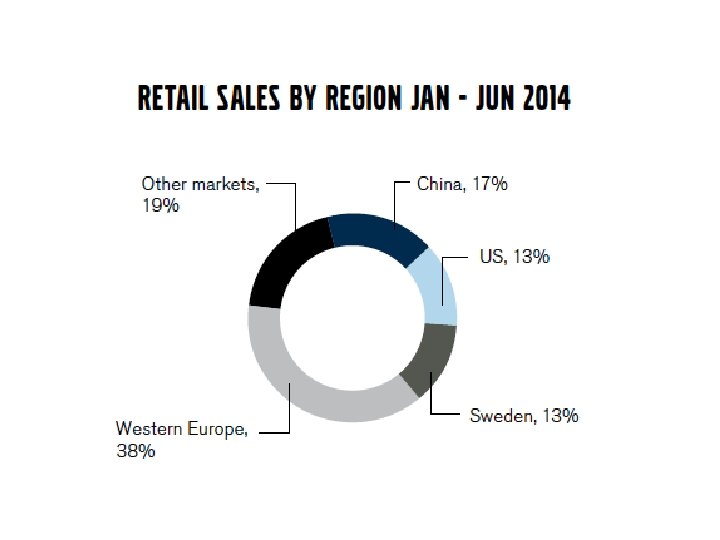
Increased sales volumes in China
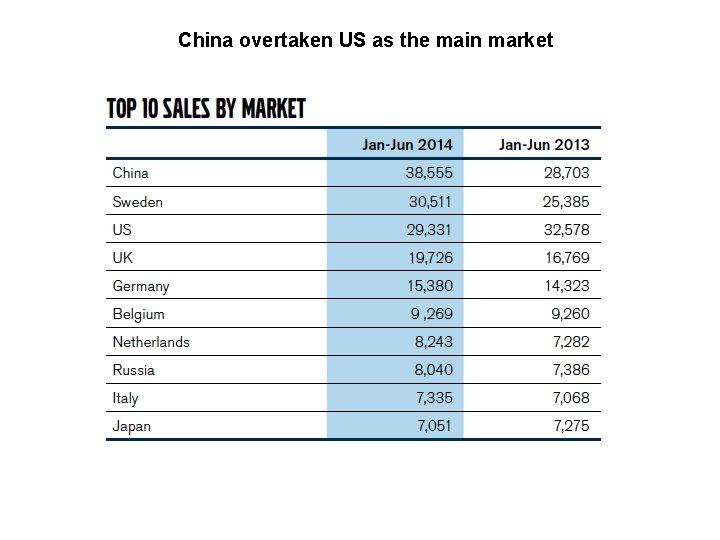
China overtaken US as the main market
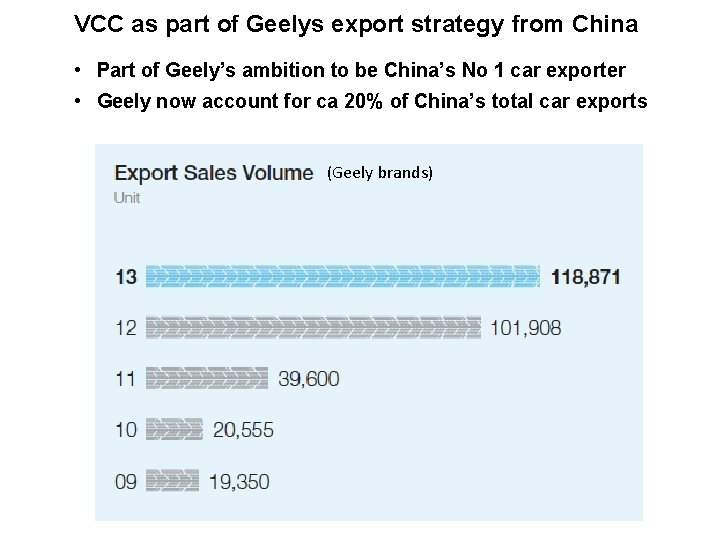
VCC as part of Geelys export strategy from China • Part of Geely’s ambition to be China’s No 1 car exporter • Geely now account for ca 20% of China’s total car exports (Geely brands)
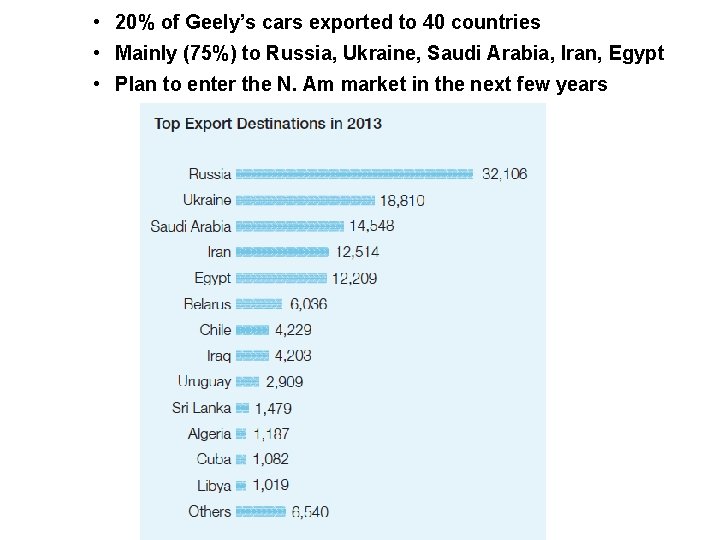
• 20% of Geely’s cars exported to 40 countries • Mainly (75%) to Russia, Ukraine, Saudi Arabia, Iran, Egypt • Plan to enter the N. Am market in the next few years
Geely has also local assembly through JVs or contract manufacturing: • Africa (Egypt, Ethiopia) • East Europe (Russia, Ukraine, Belarus) • Latin America (Uruguay) • Asia (Sri Lanka)
Even more interesting…. . • Plan to export Volvo S 60 from China to US in 2015 (from Chengdu) • Becoming the first established car brand to export to US from China • ”Volvo the only company that can use their Chinese factories for export” • Using”Volvo Cars Manufacturing System” (VCMS): the same quality as cars ”Made in Sweden” (a ”mirror organisation”) • Small volumes; test of quality/consumer response on ”Made in China” • Replace current exports of Volvo S 60 from Sweden • Advantages: Lower production cost; exchange rate stability ($ vs RMB) • Possibly also exports to SE Asia and to Russia (Volvo XC 90 from Daqing )
Volvo-Geely Collaboration in Technology Development Towards ”technological independence” • Volvo earlier dependent on Ford technology (V 40 the last ”Ford” model) • Since 2010, large R&D investments by Geely ($11 billion), financing:
1. Volvo’s in-house technology (only for the Volvo brand) • New Drive-E engine family based on Volvo Engine Architecture (VEA), “four-cylinder engines with six and eight-cylinder performance” • Scalable Product Architecture (SPA): ”modules” (not ”platforms”) with increased flexibility (c. f. VWs Modularer Querbaukasten MQB) • Will cover all Volvo Sedans/SUVs (first model: new XC 90 in sept 2014)
2. Technological collaboration Volvo-Geely • 2013 R&D center ”China Euro Vehicle Technology (CEVT ) opened in Gothenburg (Lindholmen Science Park), close to VCC global HQ/R&D • 200+ engineers (incl from China for training & tech. transfer) • Focus on smaller cars in the ”C-class” (”Golf”-segment)) • Serve Volvo (new V 40 + other models) and Geely models (intro ca 2017) • Based on Compact Modular Architecture (CMA): o Shared technologies (economies of scale) o Specific solutions for each brand (synergies)
Compact Modular Architecture (CMA) Collaboration on three levels, around identical interfaces: 1. Unique components for each brand: standard (low-cost models) and premium (Volvo models): e. g. rear axles 2. Shared components, with ad-on possibilities for premium models: eg. seats, chassi 3. Common components and systems for both brands; e. g brakes, electric/electronic systems
A tricky balance: • ”There will be problems If the technology is not advanced enough for Volvo – or to expensive for Geely” • “Volvo cannot afford to be dragged downwards” • “Geely will move more than us, it has an ambition to move upwards towards us. There is a limit how big this band of shared products can be. ” (Mr Håkan Samuelsson, Volvo Cars, CEO)
Most difficult: hybrids/electrification to meet new emission standards • Volvo’s new Drive-E engine family planned to be used in all C- models and combinations (electric, hybrids, gas, alcohol, petrol, diesel) • Discussion on joint R&D and manufacturing for electric drive system • Geely’s new EC 7 pure electric car has electrical technology from Volvo • There also rumours that Volvo/Geely consider to develop a small B-class (super compact) electric plug-in car at CEVT in Gothenburg • A basic (non-electrical) B-class car might also be developed (for Geely)
Other example of ”technological cooperation” • In 2012, Geely bought VCCs old (pre-Ford) P 2 platform for large cars (e. g S 80, SUV XC 90) • This will be used by Geely starting a new premium brand in China (together with Volvo? )
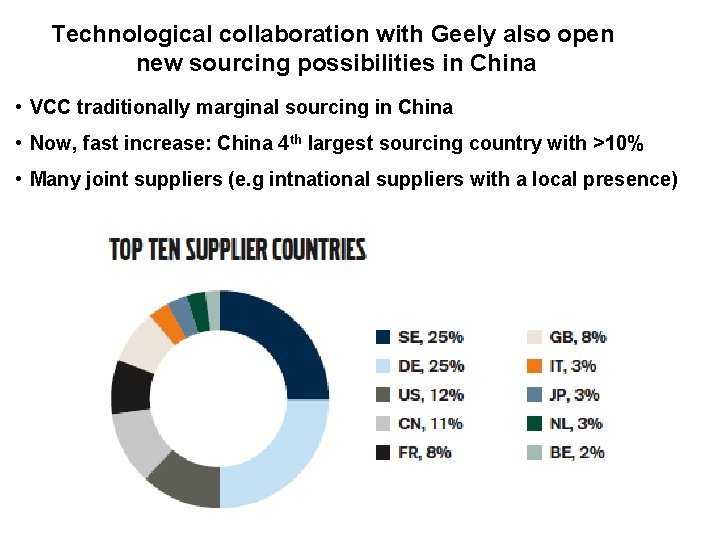
Technological collaboration with Geely also open new sourcing possibilities in China • VCC traditionally marginal sourcing in China • Now, fast increase: China 4 th largest sourcing country with >10% • Many joint suppliers (e. g intnational suppliers with a local presence)
Thus, collaboration Geely-Volvo make possible ”independence”, instead of compromising in external partnership • ”More independence than when Volvo shared platforms with Ford” • The majority owner and Chairman of the Board, mr Li Shufu very seldom attend the Board meetings • Instead these are chaired by mr Hans Olof Olsson, former CEO of VCC and former Senior Vice President of Ford Motor Co. • The Chinese minority owners are not represented in the VCC board • The current CEO of VCC is mr Håkan Samuelsson, former CEO of MAN Trucks • Mr Freeman Shen, originally from Geely, and first CEO of VCC China (sole Chinese in top management), replaced by mr Lars Danielsson, (VCC-oldtimer) • CEV is also mainly managed by a Volvo team “As long as we are inside the strategy, we have full freedom…. there is no interference at the operational level. ” (CEO VCC, H. Samuelsson)
In adition, the important political context: • Generally, foreign/domestic auto JVs in China’s become more difficult to manage, with fights over profits and technology • Also, the Chinese Govm’t increasingly support domestic firms
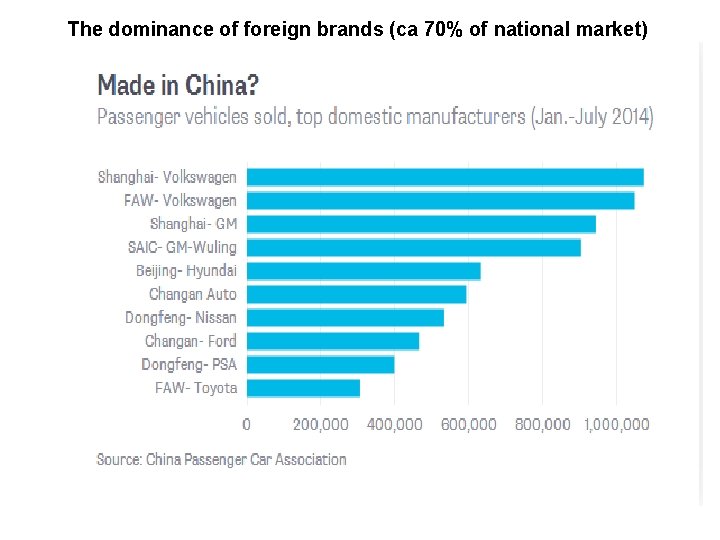
The dominance of foreign brands (ca 70% of national market)
Geely (and Volvo) supported by the Chinese gouvernment: A role model for private independent Chinese car manufacturers ? • Strong local govm’t investors in Geely (Jiading, Daqing) • National subsidies (e. g in 2012, $140 m, or half of Geelys net profit) • Favourable loans: in 2012 China Development Bank signed a loan to finance Geely’s business plan with the company itself as security • Chinese brands prioritized as govm’t limousines (incl Volvo, Hongqi) • ”Anti-monopoly” policy (e. g. spare-parts, dealers) affect foreign/JV firms • Consolidation (100+ firms) by squeezing large foreign/small local firms • Geely selected as one of ca 10 prioritized manufacturers to remain • Geely first Chinese brand to be official car supplier for APEC (2014)
Summary discussion So: Yes, so far Geely + Volvo seem to be a good global fit: “Volvo needed a lot of investment to develop new technology, while Geely have money but no strong development team. It was a win-win situation. ”
But, success not guaranteed: • Other acquisitions, e. g state-owned SAIC’s deal with Korean Ssangyong and MG Rover, failed to bring synergies • Can the ”Volvo is Volvo, Geley is Geely” strategy be kept if/when Geely also want to use VCCs premium brand technology? • VCCs future very dependent on sales in China (shared models? ) and the US/Europe (exclusive Volvo models? ) • Can VCC compete with German cars in China? • How will the global market react to the fact that VCC is part of Geely and that Volvo cars partly are made in China?
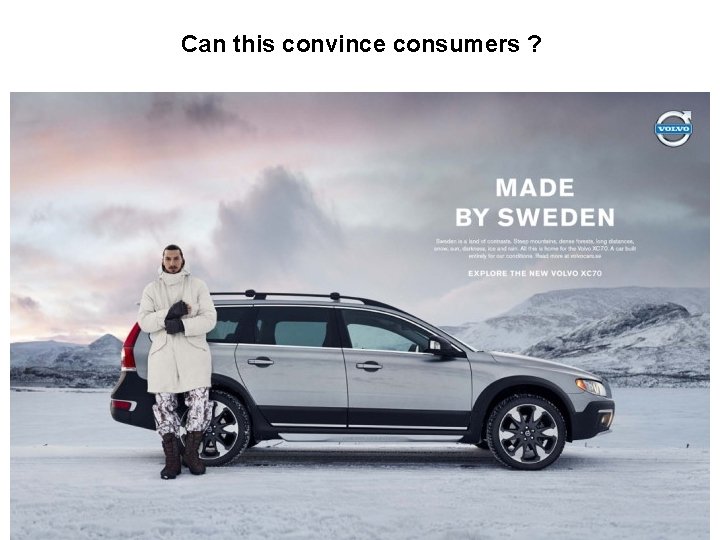
Can this convince consumers ?
• How much will the minority-owners influence the business (e. g LCR)? • Is Geely a “hybride” emerging market MNE: a mix of private-public Chinese interests with a thin balance in favor of private ownership? Alvstam, C. G. , and Ivarsson, I. (2014) "The ‘Hybrid’ Emerging Market Multinational Enterprise – The Ownership Transfer of Volvo Cars to China”. In: (Eds. ) Alvstam, C. G. , Dolles, H. and Strom, P. Asian Inward and Outward FDI New Challenges in the Global Economy. Palgrave
- Slides: 38