
GEE 21 TUTORIAL Free Enterprise Concept 1 Scarcity

- Slides: 31
GEE 21 TUTORIAL Free Enterprise
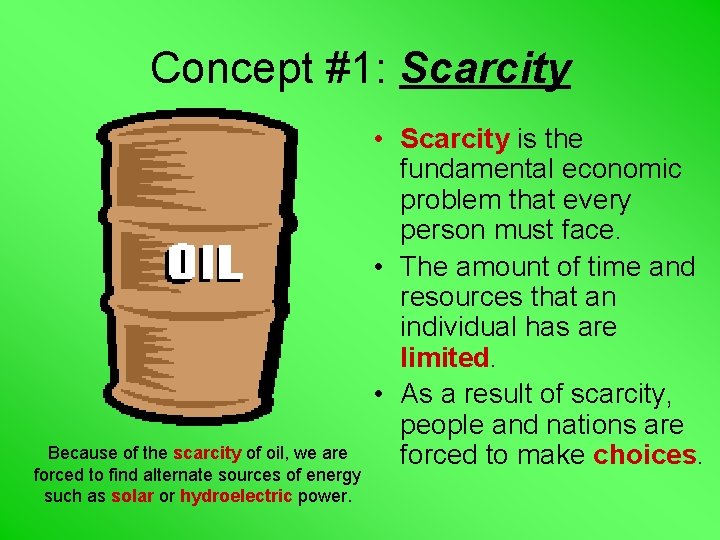
Concept #1: Scarcity Because of the scarcity of oil, we are forced to find alternate sources of energy such as solar or hydroelectric power. • Scarcity is the fundamental economic problem that every person must face. • The amount of time and resources that an individual has are limited. • As a result of scarcity, people and nations are forced to make choices.
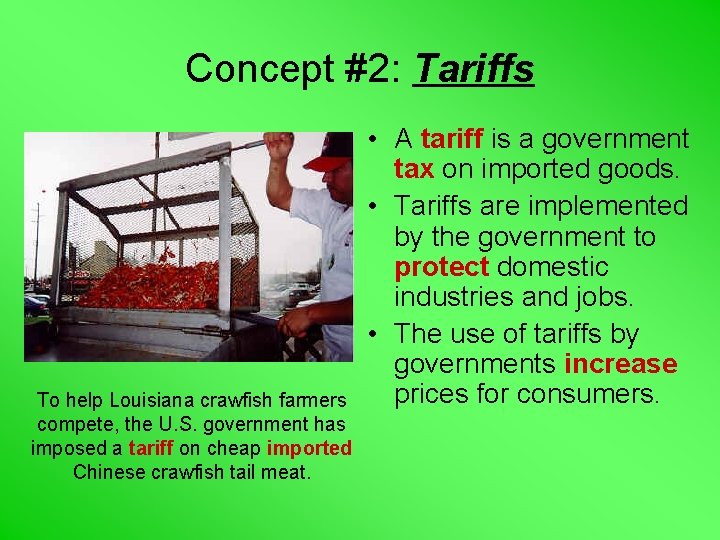
Concept #2: Tariffs To help Louisiana crawfish farmers compete, the U. S. government has imposed a tariff on cheap imported Chinese crawfish tail meat. • A tariff is a government tax on imported goods. • Tariffs are implemented by the government to protect domestic industries and jobs. • The use of tariffs by governments increase prices for consumers.
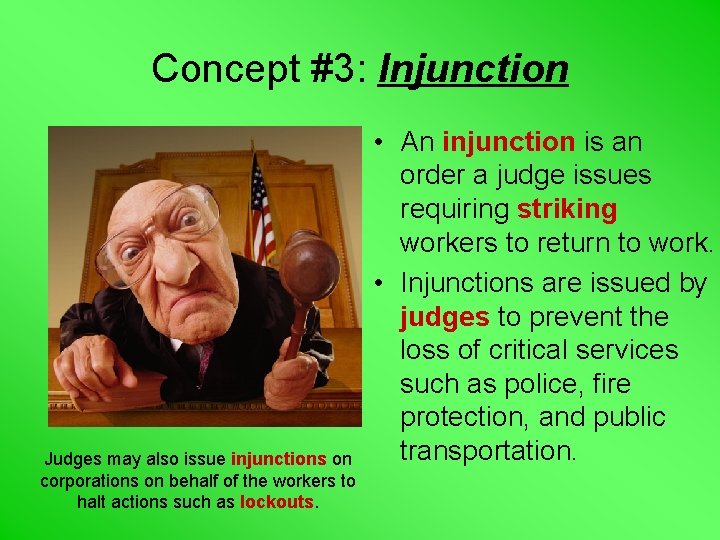
Concept #3: Injunction Judges may also issue injunctions on corporations on behalf of the workers to halt actions such as lockouts. • An injunction is an order a judge issues requiring striking workers to return to work. • Injunctions are issued by judges to prevent the loss of critical services such as police, fire protection, and public transportation.
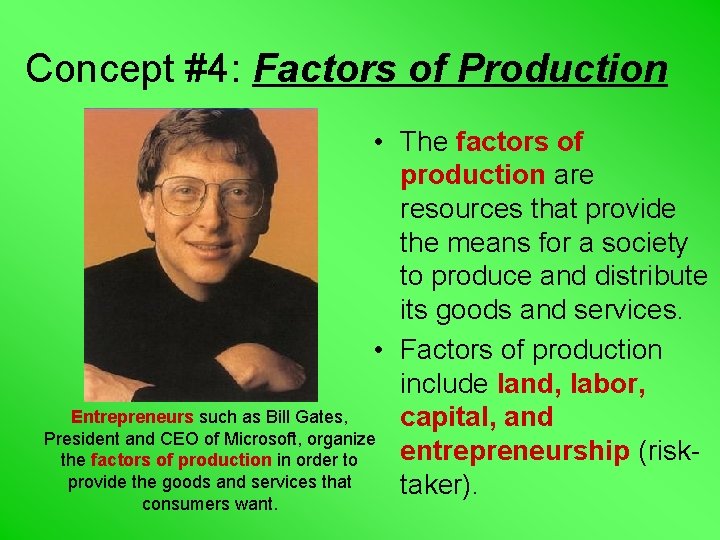
Concept #4: Factors of Production • The factors of production are resources that provide the means for a society to produce and distribute its goods and services. • Factors of production include land, labor, Entrepreneurs such as Bill Gates, capital, and President and CEO of Microsoft, organize entrepreneurship (riskthe factors of production in order to provide the goods and services that taker). consumers want.
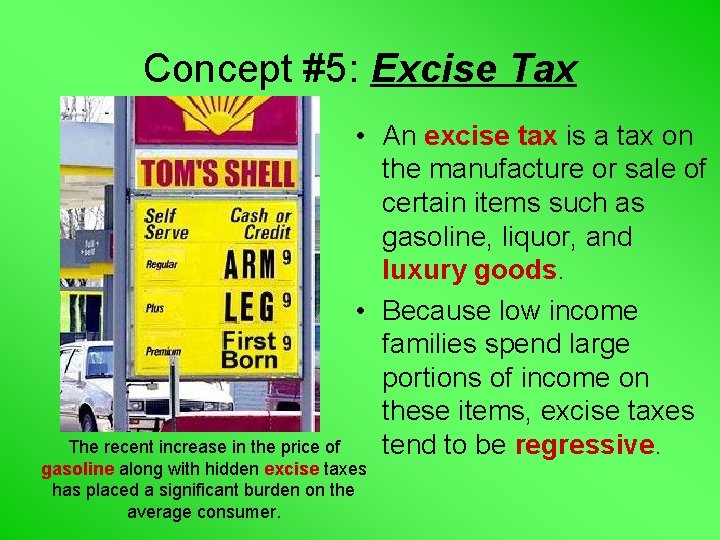
Concept #5: Excise Tax • An excise tax is a tax on the manufacture or sale of certain items such as gasoline, liquor, and luxury goods. • Because low income families spend large portions of income on these items, excise taxes tend to be regressive. The recent increase in the price of gasoline along with hidden excise taxes has placed a significant burden on the average consumer.
Concept #6: FICA • The Federal Income Contributions Act is the second most important federal tax. • It is a tax levied on both employers and employees for Social Security and Medicare, a federal health care program funded by FICA, is available to all senior citizens regardless of income.
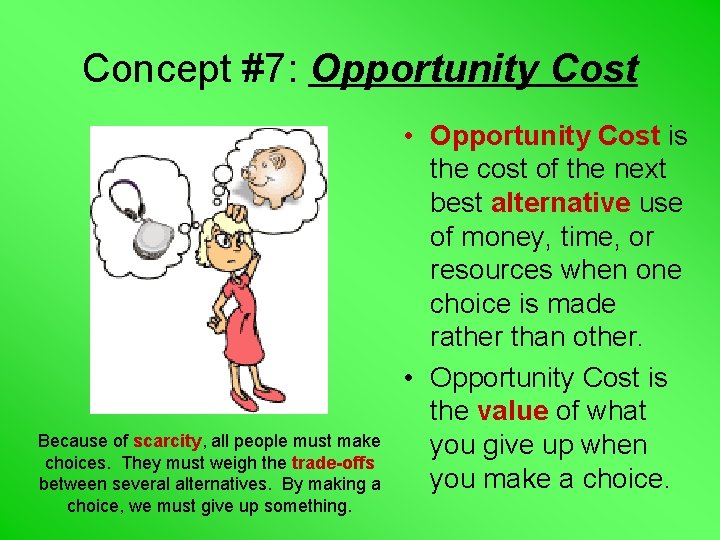
Concept #7: Opportunity Cost Because of scarcity, all people must make choices. They must weigh the trade-offs between several alternatives. By making a choice, we must give up something. • Opportunity Cost is the cost of the next best alternative use of money, time, or resources when one choice is made rather than other. • Opportunity Cost is the value of what you give up when you make a choice.
Concept #8: Labor Union The AFL-CIO, founded by Samuel Gompers, is one of the most influential labor unions in the U. S. • In order to gain bargaining power, workers in a business or industry organize into labor unions. • Labor unions are organizations that serve to protect the rights of workers in business.
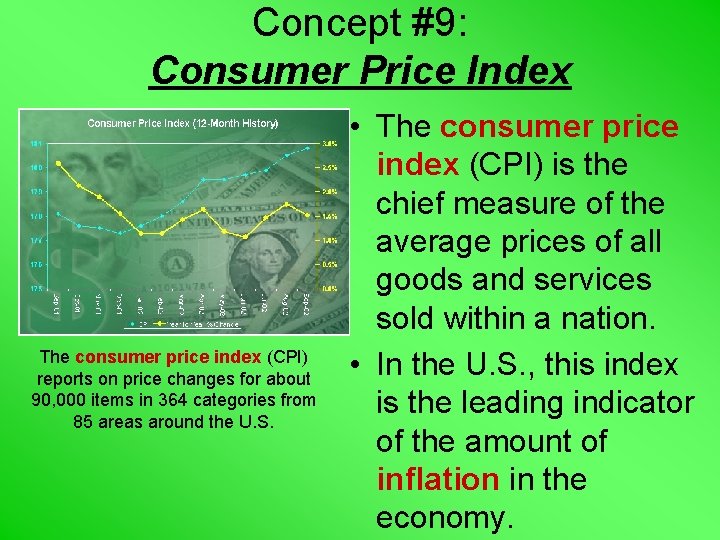
Concept #9: Consumer Price Index The consumer price index (CPI) reports on price changes for about 90, 000 items in 364 categories from 85 areas around the U. S. • The consumer price index (CPI) is the chief measure of the average prices of all goods and services sold within a nation. • In the U. S. , this index is the leading indicator of the amount of inflation in the economy.
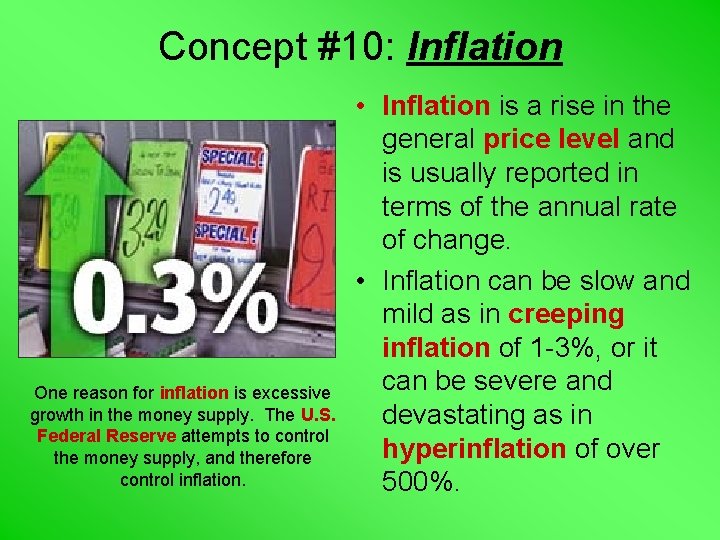
Concept #10: Inflation One reason for inflation is excessive growth in the money supply. The U. S. Federal Reserve attempts to control the money supply, and therefore control inflation. • Inflation is a rise in the general price level and is usually reported in terms of the annual rate of change. • Inflation can be slow and mild as in creeping inflation of 1 -3%, or it can be severe and devastating as in hyperinflation of over 500%.
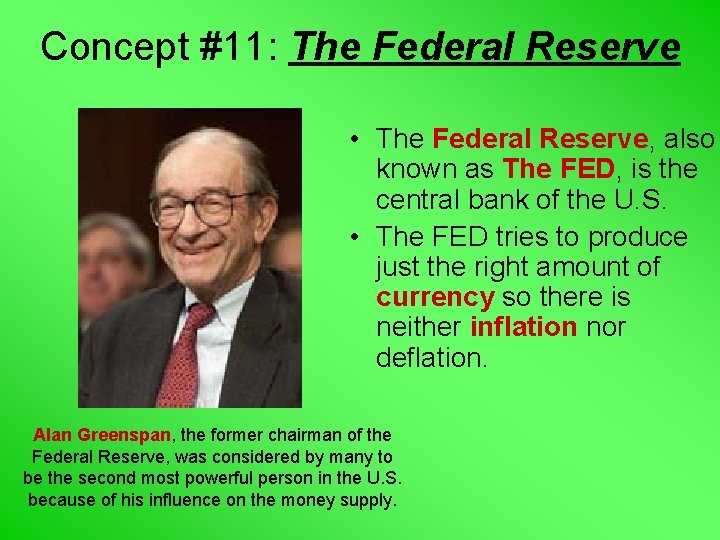
Concept #11: The Federal Reserve • The Federal Reserve, also known as The FED, is the central bank of the U. S. • The FED tries to produce just the right amount of currency so there is neither inflation nor deflation. Alan Greenspan, the former chairman of the Federal Reserve, was considered by many to be the second most powerful person in the U. S. because of his influence on the money supply.
Concept #12: Interest Rates • Interest is the percent of money made to a lender for being able to use the money at an earlier time. • Banks charge interest on loans in order to make a profit. • The FED controls interest rates by raising or lowering the rate it charges to its As interest rates lower, people are member banks known as motivated to borrow more money. If interest rates increase, people will the discount rate. not seek to borrow money from banks.
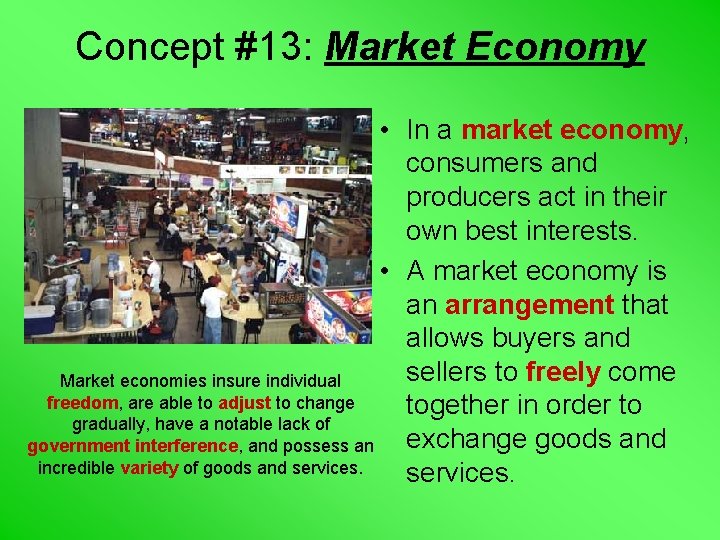
Concept #13: Market Economy • In a market economy, consumers and producers act in their own best interests. • A market economy is an arrangement that allows buyers and sellers to freely come Market economies insure individual freedom, are able to adjust to change together in order to gradually, have a notable lack of exchange goods and government interference, and possess an incredible variety of goods and services.
Concept #14: Capitalism • Capitalism is an economic system in which the means of production are privately owned. • Within capitalism, supply and demand determines prices, and businesses are free to engage in Under a capitalist system, government activities that promise the is only needed to protect rights of private property, guarantee contracts, greatest profit. and provide military protection for the nation.
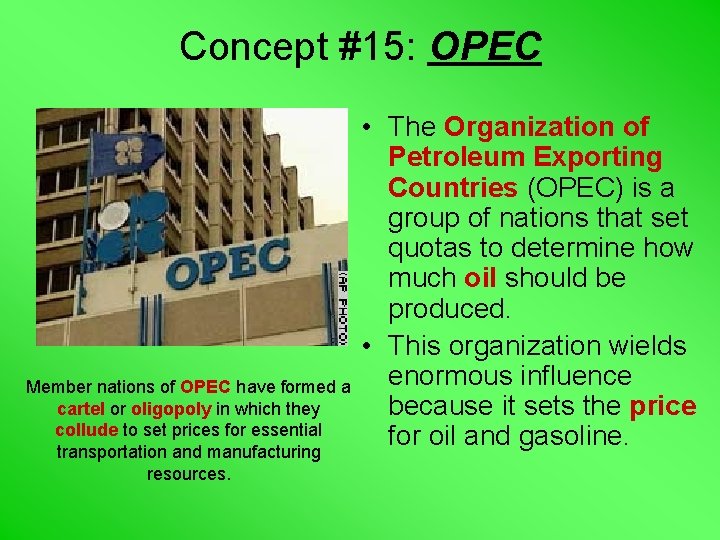
Concept #15: OPEC Member nations of OPEC have formed a cartel or oligopoly in which they collude to set prices for essential transportation and manufacturing resources. • The Organization of Petroleum Exporting Countries (OPEC) is a group of nations that set quotas to determine how much oil should be produced. • This organization wields enormous influence because it sets the price for oil and gasoline.
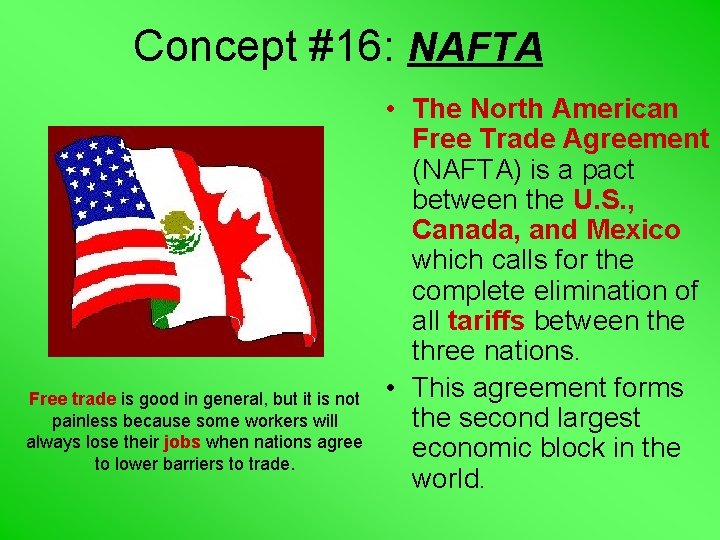
Concept #16: NAFTA Free trade is good in general, but it is not painless because some workers will always lose their jobs when nations agree to lower barriers to trade. • The North American Free Trade Agreement (NAFTA) is a pact between the U. S. , Canada, and Mexico which calls for the complete elimination of all tariffs between the three nations. • This agreement forms the second largest economic block in the world.
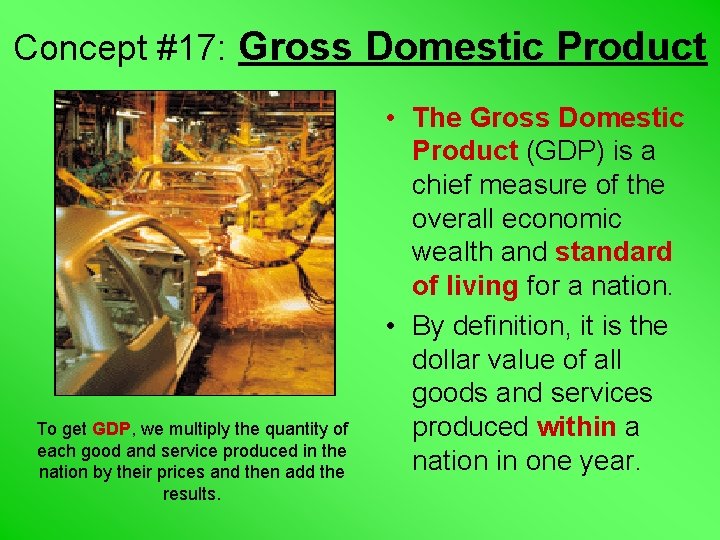
Concept #17: Gross Domestic Product To get GDP, we multiply the quantity of each good and service produced in the nation by their prices and then add the results. • The Gross Domestic Product (GDP) is a chief measure of the overall economic wealth and standard of living for a nation. • By definition, it is the dollar value of all goods and services produced within a nation in one year.
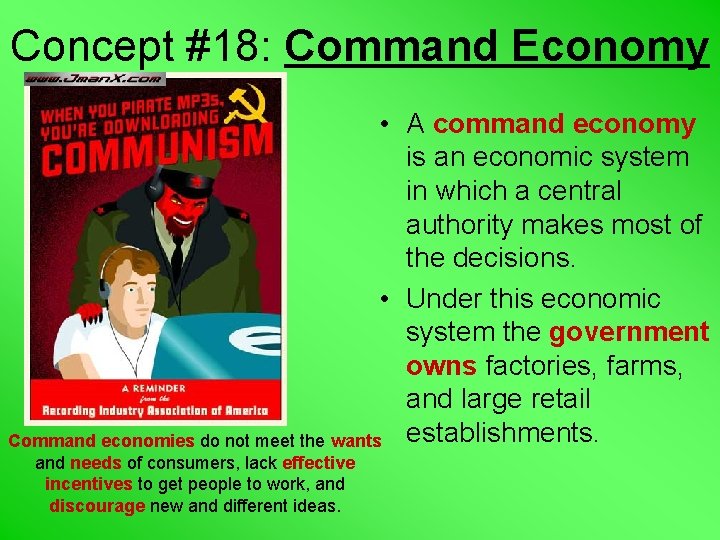
Concept #18: Command Economy • A command economy is an economic system in which a central authority makes most of the decisions. • Under this economic system the government owns factories, farms, and large retail Command economies do not meet the wants establishments. and needs of consumers, lack effective incentives to get people to work, and discourage new and different ideas.
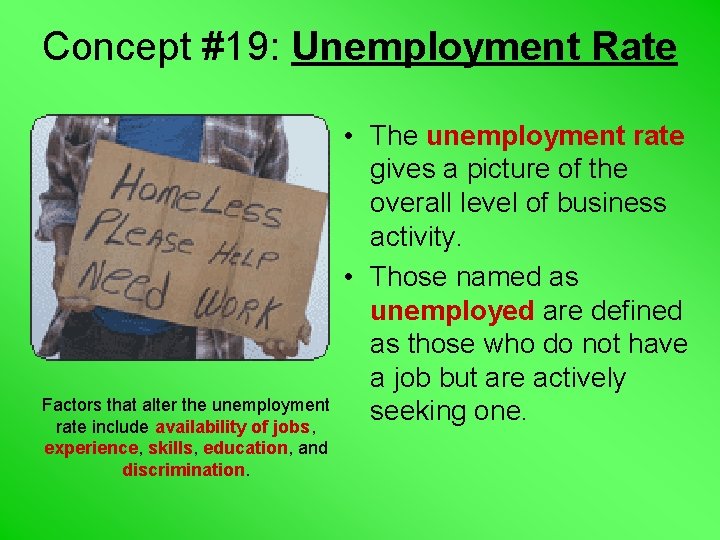
Concept #19: Unemployment Rate Factors that alter the unemployment rate include availability of jobs, experience, skills, education, and discrimination. • The unemployment rate gives a picture of the overall level of business activity. • Those named as unemployed are defined as those who do not have a job but are actively seeking one.
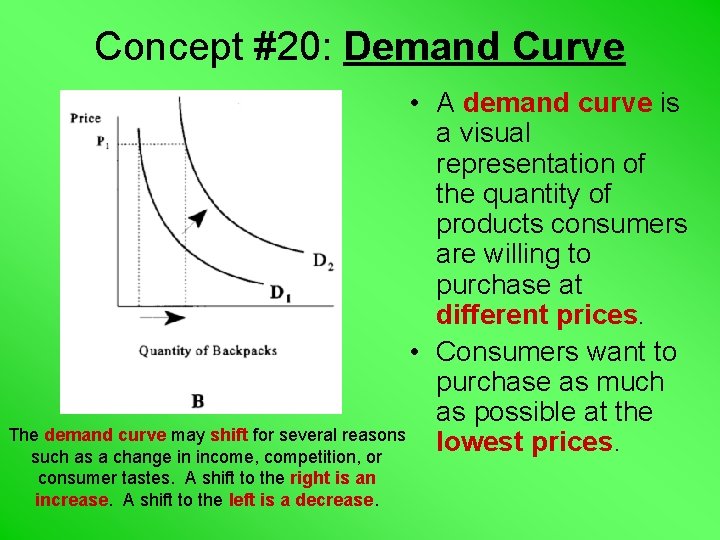
Concept #20: Demand Curve • A demand curve is a visual representation of the quantity of products consumers are willing to purchase at different prices. • Consumers want to purchase as much as possible at the The demand curve may shift for several reasons lowest prices. such as a change in income, competition, or consumer tastes. A shift to the right is an increase. A shift to the left is a decrease.
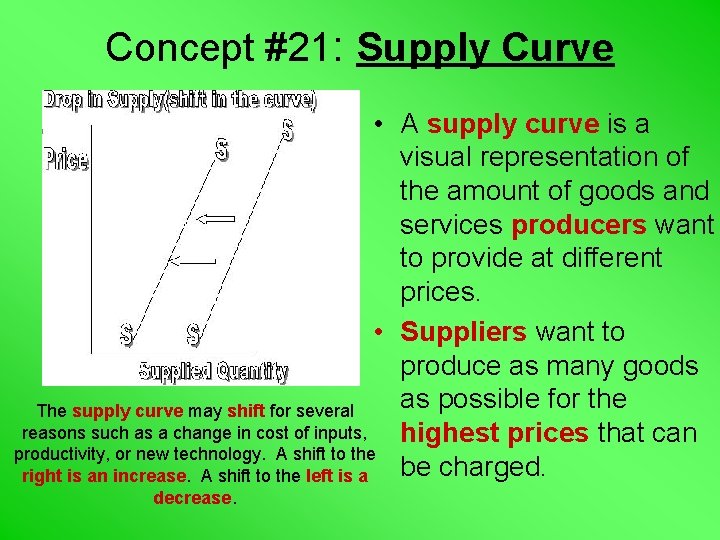
Concept #21: Supply Curve • A supply curve is a visual representation of the amount of goods and services producers want to provide at different prices. • Suppliers want to produce as many goods as possible for the The supply curve may shift for several reasons such as a change in cost of inputs, highest prices that can productivity, or new technology. A shift to the be charged. right is an increase. A shift to the left is a decrease.
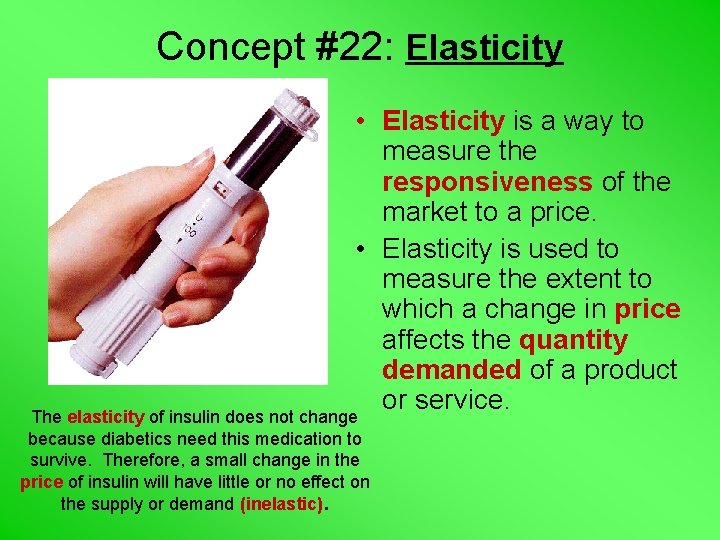
Concept #22: Elasticity • Elasticity is a way to measure the responsiveness of the market to a price. • Elasticity is used to measure the extent to which a change in price affects the quantity demanded of a product or service. The elasticity of insulin does not change because diabetics need this medication to survive. Therefore, a small change in the price of insulin will have little or no effect on the supply or demand (inelastic).
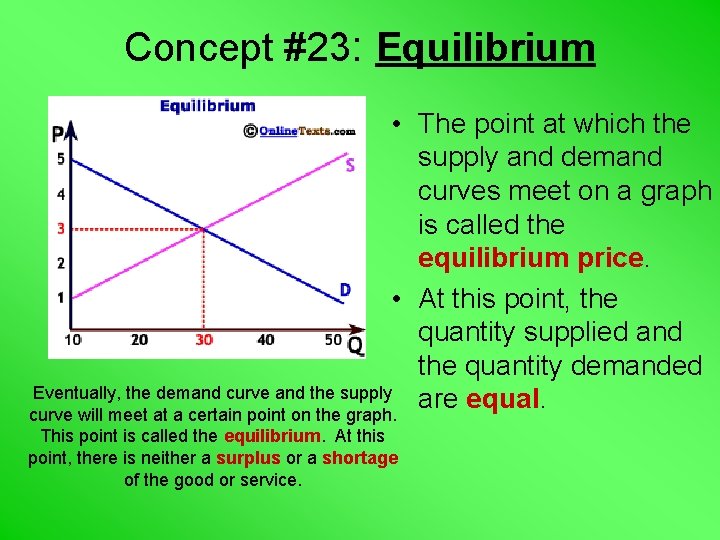
Concept #23: Equilibrium • The point at which the supply and demand curves meet on a graph is called the equilibrium price. • At this point, the quantity supplied and the quantity demanded Eventually, the demand curve and the supply are equal. curve will meet at a certain point on the graph. This point is called the equilibrium. At this point, there is neither a surplus or a shortage of the good or service.
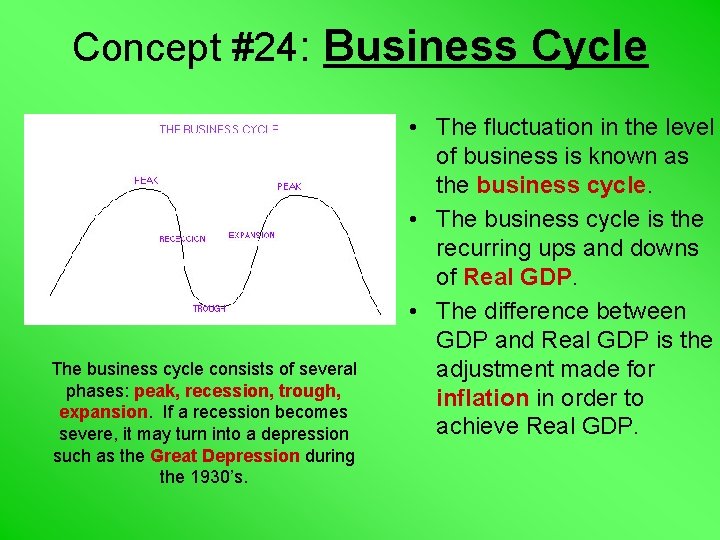
Concept #24: Business Cycle The business cycle consists of several phases: peak, recession, trough, expansion. If a recession becomes severe, it may turn into a depression such as the Great Depression during the 1930’s. • The fluctuation in the level of business is known as the business cycle. • The business cycle is the recurring ups and downs of Real GDP. • The difference between GDP and Real GDP is the adjustment made for inflation in order to achieve Real GDP.
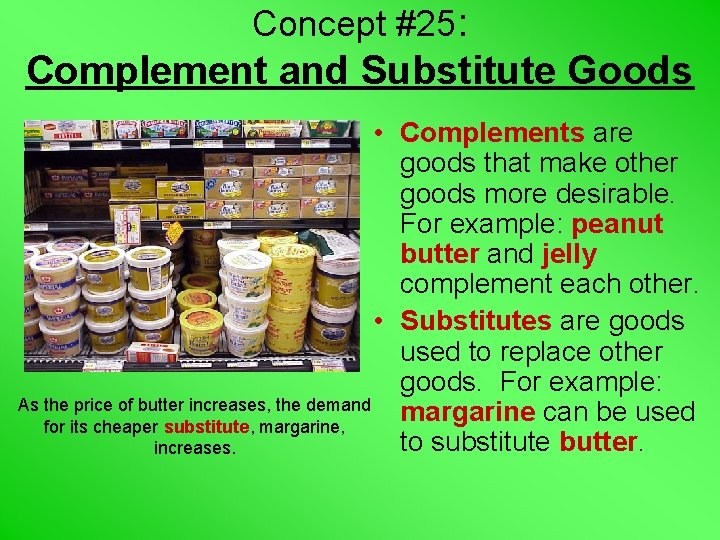
Concept #25: Complement and Substitute Goods • Complements are goods that make other goods more desirable. For example: peanut butter and jelly complement each other. • Substitutes are goods used to replace other goods. For example: As the price of butter increases, the demand margarine can be used for its cheaper substitute, margarine, to substitute butter. increases.
Concept #26: Business Organizations • Business organizations are categorized into three forms: sole proprietorships, partnerships, and corporations. • Sole proprietorships make up the most common form of business organization, but corporations are the Sole proprietors and partners receive all profits from a business, but they bear largest and most profitable. full responsibility (liability) for losses. Owners of corporations enjoy the benefit of limited liability.
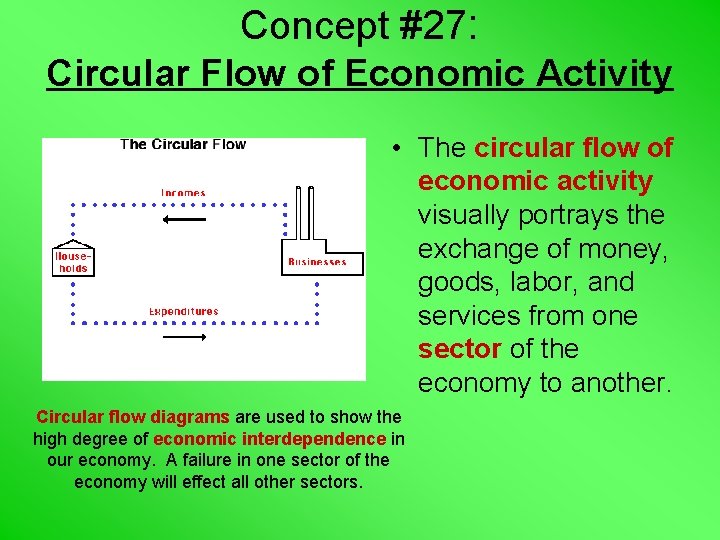
Concept #27: Circular Flow of Economic Activity • The circular flow of economic activity visually portrays the exchange of money, goods, labor, and services from one sector of the economy to another. Circular flow diagrams are used to show the high degree of economic interdependence in our economy. A failure in one sector of the economy will effect all other sectors.
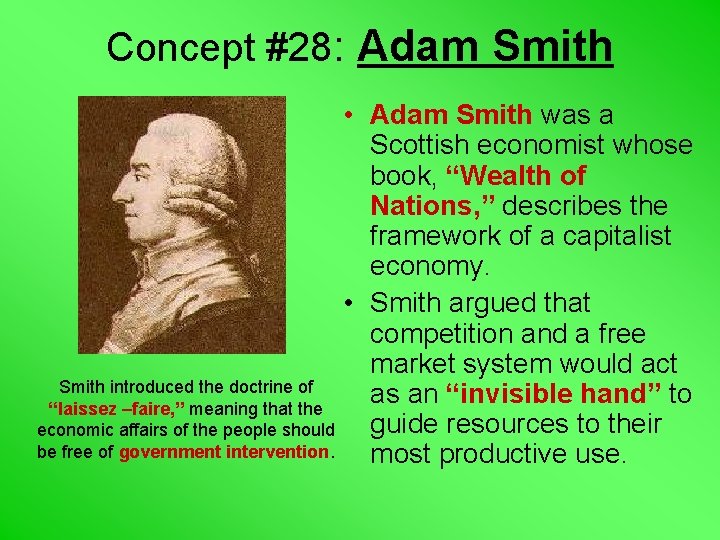
Concept #28: Adam Smith • Adam Smith was a Scottish economist whose book, “Wealth of Nations, ” describes the framework of a capitalist economy. • Smith argued that competition and a free market system would act Smith introduced the doctrine of as an “invisible hand” to “laissez –faire, ” meaning that the guide resources to their economic affairs of the people should be free of government intervention. most productive use.
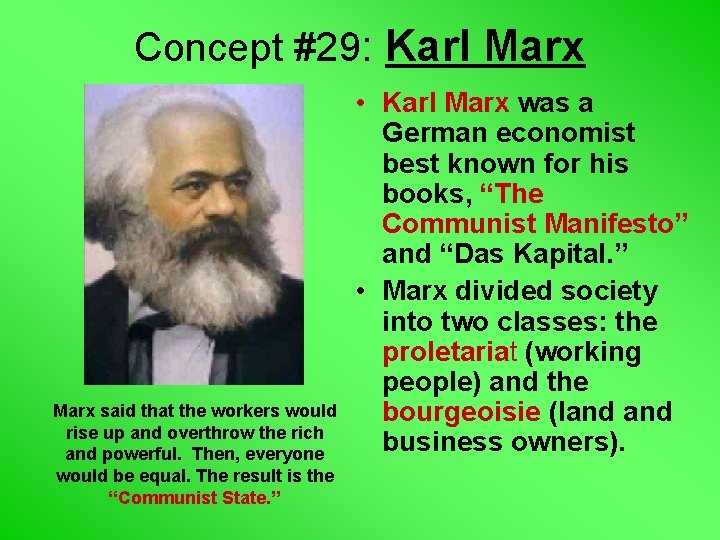
Concept #29: Karl Marx said that the workers would rise up and overthrow the rich and powerful. Then, everyone would be equal. The result is the “Communist State. ” • Karl Marx was a German economist best known for his books, “The Communist Manifesto” and “Das Kapital. ” • Marx divided society into two classes: the proletariat (working people) and the bourgeoisie (land business owners).
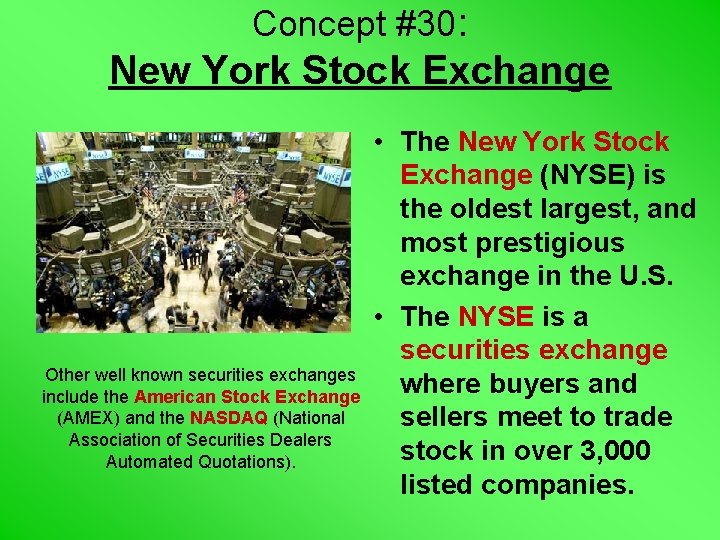
Concept #30: New York Stock Exchange Other well known securities exchanges include the American Stock Exchange (AMEX) and the NASDAQ (National Association of Securities Dealers Automated Quotations). • The New York Stock Exchange (NYSE) is the oldest largest, and most prestigious exchange in the U. S. • The NYSE is a securities exchange where buyers and sellers meet to trade stock in over 3, 000 listed companies.