
GEBCO GENERAL BATHYMETRIC CHART OF THE OCEANS Annual
GEBCO GENERAL BATHYMETRIC CHART OF THE OCEANS Annual report to IRCC-9 Shin Tani (RADM. ret. ) Chairman Joint IHO-IOC Guiding Committee for GEBCO Paramaribo, Suriname 13 June 2017

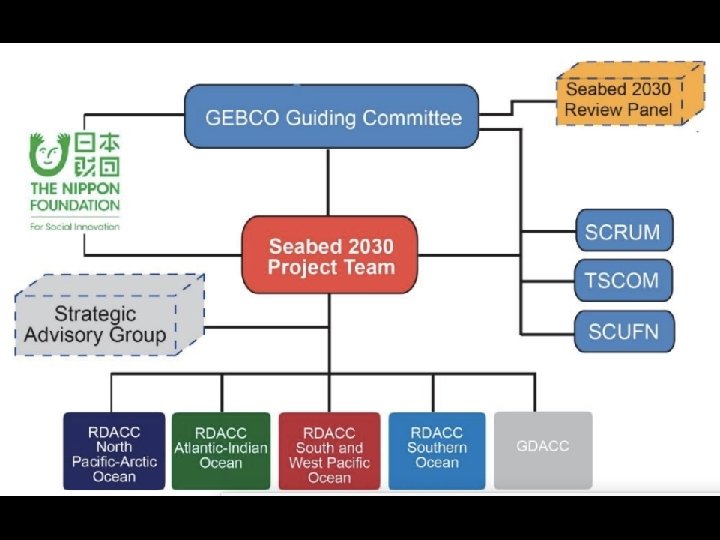
Promoting structure for GEBCO 1903 IHO UNESCO IOC Joint IHO-IOC Guiding Committee for GEBCO (GGC) Sub-Committee for Undersea Feature Names (SCUFN) Technical Sub-Committee on Ocean Mapping (TSCOM) Sub-Committee on Regional Undersea Mapping (SCRUM) IHO Data Centre for Digital Bathymetry (IHO DCDB)
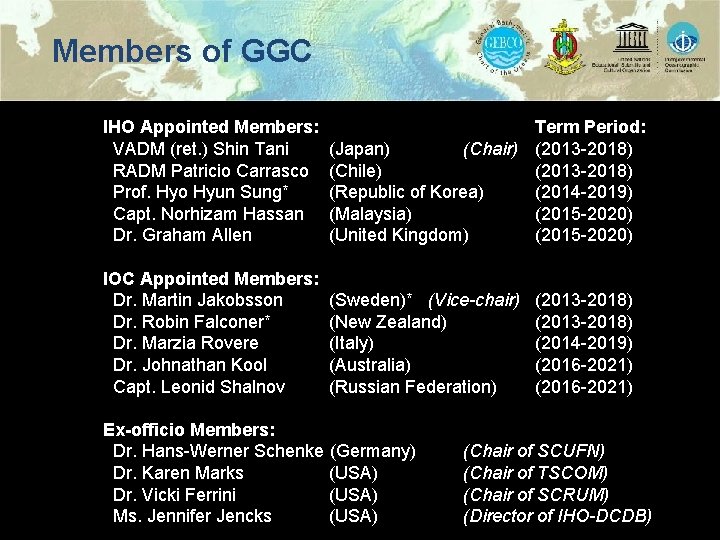
Members of GGC IHO Appointed Members: VADM (ret. ) Shin Tani RADM Patricio Carrasco Prof. Hyo Hyun Sung* Capt. Norhizam Hassan Dr. Graham Allen Term Period: (Japan) (Chair) (2013 -2018) (Chile) (2013 -2018) (Republic of Korea) (2014 -2019) (Malaysia) (2015 -2020) (United Kingdom) (2015 -2020) IOC Appointed Members: Dr. Martin Jakobsson Dr. Robin Falconer* Dr. Marzia Rovere Dr. Johnathan Kool Capt. Leonid Shalnov (Sweden)* (Vice-chair) (New Zealand) (Italy) (Australia) (Russian Federation) Ex-officio Members: Dr. Hans-Werner Schenke (Germany) Dr. Karen Marks (USA) Dr. Vicki Ferrini (USA) Ms. Jennifer Jencks (USA) (2013 -2018) (2014 -2019) (2016 -2021) (Chair of SCUFN) (Chair of TSCOM) (Chair of SCRUM) (Director of IHO-DCDB)
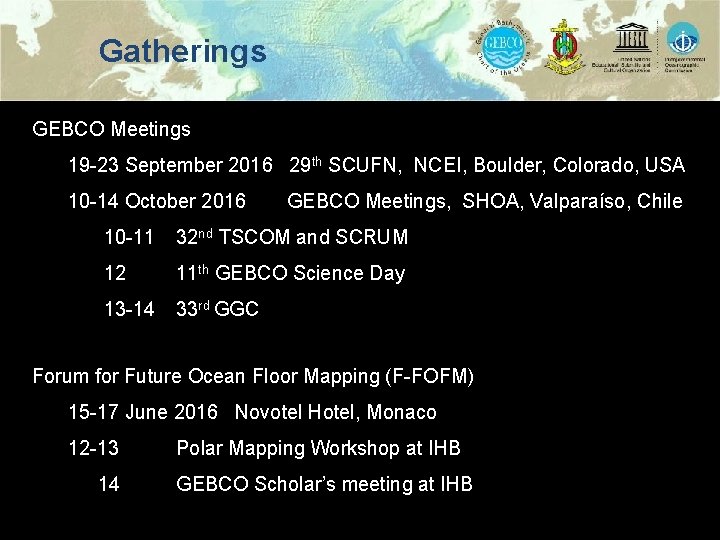
Gatherings GEBCO Meetings 19 -23 September 2016 29 th SCUFN, NCEI, Boulder, Colorado, USA 10 -14 October 2016 GEBCO Meetings, SHOA, Valparaíso, Chile 10 -11 32 nd TSCOM and SCRUM 12 11 th GEBCO Science Day 13 -14 33 rd GGC Forum for Future Ocean Floor Mapping (F-FOFM) 15 -17 June 2016 Novotel Hotel, Monaco 12 -13 14 Polar Mapping Workshop at IHB GEBCO Scholar’s meeting at IHB



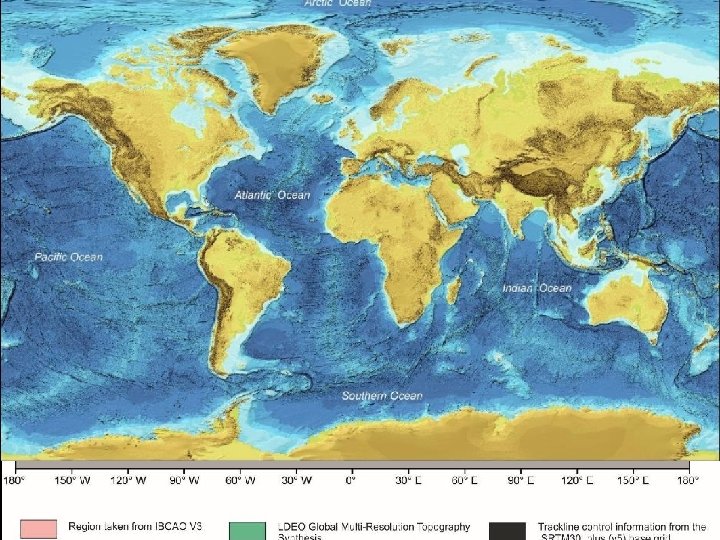
Outcome To. R of GGC says: • Aims to provide the most authoritative, publicly-available bathymetric datasets for the world’s oceans • GEBCO 2014 (30 arc-second bathymetric grid) • GEBCO World Map 2014 • Maintains and makes available a gazetteer of undersea feature names • GEBCO Gazetteer of Undersea Feature Names


50 km

ENC bathymetric sounding data coverage – provided by IHO Member States ENC coverage supplied in 2016 shown in red

Regional mapping work: improving GEBCO’s global grid Existing GEBCO Source tracklines ENC sounding coverage
SCUFN • Over 3000 UFN were reviewed and edited by an external contractor, as an ongoing maintenance requirement. • Top priority includes production of an S-100 Product Specification for UFN data. • Naming of features which falls within 200 NM limit has to be taken care of by GGC.
Interaction with RHCs • More than 20 observers joined the GGC meeting. • GGC secured that all the RHCs would be participated by GEBCO people.
B-7 GEBCO Guideline • Traditionally GEBCO has focused on areas deeper than 200 m (written in B-7) • It is now actively collecting data in shallower water areas to support coastal activities such as coastal zone management and the mitigation of seaborne disasters such as storm surges and tsunami inundation. • B-7 (GEBCO Guideline) is now covered by the current To. R and B-11 (GEBCO Cook Book). • B-7 is outdated and has to be withdrawned.
IOC • IOC’s attitude to GEBCO has been dramatically changed. • IOC reviewed and the subsequent discussions and decisions made at the 49 meeting of the IOC Executive Council. IOC’s working group will collect, integrate and assess the user requirements to GEBCO products. th
Seabed 2030 • Ultimate objective Leave no features of the world ocean floor larger than 100 metres unmapped • Three pillars 1. Compile unreleased data 2. Create maps and make them available to public 3. Identify and fill in gaps, dev of new tech.
NF-GEBCO CB • Almost all the 72 graduates engage in the bathymetry related jobs.
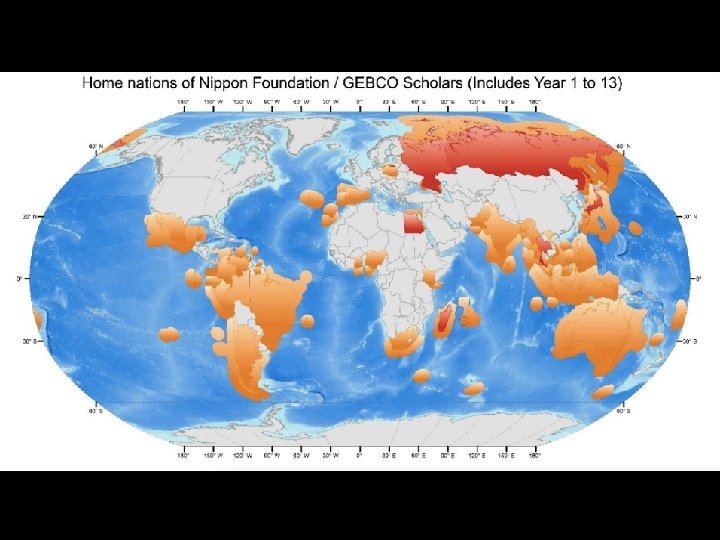
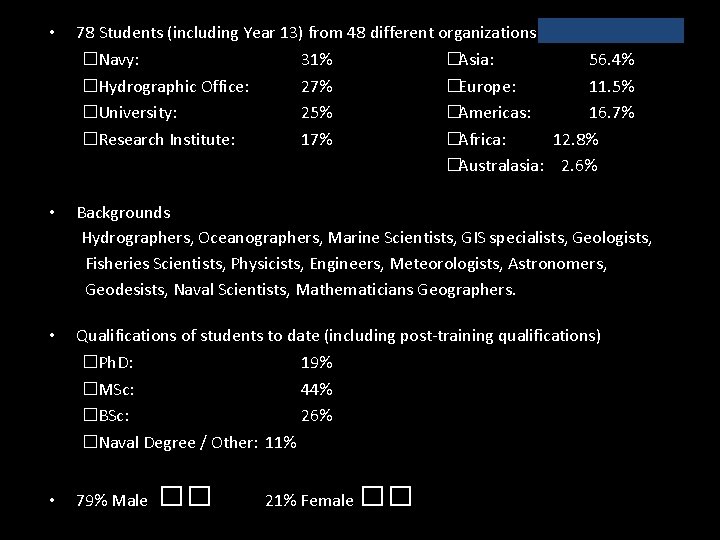
• 78 Students (including Year 13) from 48 different organizations of 35 countries. �Navy: 31% �Asia: 56. 4% �Hydrographic Office: 27% �Europe: 11. 5% �University: 25% �Americas: 16. 7% �Research Institute: 17% �Africa: 12. 8% �Australasia: 2. 6% • Backgrounds Hydrographers, Oceanographers, Marine Scientists, GIS specialists, Geologists, Fisheries Scientists, Physicists, Engineers, Meteorologists, Astronomers, Geodesists, Naval Scientists, Mathematicians Geographers. • Qualifications of students to date (including post-training qualifications) �Ph. D: 19% �MSc: 44% �BSc: 26% �Naval Degree / Other: 11% • 79% Male �� 21% Female ��
IRCC is invited to • Note the contents of the report; • Approve the withdrawal of IHO Publication B-7 – GEBCO Guidelines; • Encourage RHCs to organize contribution of bathymetric data in shallower coastal areas from their member states to GEBCO in order to support the production of higher resolution gridded data products of GEBCO; • Encourage RHCs to invite and communicate with GEBCO members to their meetings as appropriate;
IRCC is invited to • Take any actions deemed necessary, such as; – Encourage Member States to participate in and contribute to GEBCO project. – Continue supporting GEBCO’s regional projects. – Pay attention to and support Seabed 2030, which is a new direction of GEBCO based on F-FOFM
Thank you for your kind attention
- Slides: 27