
Gear Ratios Calculations The most used drive system
- Slides: 7
Gear Ratios Calculations
The most used drive system on a FIRST robot uses sprockets and chains. It is vital to the success of a robot to properly adjust the size of sprockets in order to obtain the maximum speed and power. Balancing speed versus power can be daunting but with a few basic guidelines it can be made easy. Let‘s examine a couple things to keep in mind while choosing the right gear ratio. . .
Two Broad Types of Sprockets a) Driver Sprockets are directly driven by a motor b) Driven Sprockets mesh with the driven sprocket
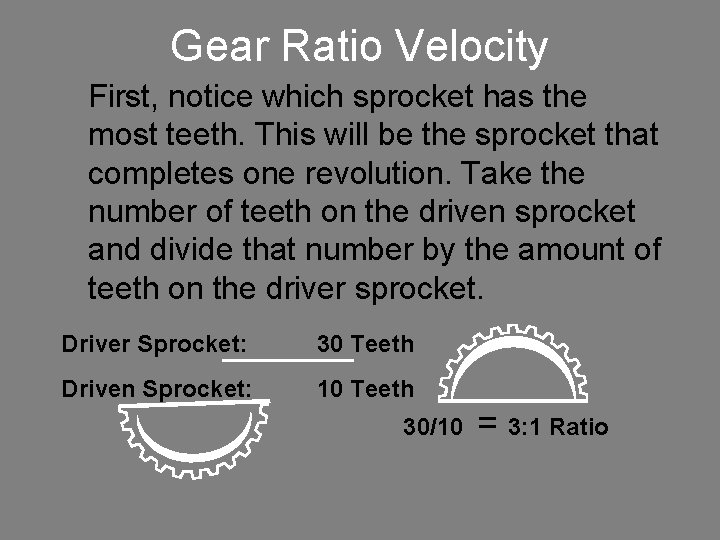
Gear Ratio Velocity First, notice which sprocket has the most teeth. This will be the sprocket that completes one revolution. Take the number of teeth on the driven sprocket and divide that number by the amount of teeth on the driver sprocket. Driver Sprocket: 30 Teeth Driven Sprocket: 10 Teeth 30/10 = 3: 1 Ratio
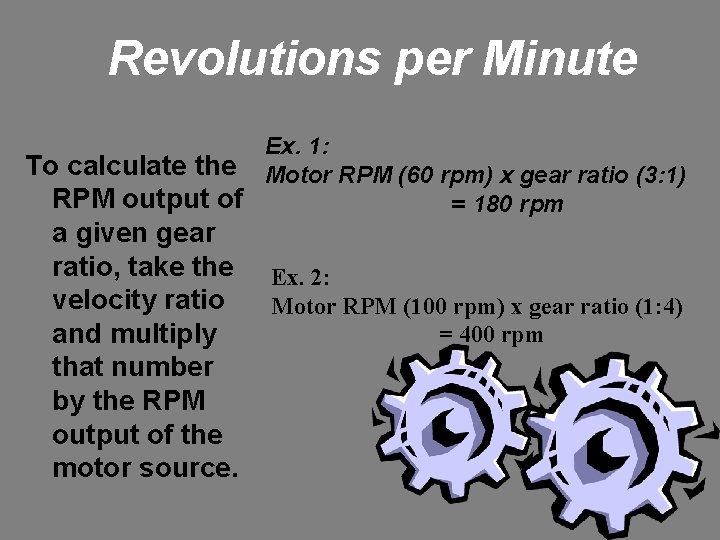
Revolutions per Minute Ex. 1: To calculate the Motor RPM (60 rpm) x gear ratio (3: 1) RPM output of = 180 rpm a given gear ratio, take the velocity ratio and multiply that number by the RPM output of the motor source. Ex. 2: Motor RPM (100 rpm) x gear ratio (1: 4) = 400 rpm
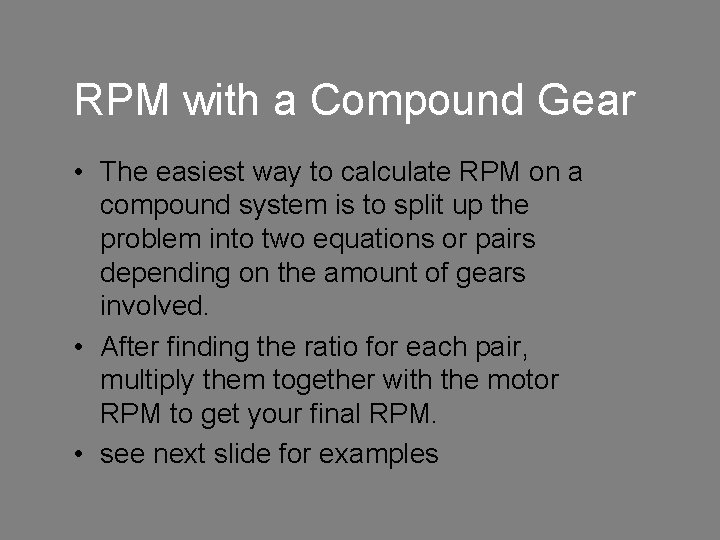
RPM with a Compound Gear • The easiest way to calculate RPM on a compound system is to split up the problem into two equations or pairs depending on the amount of gears involved. • After finding the ratio for each pair, multiply them together with the motor RPM to get your final RPM. • see next slide for examples
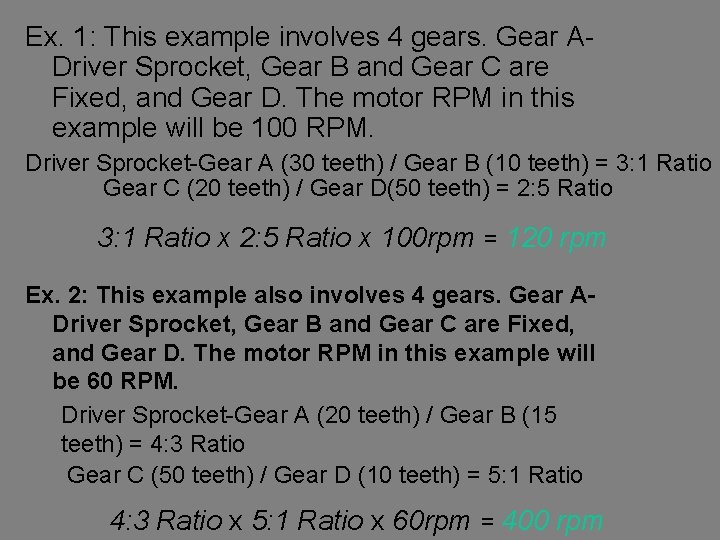
Ex. 1: This example involves 4 gears. Gear ADriver Sprocket, Gear B and Gear C are Fixed, and Gear D. The motor RPM in this example will be 100 RPM. Driver Sprocket-Gear A (30 teeth) / Gear B (10 teeth) = 3: 1 Ratio Gear C (20 teeth) / Gear D(50 teeth) = 2: 5 Ratio 3: 1 Ratio x 2: 5 Ratio x 100 rpm = 120 rpm Ex. 2: This example also involves 4 gears. Gear ADriver Sprocket, Gear B and Gear C are Fixed, and Gear D. The motor RPM in this example will be 60 RPM. Driver Sprocket-Gear A (20 teeth) / Gear B (15 teeth) = 4: 3 Ratio Gear C (50 teeth) / Gear D (10 teeth) = 5: 1 Ratio 4: 3 Ratio x 5: 1 Ratio x 60 rpm = 400 rpm