
Gear Model to support Roadmapping of Value Chain

- Slides: 24
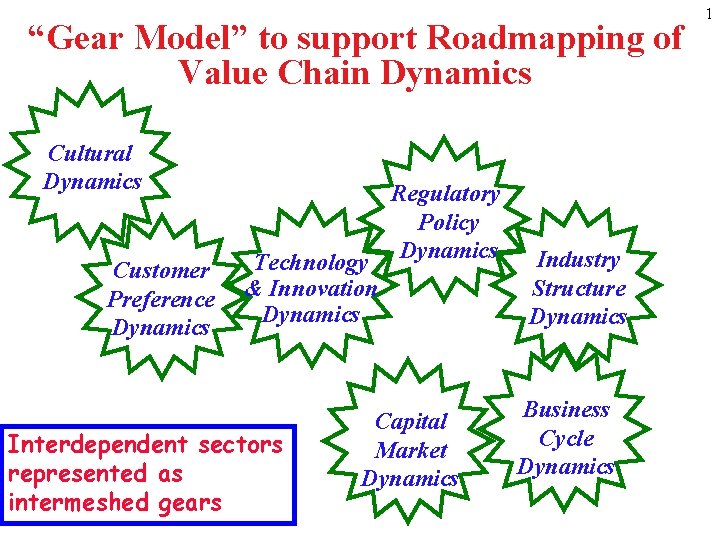
“Gear Model” to support Roadmapping of Value Chain Dynamics Cultural Dynamics Customer Preference Dynamics Technology & Innovation Dynamics Interdependent sectors represented as intermeshed gears Regulatory Policy Dynamics Capital Market Dynamics Industry Structure Dynamics Business Cycle Dynamics 1
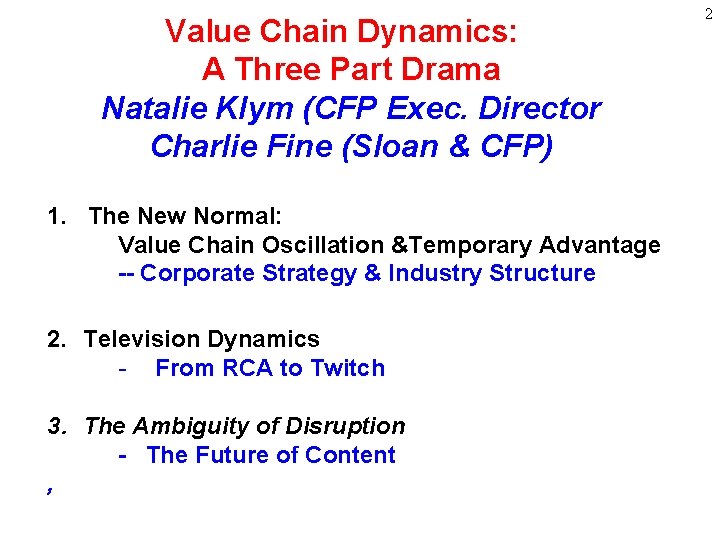
Value Chain Dynamics: A Three Part Drama Natalie Klym (CFP Exec. Director Charlie Fine (Sloan & CFP) 1. The New Normal: Value Chain Oscillation &Temporary Advantage -- Corporate Strategy & Industry Structure 2. Television Dynamics - From RCA to Twitch 3. The Ambiguity of Disruption - The Future of Content , 2
3
4
5
6
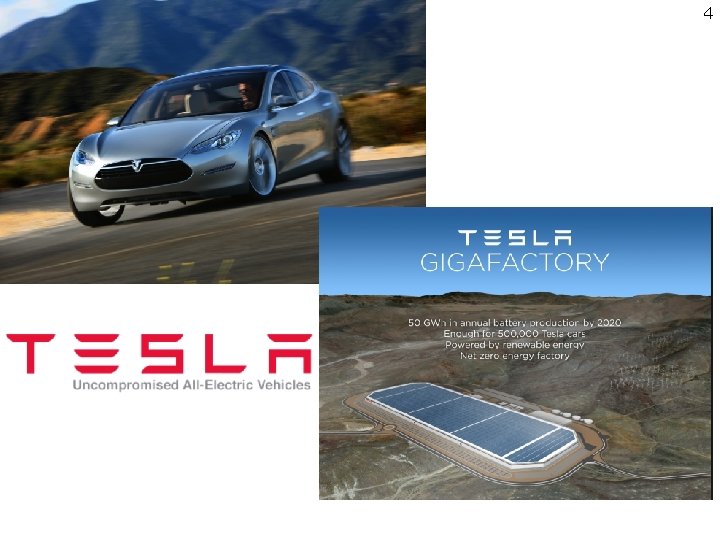
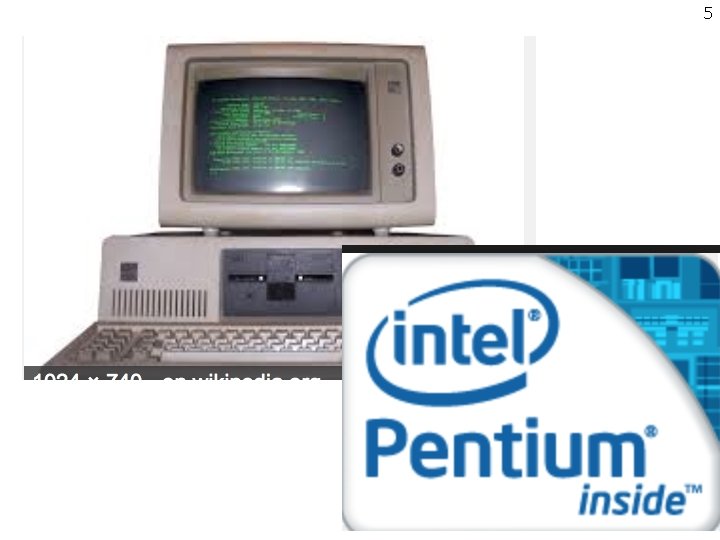
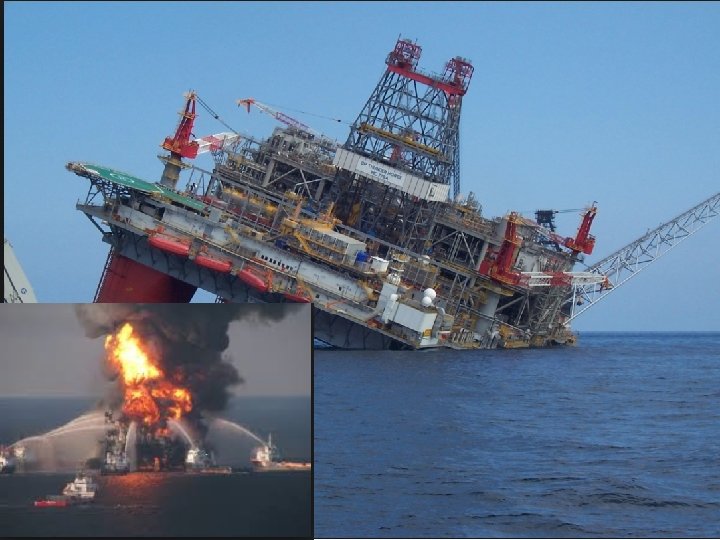
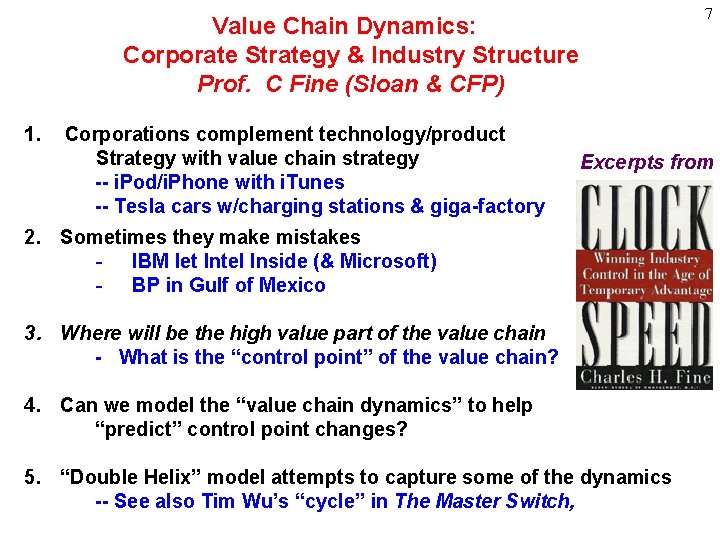
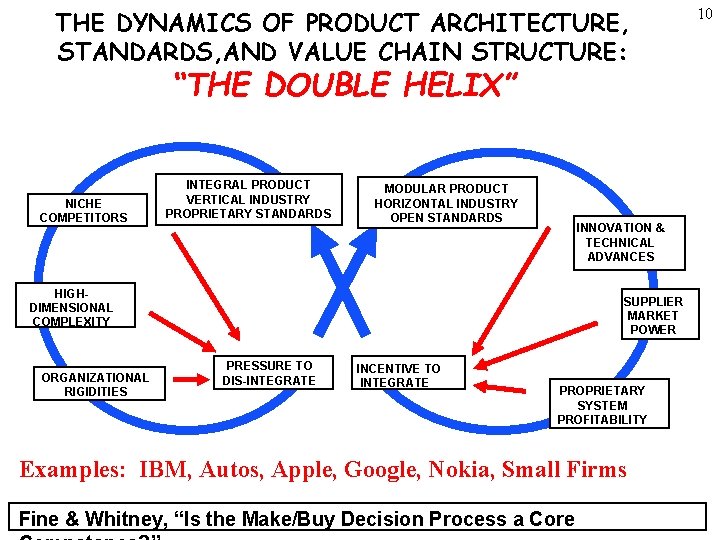
7 Value Chain Dynamics: Corporate Strategy & Industry Structure Prof. C Fine (Sloan & CFP) 1. Corporations complement technology/product Strategy with value chain strategy -- i. Pod/i. Phone with i. Tunes -- Tesla cars w/charging stations & giga-factory Excerpts from 2. Sometimes they make mistakes - IBM let Intel Inside (& Microsoft) - BP in Gulf of Mexico 3. Where will be the high value part of the value chain - What is the “control point” of the value chain? 4. Can we model the “value chain dynamics” to help “predict” control point changes? 5. “Double Helix” model attempts to capture some of the dynamics -- See also Tim Wu’s “cycle” in The Master Switch,
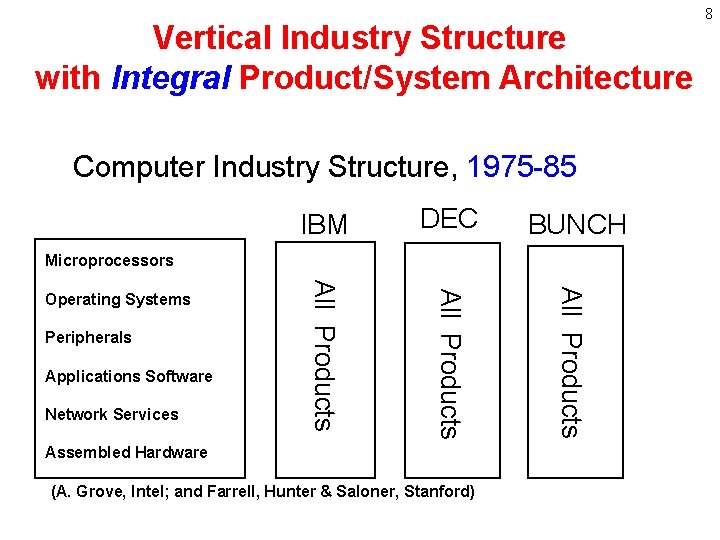
Vertical Industry Structure with Integral Product/System Architecture Computer Industry Structure, 1975 -85 IBM DEC BUNCH All Products Microprocessors Operating Systems Peripherals Applications Software Network Services Assembled Hardware (A. Grove, Intel; and Farrell, Hunter & Saloner, Stanford) 8
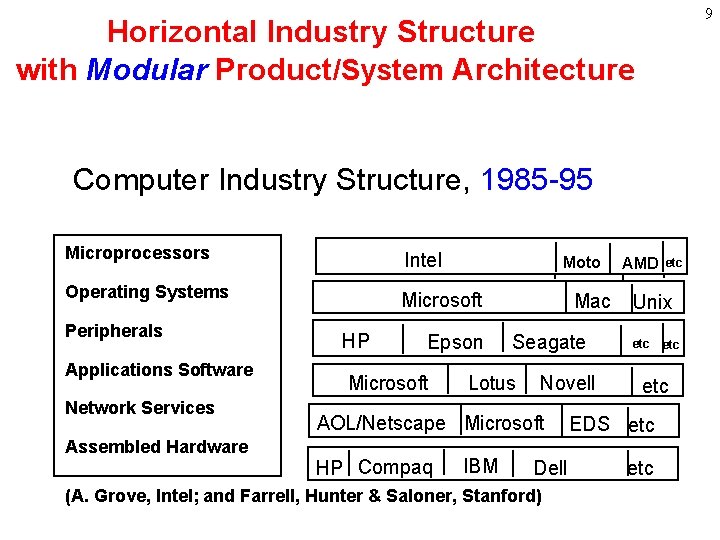
9 Horizontal Industry Structure with Modular Product/System Architecture Computer Industry Structure, 1985 -95 Intel Microprocessors Operating Systems Peripherals Applications Software Network Services Assembled Hardware Mac Moto Microsoft HP Intel. Epson Microsoft Mac Seagate Lotus Novell AOL/Netscape Microsoft HP Compaq IBM Dell (A. Grove, Intel; and Farrell, Hunter & Saloner, Stanford) TI etc AMD Unix TIetc etc EDS etc etc
THE DYNAMICS OF PRODUCT ARCHITECTURE, STANDARDS, AND VALUE CHAIN STRUCTURE: “THE DOUBLE HELIX” NICHE COMPETITORS INTEGRAL PRODUCT VERTICAL INDUSTRY PROPRIETARY STANDARDS MODULAR PRODUCT HORIZONTAL INDUSTRY OPEN STANDARDS INNOVATION & TECHNICAL ADVANCES HIGHDIMENSIONAL COMPLEXITY ORGANIZATIONAL RIGIDITIES SUPPLIER MARKET POWER PRESSURE TO DIS-INTEGRATE INCENTIVE TO INTEGRATE PROPRIETARY SYSTEM PROFITABILITY Examples: IBM, Autos, Apple, Google, Nokia, Small Firms Fine & Whitney, “Is the Make/Buy Decision Process a Core 10
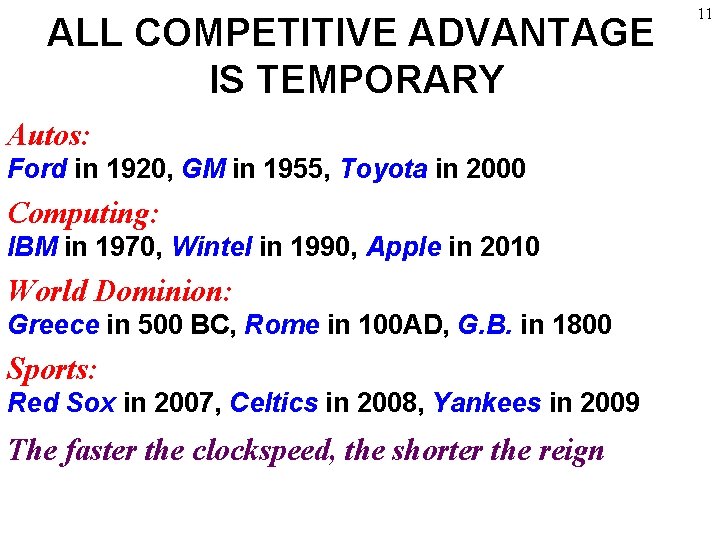
ALL COMPETITIVE ADVANTAGE IS TEMPORARY Autos: Ford in 1920, GM in 1955, Toyota in 2000 Computing: IBM in 1970, Wintel in 1990, Apple in 2010 World Dominion: Greece in 500 BC, Rome in 100 AD, G. B. in 1800 Sports: Red Sox in 2007, Celtics in 2008, Yankees in 2009 The faster the clockspeed, the shorter the reign 11
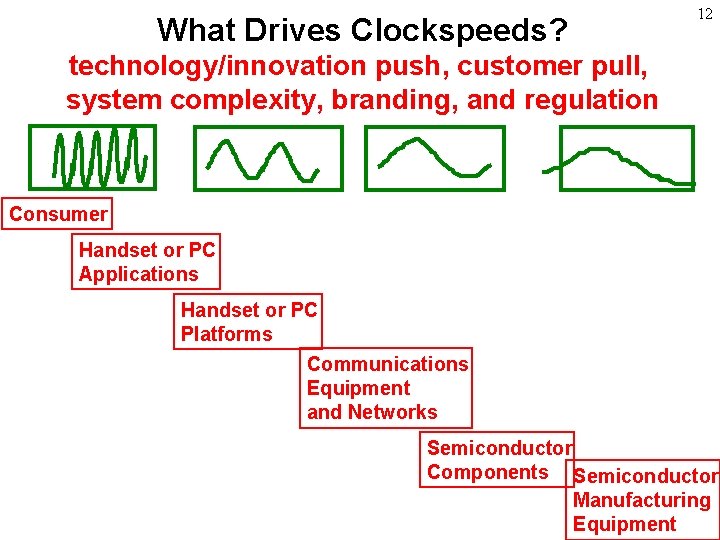
What Drives Clockspeeds? 12 technology/innovation push, customer pull, system complexity, branding, and regulation Consumer Handset or PC Applications Handset or PC Platforms Communications Equipment and Networks Semiconductor Components Semiconductor Manufacturing Equipment
The Double Helix Redux 13
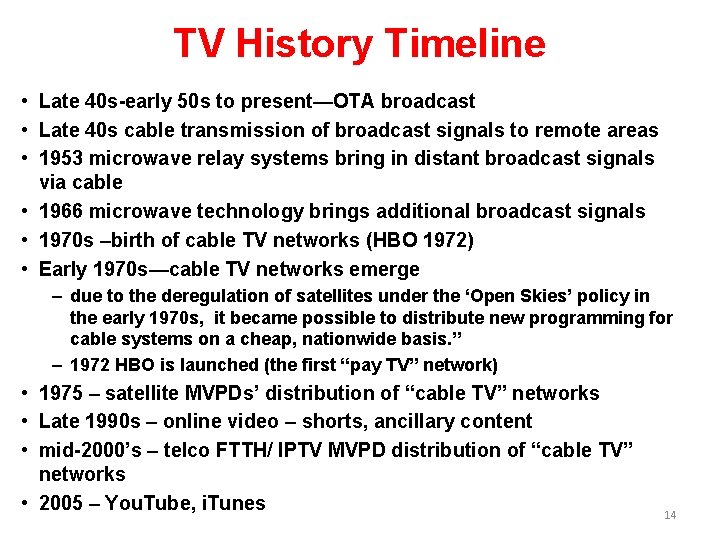
TV History Timeline • Late 40 s-early 50 s to present—OTA broadcast • Late 40 s cable transmission of broadcast signals to remote areas • 1953 microwave relay systems bring in distant broadcast signals via cable • 1966 microwave technology brings additional broadcast signals • 1970 s –birth of cable TV networks (HBO 1972) • Early 1970 s—cable TV networks emerge – due to the deregulation of satellites under the ‘Open Skies’ policy in the early 1970 s, it became possible to distribute new programming for cable systems on a cheap, nationwide basis. ” – 1972 HBO is launched (the first “pay TV” network) • 1975 – satellite MVPDs’ distribution of “cable TV” networks • Late 1990 s – online video – shorts, ancillary content • mid-2000’s – telco FTTH/ IPTV MVPD distribution of “cable TV” networks • 2005 – You. Tube, i. Tunes 14
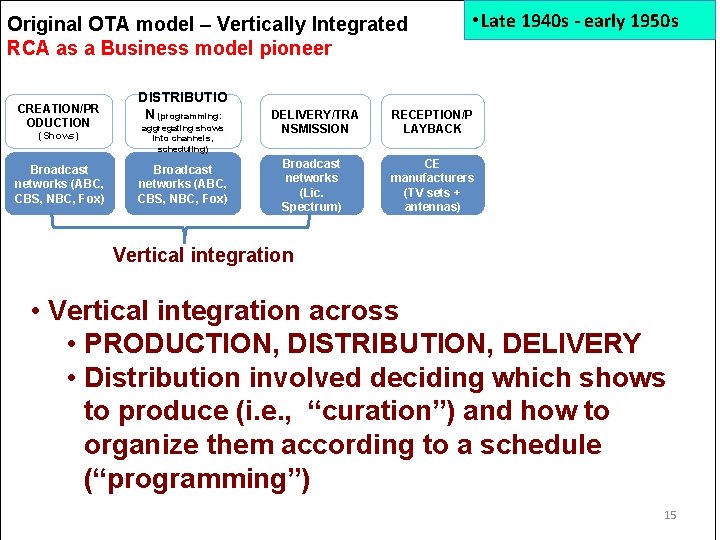
Original OTA model – Vertically Integrated RCA as a Business model pioneer CREATION/PR ODUCTION DISTRIBUTIO N (programming: (Shows) aggregating shows into channels, scheduling) Broadcast networks (ABC, CBS, NBC, Fox) • Late 1940 s - early 1950 s DELIVERY/TRA NSMISSION RECEPTION/P LAYBACK Broadcast networks (Lic. Spectrum) CE manufacturers (TV sets + antennas) Vertical integration • Vertical integration across • PRODUCTION, DISTRIBUTION, DELIVERY • Distribution involved deciding which shows to produce (i. e. , “curation”) and how to organize them according to a schedule (“programming”) 15
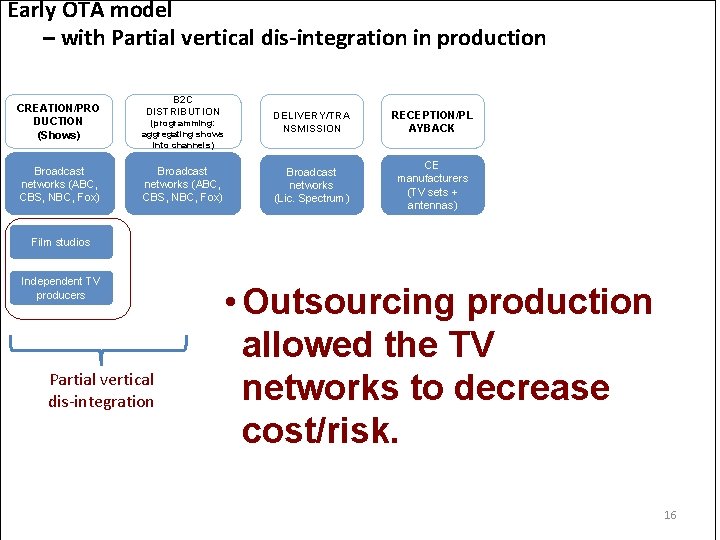
Early OTA model – with Partial vertical dis-integration in production CREATION/PRO DUCTION (Shows) Broadcast networks (ABC, CBS, NBC, Fox) B 2 C DISTRIBUTION (programming: aggregating shows into channels) Broadcast networks (ABC, CBS, NBC, Fox) DELIVERY/TRA NSMISSION RECEPTION/PL AYBACK Broadcast networks (Lic. Spectrum) CE manufacturers (TV sets + antennas) Film studios Independent TV producers Partial vertical dis-integration • Outsourcing production allowed the TV networks to decrease cost/risk. 16
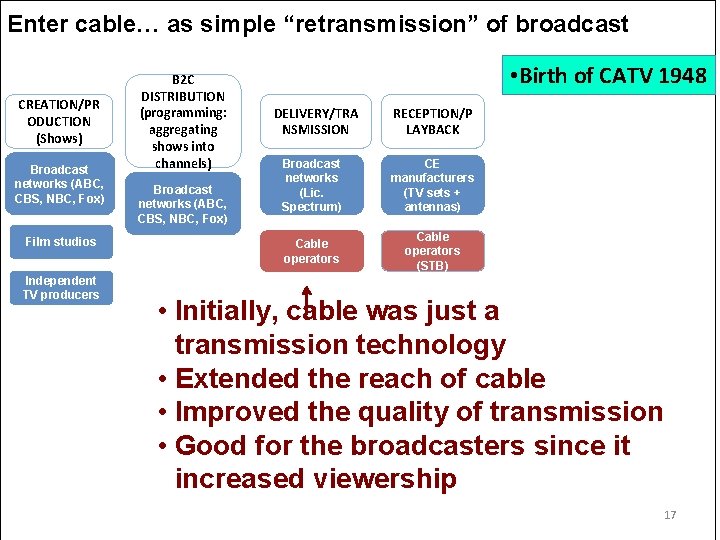
Enter cable… as simple “retransmission” of broadcast CREATION/PR ODUCTION (Shows) Broadcast networks (ABC, CBS, NBC, Fox) Film studios Independent TV producers B 2 C DISTRIBUTION (programming: aggregating shows into channels) Broadcast networks (ABC, CBS, NBC, Fox) • Birth of CATV 1948 DELIVERY/TRA NSMISSION RECEPTION/P LAYBACK Broadcast networks (Lic. Spectrum) CE manufacturers (TV sets + antennas) Cable operators (STB) • Initially, cable was just a transmission technology • Extended the reach of cable • Improved the quality of transmission • Good for the broadcasters since it increased viewership 17
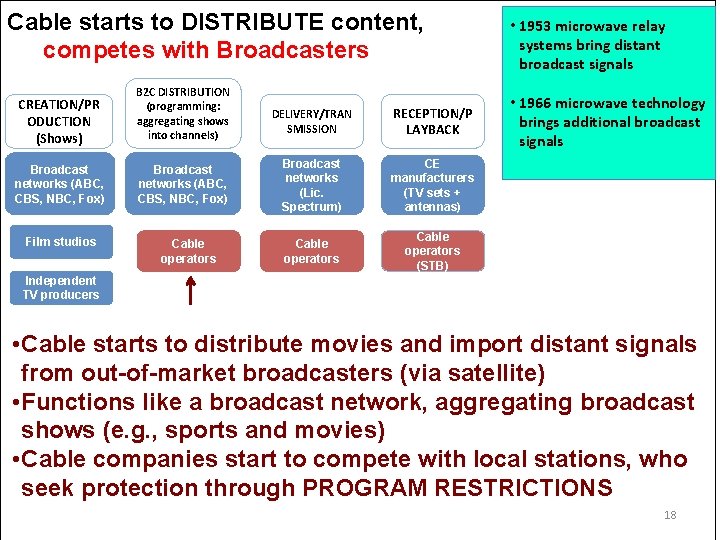
Cable starts to DISTRIBUTE content, competes with Broadcasters CREATION/PR ODUCTION (Shows) B 2 C DISTRIBUTION (programming: aggregating shows into channels) Broadcast networks (ABC, CBS, NBC, Fox) Film studios Cable operators DELIVERY/TRAN SMISSION RECEPTION/P LAYBACK Broadcast networks (Lic. Spectrum) CE manufacturers (TV sets + antennas) Cable operators (STB) • 1953 microwave relay systems bring distant broadcast signals • 1966 microwave technology brings additional broadcast signals Independent TV producers • Cable starts to distribute movies and import distant signals from out-of-market broadcasters (via satellite) • Functions like a broadcast network, aggregating broadcast shows (e. g. , sports and movies) • Cable companies start to compete with local stations, who seek protection through PROGRAM RESTRICTIONS 18
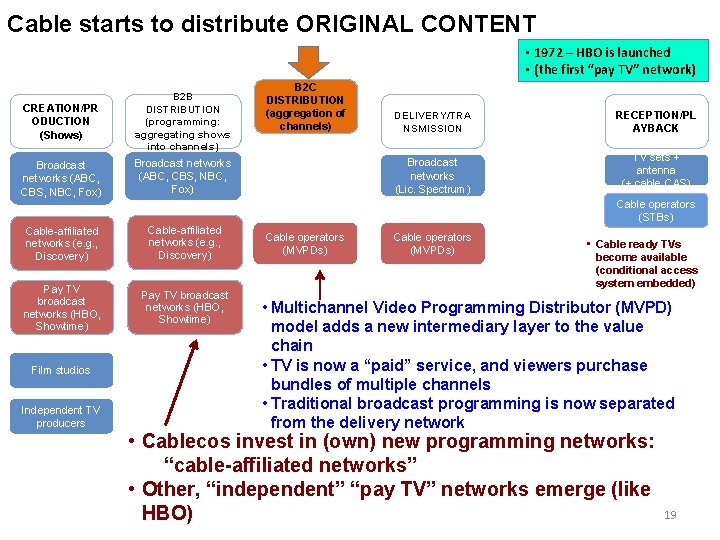
Cable starts to distribute ORIGINAL CONTENT • 1972 – HBO is launched • (the first “pay TV” network) CREATION/PR ODUCTION (Shows) B 2 B DISTRIBUTION (programming: aggregating shows into channels) Broadcast networks (ABC, CBS, NBC, Fox) Cable-affiliated networks (e. g. , Discovery) Pay TV broadcast networks (HBO, Showtime) Film studios Independent TV producers B 2 C DISTRIBUTION (aggregation of channels) DELIVERY/TRA NSMISSION Broadcast networks (Lic. Spectrum) RECEPTION/PL AYBACK TV sets + antenna (+ cable CAS) Cable operators (STBs) Cable operators (MVPDs) • Cable ready TVs become available (conditional access system embedded) • Multichannel Video Programming Distributor (MVPD) model adds a new intermediary layer to the value chain • TV is now a “paid” service, and viewers purchase bundles of multiple channels • Traditional broadcast programming is now separated from the delivery network • Cablecos invest in (own) new programming networks: “cable-affiliated networks” • Other, “independent” “pay TV” networks emerge (like HBO) 19
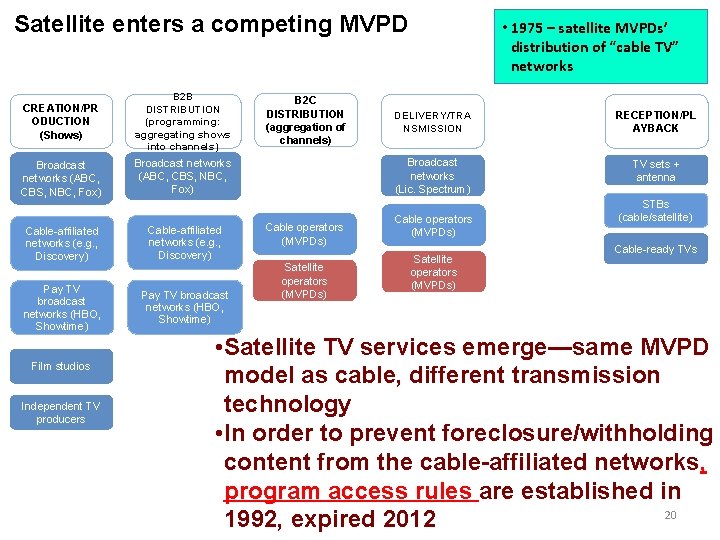
Satellite enters a competing MVPD CREATION/PR ODUCTION (Shows) B 2 B DISTRIBUTION (programming: aggregating shows into channels) Broadcast networks (ABC, CBS, NBC, Fox) Cable-affiliated networks (e. g. , Discovery) Pay TV broadcast networks (HBO, Showtime) Film studios Independent TV producers B 2 C DISTRIBUTION (aggregation of channels) Cable operators (MVPDs) Satellite operators (MVPDs) • 1975 – satellite MVPDs’ distribution of “cable TV” networks DELIVERY/TRA NSMISSION RECEPTION/PL AYBACK Broadcast networks (Lic. Spectrum) TV sets + antenna Cable operators (MVPDs) Satellite operators (MVPDs) STBs (cable/satellite) Cable-ready TVs • Satellite TV services emerge—same MVPD model as cable, different transmission technology • In order to prevent foreclosure/withholding content from the cable-affiliated networks, program access rules are established in 20 1992, expired 2012
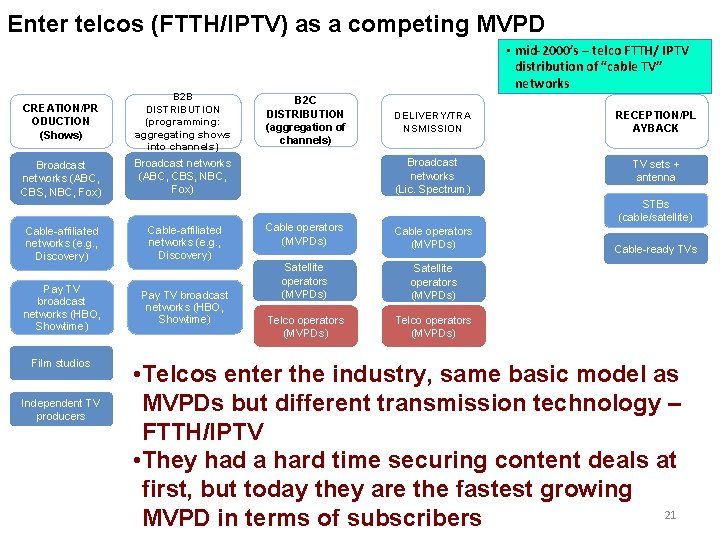
Enter telcos (FTTH/IPTV) as a competing MVPD CREATION/PR ODUCTION (Shows) B 2 B DISTRIBUTION (programming: aggregating shows into channels) Broadcast networks (ABC, CBS, NBC, Fox) Cable-affiliated networks (e. g. , Discovery) Pay TV broadcast networks (HBO, Showtime) Film studios Independent TV producers Pay TV broadcast networks (HBO, Showtime) • mid-2000’s – telco FTTH/ IPTV distribution of “cable TV” networks B 2 C DISTRIBUTION (aggregation of channels) DELIVERY/TRA NSMISSION RECEPTION/PL AYBACK Broadcast networks (Lic. Spectrum) TV sets + antenna STBs (cable/satellite) Cable operators (MVPDs) Satellite operators (MVPDs) Telco operators (MVPDs) Cable-ready TVs • Telcos enter the industry, same basic model as MVPDs but different transmission technology – FTTH/IPTV • They had a hard time securing content deals at first, but today they are the fastest growing 21 MVPD in terms of subscribers
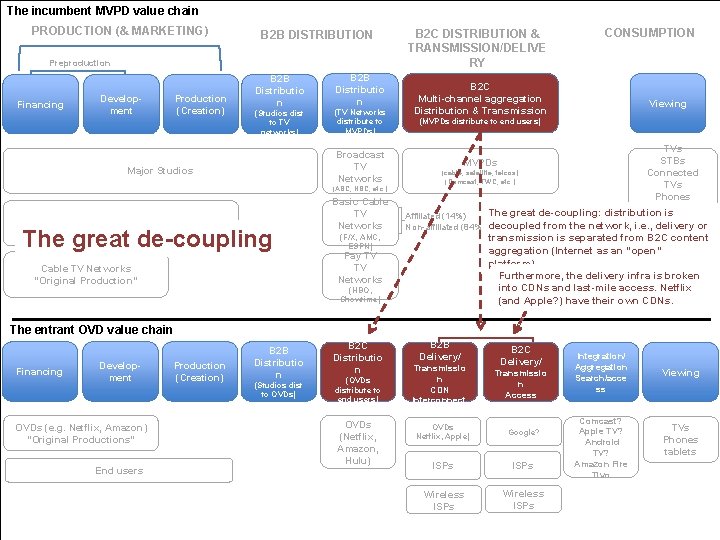
The incumbent MVPD value chain PRODUCTION (& MARKETING) B 2 B DISTRIBUTION Preproduction Financing Development Production (Creation) B 2 B Distributio n (Studios dist to TV networks) B 2 B Distributio n (TV Networks distribute to MVPDs) Broadcast TV Networks Major Studios (ABC, NBC, etc. ) Independent production companies The great de-coupling Cable TV Networks “Original Production” Basic Cable TV Networks B 2 C DISTRIBUTION & TRANSMISSION/DELIVE RY CONSUMPTION B 2 C Multi-channel aggregation Distribution & Transmission Viewing (MVPDs distribute to end users) TVs STBs (cable, satellite, telcos) Connected (Comcast, TWC, etc. ) TVs Phones tablets The great de-coupling: distribution is MVPDs Affiliated (14%) Non-affiliated (84%) decoupled from the network, i. e. , delivery or transmission is separated from B 2 C content aggregation (Internet as an “open” platform) Furthermore, the delivery infra is broken into CDNs and last-mile access. Netflix (and Apple? ) have their own CDNs. (F/X, AMC, ESPN) Pay TV TV Networks (HBO, Showtime) The entrant OVD value chain Financing Development OVDs (e. g. Netflix, Amazon) “Original Productions” End users Production (Creation) B 2 B Distributio n (Studios dist to OVDs) B 2 C Distributio n (OVDs distribute to end users) OVDs (Netflix, Amazon, Hulu) B 2 B Delivery/ Transmissio n CDN Interconnect. B 2 C Delivery/ Transmissio n Access OVDs Netflix, Apple) Google? ISPs Wireless ISPs Integration/ Aggregation Search/acce ss Comcast? Apple TV? Android TV? Amazon Fire Tivo Viewing TVs Phones tablets
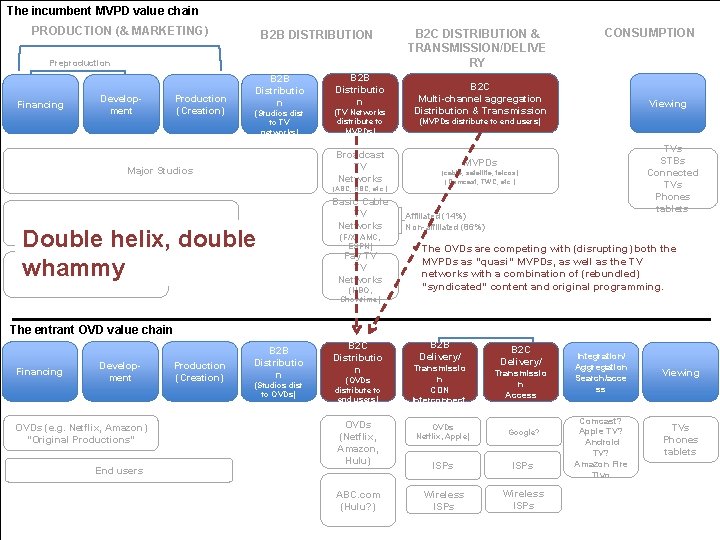
The incumbent MVPD value chain PRODUCTION (& MARKETING) B 2 B DISTRIBUTION Preproduction Financing Development Production (Creation) B 2 B Distributio n (Studios dist to TV networks) B 2 B Distributio n (TV Networks distribute to MVPDs) Broadcast TV Networks Major Studios (ABC, NBC, etc. ) Independent production companies Double helix, double Cable TV Networks whammy “Original Production” Basic Cable TV Networks (F/X, AMC, ESPN) Pay TV TV Networks (HBO, Showtime) B 2 C DISTRIBUTION & TRANSMISSION/DELIVE RY CONSUMPTION B 2 C Multi-channel aggregation Distribution & Transmission Viewing (MVPDs distribute to end users) TVs STBs Connected TVs Phones tablets MVPDs (cable, satellite, telcos) (Comcast, TWC, etc. ) Affiliated (14%) Non-affiliated (86%) • The OVDs are competing with (disrupting) both the MVPDs as “quasi” MVPDs, as well as the TV networks with a combination of (rebundled) “syndicated” content and original programming. The entrant OVD value chain Financing Development OVDs (e. g. Netflix, Amazon) “Original Productions” End users Production (Creation) B 2 B Distributio n (Studios dist to OVDs) B 2 C Distributio n (OVDs distribute to end users) B 2 B Delivery/ Transmissio n CDN Interconnect. B 2 C Delivery/ Transmissio n Access OVDs (Netflix, Amazon, Hulu) OVDs Netflix, Apple) Google? ISPs ABC. com (Hulu? ) Wireless ISPs Integration/ Aggregation Search/acce ss Comcast? Apple TV? Android TV? Amazon Fire Tivo Viewing TVs Phones tablets
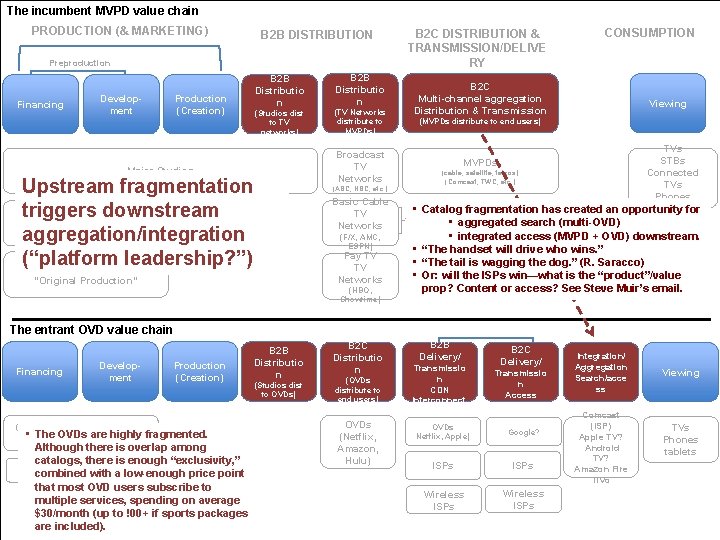
The incumbent MVPD value chain PRODUCTION (& MARKETING) B 2 B DISTRIBUTION Preproduction Financing Development Production (Creation) B 2 B Distributio n (Studios dist to TV networks) B 2 B Distributio n (TV Networks distribute to MVPDs) Broadcast TV Networks Major Studios Upstream fragmentation triggers downstream Independent production companies aggregation/integration (“platform leadership? ”) Cable TV Networks (ABC, NBC, etc. ) Basic Cable TV Networks (F/X, AMC, ESPN) Pay TV TV Networks “Original Production” (HBO, Showtime) B 2 C DISTRIBUTION & TRANSMISSION/DELIVE RY CONSUMPTION B 2 C Multi-channel aggregation Distribution & Transmission Viewing (MVPDs distribute to end users) TVs STBs (cable, satellite, telcos) Connected (Comcast, TWC, etc. ) TVs Phones tabletsfor • Catalog fragmentation has created an opportunity MVPDs Affiliated (14%) • aggregated Non-affiliated (84%) search (multi-OVD) • integrated access (MVPD + OVD) downstream. • “The handset will drive who wins. ” • “The tail is wagging the dog. ” (R. Saracco) • Or: will the ISPs win—what is the “product”/value prop? Content or access? See Steve Muir’s email. The entrant OVD value chain Financing Development Production (Creation) OVDs (e. g. Netflix, Amazon) • “Original The OVDs are highly fragmented. Productions” Although there is overlap among catalogs, there is enough “exclusivity, ” Endausers combined with low-enough price point that most OVD users subscribe to multiple services, spending on average $30/month (up to !00+ if sports packages are included). B 2 B Distributio n (Studios dist to OVDs) B 2 C Distributio n (OVDs distribute to end users) OVDs (Netflix, Amazon, Hulu) B 2 B Delivery/ Transmissio n CDN Interconnect. B 2 C Delivery/ Transmissio n Access OVDs Netflix, Apple) Google? ISPs Wireless ISPs Integration/ Aggregation Search/acce ss Comcast (ISP) Apple TV? Android TV? Amazon Fire Tivo Viewing TVs Phones tablets