
Geant 4 simulation of SEE in EEE components


- Slides: 44
Geant 4 simulation of SEE in EEE components Patrícia Gonçalves LIP Laboratório de Instrumentação e Física Experimental de Partículas Lisboa, Portugal 14 th April 2011 1
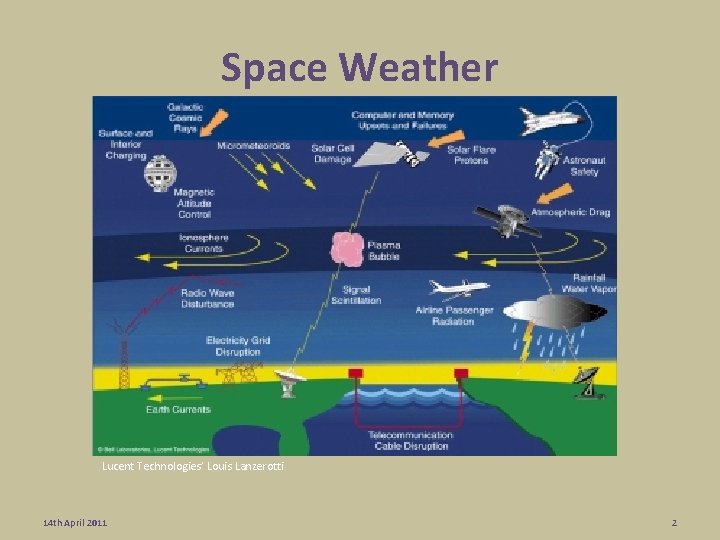
Space Weather Lucent Technologies’ Louis Lanzerotti 14 th April 2011 2
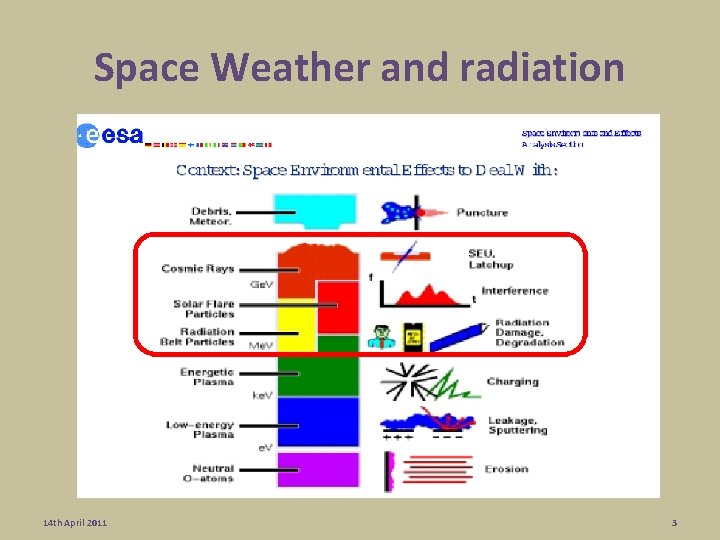
Space Weather and radiation 14 th April 2011 3
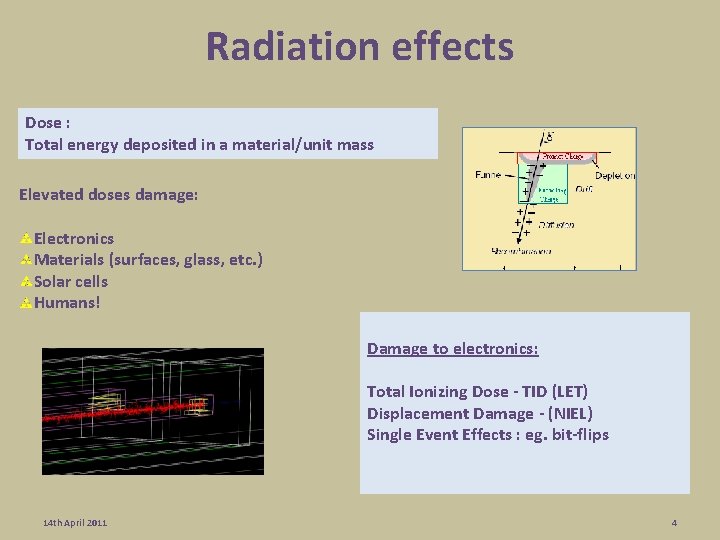
Radiation effects Dose : Total energy deposited in a material/unit mass Elevated doses damage: Electronics Materials (surfaces, glass, etc. ) Solar cells Humans! Damage to electronics: Total Ionizing Dose - TID (LET) Displacement Damage - (NIEL) Single Event Effects : eg. bit-flips 14 th April 2011 4
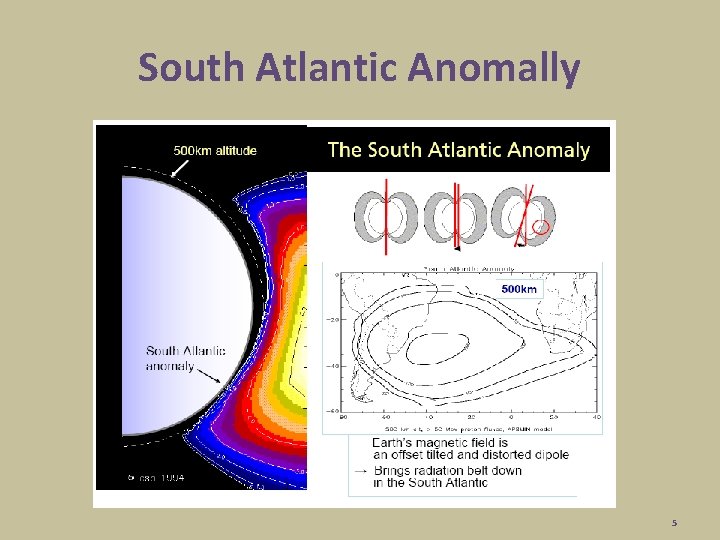
South Atlantic Anomally 5
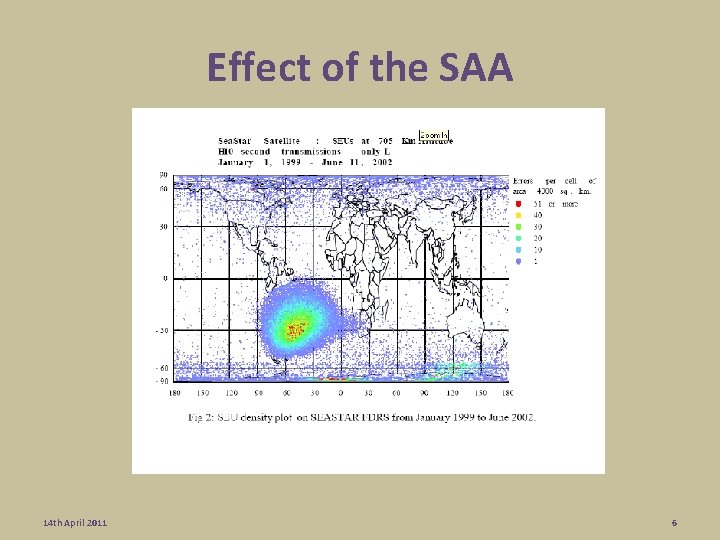
Effect of the SAA 14 th April 2011 6
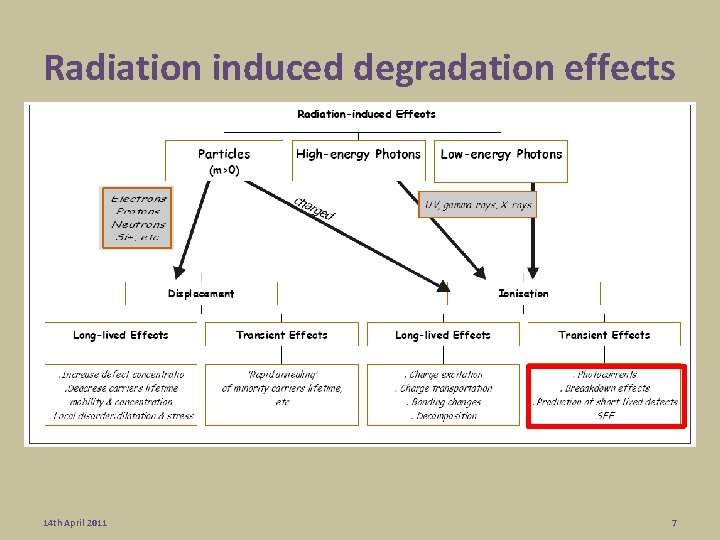
Radiation induced degradation effects 14 th April 2011 7
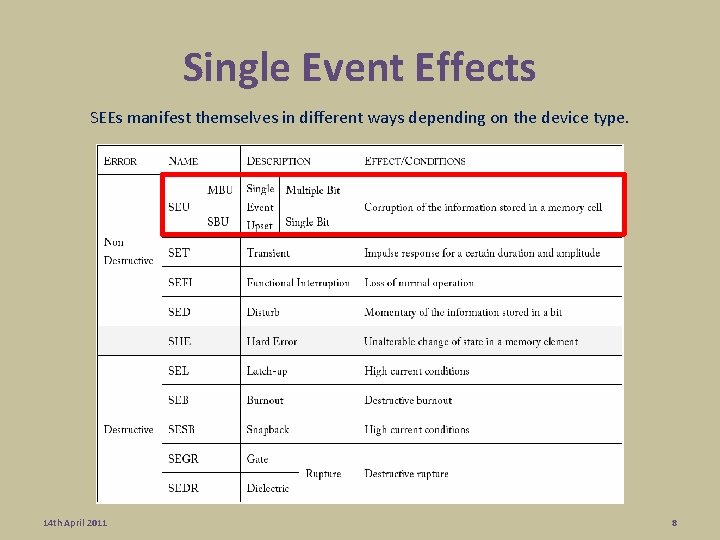
Single Event Effects SEEs manifest themselves in different ways depending on the device type. 14 th April 2011 8
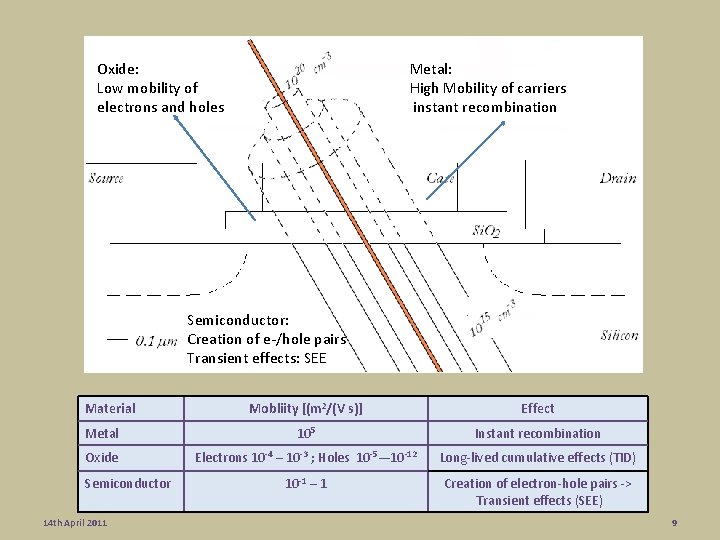
Oxide: Low mobility of electrons and holes The problem Metal: High Mobility of carriers instant recombination Semiconductor: Creation of e‐/hole pairs Transient effects: SEE Material Mobliity [(m 2/(V s)] Effect Metal 105 Instant recombination Oxide Electrons 10‐ 4 – 10‐ 3 ; Holes 10‐ 5— 10‐ 12 Long‐lived cumulative effects (TID) 10‐ 1 – 1 Creation of electron‐hole pairs ‐> Transient effects (SEE) Semiconductor 14 th April 2011 9
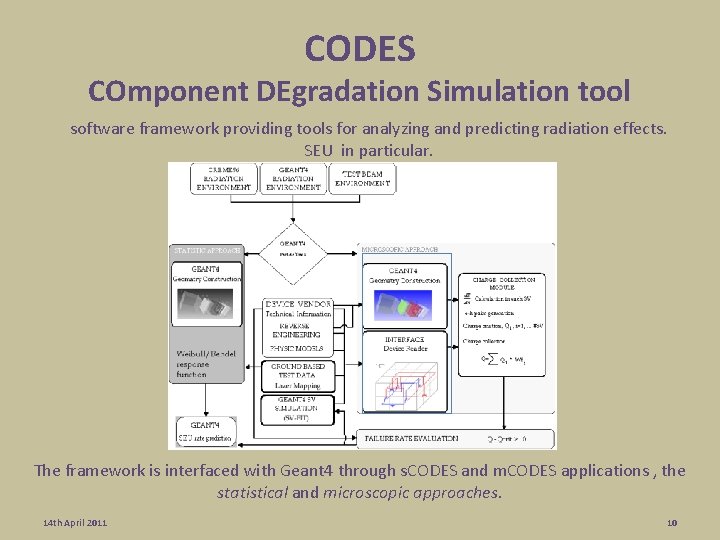
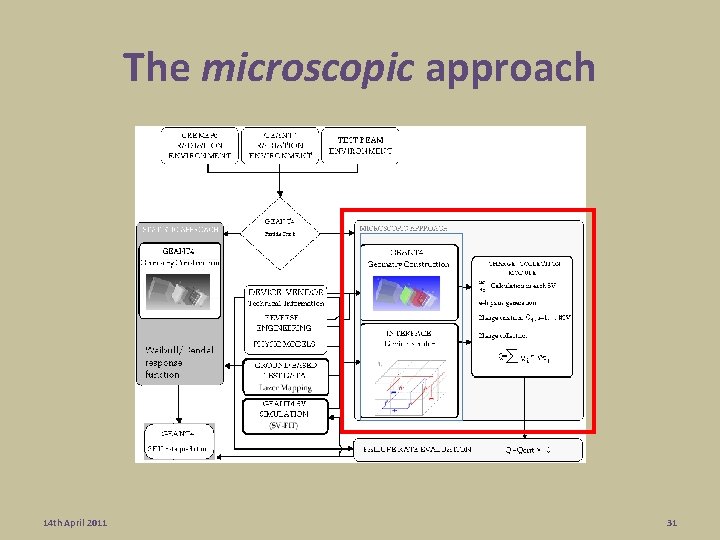
CODES COmponent DEgradation Simulation tool software framework providing tools for analyzing and predicting radiation effects. SEU in particular. The framework is interfaced with Geant 4 through s. CODES and m. CODES applications , the statistical and microscopic approaches. 14 th April 2011 10
The data 14 th April 2011 11
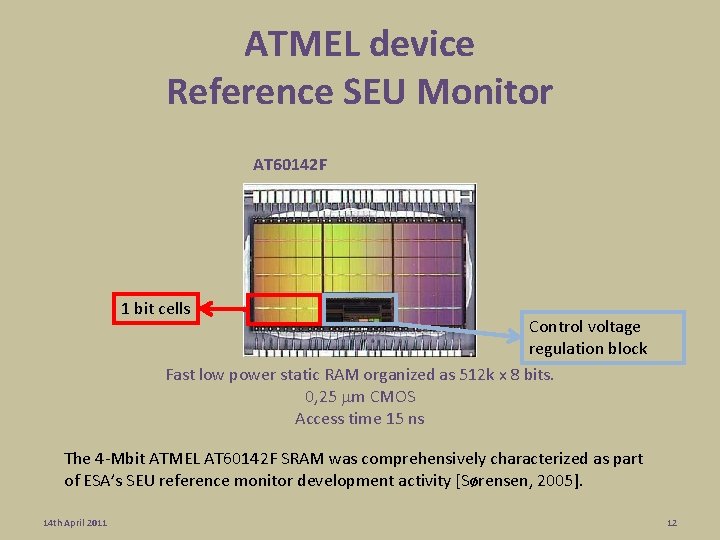
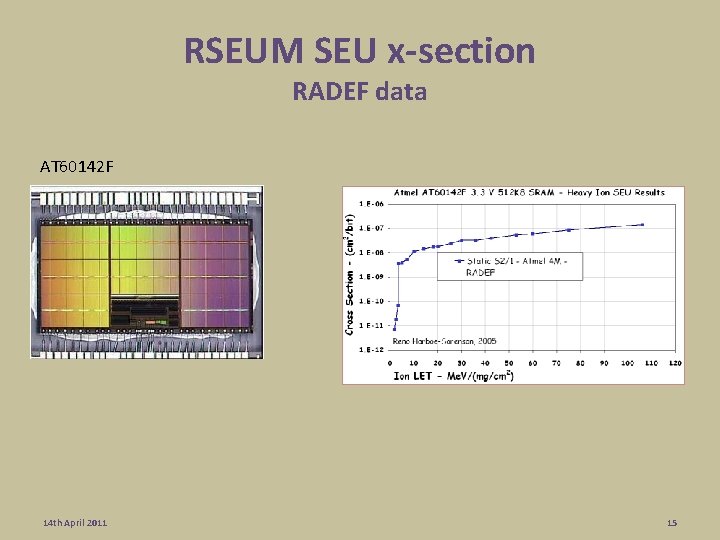
ATMEL device Reference SEU Monitor AT 60142 F 1 bit cells Control voltage regulation block Fast low power static RAM organized as 512 k x 8 bits. 0, 25 m CMOS Access time 15 ns The 4‐Mbit ATMEL AT 60142 F SRAM was comprehensively characterized as part of ESA’s SEU reference monitor development activity [Sørensen, 2005]. 14 th April 2011 12
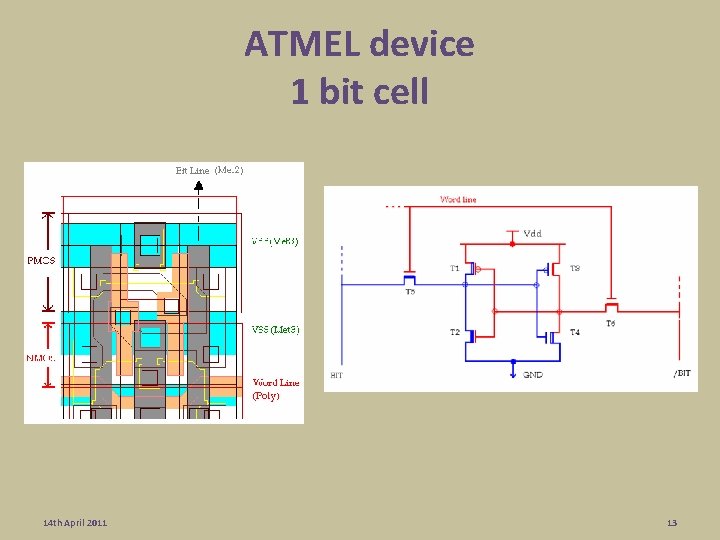
ATMEL device 1 bit cell 14 th April 2011 13
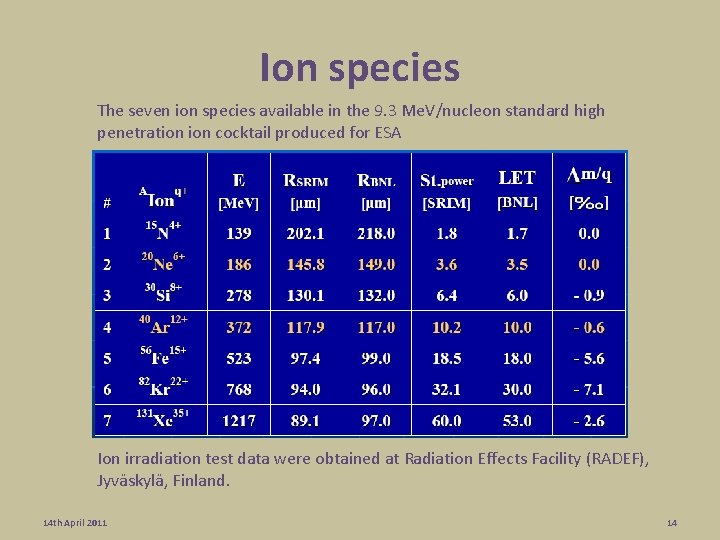
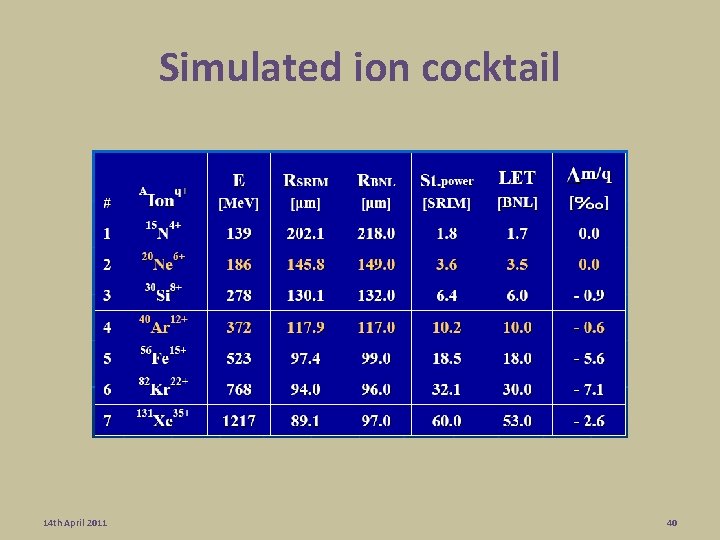
Ion species The seven ion species available in the 9. 3 Me. V/nucleon standard high penetration cocktail produced for ESA Ion irradiation test data were obtained at Radiation Effects Facility (RADEF), Jyväskylä, Finland. 14 th April 2011 14
RSEUM SEU x-section RADEF data AT 60142 F 14 th April 2011 15
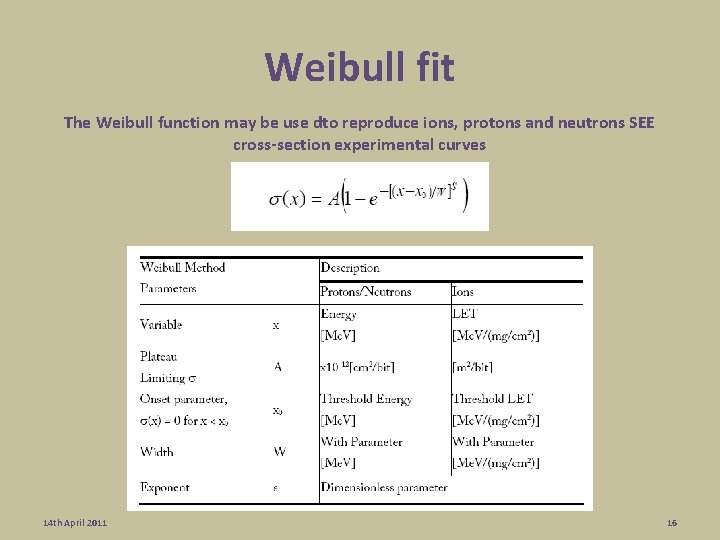
Weibull fit The Weibull function may be use dto reproduce ions, protons and neutrons SEE cross-section experimental curves 14 th April 2011 16
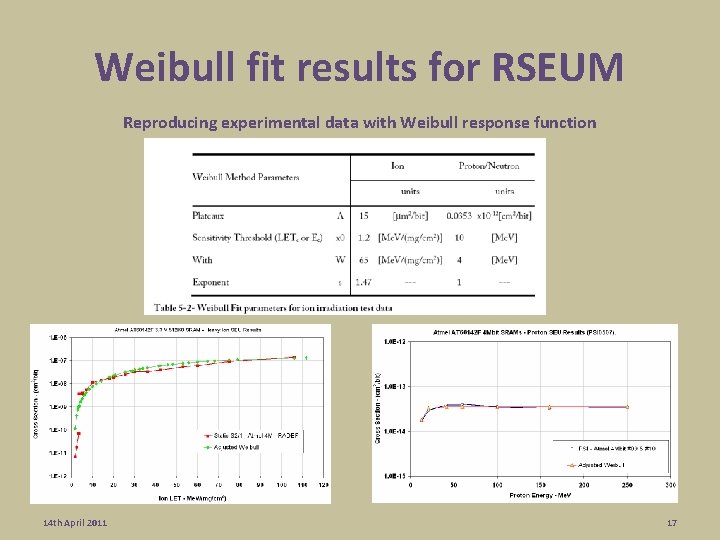
Weibull fit results for RSEUM Reproducing experimental data with Weibull response function 14 th April 2011 17
The simulation 14 th April 2011 18
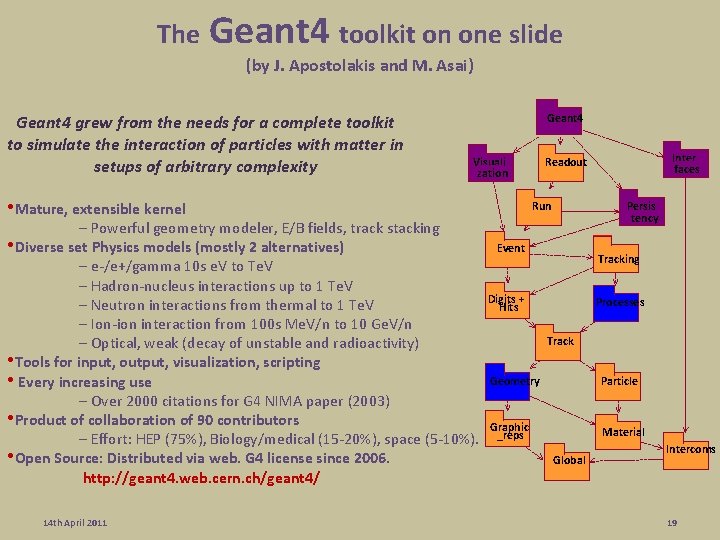
The Geant 4 toolkit on one slide (by J. Apostolakis and M. Asai) Geant 4 grew from the needs for a complete toolkit to simulate the interaction of particles with matter in setups of arbitrary complexity Geant 4 Visuali zation • Mature, extensible kernel – Powerful geometry modeler, E/B fields, track stacking • Diverse set Physics models (mostly 2 alternatives) – e‐/e+/gamma 10 s e. V to Te. V – Hadron‐nucleus interactions up to 1 Te. V – Neutron interactions from thermal to 1 Te. V – Ion‐ion interaction from 100 s Me. V/n to 10 Ge. V/n – Optical, weak (decay of unstable and radioactivity) • Tools for input, output, visualization, scripting • Every increasing use – Over 2000 citations for G 4 NIMA paper (2003) • Product of collaboration of 90 contributors – Effort: HEP (75%), Biology/medical (15‐ 20%), space (5‐ 10%). • Open Source: Distributed via web. G 4 license since 2006. http: //geant 4. web. cern. ch/geant 4/ 14 th April 2011 Inter faces Readout Run Persis tency Event Tracking Digits + Hits Processes Track Geometry Particle Graphic _reps Material Global Intercoms 19
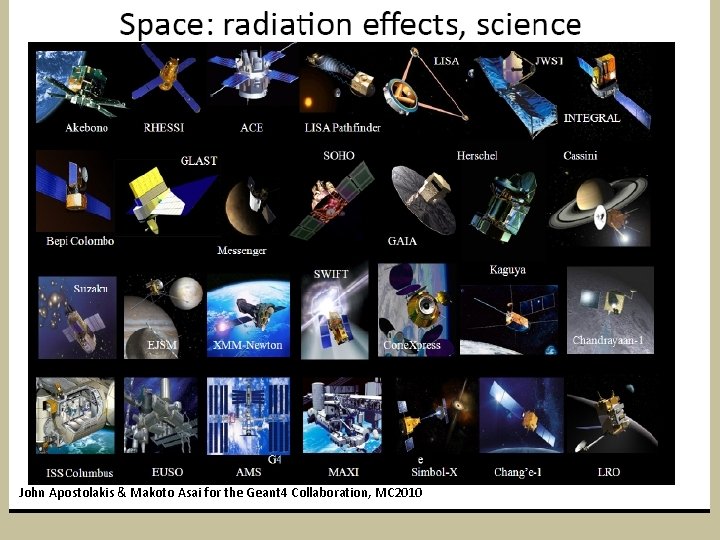
John Apostolakis & Makoto Asai for the Geant 4 Collaboration, MC 2010
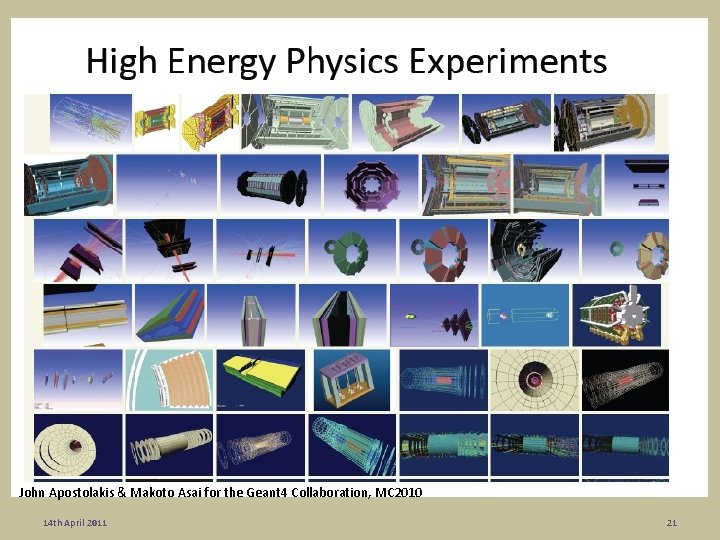
John Apostolakis & Makoto Asai for the Geant 4 Collaboration, MC 2010 14 th April 2011 21
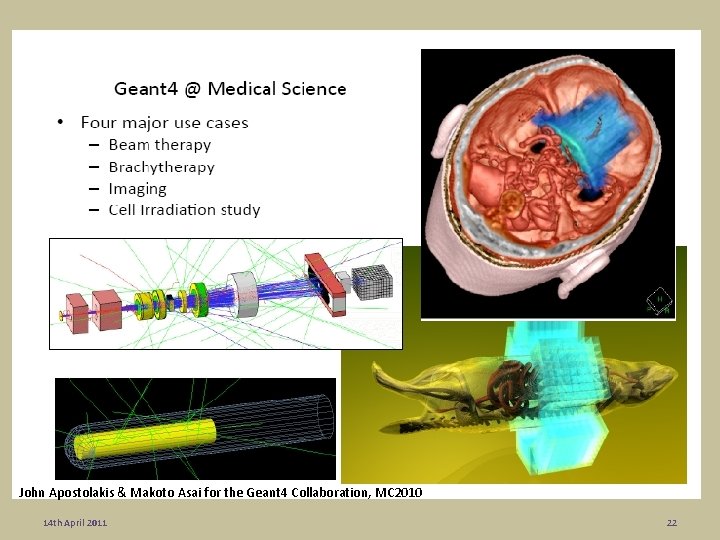
John Apostolakis & Makoto Asai for the Geant 4 Collaboration, MC 2010 14 th April 2011 22
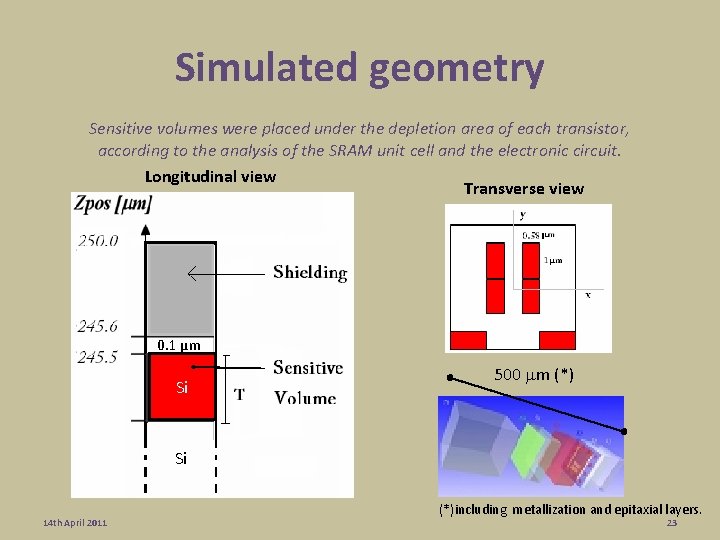
Simulated geometry Sensitive volumes were placed under the depletion area of each transistor, according to the analysis of the SRAM unit cell and the electronic circuit. Longitudinal view Transverse view 0. 1 μm Si 500 m (*) Si 14 th April 2011 (*)including metallization and epitaxial layers. 23
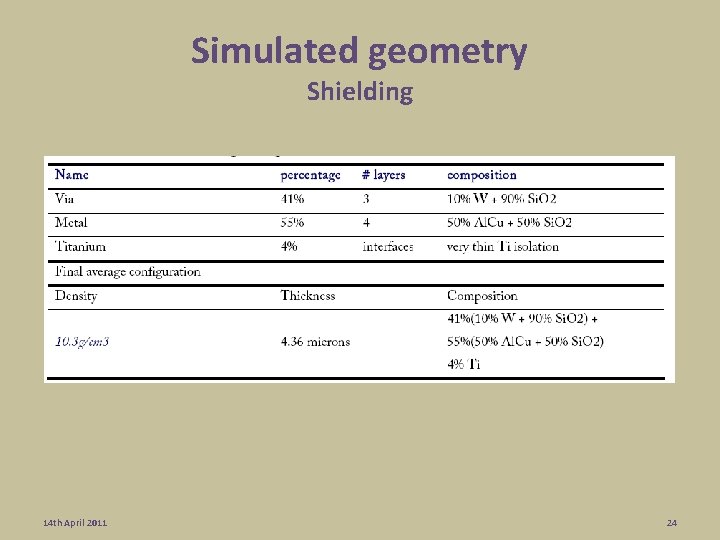
Simulated geometry Shielding 14 th April 2011 24
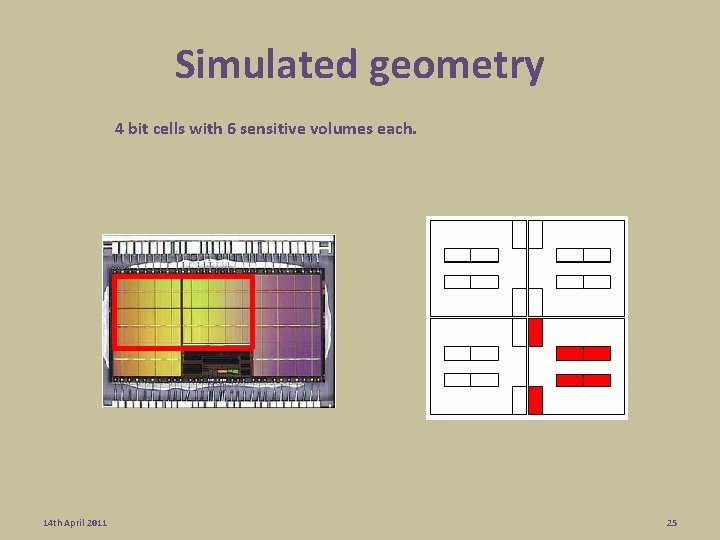
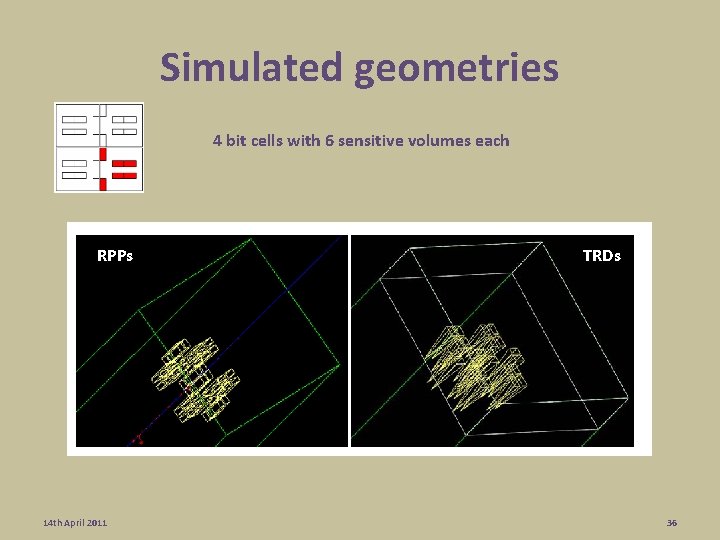
Simulated geometry 4 bit cells with 6 sensitive volumes each. 14 th April 2011 25
The sensitive volume 14 th April 2011 26
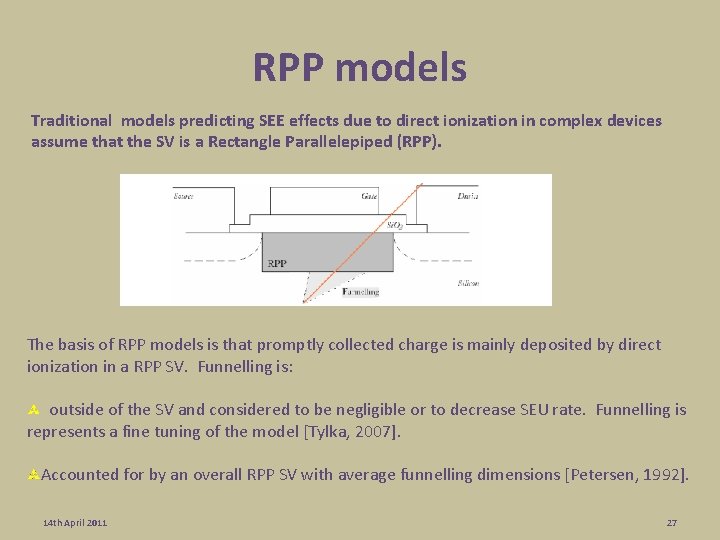
RPP models Traditional models predicting SEE effects due to direct ionization in complex devices assume that the SV is a Rectangle Parallelepiped (RPP). The basis of RPP models is that promptly collected charge is mainly deposited by direct ionization in a RPP SV. Funnelling is: outside of the SV and considered to be negligible or to decrease SEU rate. Funnelling is represents a fine tuning of the model [Tylka, 2007]. Accounted for by an overall RPP SV with average funnelling dimensions [Petersen, 1992]. 14 th April 2011 27
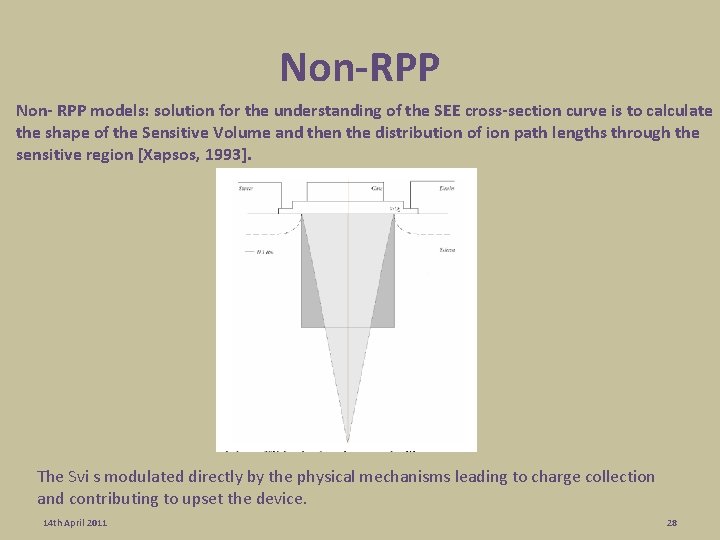
Non-RPP Non- RPP models: solution for the understanding of the SEE cross-section curve is to calculate the shape of the Sensitive Volume and then the distribution of ion path lengths through the sensitive region [Xapsos, 1993]. The Svi s modulated directly by the physical mechanisms leading to charge collection and contributing to upset the device. 14 th April 2011 28
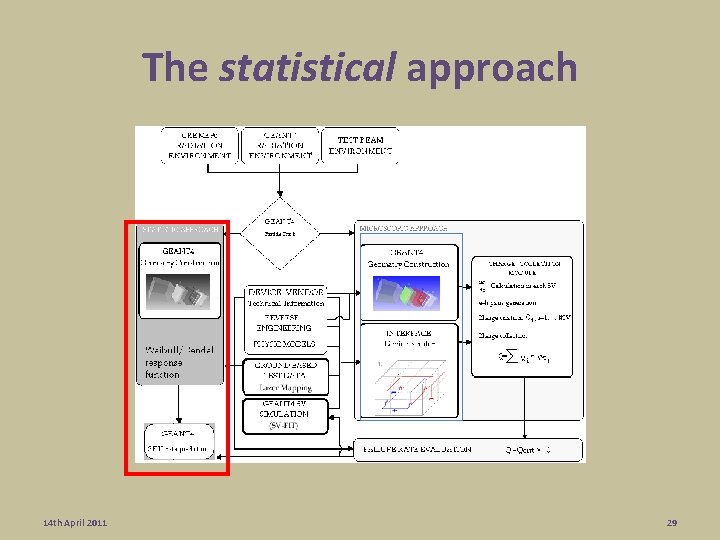
The statistical approach 14 th April 2011 29
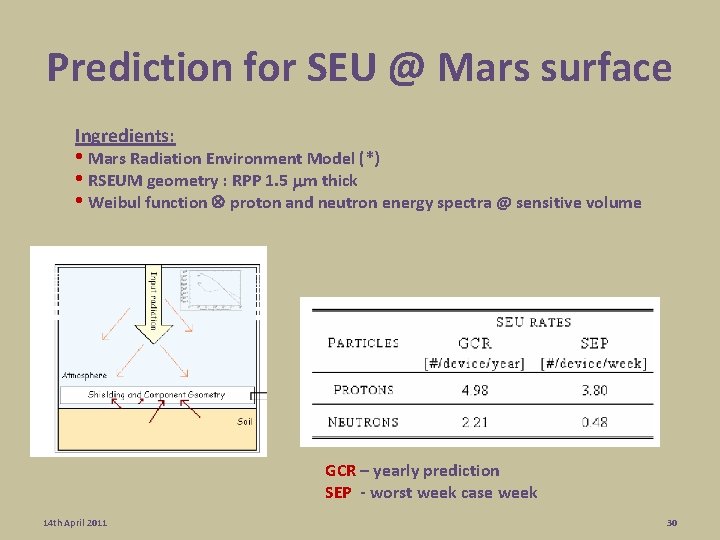
Prediction for SEU @ Mars surface Ingredients: • Mars Radiation Environment Model (*) • RSEUM geometry : RPP 1. 5 m thick • Weibul function proton and neutron energy spectra @ sensitive volume GCR – yearly prediction SEP - worst week case week 14 th April 2011 30
The microscopic approach 14 th April 2011 31
SV fit The Sensitive Volume Interactive Fit Tool (SV-FIT) aims at reconstructing the irradiation test data using a GEANT 4 based simulation by adjusting the device sensitive volume (SV) shape and size. • • • The sensitive volume shape can be varied The energy deposited/charge in the SV contributes entirely to prompt charge collection Different SV shapes can be compared to select the best match with experimental data. CODES assumes SV to be the volume in the device where the charge deposited contributes entirely to prompt charge collection. The sensitive volume shape is not pre-defined and will be determined with SV-FIT. 14 th April 2011 32
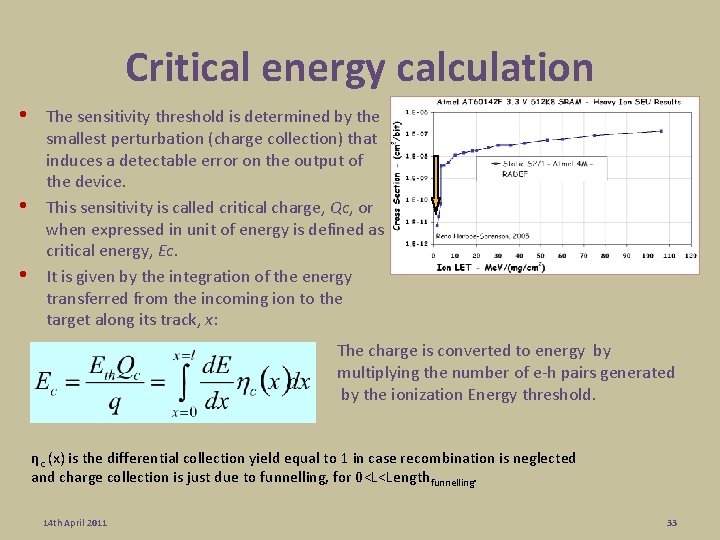
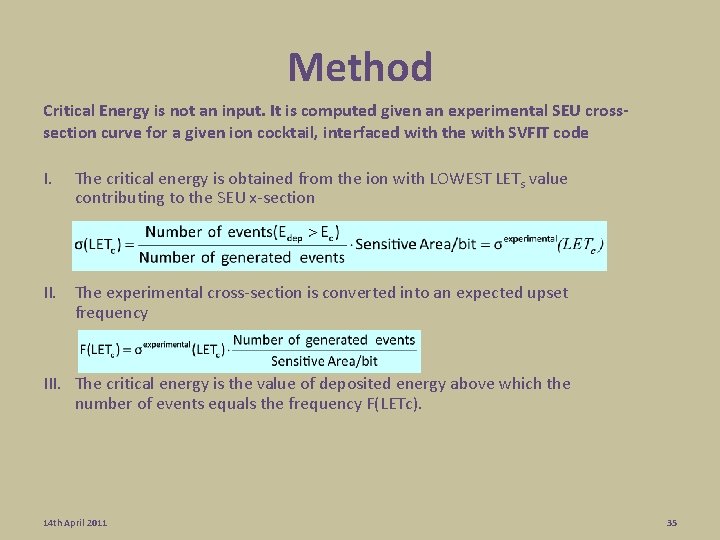
Critical energy calculation • • • The sensitivity threshold is determined by the smallest perturbation (charge collection) that induces a detectable error on the output of the device. This sensitivity is called critical charge, Qc, or when expressed in unit of energy is defined as critical energy, Ec. It is given by the integration of the energy transferred from the incoming ion to the target along its track, x: The charge is converted to energy by multiplying the number of e‐h pairs generated by the ionization Energy threshold. ηc (x) is the differential collection yield equal to 1 in case recombination is neglected and charge collection is just due to funnelling, for 0<L<Lengthfunnelling. 14 th April 2011 33
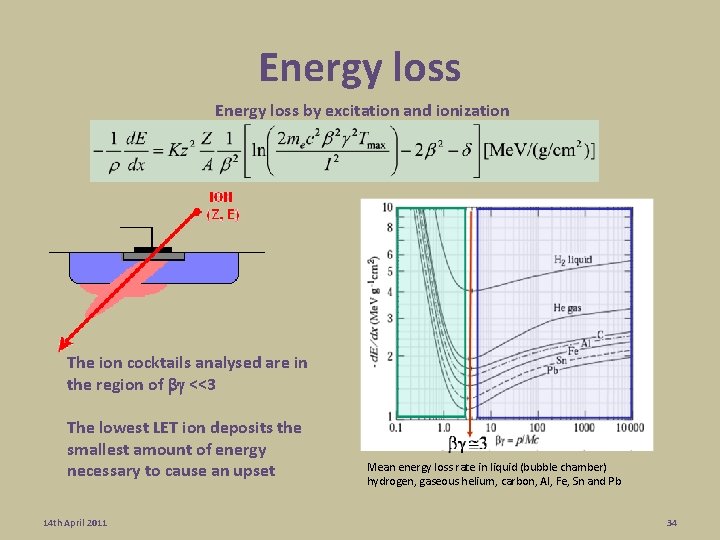
Energy loss by excitation and ionization The ion cocktails analysed are in the region of <<3 The lowest LET ion deposits the smallest amount of energy necessary to cause an upset 14 th April 2011 Mean energy loss rate in liquid (bubble chamber) hydrogen, gaseous helium, carbon, Al, Fe, Sn and Pb 34
Method Critical Energy is not an input. It is computed given an experimental SEU crosssection curve for a given ion cocktail, interfaced with the with SVFIT code I. The critical energy is obtained from the ion with LOWEST LETs value contributing to the SEU x‐section II. The experimental cross‐section is converted into an expected upset frequency III. The critical energy is the value of deposited energy above which the number of events equals the frequency F(LETc). 14 th April 2011 35
Simulated geometries 4 bit cells with 6 sensitive volumes each RPPs 14 th April 2011 TRDs 36
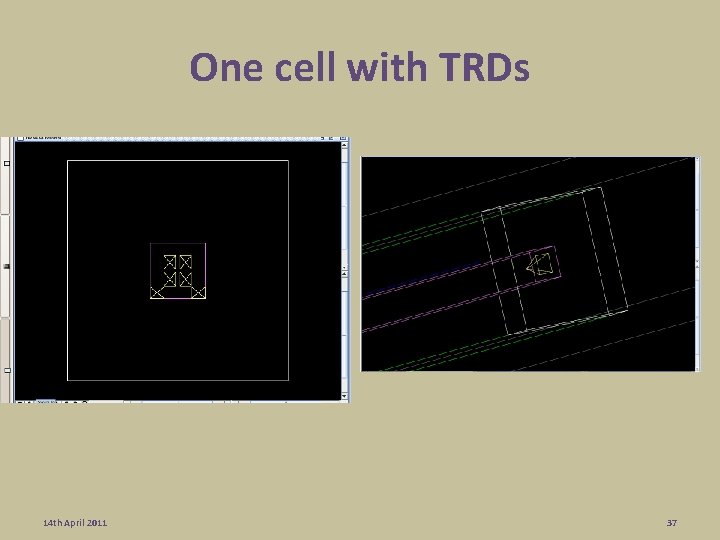
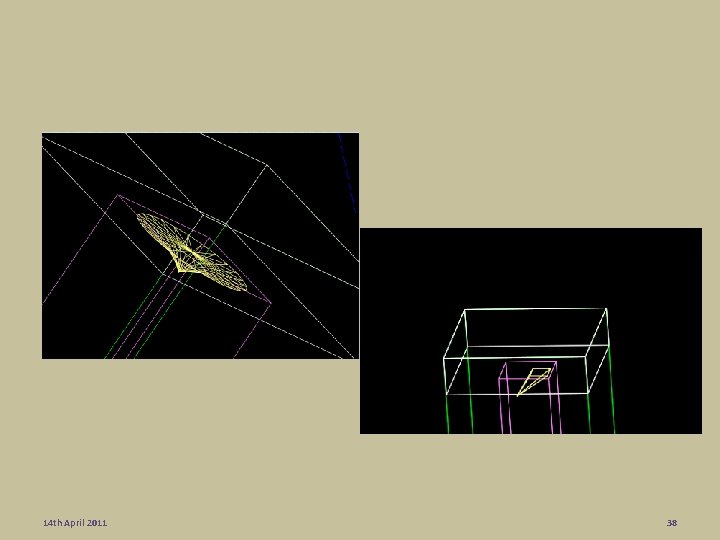
One cell with TRDs 14 th April 2011 37
14 th April 2011 38
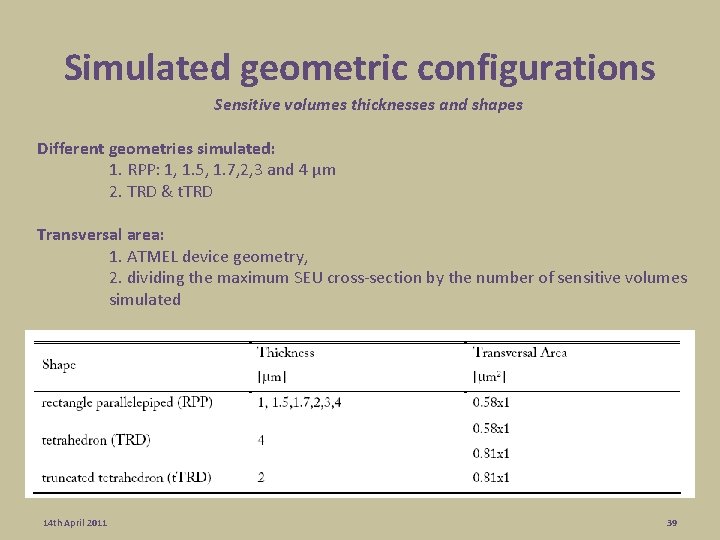
Simulated geometric configurations Sensitive volumes thicknesses and shapes Different geometries simulated: 1. RPP: 1, 1. 5, 1. 7, 2, 3 and 4 μm 2. TRD & t. TRD Transversal area: 1. ATMEL device geometry, 2. dividing the maximum SEU cross‐section by the number of sensitive volumes simulated 14 th April 2011 39
Simulated ion cocktail 14 th April 2011 40
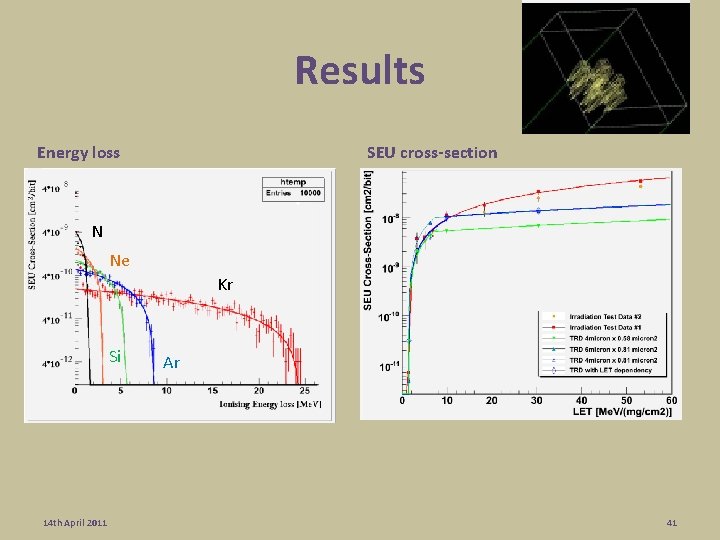
Results Energy loss SEU cross-section N Ne Kr Si 14 th April 2011 Ar 41
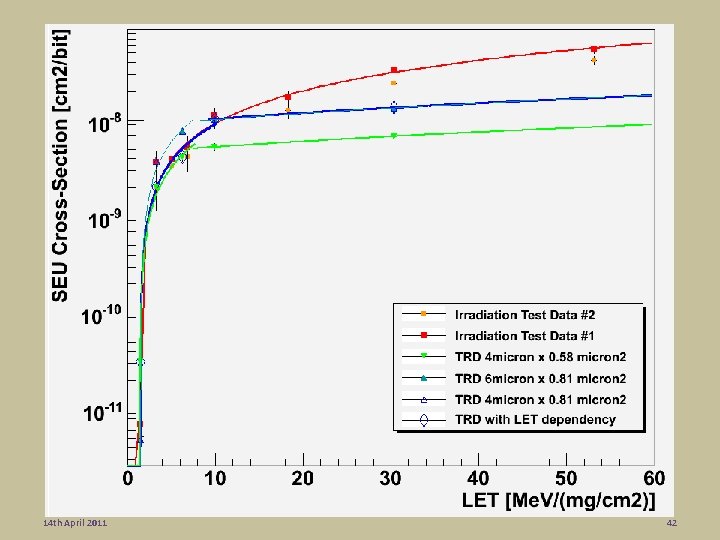
14 th April 2011 42
Comments The SEU cross-section curve due to Irradiation test data of ATMEL AT 60142 F SRAM does not exhibit saturation for the tested LET range. The ATMEL AT 60142 F SRAM SEU response function can be defined as a combination of two effects: 1. a standard SEU cross-section curve that saturates around 10 Me. V/(mg/cm 2) -> due to drift mechanisms 2. an increasing LET-dependent perturbation –> due to diffusion mechanisms The first effect is reproduced by GEANT 4 simulation by fitting the SV shape. The second effect has to be further investigated. The possibility of studying Diffusion-induced sensitive area enhancement by the difference between irradiation test data and simulations of SEU cross-section shall be investigated. 14 th April 2011 43
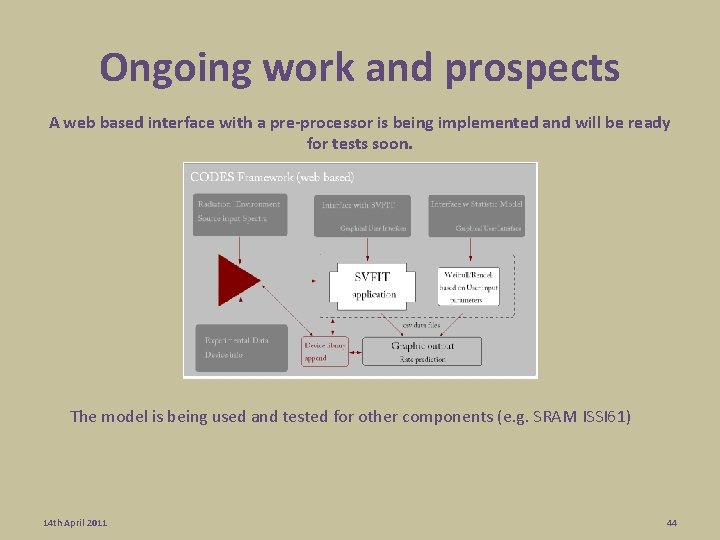
Ongoing work and prospects A web based interface with a pre-processor is being implemented and will be ready for tests soon. The model is being used and tested for other components (e. g. SRAM ISSI 61) 14 th April 2011 44