
Geant 4 Electromagnetic Validation mostly electromagnetic but also
Geant 4 Electromagnetic Validation (mostly electromagnetic, but also a bit of hadronic…) K. Amako, G. A. P. Cirrone, G. Cuttone, F. Di Rosa, S. Guatelli, V. Ivanchenko, M. Maire, B. Mascialino, K. Murakami, P. Nieminen, L. Pandola, S. Parlati, M. G. Pia, G. Russo, T. Sasaki, L. Urban et al. Geant 4 Workshop Bordeaux, 7 -10 November 2005 Maria Grazia Pia, INFN Genova
Geant 4 Electromagnetic Validation Ample variety of physics models in the Geant 4 Toolkit – complementary and alternative Electromagnetic physics – Standard, Low. Energy, Muon, Optical, Utilities (contains multiple scattering, energy loss!) Hadronic physics – in some experimental cases EM and hadronic physics cannot be separated Geant 4 Physics Book – on-going project to document the performance of Geant 4 physics against experimental data and in relevant experimental application domains Maria Grazia Pia, INFN Genova
Validation process Geant 4 test process – – Physics packages are subject to unit and system testing Verification, validation of single processes/models performed by Working Groups Validation process – – systematic: cover all models of a given process comparison to experimental data and established reference databases rigorous software process to guarantee quality and reliability statistical analysis: quantitative mathematical evaluation analysis Goals – – – evaluate quantitatively the accuracy of Geant 4 physics models document their respective strength provide guidance to users to select appropriate models in their applications Maria Grazia Pia, INFN Genova
Scope of this talk Common project for Geant 4 Electromagnetic Physics validation – systematic – spanning all existing electromagnetic models – rigorous software process – performed in a transparent way (agreed methods & tools, code in CVS) transparent – quantitative results through rigorous statistical analysis – goal: produce publication-quality results publication-quality Other on-going “private” activities not covered in this talk – – no time to present everything… but also don’t know what is going on… Maria Grazia Pia, INFN Genova
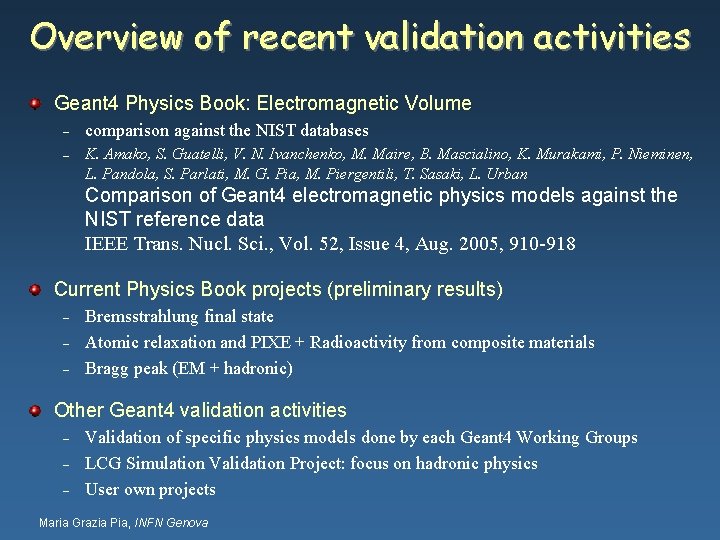
Overview of recent validation activities Geant 4 Physics Book: Electromagnetic Volume – comparison against the NIST databases – K. Amako, S. Guatelli, V. N. Ivanchenko, M. Maire, B. Mascialino, K. Murakami, P. Nieminen, L. Pandola, S. Parlati, M. G. Pia, M. Piergentili, T. Sasaki, L. Urban Comparison of Geant 4 electromagnetic physics models against the NIST reference data IEEE Trans. Nucl. Sci. , Vol. 52, Issue 4, Aug. 2005, 910 -918 Current Physics Book projects (preliminary results) – – – Bremsstrahlung final state Atomic relaxation and PIXE + Radioactivity from composite materials Bragg peak (EM + hadronic) Other Geant 4 validation activities – – – Validation of specific physics models done by each Geant 4 Working Groups LCG Simulation Validation Project: focus on hadronic physics User own projects Maria Grazia Pia, INFN Genova
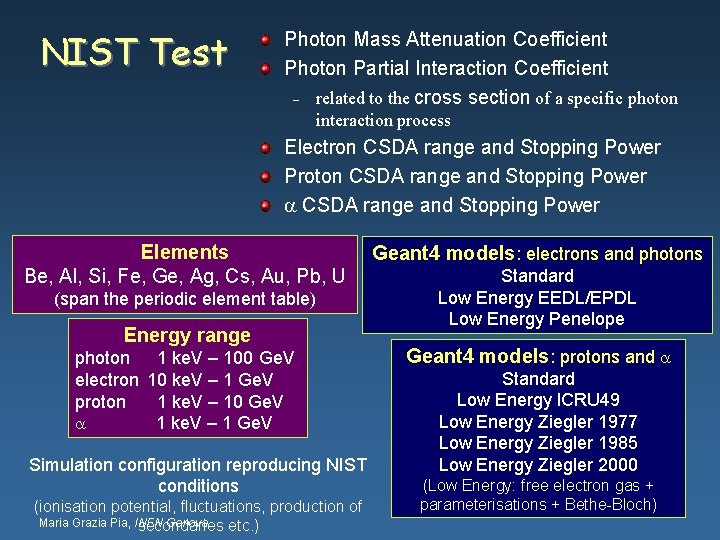
NIST Test Photon Mass Attenuation Coefficient Photon Partial Interaction Coefficient – related to the cross section of a specific photon interaction process Electron CSDA range and Stopping Power Proton CSDA range and Stopping Power a CSDA range and Stopping Power Elements Be, Al, Si, Fe, Ge, Ag, Cs, Au, Pb, U (span the periodic element table) Energy range photon electron proton a 1 ke. V – 100 Ge. V 10 ke. V – 1 Ge. V 1 ke. V – 10 Ge. V 1 ke. V – 1 Ge. V Simulation configuration reproducing NIST conditions (ionisation potential, fluctuations, production of Maria Grazia Pia, INFN Genova secondaries etc. ) Geant 4 models: electrons and photons Standard Low Energy EEDL/EPDL Low Energy Penelope Geant 4 models: protons and a Standard Low Energy ICRU 49 Low Energy Ziegler 1977 Low Energy Ziegler 1985 Low Energy Ziegler 2000 (Low Energy: free electron gas + parameterisations + Bethe-Bloch)
G. A. P Cirrone, S. Donadio, S. Guatelli, A. Mantero, B. Mascialino, S. Parlati, M. G. Pia, A. Pfeiffer, A. Ribon, P. Viarengo “A Goodness-of-Fit Statistical Toolkit” IEEE- Transactions on Nuclear Science (2004), 51 (5): 2056 -2063 Partly funded by ESA (SEPTIMESS Project) Maria Grazia Pia, INFN Genova
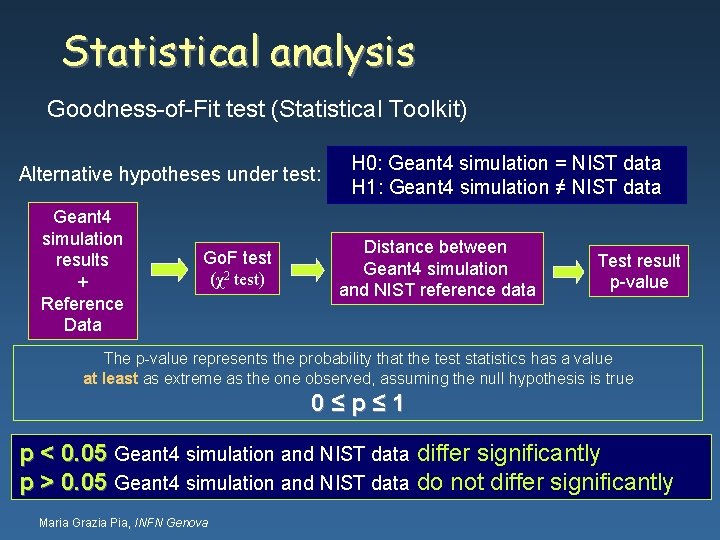
Statistical analysis Goodness-of-Fit test (Statistical Toolkit) Alternative hypotheses under test: Geant 4 simulation results + Reference Data Go. F test (χ2 test) H 0: Geant 4 simulation = NIST data H 1: Geant 4 simulation ≠ NIST data Distance between Geant 4 simulation and NIST reference data Test result p-value The p-value represents the probability that the test statistics has a value at least as extreme as the one observed, assuming the null hypothesis is true 0≤p≤ 1 p < 0. 05 Geant 4 simulation and NIST data differ significantly p > 0. 05 Geant 4 simulation and NIST data do not differ significantly Maria Grazia Pia, INFN Genova
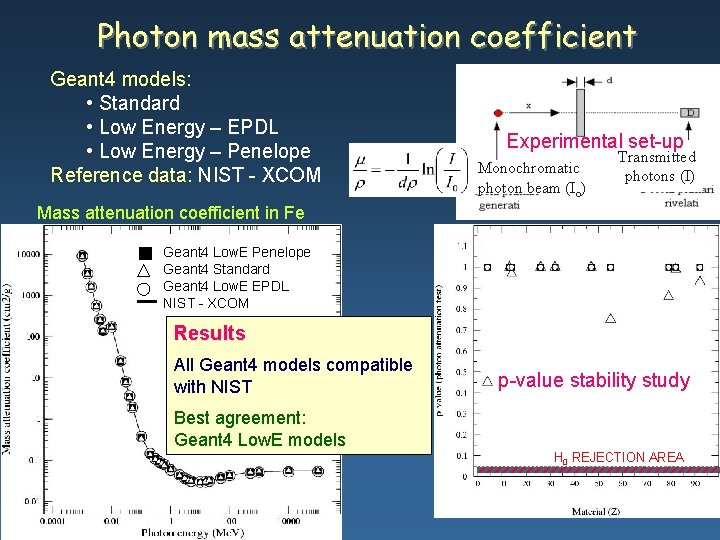
Photon mass attenuation coefficient Geant 4 models: • Standard • Low Energy – EPDL • Low Energy – Penelope Reference data: NIST - XCOM Experimental set-up Monochromatic photon beam (Io) Transmitted photons (I) Mass attenuation coefficient in Fe Geant 4 Low. E Penelope Geant 4 Standard Geant 4 Low. E EPDL NIST - XCOM Results All Geant 4 models compatible with NIST p-value stability study Best agreement: Geant 4 Low. E models H 0 REJECTION AREA Maria Grazia Pia, INFN Genova
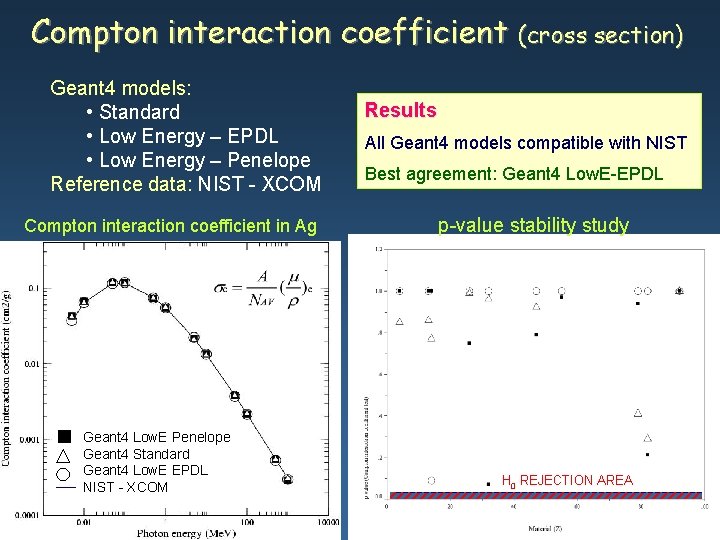
Compton interaction coefficient (cross section) Geant 4 models: • Standard • Low Energy – EPDL • Low Energy – Penelope Reference data: NIST - XCOM Compton interaction coefficient in Ag Geant 4 Low. E Penelope Geant 4 Standard Geant 4 Low. E EPDL NIST - XCOM Maria Grazia Pia, INFN Genova Results All Geant 4 models compatible with NIST Best agreement: Geant 4 Low. E-EPDL p-value stability study H 0 REJECTION AREA
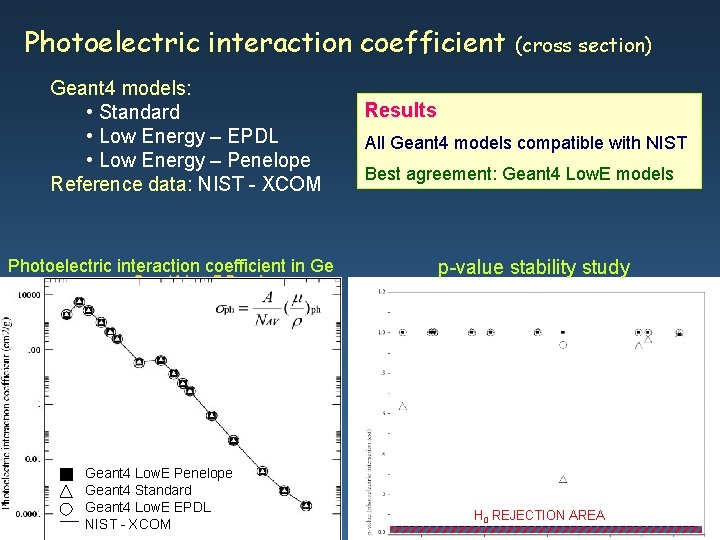
Photoelectric interaction coefficient Geant 4 models: • Standard • Low Energy – EPDL • Low Energy – Penelope Reference data: NIST - XCOM Photoelectric interaction coefficient in Ge Geant 4 Low. E Penelope Geant 4 Standard Geant 4 Low. E EPDL NIST - XCOM Geant 4 Low. E Penelope Geant 4 Standard Geant 4 Low. E EPDL Maria Grazia INFN Genova NISTPia, - XCOM (cross section) Results All Geant 4 models compatible with NIST Best agreement: Geant 4 Low. E models p-value stability study H 0 REJECTION AREA
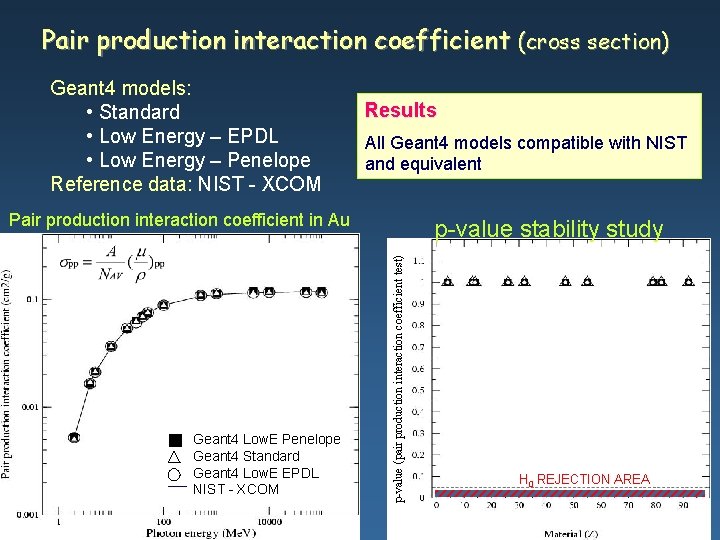
Pair production interaction coefficient (cross section) Geant 4 models: • Standard • Low Energy – EPDL • Low Energy – Penelope Reference data: NIST - XCOM Results All Geant 4 models compatible with NIST and equivalent Pair production interaction coefficient in Au Maria Grazia Pia, INFN Genova p-value (pair production interaction coefficient test) Geant 4 Low. E Penelope Geant 4 Standard Geant 4 Low. E EPDL NIST - XCOM p-value stability study H 0 REJECTION AREA
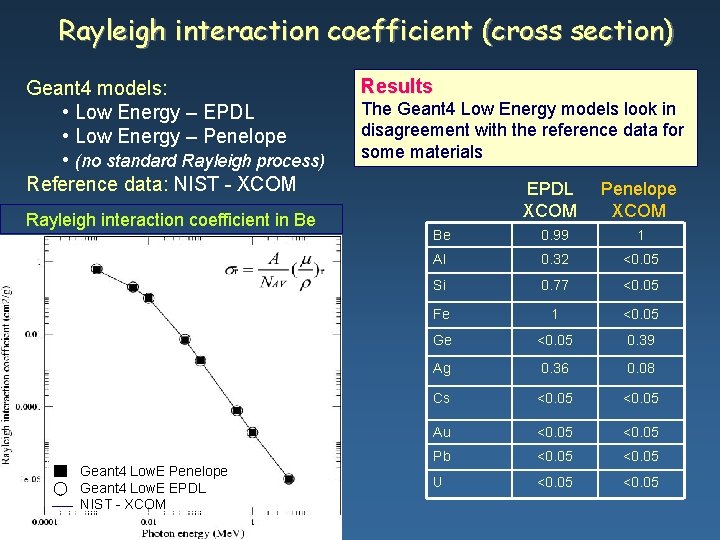
Rayleigh interaction coefficient (cross section) Geant 4 models: • Low Energy – EPDL • Low Energy – Penelope • (no standard Rayleigh process) Reference data: NIST - XCOM Rayleigh interaction coefficient in Be Geant 4 Low. E Penelope Geant 4 Low. E EPDL NIST - XCOM Maria Grazia Pia, INFN Genova Results The Geant 4 Low Energy models look in disagreement with the reference data for some materials EPDL XCOM Penelope XCOM Be 0. 99 1 Al 0. 32 <0. 05 Si 0. 77 <0. 05 Fe 1 <0. 05 Ge <0. 05 0. 39 Ag 0. 36 0. 08 Cs <0. 05 Au <0. 05 Pb <0. 05 U <0. 05
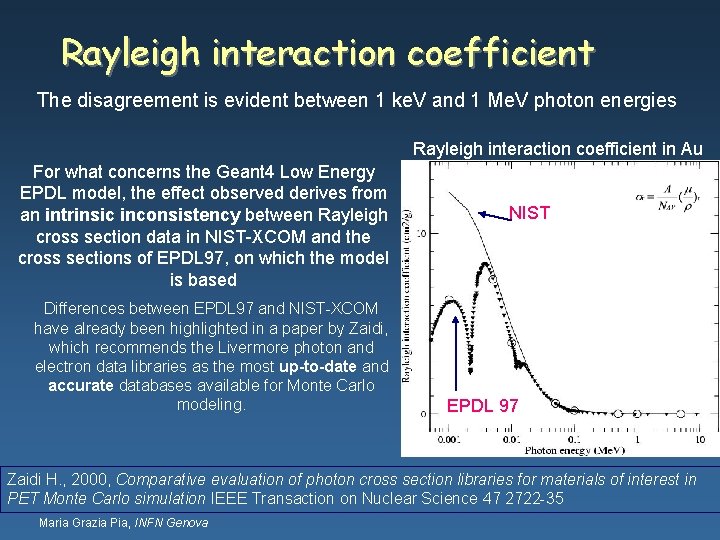
Rayleigh interaction coefficient The disagreement is evident between 1 ke. V and 1 Me. V photon energies Rayleigh interaction coefficient in Au For what concerns the Geant 4 Low Energy EPDL model, the effect observed derives from an intrinsic inconsistency between Rayleigh cross section data in NIST-XCOM and the cross sections of EPDL 97, on which the model is based Differences between EPDL 97 and NIST-XCOM have already been highlighted in a paper by Zaidi, which recommends the Livermore photon and electron data libraries as the most up-to-date and accurate databases available for Monte Carlo modeling. NIST EPDL 97 Zaidi H. , 2000, Comparative evaluation of photon cross section libraries for materials of interest in PET Monte Carlo simulation IEEE Transaction on Nuclear Science 47 2722 -35 Maria Grazia Pia, INFN Genova
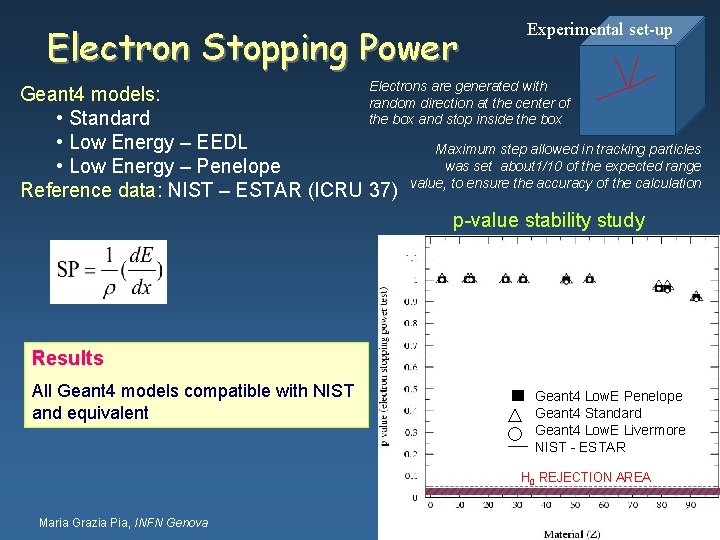
Electron Stopping Power Experimental set-up Electrons are generated with Geant 4 models: random direction at the center of the box and stop inside the box • Standard • Low Energy – EEDL Maximum step allowed in tracking particles was set about 1/10 of the expected range • Low Energy – Penelope Reference data: NIST – ESTAR (ICRU 37) value, to ensure the accuracy of the calculation p-value stability study Results All Geant 4 models compatible with NIST and equivalent Geant 4 Low. E Penelope Geant 4 Standard Geant 4 Low. E Livermore NIST - ESTAR H 0 REJECTION AREA Maria Grazia Pia, INFN Genova
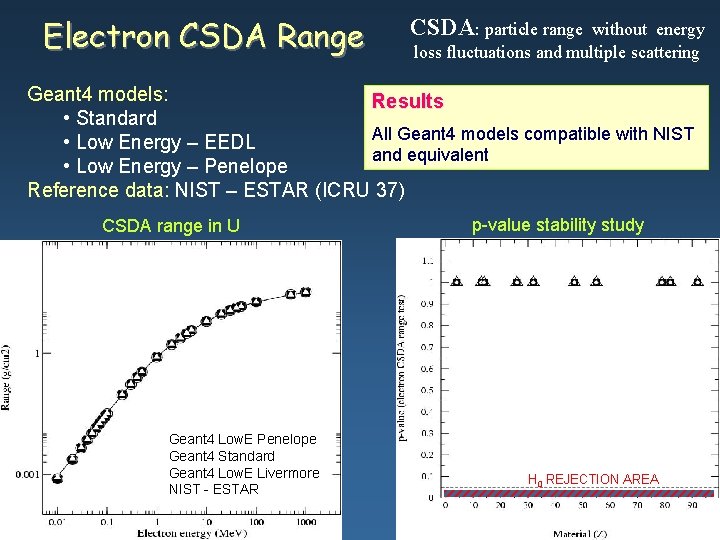
Electron CSDA Range CSDA: particle range without energy loss fluctuations and multiple scattering Geant 4 models: Results • Standard All Geant 4 models compatible with NIST • Low Energy – EEDL and equivalent • Low Energy – Penelope Reference data: NIST – ESTAR (ICRU 37) CSDA range in U Geant 4 Low. E Penelope Geant 4 Standard Geant 4 Low. E Livermore NIST - ESTAR Maria Grazia Pia, INFN Genova p-value stability study H 0 REJECTION AREA
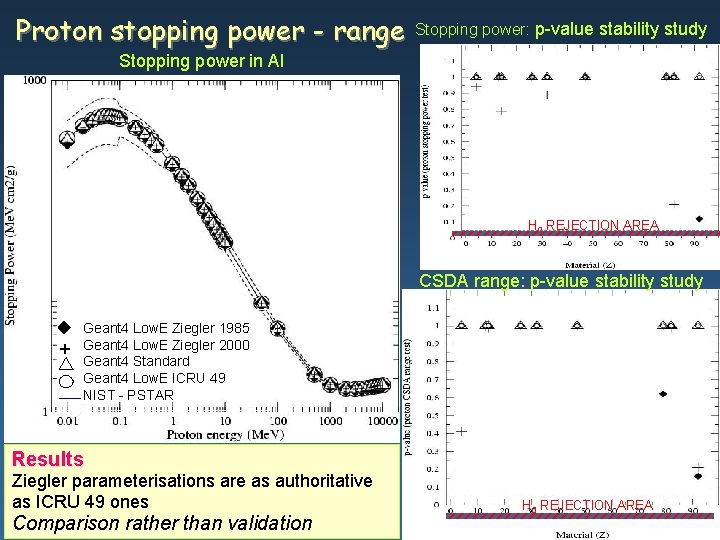
Proton stopping power - range Stopping power: p-value stability study Stopping power in Al H 0 REJECTION AREA CSDA range: p-value stability study + Geant 4 Low. E Ziegler 1985 Geant 4 Low. E Ziegler 2000 Geant 4 Standard Geant 4 Low. E ICRU 49 NIST - PSTAR Results Ziegler parameterisations are as authoritative as ICRU 49 ones Maria Grazia Pia, rather INFN Genova Comparison than validation H 0 REJECTION AREA
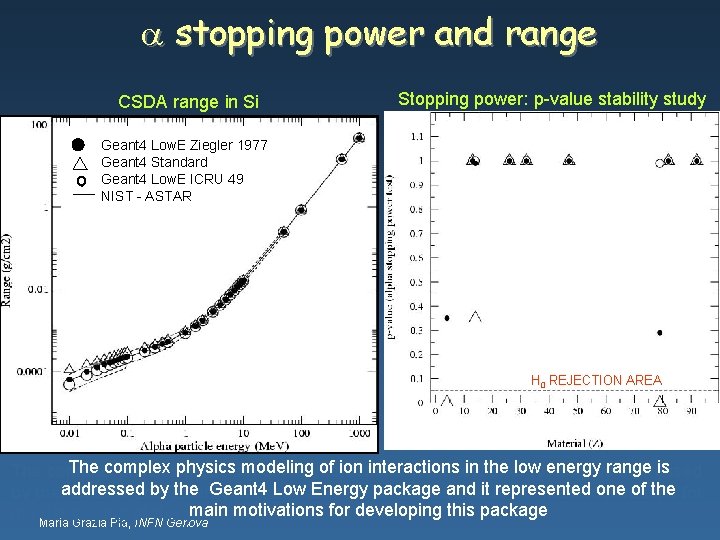
a stopping power and range CSDA range in Si Stopping power: p-value stability study Geant 4 Low. E Ziegler 1977 Geant 4 Standard Geant 4 Low. E ICRU 49 NIST - ASTAR H 0 REJECTION AREA The complex modeling of ion interactions in the low energy is The complex physics modeling of ion interactions in the low energy range isrange addressed by Energy the Geant 4 Lowand Energy package and represented one of the for by the addressed Geant 4 Low package it represented oneit of the main motivations for developing this package the Maria developing of this package. Grazia Pia, INFN Genova
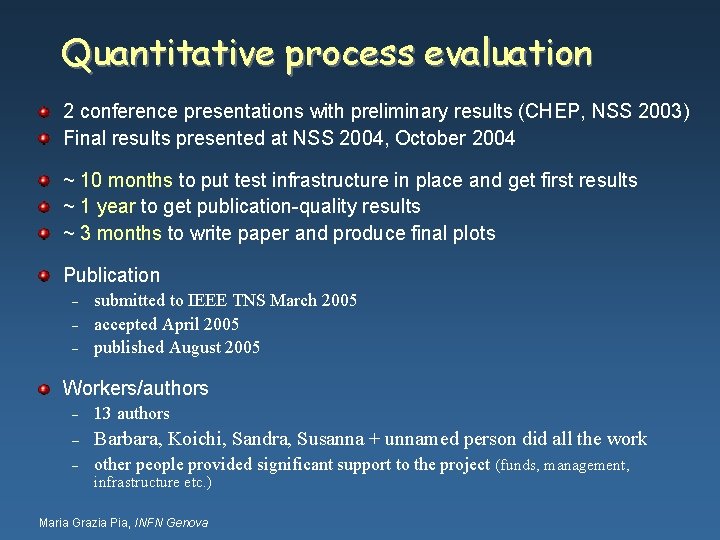
Quantitative process evaluation 2 conference presentations with preliminary results (CHEP, NSS 2003) Final results presented at NSS 2004, October 2004 ~ 10 months to put test infrastructure in place and get first results ~ 1 year to get publication-quality results ~ 3 months to write paper and produce final plots Publication – – – submitted to IEEE TNS March 2005 accepted April 2005 published August 2005 Workers/authors – 13 authors – Barbara, Koichi, Sandra, Susanna + unnamed person did all the work – other people provided significant support to the project (funds, management, infrastructure etc. ) Maria Grazia Pia, INFN Genova
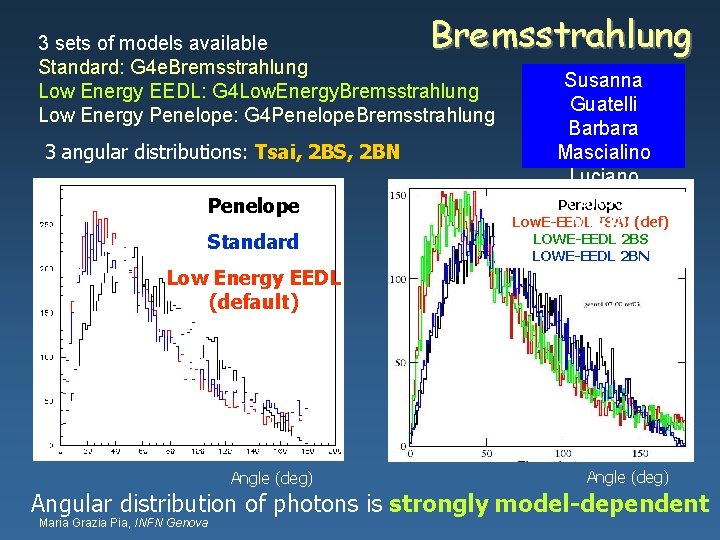
Bremsstrahlung 3 sets of models available Standard: G 4 e. Bremsstrahlung Low Energy EEDL: G 4 Low. Energy. Bremsstrahlung Low Energy Penelope: G 4 Penelope. Bremsstrahlung 3 angular distributions: Tsai, 2 BS, 2 BN Penelope Standard Susanna Guatelli Barbara Mascialino Luciano Pandola Penelope Low. E-EEDL MGTSAI Pia(def) LOWE-EEDL 2 BS LOWE-EEDL 2 BN Low Energy EEDL (default) Angle (deg) Angular distribution of photons is strongly model-dependent Maria Grazia Pia, INFN Genova
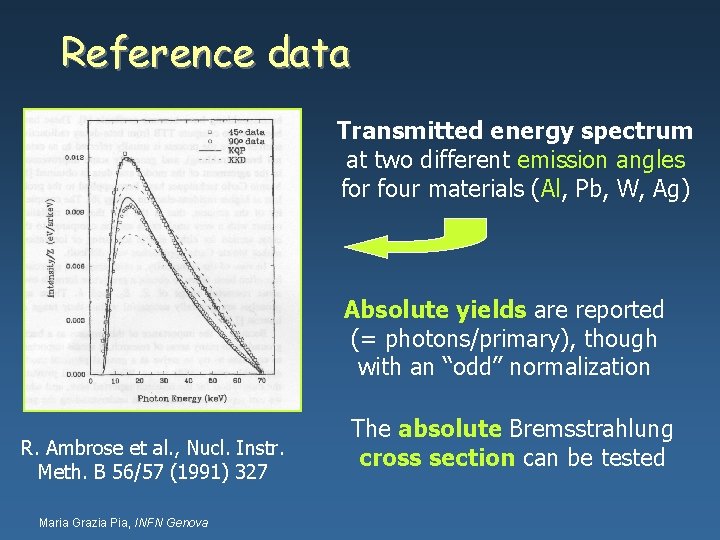
Reference data Transmitted energy spectrum at two different emission angles for four materials (Al, Pb, W, Ag) Absolute yields are reported (= photons/primary), though with an “odd” normalization R. Ambrose et al. , Nucl. Instr. Meth. B 56/57 (1991) 327 Maria Grazia Pia, INFN Genova The absolute Bremsstrahlung cross section can be tested
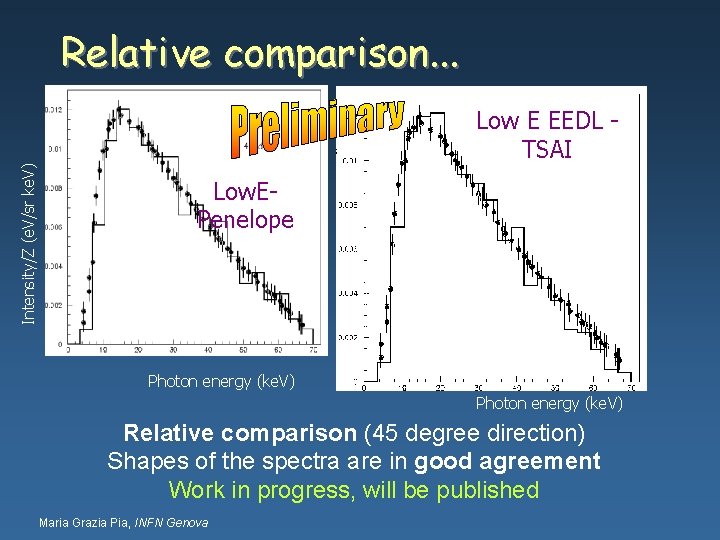
Relative comparison. . . Low. EPenelope Intensity/Z (e. V/sr ke. V) Low E EEDL TSAI Photon energy (ke. V) Relative comparison (45 degree direction) Shapes of the spectra are in good agreement Work in progress, will be published Maria Grazia Pia, INFN Genova
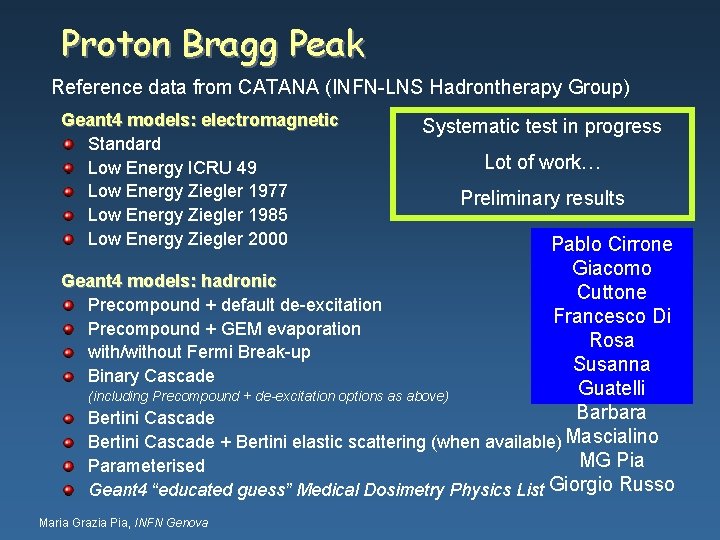
Proton Bragg Peak Reference data from CATANA (INFN-LNS Hadrontherapy Group) Geant 4 models: electromagnetic Standard Low Energy ICRU 49 Low Energy Ziegler 1977 Low Energy Ziegler 1985 Low Energy Ziegler 2000 Systematic test in progress Lot of work… Preliminary results Pablo Cirrone Giacomo Geant 4 models: hadronic Cuttone Precompound + default de-excitation Francesco Di Precompound + GEM evaporation Rosa with/without Fermi Break-up Susanna Binary Cascade Guatelli (including Precompound + de-excitation options as above) Barbara Bertini Cascade + Bertini elastic scattering (when available) Mascialino MG Pia Parameterised Geant 4 “educated guess” Medical Dosimetry Physics List Giorgio Russo Maria Grazia Pia, INFN Genova
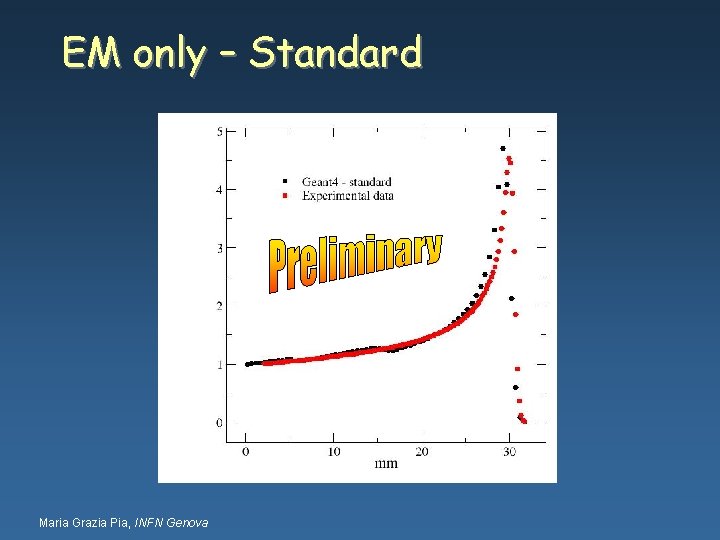
EM only – Standard Maria Grazia Pia, INFN Genova
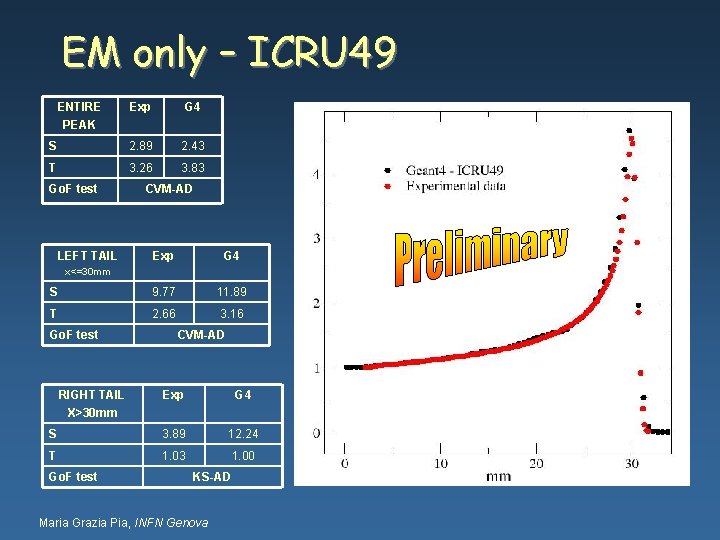
EM only – ICRU 49 ENTIRE PEAK Exp G 4 S 2. 89 2. 43 T 3. 26 3. 83 Go. F test LEFT TAIL ENTIRE PEAK CVM-AD Exp 9. 77 11. 89 T 2. 66 3. 16 CVM-AD Exp G 4 S 3. 89 12. 24 T 1. 03 1. 00 Go. F test S 2. 89 2. 43 T 3. 26 3. 83 Go. F test S RIGHT TAIL X>30 mm G 4 x<=30 mm Go. F test Exp KS-AD Maria Grazia Pia, INFN Genova CVM-AD
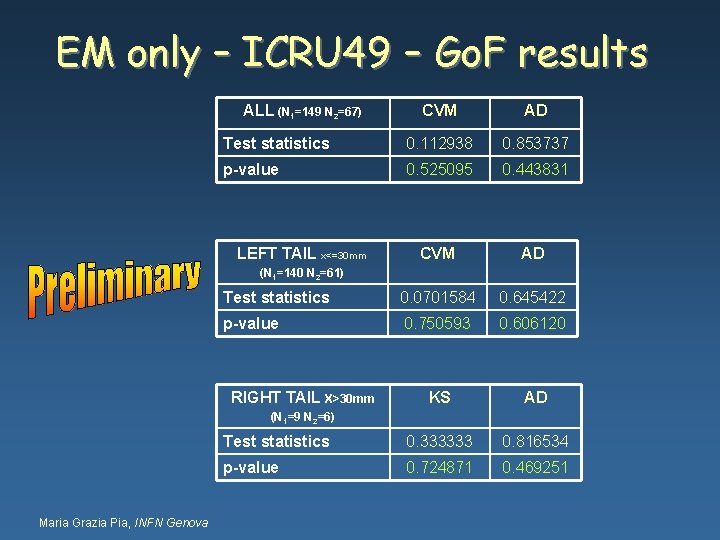
EM only – ICRU 49 – Go. F results ALL (N 1=149 N 2=67) CVM AD Test statistics 0. 112938 0. 853737 p-value 0. 525095 0. 443831 CVM AD Test statistics 0. 0701584 0. 645422 p-value 0. 750593 0. 606120 KS AD Test statistics 0. 333333 0. 816534 p-value 0. 724871 0. 469251 LEFT TAIL x<=30 mm (N 1=140 N 2=61) RIGHT TAIL X>30 mm (N 1=9 N 2=6) Maria Grazia Pia, INFN Genova
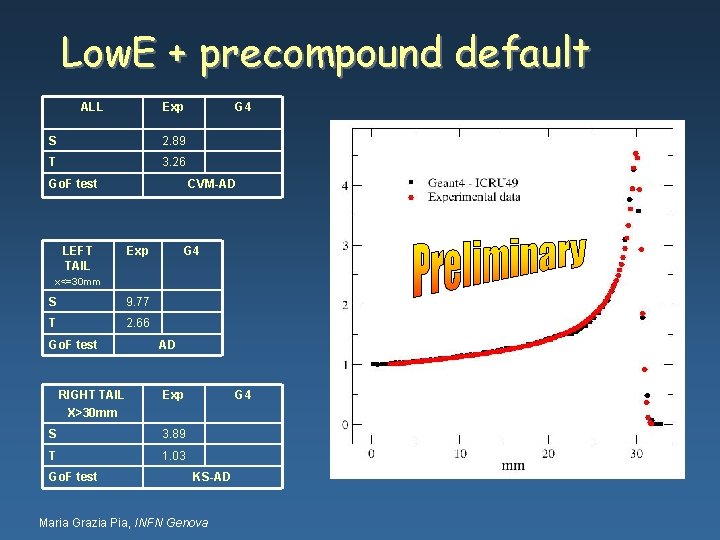
Low. E + precompound default ALL Exp S 2. 89 T 3. 26 Go. F test LEFT TAIL G 4 CVM-AD Exp G 4 x<=30 mm S 9. 77 T 2. 66 Go. F test RIGHT TAIL X>30 mm AD Exp S 3. 89 T 1. 03 Go. F test G 4 KS-AD Maria Grazia Pia, INFN Genova
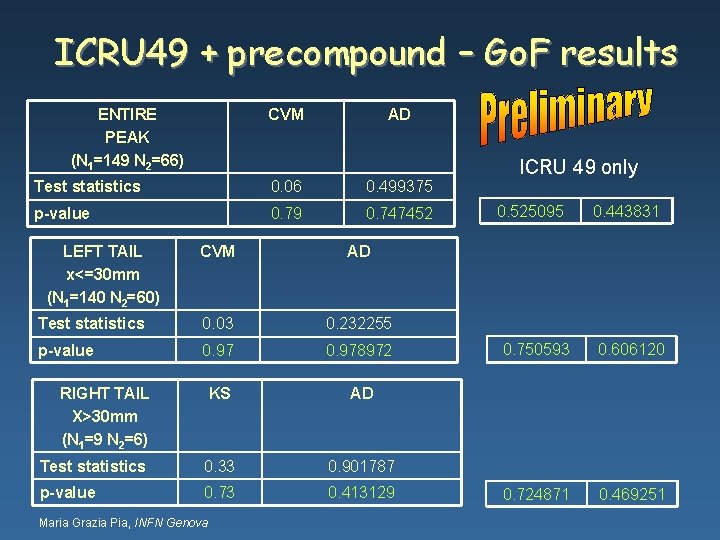
ICRU 49 + precompound – Go. F results ENTIRE PEAK (N 1=149 N 2=66) CVM AD Test statistics 0. 06 0. 499375 p-value 0. 79 0. 747452 LEFT TAIL x<=30 mm (N 1=140 N 2=60) CVM AD Test statistics 0. 03 0. 232255 p-value 0. 978972 RIGHT TAIL X>30 mm (N 1=9 N 2=6) KS AD Test statistics 0. 33 0. 901787 p-value 0. 73 0. 413129 Maria Grazia Pia, INFN Genova ICRU 49 only 0. 525095 0. 443831 0. 750593 0. 606120 0. 724871 0. 469251
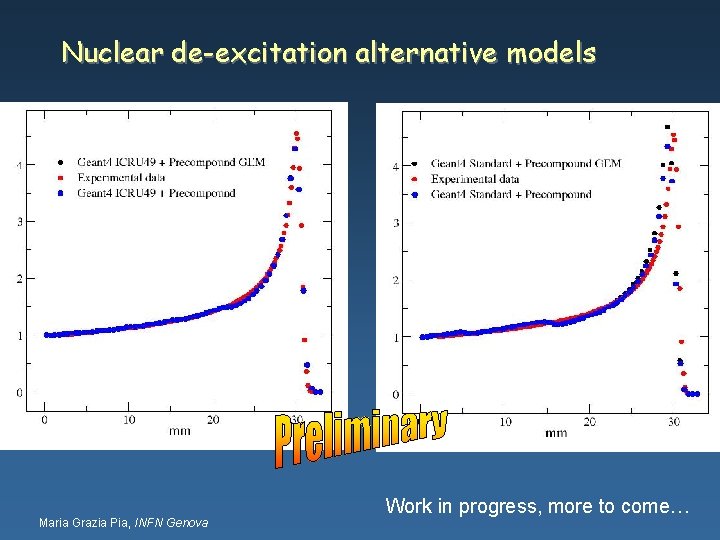
Nuclear de-excitation alternative models Maria Grazia Pia, INFN Genova Work in progress, more to come…
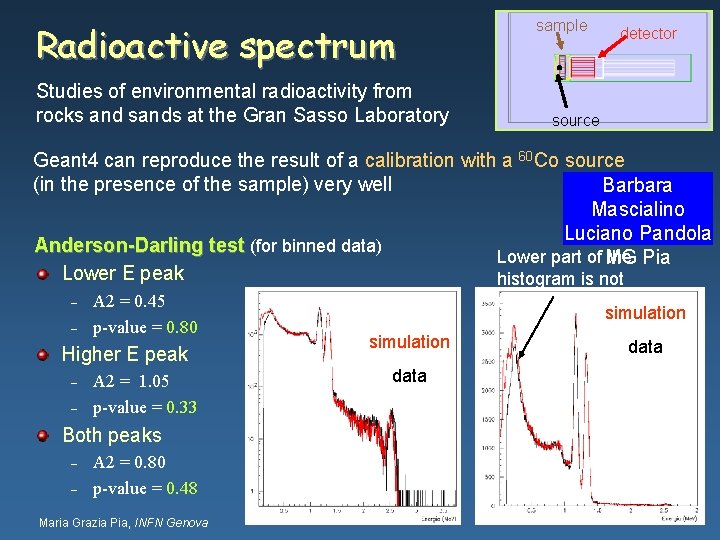
Radioactive spectrum Studies of environmental radioactivity from rocks and sands at the Gran Sasso Laboratory sample detector source Geant 4 can reproduce the result of a calibration with a 60 Co source (in the presence of the sample) very well Barbara Mascialino Luciano Pandola Anderson-Darling test (for binned data) Lower part of MG the Pia Lower E peak histogram is not – – A 2 = 0. 45 p-value = 0. 80 Higher E peak – – A 2 = 1. 05 p-value = 0. 33 Both peaks – – A 2 = 0. 80 p-value = 0. 48 Maria Grazia Pia, INFN Genova meaningful simulation data
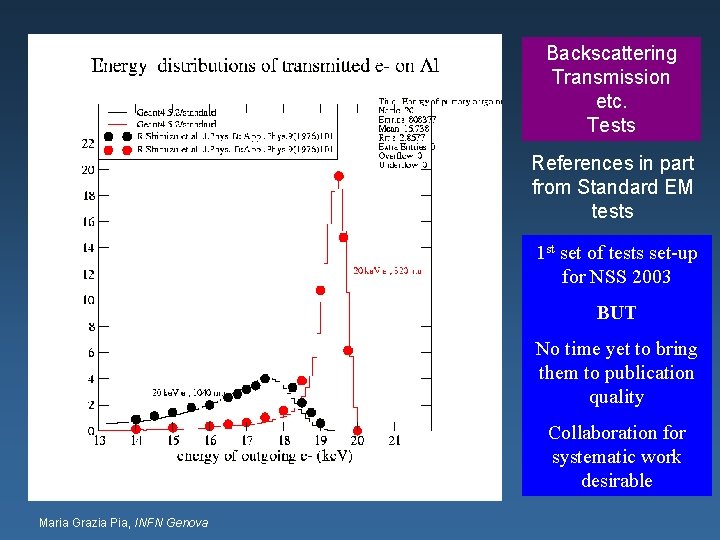
Backscattering Transmission etc. Tests References in part from Standard EM tests 1 st set of tests set-up for NSS 2003 BUT No time yet to bring them to publication quality Collaboration for systematic work desirable Maria Grazia Pia, INFN Genova
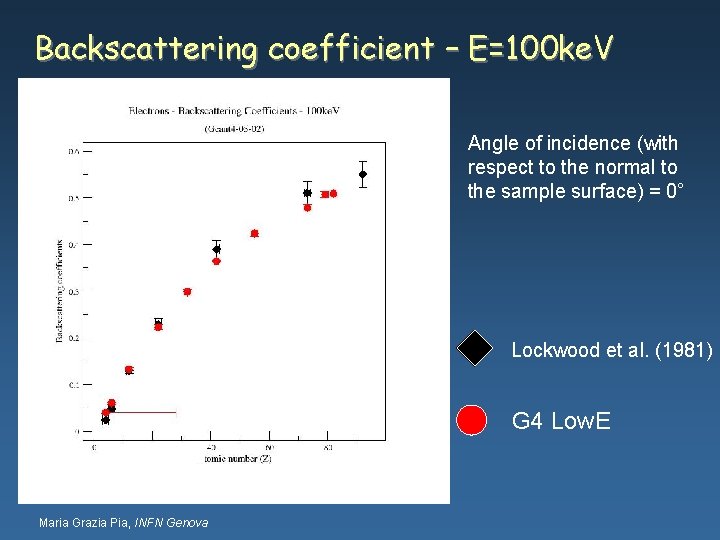
Backscattering coefficient – E=100 ke. V Angle of incidence (with respect to the normal to the sample surface) = 0° Lockwood et al. (1981) G 4 Low. E Maria Grazia Pia, INFN Genova
Comments Feedback from users is a helpful contribution to Geant 4 validation – but the systematic work needed to document Geant 4 validity quantitatively can only come from the Geant 4 Collaboration Better communication and collaboration is desirable – – – internal competition in the Geant 4 Collaboration is not constructive competition against Geant 4 students and post-docs is not constructive slow progress is due to limited womanpower Dedicated validation workshops are necessary and fruitful – not easy to organize (and expensive to attend) Regular VRVS Validation meetings will be organized in 2006 The key to success for publication-quality results is a rigorous software process Maria Grazia Pia, INFN Genova
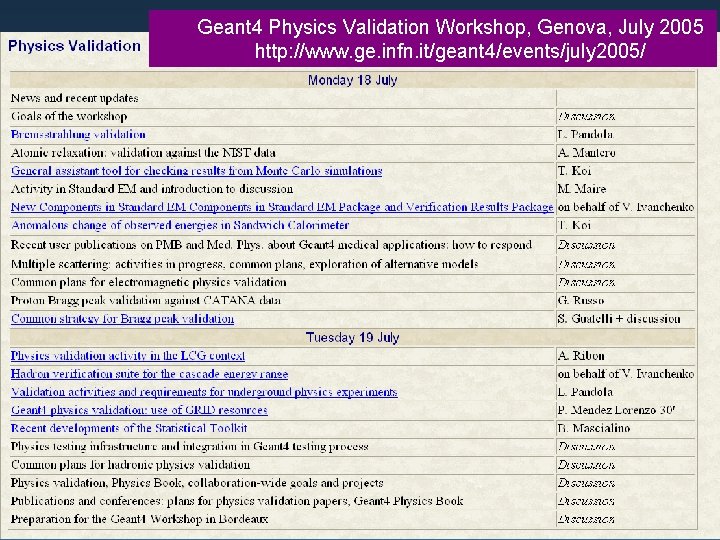
Geant 4 Physics Validation Workshop, Genova, July 2005 http: //www. ge. infn. it/geant 4/events/july 2005/ Maria Grazia Pia, INFN Genova
Conclusion More results available, no time to show them all… – – multiple scattering? atomic relaxation (A. Mantero, B. Mascialino, M. G. Pia, V. Zampichelli) validation for specific use cases etc. Systematic, quantitative validation of Geant 4 EM physics in progress – – all available models rigorous statistical analysis A lot of work! – – – first paper published several on-going projects limited resources available The validation work provides valuable feedback for the improvement of Geant 4 physics models Maria Grazia Pia, INFN Genova
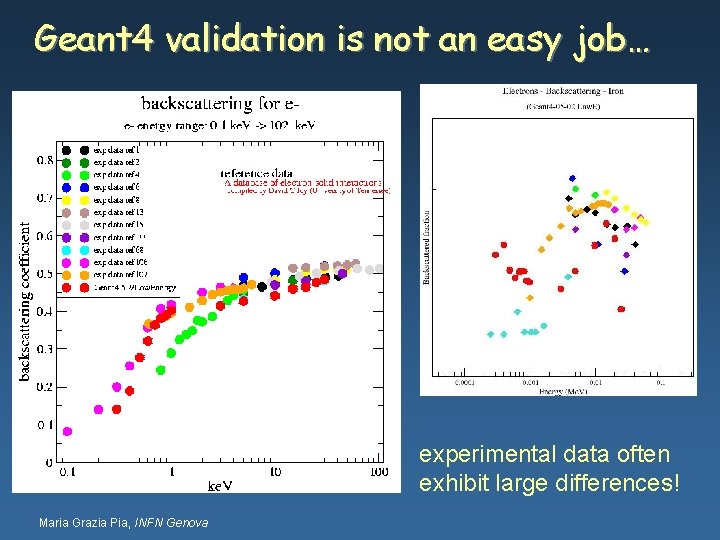
Geant 4 validation is not an easy job… experimental data often exhibit large differences! Maria Grazia Pia, INFN Genova
Publications It would be desirable to agree a publication plan for Geant 4 physics validation – electromagnetic + hadronic IEEE Trans. Nucl. Sci. – – major scientific journal about nuclear technologies and instrumentation many Geant 4 -related papers published or currently in the review process please consider publishing your results concerning Geant 4 copyright compatible with Geant 4 Physics Book Maria Grazia Pia, INFN Genova
- Slides: 37