
GE 3 1 GRAMMAR EXPLORER 3 Unit 13




- Slides: 45
GE 3. 1 GRAMMAR EXPLORER 3 Unit 13: Choices Conditionals
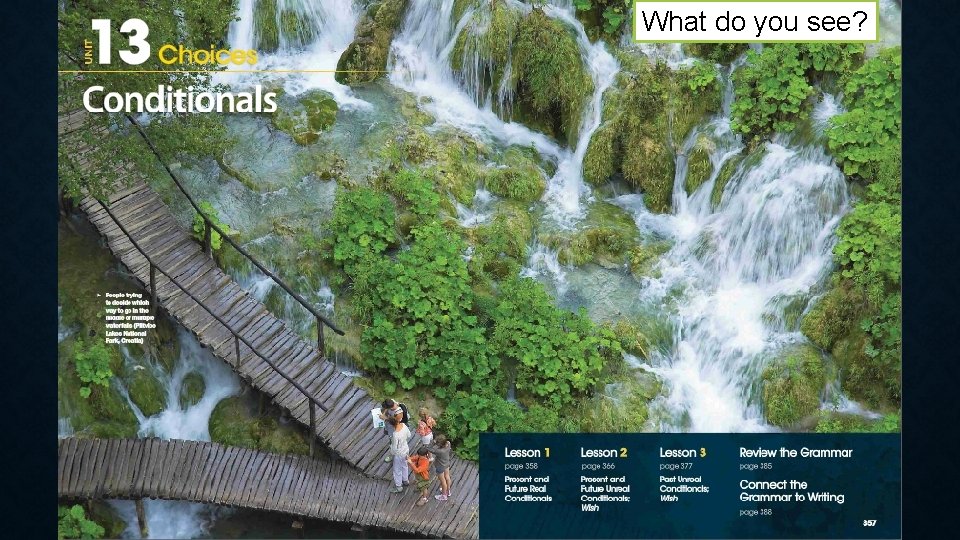
What do you see?
Journalist Paul Salopek leads a pair of camels across Ethiopia’s Afar desert (Afar, Ethiopia). A museum worker checks the hair on this woolly mammoth replica. (Victoria, British Columbia, Canada)
LESSON 1: PRESENT AND FUTURE REAL CONDITIONALS Student Learning Outcomes: • READ an article about making decisions. • MAKE sentences with conditionals. • WRITE and SPEAK about careers. • LISTEN to a talk about making decisions. • DISCUSS and WRITE about decisions. • FIND and EDIT errors with conditionals.
LESSON VOCABULARY (n. ) brand (n. ) option (n. ) candidate (v. ) perceive (adj. ) efficient (v. ) prefer (n. ) influence (adj. ) rational (v. ) matter (n. ) rate
EXPLORE 1 READ the article about why people do not always make logical decisions. What often influences the decisions we make? CD 4 -02
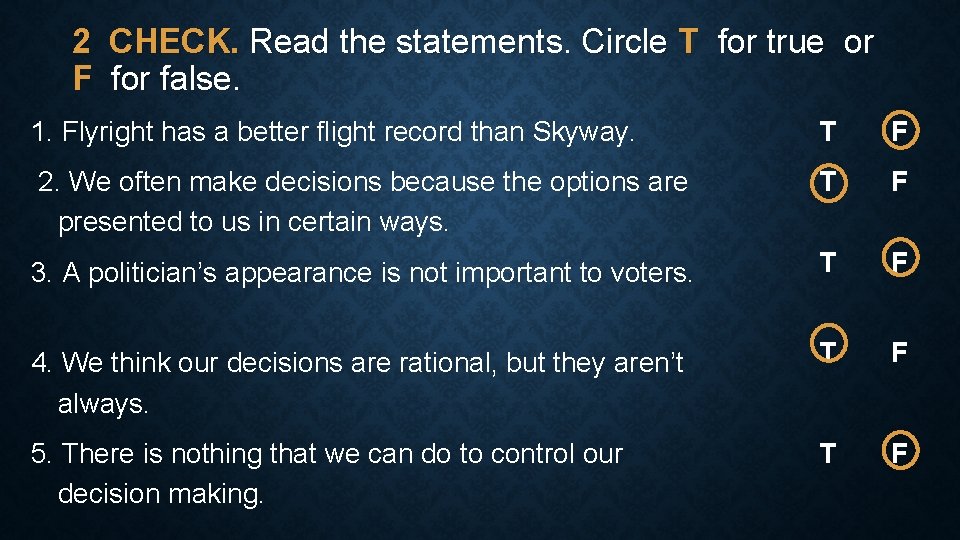
2 CHECK. Read the statements. Circle T for true or F for false. 1. Flyright has a better flight record than Skyway. T F 2. We often make decisions because the options are presented to us in certain ways. T F 3. A politician’s appearance is not important to voters. T F 4. We think our decisions are rational, but they aren’t always. T F 5. There is nothing that we can do to control our decision making. T F
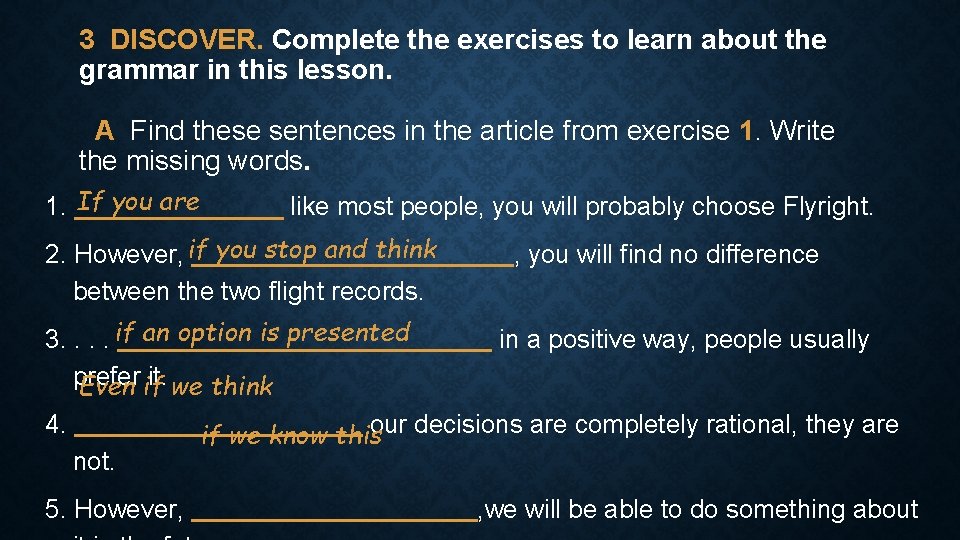
3 DISCOVER. Complete the exercises to learn about the grammar in this lesson. A Find these sentences in the article from exercise 1. Write the missing words. 1. If you are like most people, you will probably choose Flyright. 2. However, if you stop and think between the two flight records. 3. . if an option is presented prefer it. we think Even if 4. not. 5. However, , you will find no difference in a positive way, people usually if we know thisour decisions are completely rational, they are , we will be able to do something about
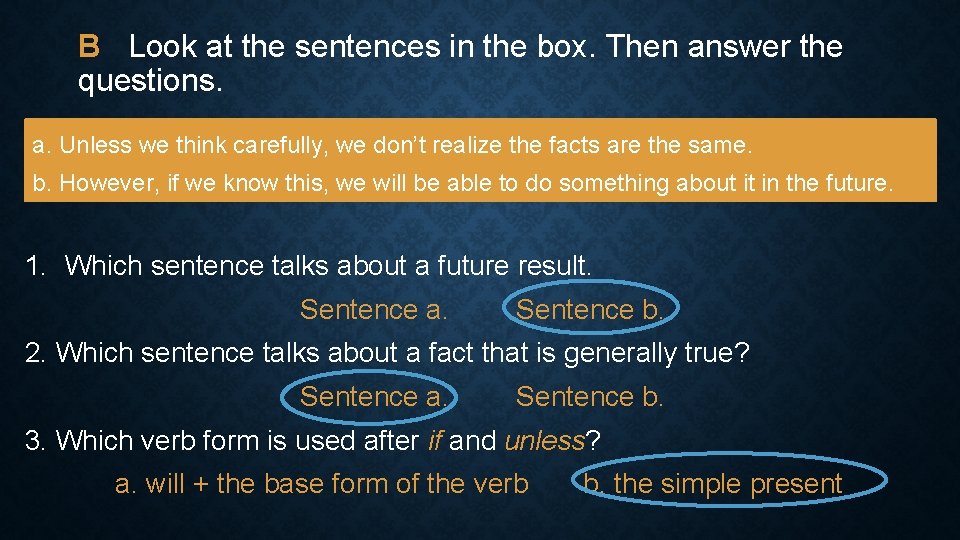
B Look at the sentences in the box. Then answer the questions. a. Unless we think carefully, we don’t realize the facts are the same. b. However, if we know this, we will be able to do something about it in the future. 1. Which sentence talks about a future result. Sentence a. Sentence b. 2. Which sentence talks about a fact that is generally true? Sentence a. Sentence b. 3. Which verb form is used after if and unless? a. will + the base form of the verb b. the simple present
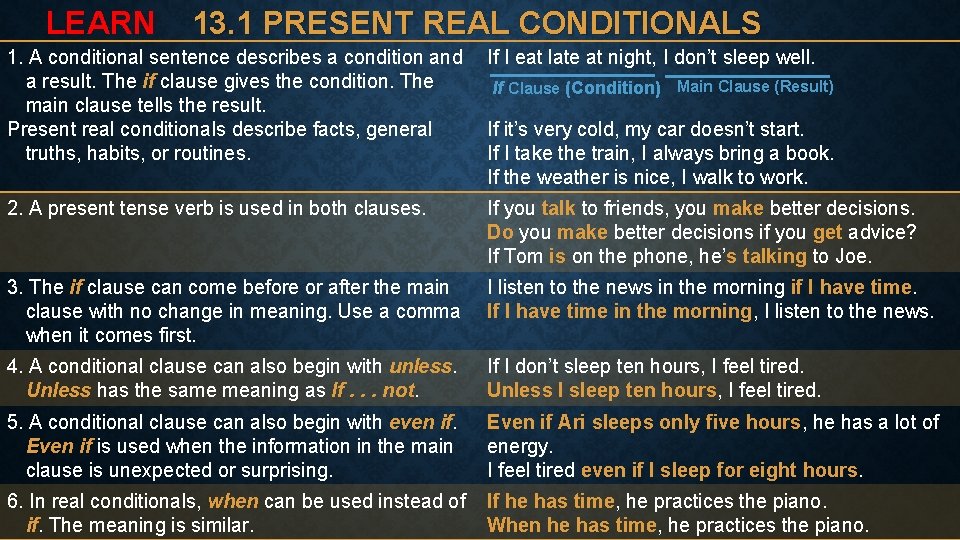
LEARN 13. 1 PRESENT REAL CONDITIONALS 1. A conditional sentence describes a condition and a result. The if clause gives the condition. The main clause tells the result. Present real conditionals describe facts, general truths, habits, or routines. If I eat late at night, I don’t sleep well. 2. A present tense verb is used in both clauses. If you talk to friends, you make better decisions. Do you make better decisions if you get advice? If Tom is on the phone, he’s talking to Joe. 3. The if clause can come before or after the main clause with no change in meaning. Use a comma when it comes first. I listen to the news in the morning if I have time. If I have time in the morning, I listen to the news. 4. A conditional clause can also begin with unless. Unless has the same meaning as If. . . not. If I don’t sleep ten hours, I feel tired. Unless I sleep ten hours, I feel tired. 5. A conditional clause can also begin with even if. Even if is used when the information in the main clause is unexpected or surprising. Even if Ari sleeps only five hours, he has a lot of energy. I feel tired even if I sleep for eight hours. 6. In real conditionals, when can be used instead of if. The meaning is similar. If he has time, he practices the piano. When he has time, he practices the piano. If Clause (Condition) Main Clause (Result) If it’s very cold, my car doesn’t start. If I take the train, I always bring a book. If the weather is nice, I walk to work.
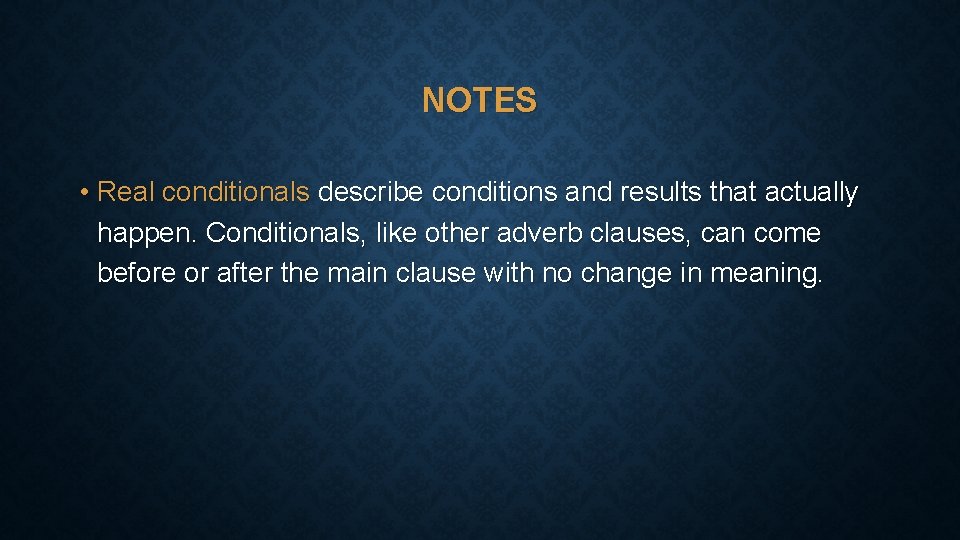
NOTES • Real conditionals describe conditions and results that actually happen. Conditionals, like other adverb clauses, can come before or after the main clause with no change in meaning.
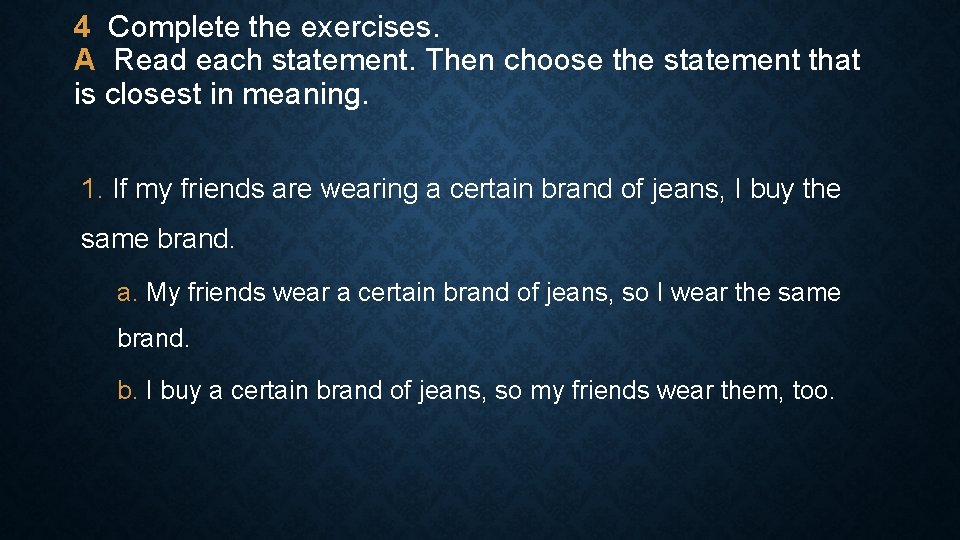
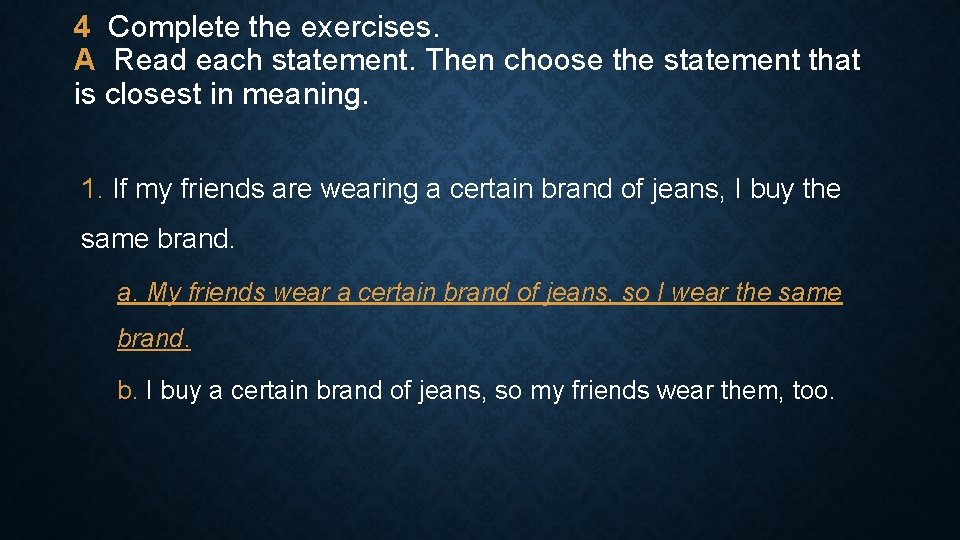
4 Complete the exercises. A Read each statement. Then choose the statement that is closest in meaning. 1. If my friends are wearing a certain brand of jeans, I buy the same brand. a. My friends wear a certain brand of jeans, so I wear the same brand. b. I buy a certain brand of jeans, so my friends wear them, too.
4 Complete the exercises. A Read each statement. Then choose the statement that is closest in meaning. 1. If my friends are wearing a certain brand of jeans, I buy the same brand. a. My friends wear a certain brand of jeans, so I wear the same brand. b. I buy a certain brand of jeans, so my friends wear them, too.
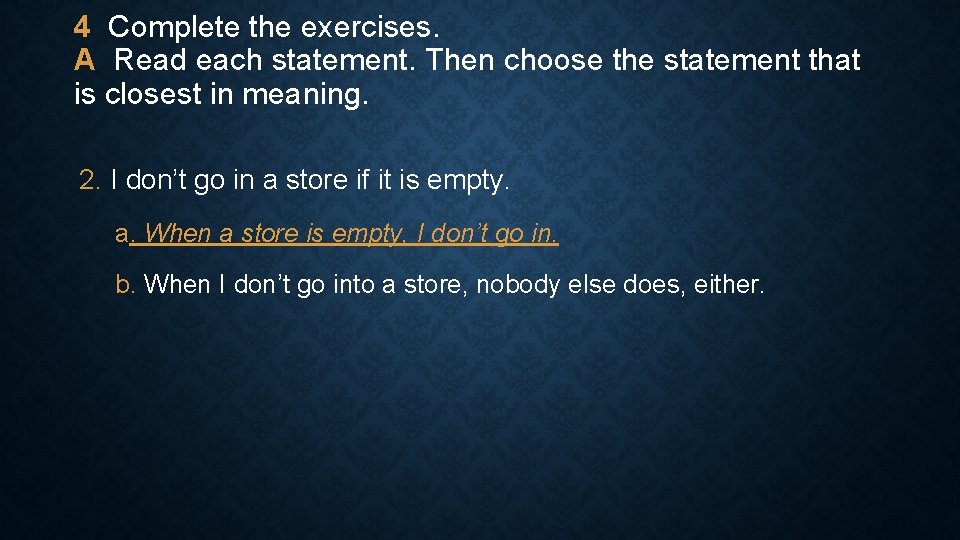
4 Complete the exercises. A Read each statement. Then choose the statement that is closest in meaning. 2. I don’t go in a store if it is empty. a. When a store is empty, I don’t go in. b. When I don’t go into a store, nobody else does, either.
4 Complete the exercises. A Read each statement. Then choose the statement that is closest in meaning. 2. I don’t go in a store if it is empty. a. When a store is empty, I don’t go in. b. When I don’t go into a store, nobody else does, either.
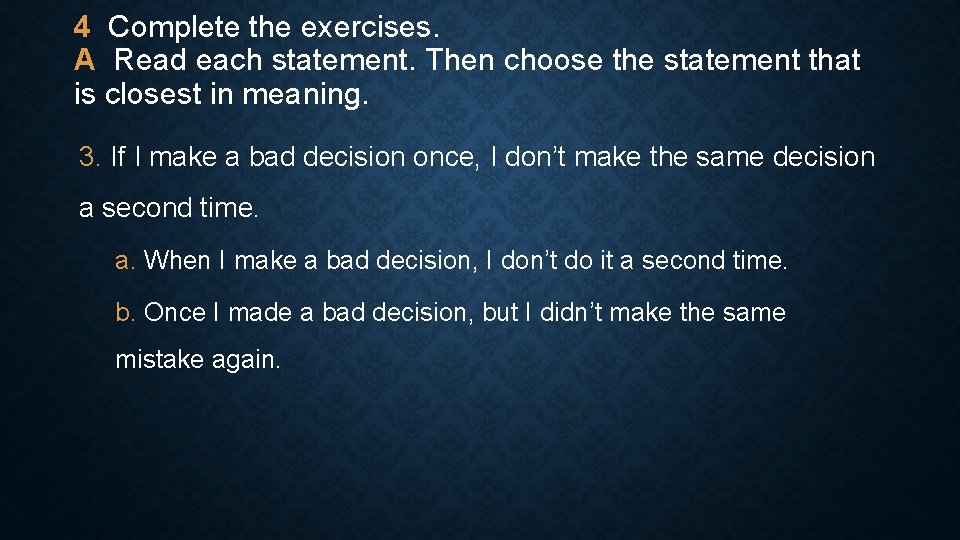
4 Complete the exercises. A Read each statement. Then choose the statement that is closest in meaning. 3. If I make a bad decision once, I don’t make the same decision a second time. a. When I make a bad decision, I don’t do it a second time. b. Once I made a bad decision, but I didn’t make the same mistake again.
4 Complete the exercises. A Read each statement. Then choose the statement that is closest in meaning. 3. If I make a bad decision once, I don’t make the same decision a second time. a. When I make a bad decision, I don’t do it a second time. b. Once I made a bad decision, but I didn’t make the same mistake again.
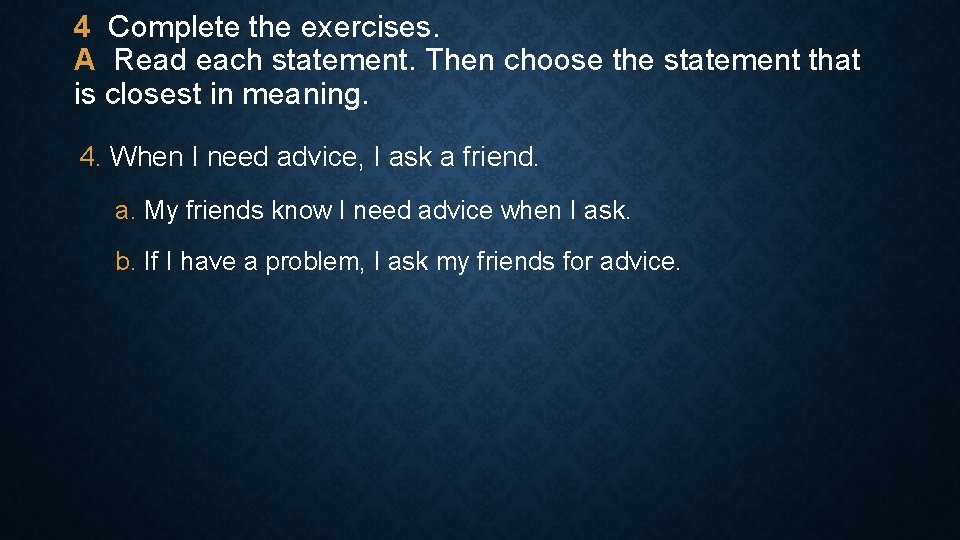
4 Complete the exercises. A Read each statement. Then choose the statement that is closest in meaning. 4. When I need advice, I ask a friend. a. My friends know I need advice when I ask. b. If I have a problem, I ask my friends for advice.
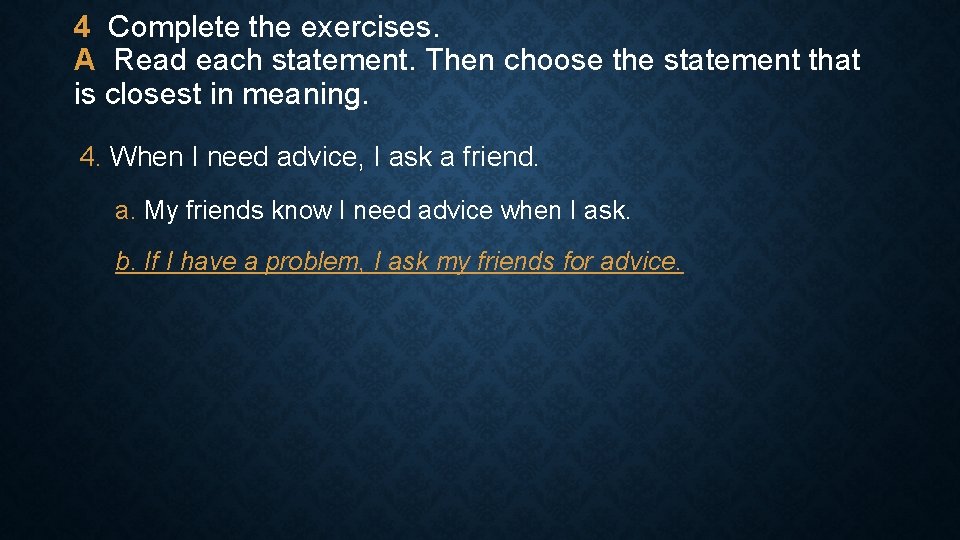
4 Complete the exercises. A Read each statement. Then choose the statement that is closest in meaning. 4. When I need advice, I ask a friend. a. My friends know I need advice when I ask. b. If I have a problem, I ask my friends for advice.
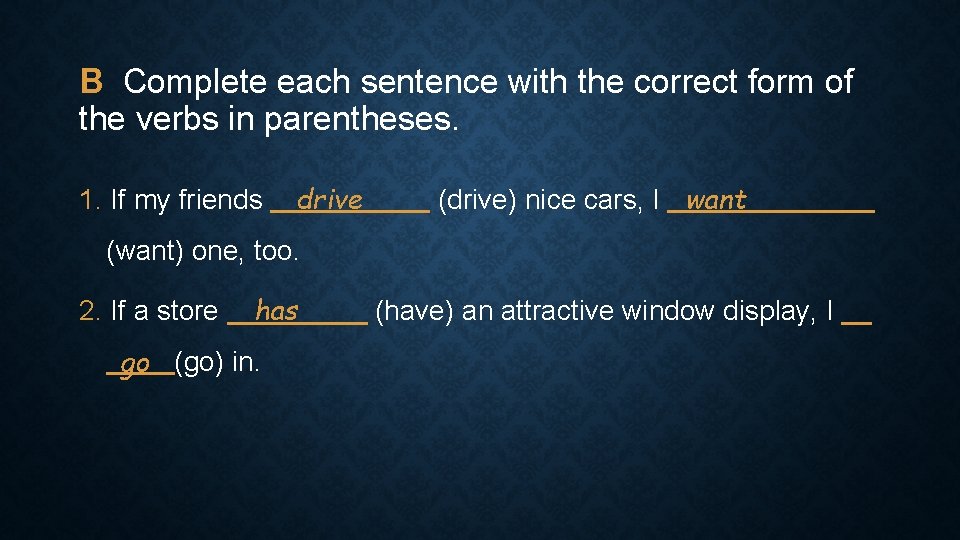
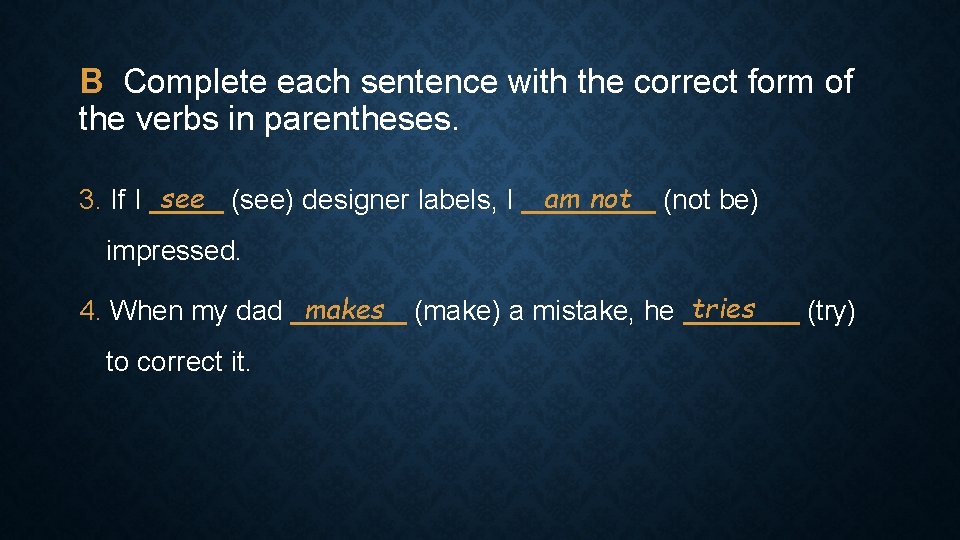
B Complete each sentence with the correct form of the verbs in parentheses. 1. If my friends drive (drive) nice cars, I want (want) one, too. 2. If a store has go (go) in. (have) an attractive window display, I
B Complete each sentence with the correct form of the verbs in parentheses. 3. If I see (see) designer labels, I am not (not be) impressed. 4. When my dad makes to correct it. (make) a mistake, he tries (try)
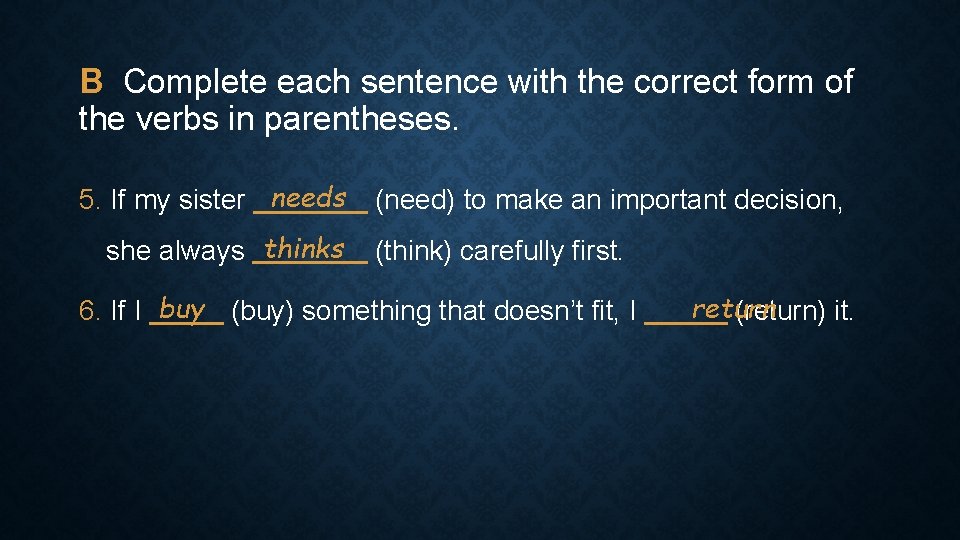
B Complete each sentence with the correct form of the verbs in parentheses. 5. If my sister needs she always thinks (need) to make an important decision, (think) carefully first. 6. If I buy (buy) something that doesn’t fit, I return (return) it.
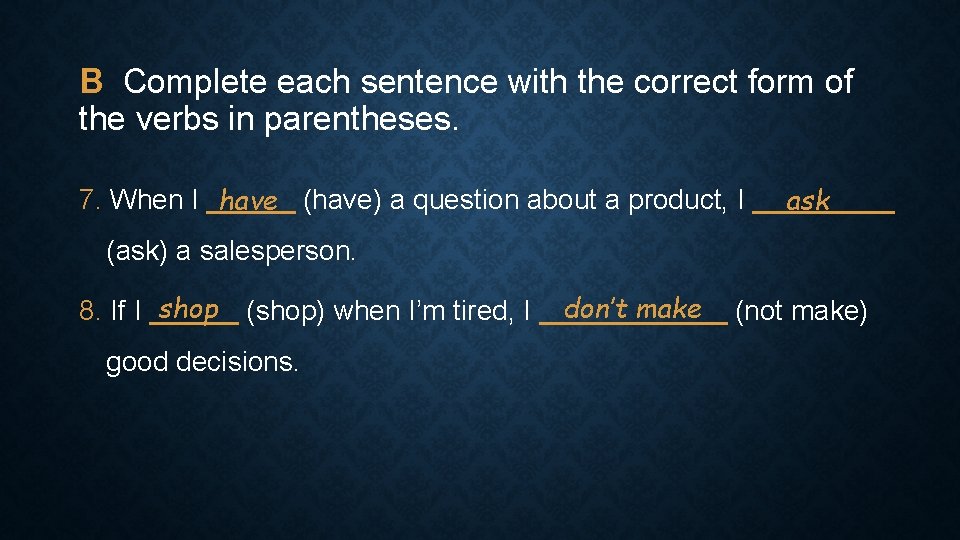
B Complete each sentence with the correct form of the verbs in parentheses. 7. When I have (have) a question about a product, I ask (ask) a salesperson. 8. If I shop (shop) when I’m tired, I good decisions. don’t make (not make)
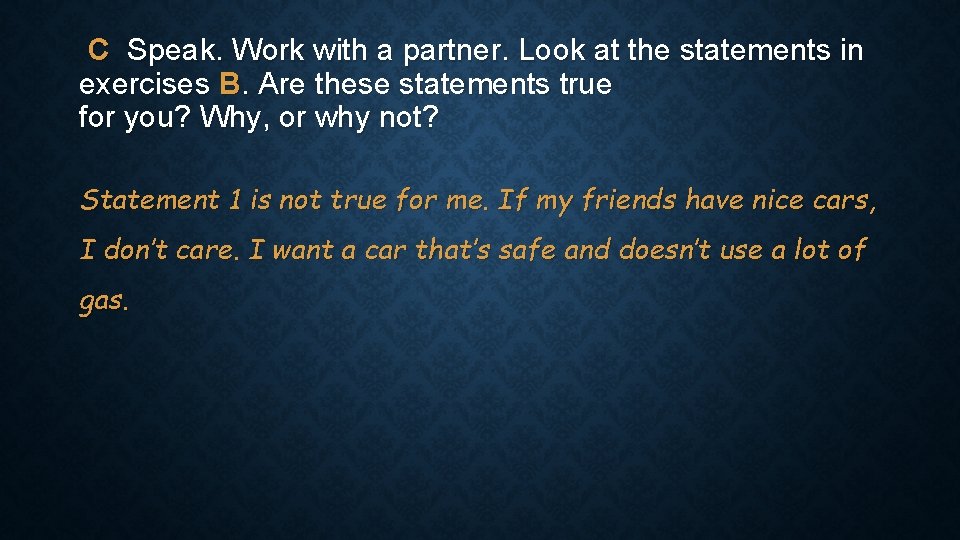
C Speak. Work with a partner. Look at the statements in exercises B. Are these statements true for you? Why, or why not? Statement 1 is not true for me. If my friends have nice cars, I don’t care. I want a car that’s safe and doesn’t use a lot of gas.
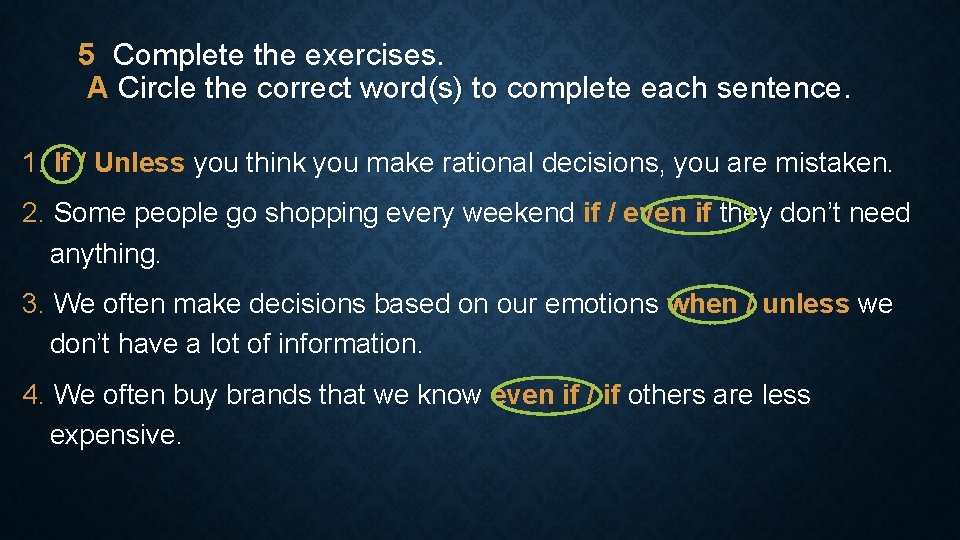
5 Complete the exercises. A Circle the correct word(s) to complete each sentence. 1. If / Unless you think you make rational decisions, you are mistaken. 2. Some people go shopping every weekend if / even if they don’t need anything. 3. We often make decisions based on our emotions when / unless we don’t have a lot of information. 4. We often buy brands that we know even if / if others are less expensive.
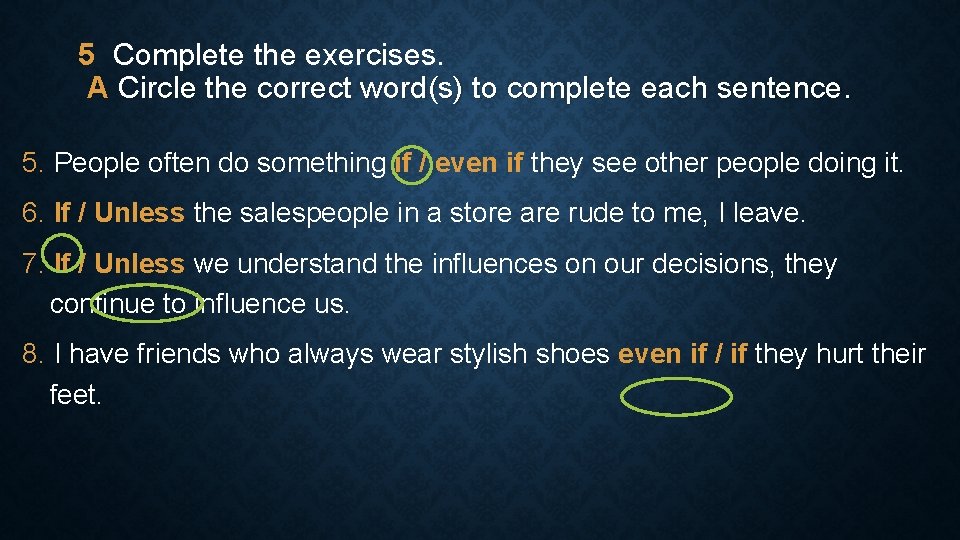
5 Complete the exercises. A Circle the correct word(s) to complete each sentence. 5. People often do something if / even if they see other people doing it. 6. If / Unless the salespeople in a store are rude to me, I leave. 7. If / Unless we understand the influences on our decisions, they continue to influence us. 8. I have friends who always wear stylish shoes even if / if they hurt their feet.
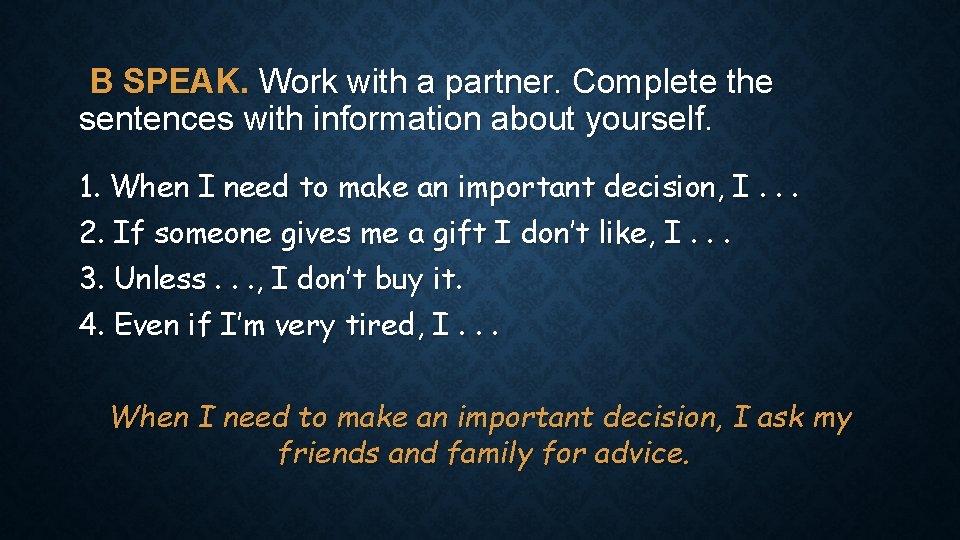
B SPEAK. Work with a partner. Complete the sentences with information about yourself. 1. When I need to make an important decision, I. . . 2. If someone gives me a gift I don’t like, I. . . 3. Unless. . . , I don’t buy it. 4. Even if I’m very tired, I. . . When I need to make an important decision, I ask my friends and family for advice.
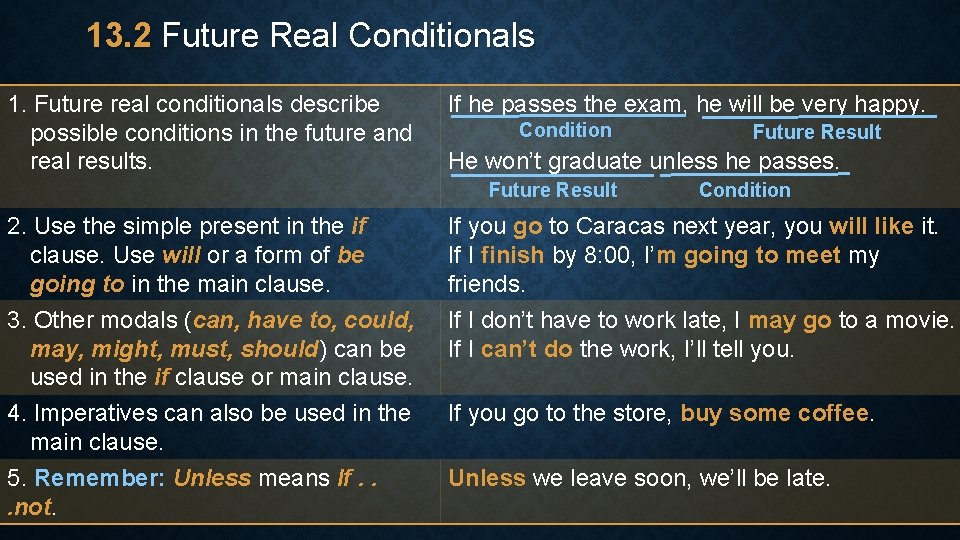
13. 2 Future Real Conditionals 1. Future real conditionals describe possible conditions in the future and real results. If he passes the exam, he will be very happy. Condition Future Result He won’t graduate unless he passes. Future Result Condition 2. Use the simple present in the if clause. Use will or a form of be going to in the main clause. If you go to Caracas next year, you will like it. If I finish by 8: 00, I’m going to meet my friends. 3. Other modals (can, have to, could, may, might, must, should) can be used in the if clause or main clause. 4. Imperatives can also be used in the main clause. If I don’t have to work late, I may go to a movie. If I can’t do the work, I’ll tell you. 5. Remember: Unless means If. . . not. Unless we leave soon, we’ll be late. If you go to the store, buy some coffee.
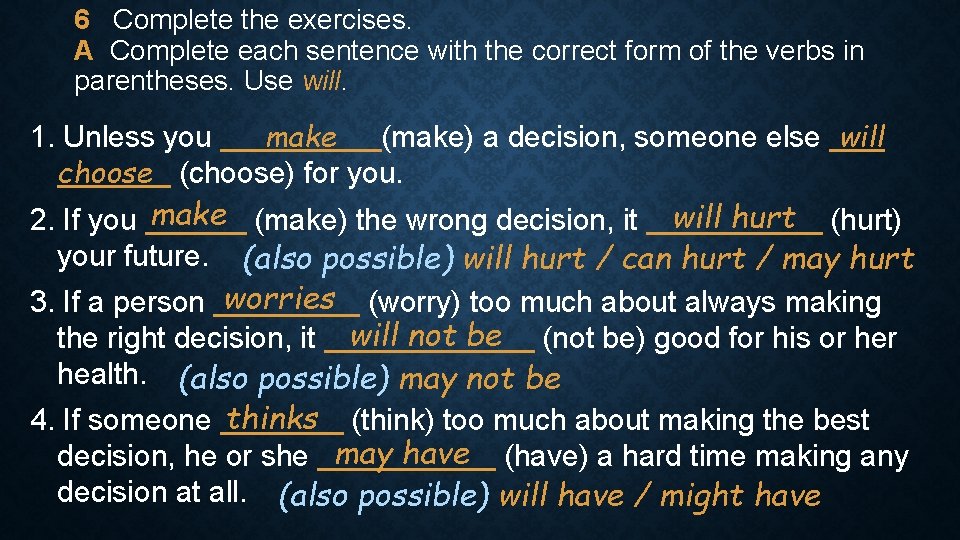
6 Complete the exercises. A Complete each sentence with the correct form of the verbs in parentheses. Use will. 1. Unless you make (make) a decision, someone else will choose (choose) for you. 2. If you make (make) the wrong decision, it will hurt (hurt) your future. (also possible) will hurt / can hurt / may hurt 3. If a person worries (worry) too much about always making the right decision, it will not be (not be) good for his or health. (also possible) may not be 4. If someone thinks (think) too much about making the best decision, he or she may have (have) a hard time making any decision at all. (also possible) will have / might have
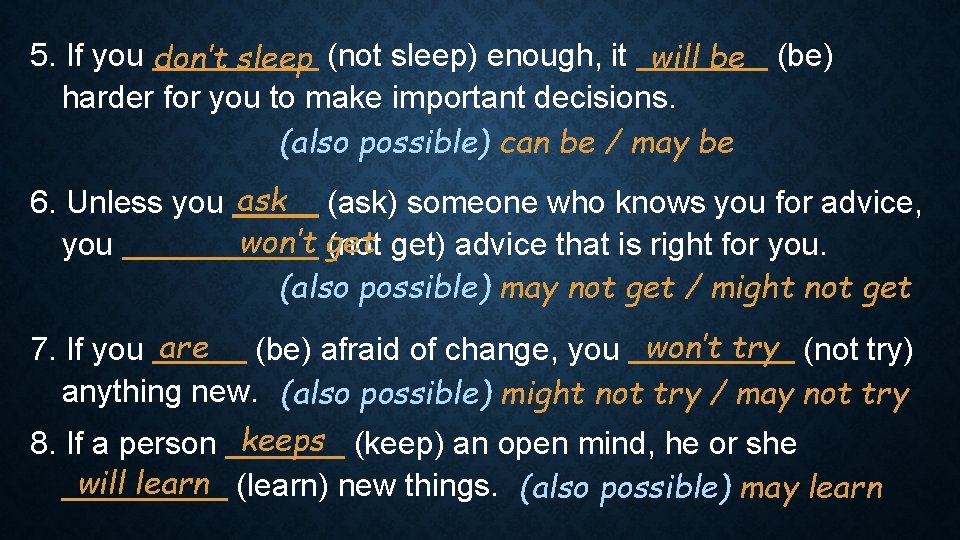
5. If you don’t sleep (not sleep) enough, it will be harder for you to make important decisions. (also possible) can be / may be (be) 6. Unless you ask (ask) someone who knows you for advice, won’t get you (not get) advice that is right for you. (also possible) may not get / might not get 7. If you are (be) afraid of change, you won’t try (not try) anything new. (also possible) might not try / may not try 8. If a person keeps (keep) an open mind, he or she will learn (learn) new things. (also possible) may learn
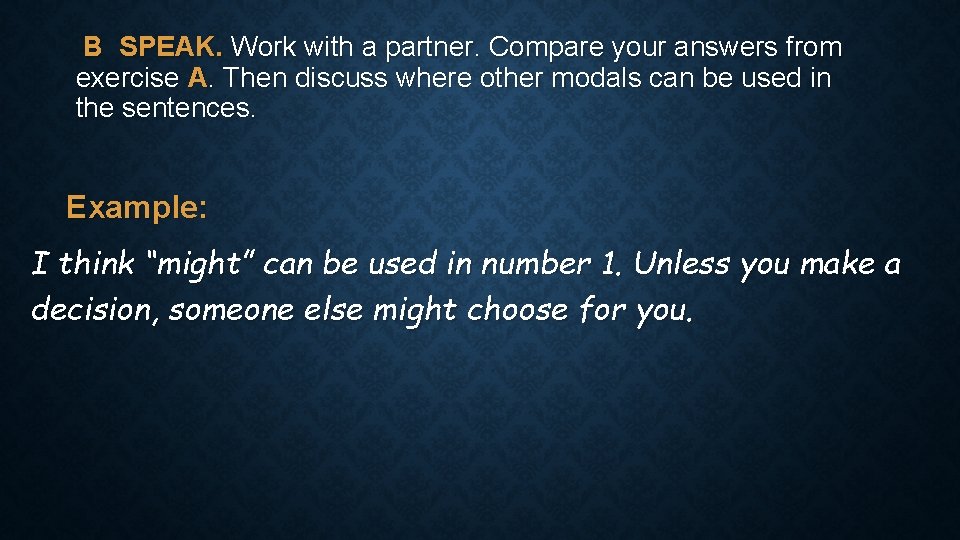
B SPEAK. Work with a partner. Compare your answers from exercise A. Then discuss where other modals can be used in the sentences. Example: I think “might” can be used in number 1. Unless you make a decision, someone else might choose for you.
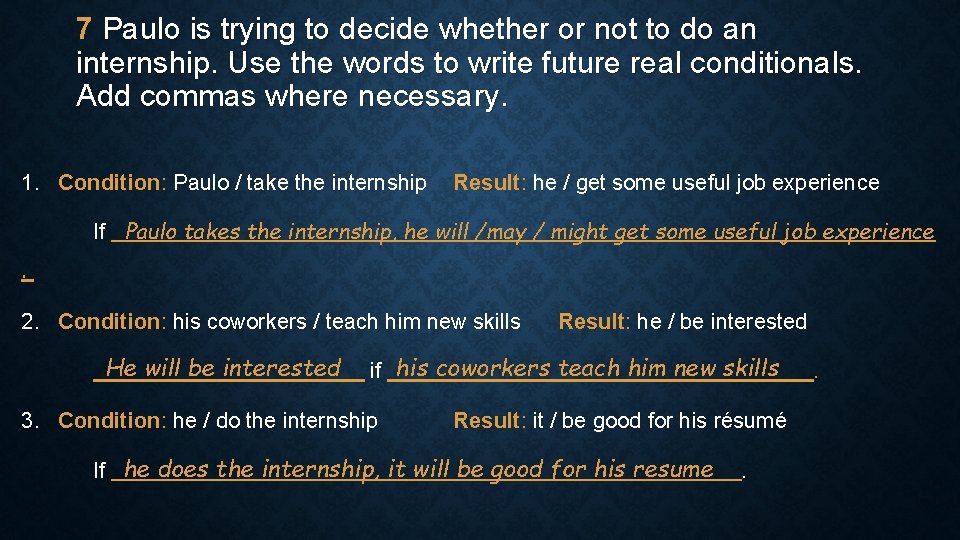
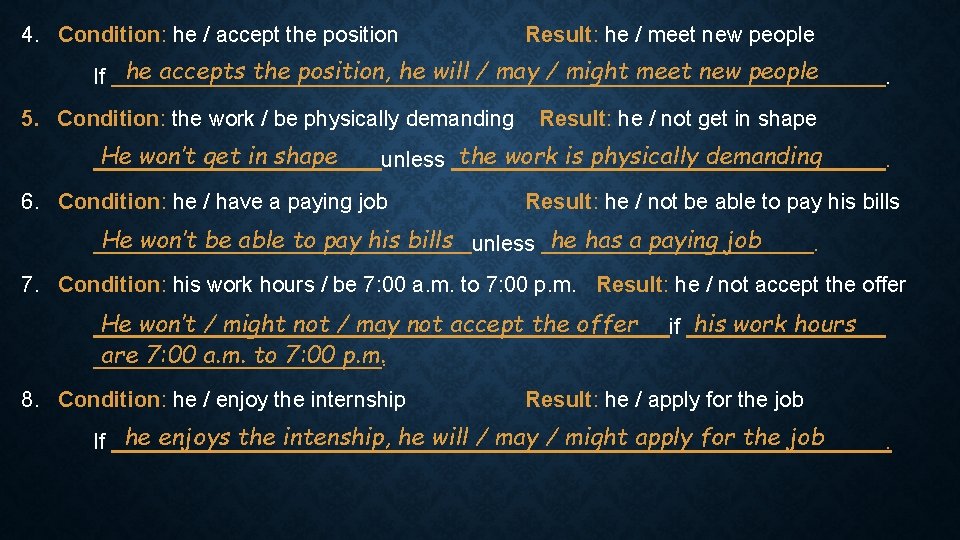
7 Paulo is trying to decide whether or not to do an internship. Use the words to write future real conditionals. Add commas where necessary. 1. Condition: Paulo / take the internship Result: he / get some useful job experience If Paulo takes the internship, he will /may / might get some useful job experience. 2. Condition: his coworkers / teach him new skills He will be interested Result: he / be interested if his coworkers teach him new skills 3. Condition: he / do the internship Result: it / be good for his résumé If he does the internship, it will be good for his resume . .
4. Condition: he / accept the position Result: he / meet new people If he accepts the position, he will / may / might meet new people 5. Condition: the work / be physically demanding He won’t get in shape Result: he / not get in shape unless the work is physically demanding 6. Condition: he / have a paying job . . Result: he / not be able to pay his bills He won’t be able to pay his bills unless he has a paying job . 7. Condition: his work hours / be 7: 00 a. m. to 7: 00 p. m. Result: he / not accept the offer He won’t / might not / may not accept the offer are 7: 00 a. m. to 7: 00 p. m. . 8. Condition: he / enjoy the internship if his work hours Result: he / apply for the job If he enjoys the intenship, he will / may / might apply for the job .
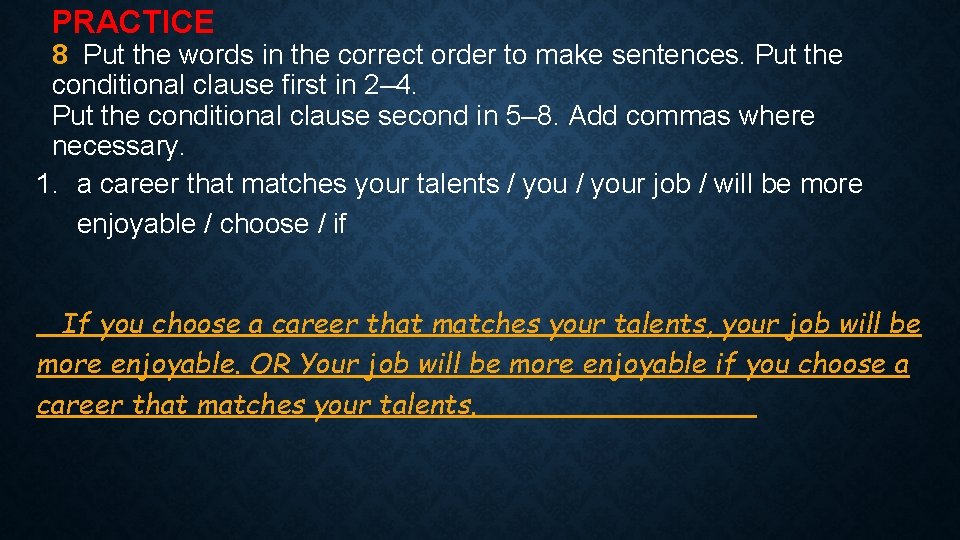
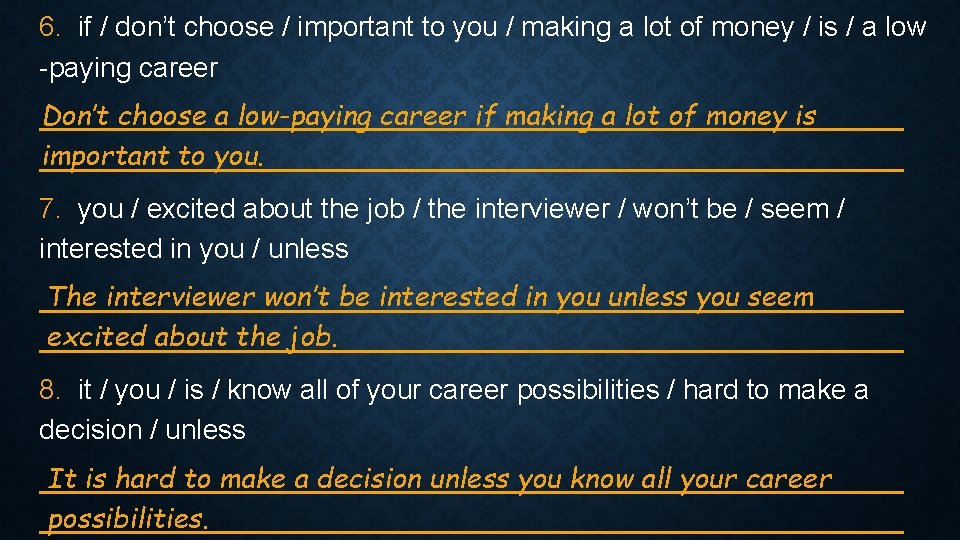
PRACTICE 8 Put the words in the correct order to make sentences. Put the conditional clause first in 2– 4. Put the conditional clause second in 5– 8. Add commas where necessary. 1. a career that matches your talents / your job / will be more enjoyable / choose / if If you choose a career that matches your talents, your job will be more enjoyable. OR Your job will be more enjoyable if you choose a career that matches your talents.
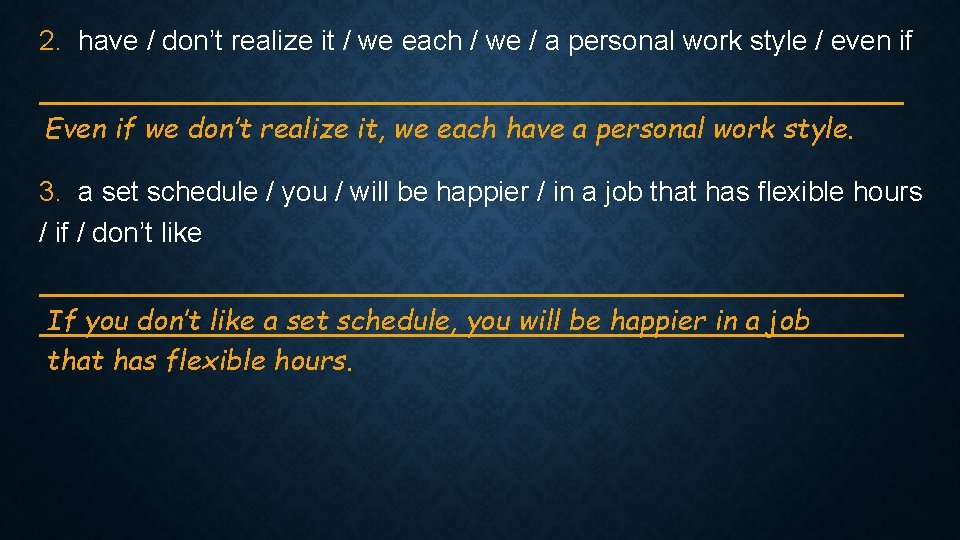
2. have / don’t realize it / we each / we / a personal work style / even if Even if we don’t realize it, we each have a personal work style. 3. a set schedule / you / will be happier / in a job that has flexible hours / if / don’t like If you don’t like a set schedule, you will be happier in a job that has flexible hours.
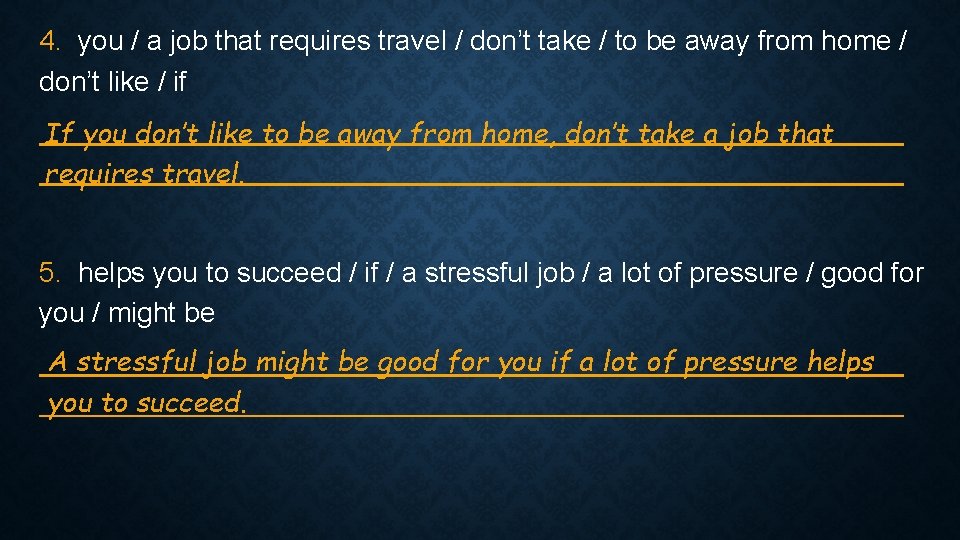
4. you / a job that requires travel / don’t take / to be away from home / don’t like / if If you don’t like to be away from home, don’t take a job that requires travel. 5. helps you to succeed / if / a stressful job / a lot of pressure / good for you / might be A stressful job might be good for you if a lot of pressure helps you to succeed.
6. if / don’t choose / important to you / making a lot of money / is / a low -paying career Don’t choose a low-paying career if making a lot of money is important to you. 7. you / excited about the job / the interviewer / won’t be / seem / interested in you / unless The interviewer won’t be interested in you unless you seem excited about the job. 8. it / you / is / know all of your career possibilities / hard to make a decision / unless It is hard to make a decision unless you know all your career possibilities.
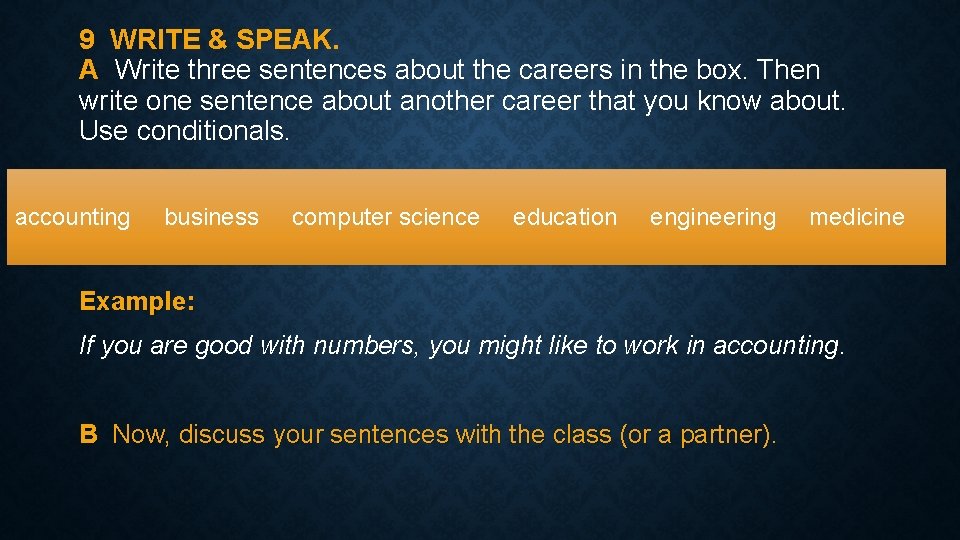
9 WRITE & SPEAK. A Write three sentences about the careers in the box. Then write one sentence about another career that you know about. Use conditionals. accounting business computer science education engineering medicine Example: If you are good with numbers, you might like to work in accounting. B Now, discuss your sentences with the class (or a partner).
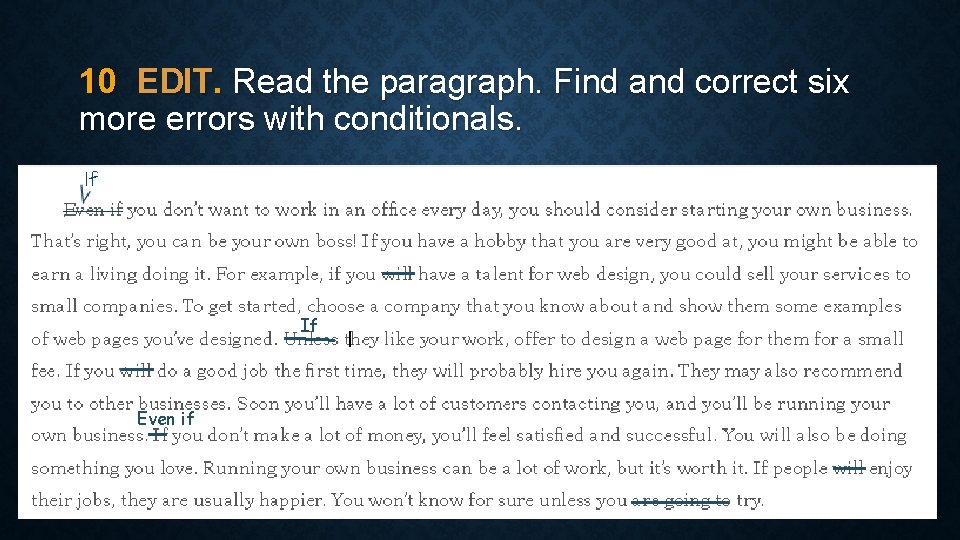
10 EDIT. Read the paragraph. Find and correct six more errors with conditionals. If Even if
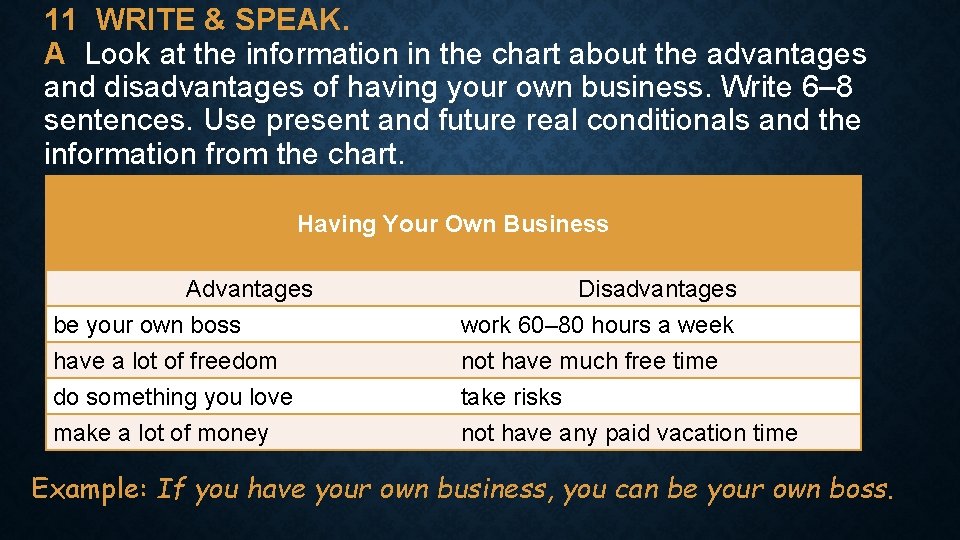
11 WRITE & SPEAK. A Look at the information in the chart about the advantages and disadvantages of having your own business. Write 6– 8 sentences. Use present and future real conditionals and the information from the chart. Having Your Own Business Advantages be your own boss have a lot of freedom do something you love make a lot of money Disadvantages work 60– 80 hours a week not have much free time take risks not have any paid vacation time Example: If you have your own business, you can be your own boss.
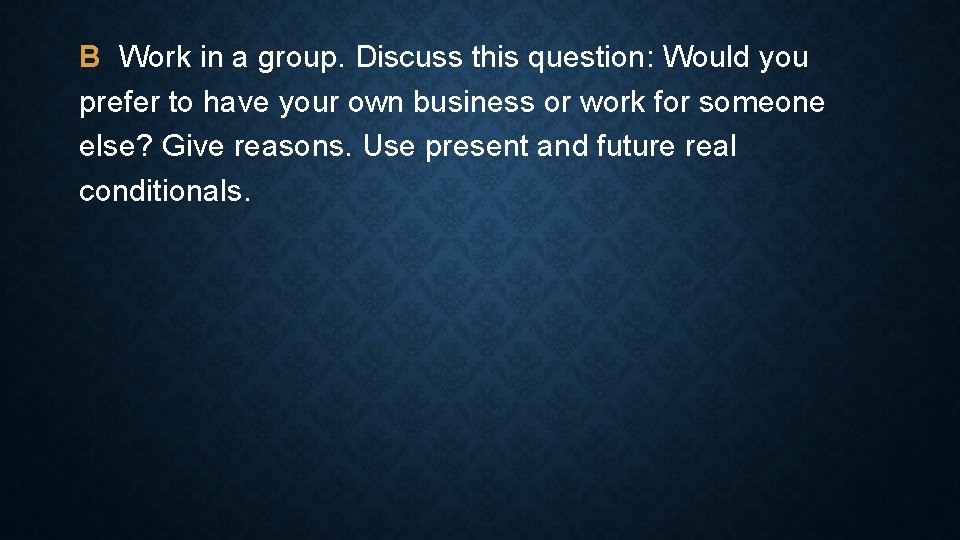
B Work in a group. Discuss this question: Would you prefer to have your own business or work for someone else? Give reasons. Use present and future real conditionals.
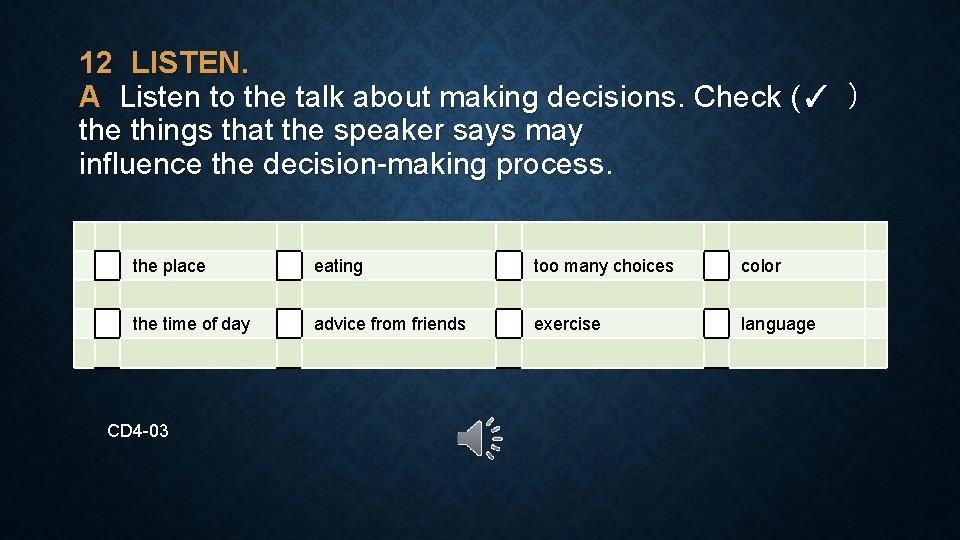
12 LISTEN. A Listen to the talk about making decisions. Check (✓ ) the things that the speaker says may influence the decision-making process. the place eating too many choices color the time of day advice from friends exercise language CD 4 -03
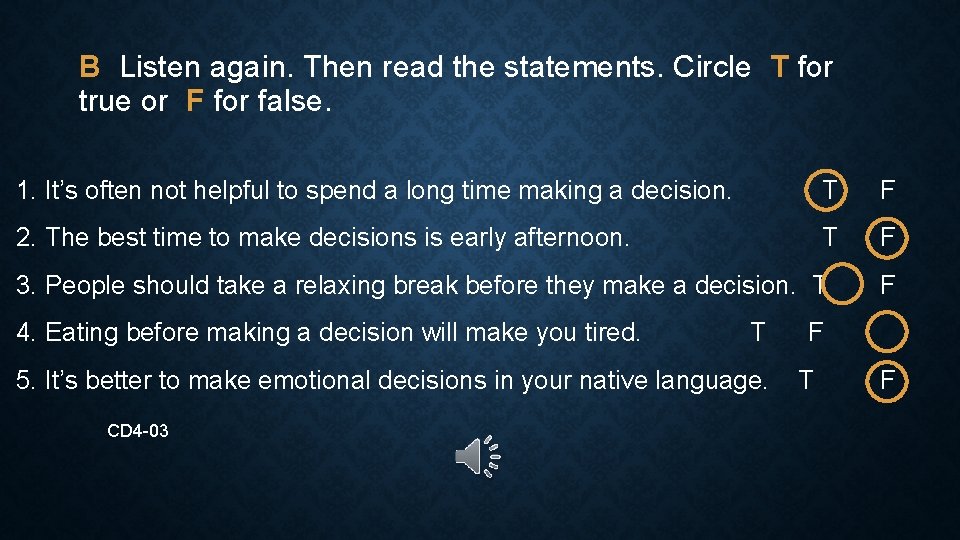
B Listen again. Then read the statements. Circle T for true or F for false. 1. It’s often not helpful to spend a long time making a decision. T F 2. The best time to make decisions is early afternoon. T F 3. People should take a relaxing break before they make a decision. T 4. Eating before making a decision will make you tired. T 5. It’s better to make emotional decisions in your native language. CD 4 -03 F F T F
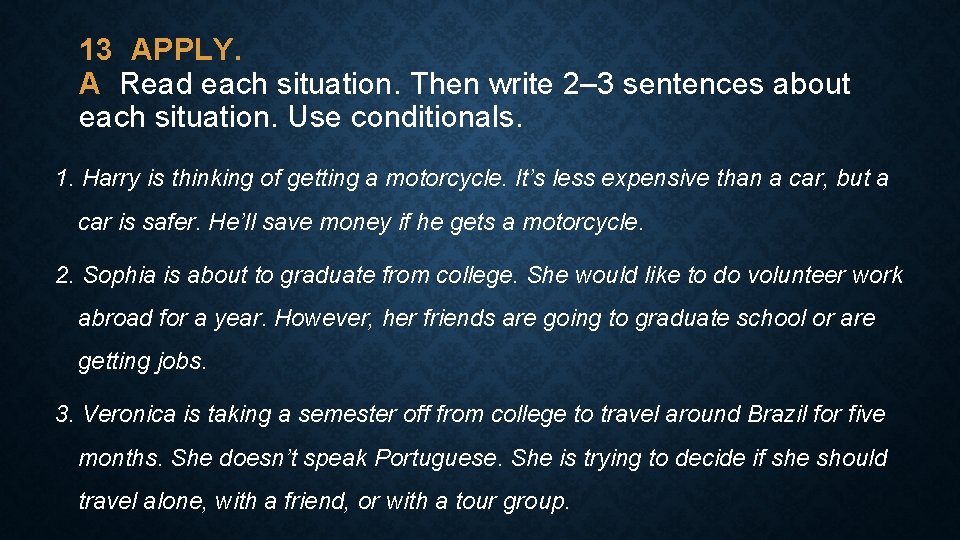
13 APPLY. A Read each situation. Then write 2– 3 sentences about each situation. Use conditionals. 1. Harry is thinking of getting a motorcycle. It’s less expensive than a car, but a car is safer. He’ll save money if he gets a motorcycle. 2. Sophia is about to graduate from college. She would like to do volunteer work abroad for a year. However, her friends are going to graduate school or are getting jobs. 3. Veronica is taking a semester off from college to travel around Brazil for five months. She doesn’t speak Portuguese. She is trying to decide if she should travel alone, with a friend, or with a tour group.
B Work in a group. Discuss the consequences for each situation in exercise A and the best decision for each person.