
GE 105 Introduction to Engineering Design College of
- Slides: 19
GE 105 Introduction to Engineering Design College of Engineering King Saud University Studio 5. Need Analysis FALL 2016
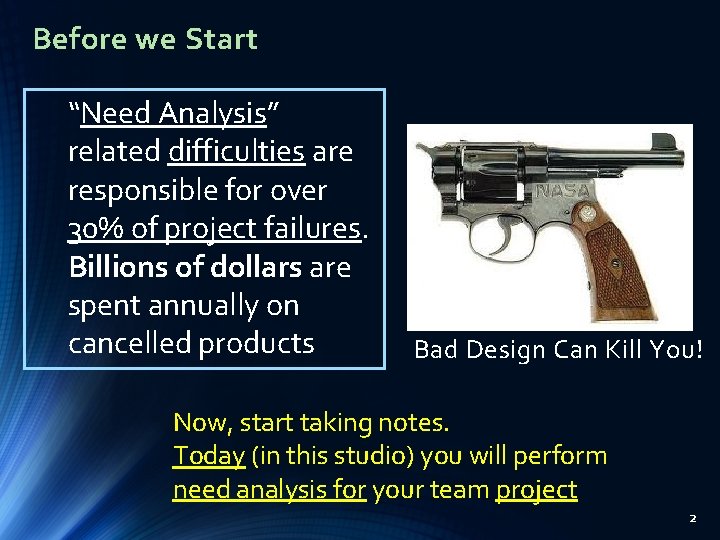
Before we Start “Need Analysis” related difficulties are responsible for over 30% of project failures. Billions of dollars are spent annually on cancelled products Bad Design Can Kill You! Now, start taking notes. Today (in this studio) you will perform need analysis for your team project 2
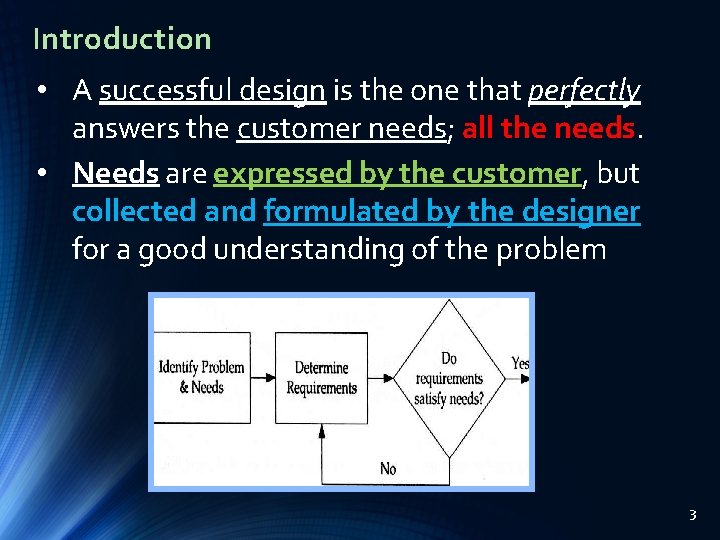
Introduction • A successful design is the one that perfectly answers the customer needs; all the needs. • Needs are expressed by the customer, but collected and formulated by the designer for a good understanding of the problem 3
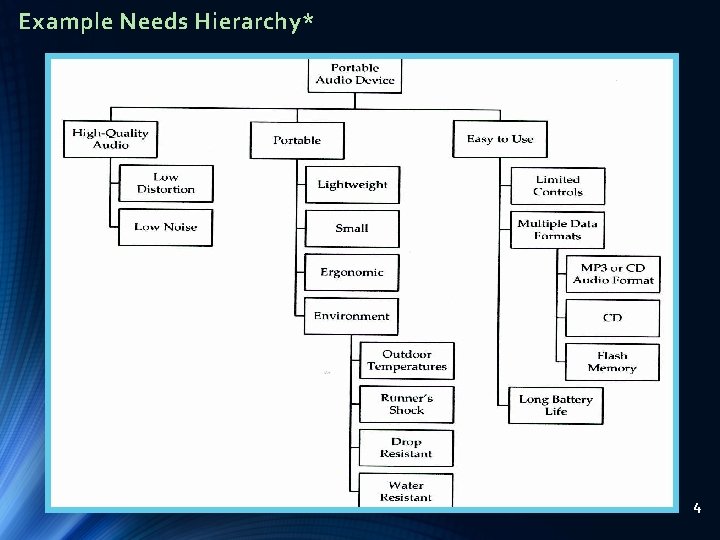
Example Needs Hierarchy* 4
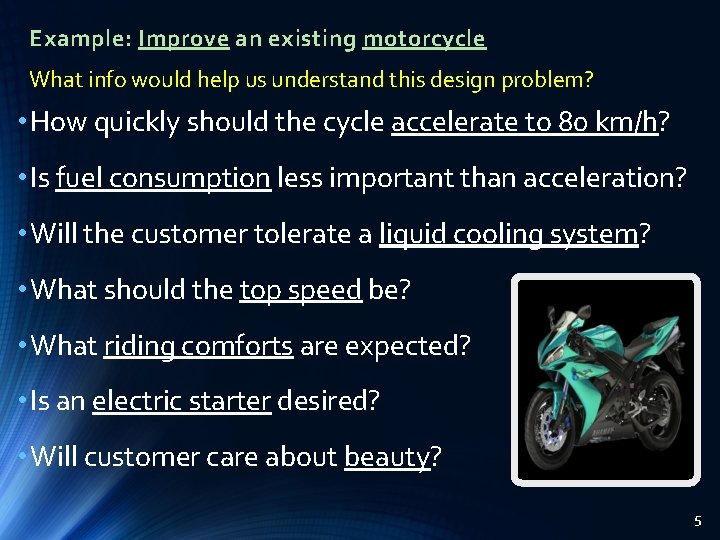
Example: Improve an existing motorcycle What info would help us understand this design problem? • How quickly should the cycle accelerate to 80 km/h? • Is fuel consumption less important than acceleration? • Will the customer tolerate a liquid cooling system? • What should the top speed be? • What riding comforts are expected? • Is an electric starter desired? • Will customer care about beauty? 5
Remember • Requirements*, constraints and criteria are interchangeable depending on the details of the design solution specification • Customer says, “I want a fast motorcycle. ” What does “fast” mean? 120 mph top speed? 32 ft/sec 2 acceleration? 4, 000 Hz engine frequency? • Could be a constraint (top speed >120 km/h) • Could be a criterion (high speed) • “must have” requirements = become design constraints • “desirable” requirements = weighted by importance 6
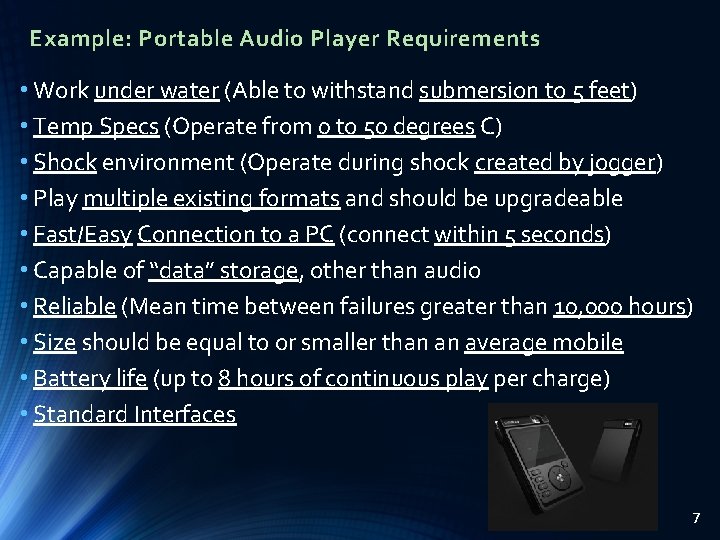
Example: Portable Audio Player Requirements • Work under water (Able to withstand submersion to 5 feet) • Temp Specs (Operate from 0 to 50 degrees C) • Shock environment (Operate during shock created by jogger) • Play multiple existing formats and should be upgradeable • Fast/Easy Connection to a PC (connect within 5 seconds) • Capable of “data” storage, other than audio • Reliable (Mean time between failures greater than 10, 000 hours) • Size should be equal to or smaller than an average mobile • Battery life (up to 8 hours of continuous play per charge) • Standard Interfaces 7
• The next slides will quickly list some different types of requirements • Take notes and identify what applies to your project • Prepare yourself to perform a need analysis for your team project 8
Functional Requirements • Overall Geometry – size, width, space, arrangement • Motion of parts – type, direction, velocities, acceleration • Forces involved – load direction, magnitude, load, impact • Energy needed – heating, cooling, conversion, pressure • Materials to be used – flow, transport, properties • Control system – electrical, hydraulic, mechanical, pneumatic • Information flow – inputs, outputs, form, display 9
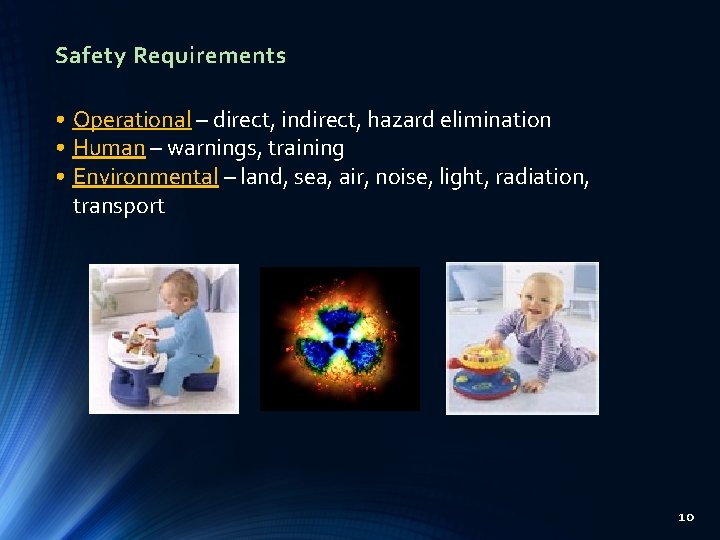
Safety Requirements • Operational – direct, indirect, hazard elimination • Human – warnings, training • Environmental – land, sea, air, noise, light, radiation, transport 10
Quality Requirements • Quality assurance – regulations, standards, codes • Quality control – inspection, testing, labeling • Reliability – design life, failures, statistics 11
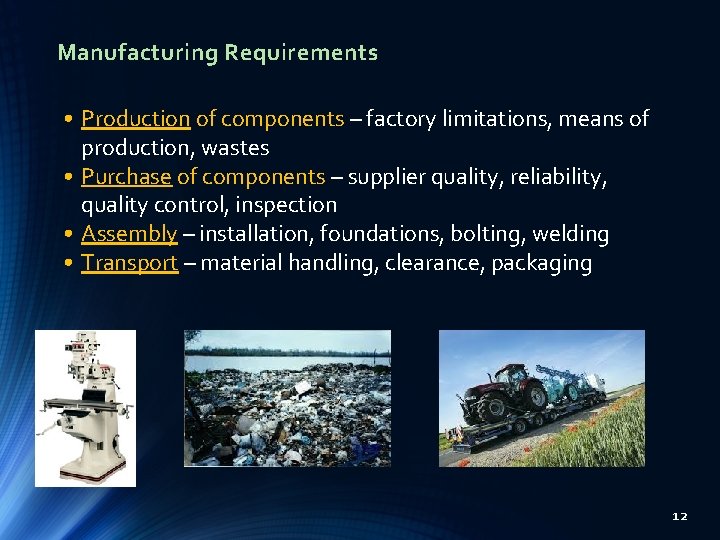
Manufacturing Requirements • Production of components – factory limitations, means of production, wastes • Purchase of components – supplier quality, reliability, quality control, inspection • Assembly – installation, foundations, bolting, welding • Transport – material handling, clearance, packaging 12
Timing Requirements • Design schedule – project planning, project control • Development schedule – design detailing, compliance tests • Production schedule – manufacture, assembly, packing, transport • Delivery schedule – delivery date, distribution network, supply chains 13
Economic Requirements • Marketing analysis – size of market, distribution, market segments • Design costs – design team computing, information retrieval • Development costs – design detailing, supplier costs, testing costs • Manufacturing cost - tooling, labor, overhead, assembly, inspection • Distribution costs - packing, transport, service centers, spare parts, warranty • Resources – time, budget, labor, capital, machines, material 14
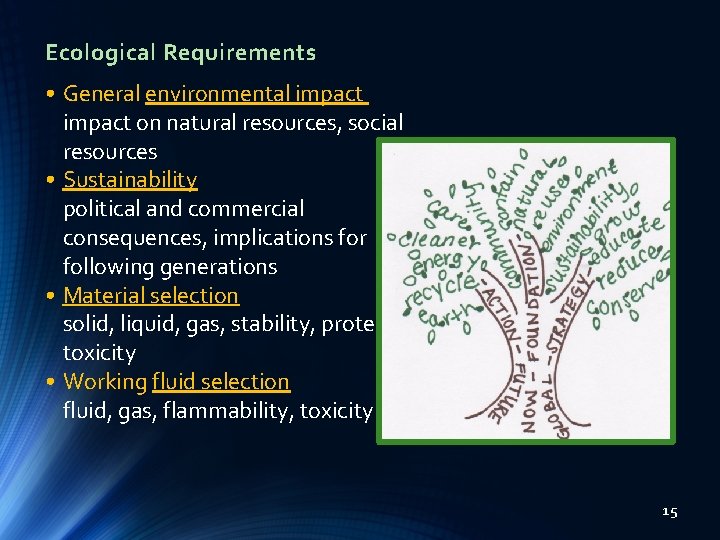
Ecological Requirements • General environmental impact on natural resources, social resources • Sustainability political and commercial consequences, implications for following generations • Material selection solid, liquid, gas, stability, protection, toxicity • Working fluid selection fluid, gas, flammability, toxicity 15
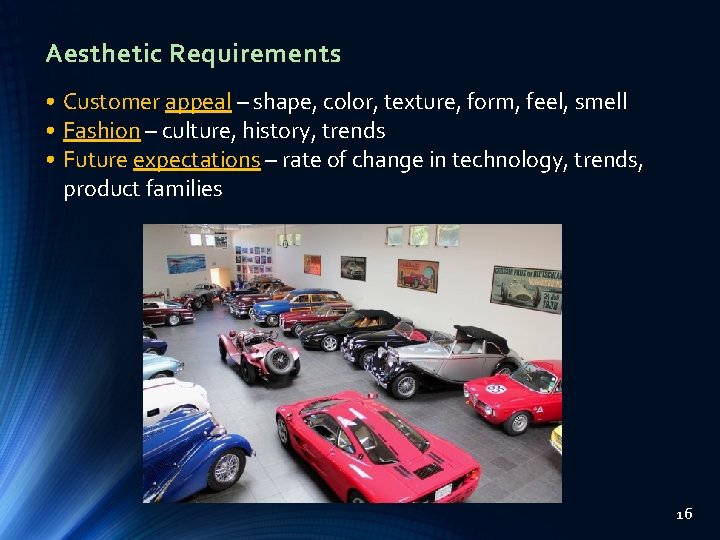
Aesthetic Requirements • Customer appeal – shape, color, texture, form, feel, smell • Fashion – culture, history, trends • Future expectations – rate of change in technology, trends, product families 16
Life-Cycle Requirements • Distribution – means of transport, nature and conditions of dispatch, rules, regulations • Operation – quietness, wear, special uses, working environments • Maintenance – servicing intervals, inspection, exchange and repair, cleaning, diagnostics • Disposal – recycle, scrap 17
Legal/Ethical Requirements • Regulations –FDA, other rules • Ethics – public safety, health, welfare and integrity • Intellectual Property – patents, trademarks, copyrights 18
Activity Over the next hour, teams are required to perform need analysis for their projects: • Requirement hierarchy • Primary objectives 1 • Secondary Objectives 1 • Constraints 2 • Criteria 3 • Problem statement 4 19