
GE 105 Introduction to Engineering Design College of
- Slides: 12
GE 105 Introduction to Engineering Design College of Engineering King Saud University Studio 1. Course Assessment Policy and a Quick Guide to Meetings FALL 2016 1
Course Ground Rules 1. Academic Integrity is a must 2. Punctual attendance is mandatory 3. Late assignments are penalized 4. No makeup studios (studios are unique for each section) 5. Grading is based on teamwork as well as on individual contributions 2
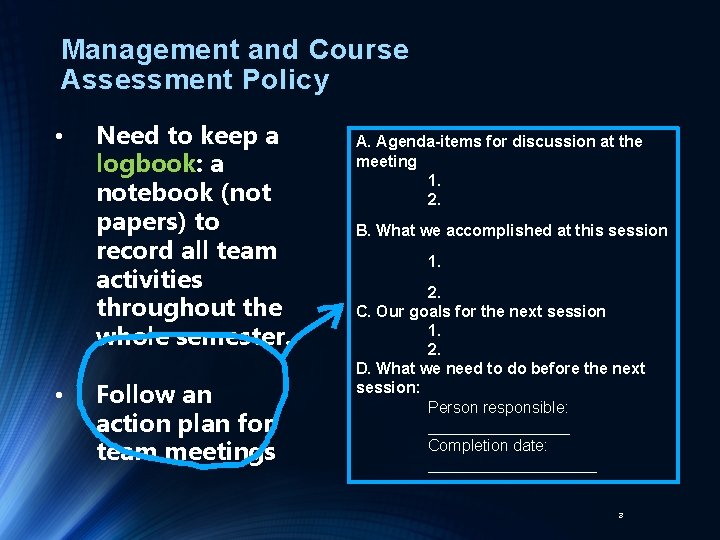
Management and Course Assessment Policy • • Need to keep a logbook: a notebook (not papers) to record all team activities throughout the whole semester. Follow an action plan for team meetings A. Agenda-items for discussion at the meeting 1. 2. B. What we accomplished at this session 1. 2. C. Our goals for the next session 1. 2. D. What we need to do before the next session: Person responsible: ________ Completion date: __________ 3
Why keeping a logbook is important? • To organize thoughts and prove origin of an idea in legal situations. • To use it as a report in case of data loss • To know the responsibilities of each team member in the project • To find answers to previously discussed topics easily • To track the project progress 4
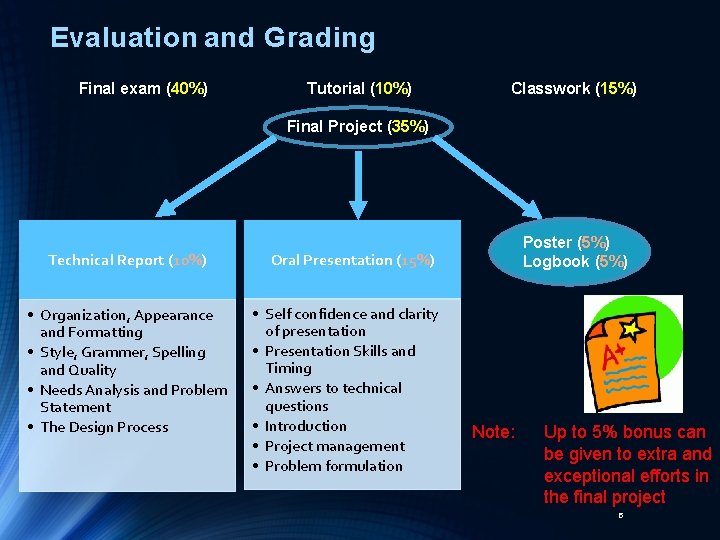
Evaluation and Grading Final exam (40%) Tutorial (10%) Classwork (15%) Final Project (35%) Technical Report (10%) • Organization, Appearance and Formatting • Style, Grammer, Spelling and Quality • Needs Analysis and Problem Statement • The Design Process Poster (5%) Logbook (5%) Oral Presentation (15%) • Self confidence and clarity of presentation • Presentation Skills and Timing • Answers to technical questions • Introduction • Project management • Problem formulation Note: Up to 5% bonus can be given to extra and exceptional efforts in the final project 5
Examples of Final Projects ( just examples and not to be selected ) Chemical engineering • Design of a unit of water desalination • Design of a unit of sugar extraction from plants Mechanical Engineering • Design of a steam generator from solar energy • Design of a greenhouse weather conditioning Electrical Engineering • Design of a car rear impact prevention system • Design of mobile ringing prevention system • Design of a solar-wind hybrid electricity generator system Civil Engineering • Design of an open/closed air roof stadium • Design of an “easy clean” kids spool 6
Quick Guide to meetings • • • Get acquainted Clarify the project Choose a leader and a recorder. Your group can decide to rotate leadership among members The leader should keep the meeting on track and on time Consider how you will provide leadership for the various phases of the project. 7
Planning your meetings • • Set regular meeting times (weekly, twice weekly, etc. ) and make every effort to meet during this time block. Set a beginning AND an ending time for your meetings. • Prior to or at the beginning of the meeting, determine how much time to spend on each agenda topic. • Prioritize what MUST be done at the meeting and determine what topics are of lesser priority. • Low priority topics can be held 8
Preparing for meetings • Prior to each meeting each team member should complete tasks assigned at previous meetings • Prior to each meeting, the recorder, in coordination with the leader, should give the agenda, decided upon at the previous meeting, to team members. 9
Running a Meeting • Start (and end) the meeting on time • Stick to the agenda (as much as possible). The leader is responsible for keeping the meeting on time and on track • Use brainstorming techniques for creative sessions • Attack problems, not the people in the group. Try to reach consensus • Divide up the tasks. • Take turns doing various tasks 10
Transition to Next Meeting • During the meeting record the decisions, deadlines, assignments. See "Action Plan. " • At the end of each meeting: ü Review the decisions and deadlines ü Make certain all team members know their responsibilities ü Evaluate your meeting processes, how your group worked together, and suggest changes for improvement 11
ACTIVITY Practicing preparing agendas and taking meeting minutes • • Form groups Assign a meeting topic Prepare a short agenda Conduct the group meeting • Record minutes within the allocated time 12